Before Launch: How Does a Chinese Rocket Stand or Lie?
 10/12 2026
 544
544
On September 23, the Long March 8A rocket soared into the sky from the Hainan Commercial Space Launch Site, successfully deploying 26 low-Earth orbit satellites for a satellite internet constellation into their designated (predetermined) orbits. Prior to its launch, this 50.5-meter-tall rocket was not transported in its entirety. Instead, the core stage and booster assembly, along with the core second stage and fairing assembly, were transported vertically in batches to the launch zone. They were then assembled into a complete rocket using a tower crane.
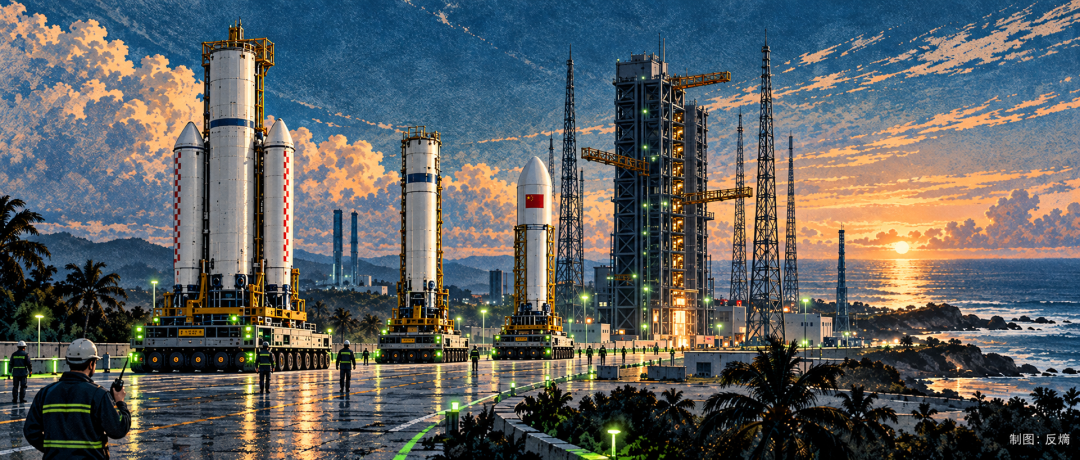
Six days later, the same launch site announced that the second-phase project had entered a full-system rehearsal. The newly constructed Stands 3 and 4 adopted the "three-horizontal" testing and launch mode. In this mode, rockets are assembled, tested, and transported horizontally before being erected at the launch pad.
Stand 1 is configured with the "new three-vertical" approach for the Long March 8 series, while the other three stands opt for the three-horizontal method. Both schemes are designed to handle high-density launch missions.
Even before rocket ignition, significant cost differences emerge. From the construction of facilities and transportation of rockets to final assembly testing and launch preparation, different testing and launch schemes entail varying infrastructure investments and operational costs. The complexity is compounded by the fact that while rockets can undergo continuous iterations, the large fixed facilities at launch sites often remain in use for decades. Today's construction investments will have a profound and long-lasting impact on the technical adaptability and operational costs of subsequent rocket models.
01 From Lunar Facilities to Commercial Launches
On August 26, 1967, the first flight-ready Saturn V rocket departed from the Vertical Assembly Building at Kennedy Space Center. The 110-meter rocket, along with its mobile launch platform, was transported 5.6 kilometers to Launch Pad 39A by a massive crawler transporter, a journey that took approximately five hours.
This colossal ground infrastructure was constructed exclusively for the Apollo lunar program, catering to its highly complex mission requirements. In contrast, the Soviet Soyuz rockets of the same era employed horizontal transportation. Rockets arrived at the launch stand lying on railway transport vehicles before being erected.
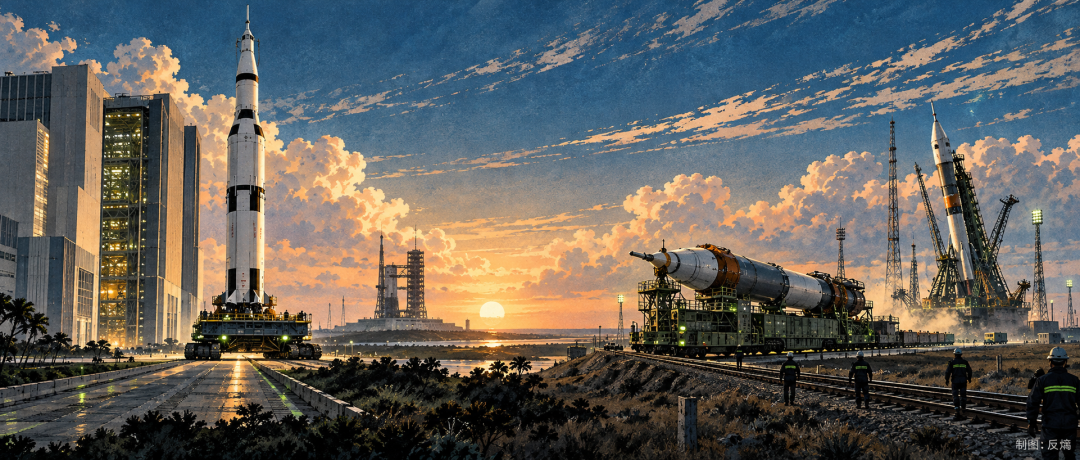
Half a century later, SpaceX modified Launch Pad 39A, equipping the Falcon 9 with horizontal integration buildings and transport-erector devices. Both the vertical and horizontal approaches continue to coexist today, with neither fully replacing the other.
The "three-horizontal" approach involves horizontal assembly, testing, and transportation of the rocket, followed by vertical launch. The "three-vertical" approach, on the other hand, completes assembly, testing, and transportation of the rocket vertically. China's Long March series has long utilized both three-horizontal and three-vertical methods in parallel, along with hybrid schemes that combine horizontal transportation with vertical assembly.
These differences primarily stem from the rocket's structural design. Despite their massive size, rockets employ highly lightweight thin-walled structures. When vertical, they primarily bear axial loads; when horizontal, their self-weight causes bending, necessitating specialized transportation supports and erection processes. The additional structural weight required for horizontal transportation may also reduce the rocket's payload capacity.
Vertical transportation eliminates the need for full-rocket erection but requires tall assembly buildings, dedicated transport platforms, and careful management of wind loads and vibrations. Horizontal schemes generally reduce investment in large vertical facilities but may increase costs for rocket design, support devices, and erection systems.
In practice, hybrid approaches also exist. The Zhuque-3, a 66.1-meter large liquid launch vehicle, completes assembly, testing, and transportation horizontally before being erected at the launch stand. Its fairing assembly, however, is transported vertically and finally docked via crane. Falcon 9 employs horizontal integration and transportation, while the larger Starship utilizes vertical stacking via a launch tower.
Differences in rocket configuration, assembly requirements, launch facilities, and recovery schemes mean that even models from the same company may adopt different testing and launch processes.
02 Innovations in the New Three-Vertical Approach
The new three-vertical approach adopted by the Long March 8 series modifies the traditional three-vertical method, which relied on whole-rocket vertical transportation. Instead, rocket segments are transported upright to the launch zone for final assembly. Parallel testing across different technical area workstations reduces waiting times. While retaining the characteristics of vertical transportation, the division of labor between assembly buildings and launch pads has undergone significant changes.
According to the China Academy of Launch Vehicle Technology, the launch testing cycle for the Long March 8A has been compressed from 29 to 18 days. Meanwhile, the launch on January 13, 2026, occurred just 18 days after the previous mission of this model. In June, the series' second vertical testing stand became operational, enabling parallel testing of two rockets and increasing the annual launch capacity to 30.
However, a 30-launch annual capacity does not necessarily translate into actual launches. Factors such as rocket delivery continuity, satellite readiness, and weather/orbital window availability all influence launch frequency. The team's goal of achieving "7-day launch, 7-day recovery" remains an optimization target.
As launch missions intensify, waiting times generate real costs. A rocket occupying assembly/testing stands for extended periods may delay subsequent preparations. If major inspections can be brought forward and different rockets processed in parallel, launch pads can dedicate more time to final fueling and launch operations.
Satellite internet, in particular, requires a stable launch supply. Constellation deployment involves continuous networking, failure replacements, and long-term replenishment, demanding predictable orbital delivery services. No matter how high a single mission's capacity, it cannot fully offset instability in launch scheduling.
Both the three-horizontal and new three-vertical approaches aim to improve efficiency but follow different paths. The former completes more assembly/testing work in technical areas to reduce launch stand occupation, while the latter enhances efficiency between multiple missions through segmented transportation, parallel vertical testing, and process optimization. Determining which scheme is more economical requires a comprehensive comparison of complete testing/launch processes, facility investments, and actual utilization rates.
03 Half a Meter of Flexibility
Beyond testing/launch modes, launch sites face another long-term decision: should they build dedicated stands for specific new rocket models or reserve generalized launch capacity for a wider range of models?
During the initial design phase of Hainan Commercial Space Launch Site's Stand 2, disagreements arose. Dedicated stands built around specific models offer clear technical interfaces and controllable construction risks. However, generalized stands must accommodate different rocket diameters, propellants, and launch procedures, making the design more complex while the future volume of clients and tasks remains uncertain.
According to the Hainan Daily, after repeated deliberations, Hainan Commercial Space abandoned the original design and budget, opting for a generalized approach. This decision raised the maximum compatible rocket diameter from 4.5 to 5 meters, allowing the stand to serve rockets ranging from 3.35 to 5 meters in diameter.
On July 10, 2026, the 5-meter-diameter Long March 10B rocket lifted off from this stand and successfully completed first-stage sea-based net recovery. The extra half meter of flexibility reserved two years earlier enabled this stand to accommodate the new model. Under the original design, this mission could not have launched directly from Stand 2.

Of course, reserving diameter is just the first step. The Long March 10B's core first stage uses LOX/kerosene, while its core second stage uses LOX/methane. To accommodate this new model, Stand 2 required additional methane storage areas and piping, along with parallel modifications to the LOX piping to meet higher fueling flow requirements. Generalization lowers barriers for new models to use existing stands but cannot eliminate the necessary retrofitting costs.
In late September, Hainan Commercial Space disclosed that Stands 1 and 2 now support two launches in five days and three monthly launches. With Stands 3 and 4 and supporting facilities coming online, the entire launch site plans for over 60 annual launches. Converting facility capacity into actual launches depends on market demand and supply chain delivery capabilities.
Over the past half-century, Kennedy Space Center's Launch Pad 39A has served both the Saturn V and Falcon 9 rockets, undergoing facility modifications to accommodate different rockets. In Hainan, the extra half meter of flexibility reserved at Stand 2 two years ago proved essential for launching this new rocket model.
Rocket iterations typically occur annually, while launch site lifespans may extend for decades. For China's commercial space industry, which is pursuing high-frequency launches, the facilities built today must continue to accommodate new rocket models and missions in the future.
How a rocket reaches the launch pad depends on current technical choices. A decade later, how easily the same launch site can adapt to next-generation rockets will largely depend on how much flexibility was built into the facilities today.
-
![]()
BYD Takes the Lead, Li Auto Lags Behind: Are Joint Ventures Making a Comeback? September’s New Energy Vehicle Sales Data Reveals Stark Divisions
-
![]()
New Forces Top Annual List, Tesla Holds Three-Year Reign! September's Pure Electric Model Resale Value Rates: A Tale of Contrasts
-
![]()
Lei Jun’s Bold Claim Proven: Xiaomi Tops Resale Value Charts, with NIO and Li Auto Close Behind!
-
![]()
Has Zunjie 'Stumbled', Paving the Way for Xiaomi's Success?
-
![]()
Before Launch: How Does a Chinese Rocket Stand or Lie?
-
![]()
Zunjie V800 Brake Bracket Fracture: With the Same 40% Glass Fiber-Reinforced Plastic, Where Does the Disparity Arise?
-
![]()
Why Does Your Phone Slow Down After Long-Term Use?
-
![]()
The Comprehensive Guide to Tariffs on Chinese Automobile Exports: A Stark Contrast to Japan