Zunjie V800 Brake Bracket Fracture: With the Same 40% Glass Fiber-Reinforced Plastic, Where Does the Disparity Arise?
 10/12 2026
 412
412
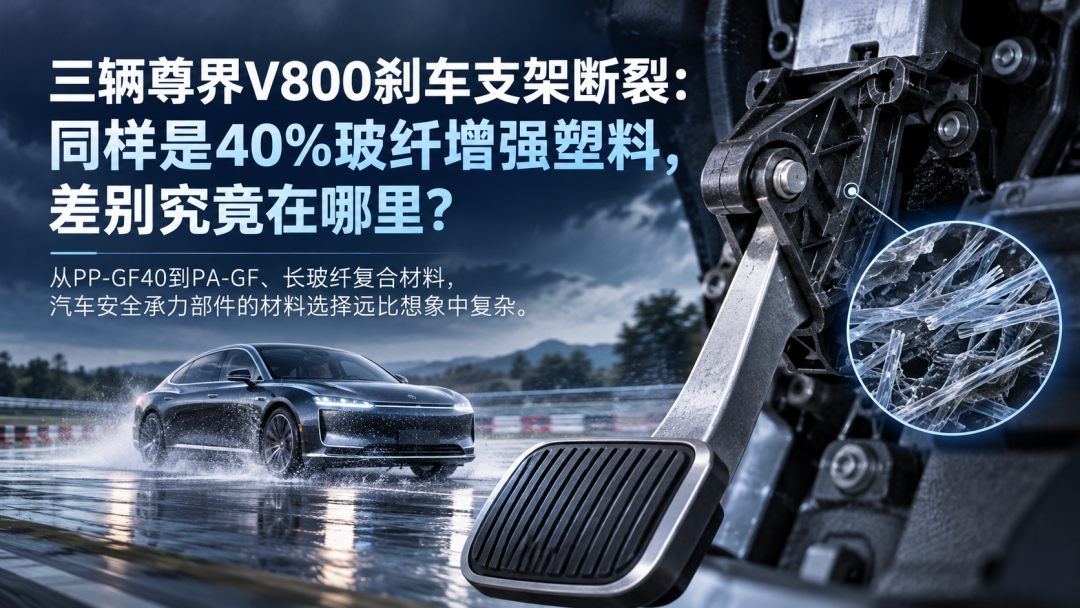
On October 8, 2026, an automotive brake test thrust glass fiber-reinforced plastics into the spotlight. According to a publicly released test video from Dongchedi, three Zunjie V800 vehicles experienced brake pedal bracket fractures during consecutive emergency braking tests from 100 km/h to 0 km/h. The fractures occurred on the third, fourth, and second full brakes, respectively. The fracture locations and morphologies were similar across the three vehicles, sparking concerns about component safety redundancy and material reliability.
Subsequent disassembly revealed that the fractured part was not the metal pedal arm, which is pressed by the driver, but rather the engineering plastic bracket connecting the pedal spindle and bearing the support load. This bracket was marked as PP-GF40, indicating it was made of 40% glass fiber-reinforced polypropylene. Notably, another comparison model labeled 'Zhi X' in the same test, which also used PP-GF40 for its pedal bracket, did not experience similar fractures after six consecutive emergency brakes.
On the evening of October 8, Zunjie Auto issued a statement asserting that the brake system had been developed and validated according to requirements exceeding relevant national and industry standards. They stated that no similar failures had occurred in actual user scenarios and announced plans to further optimize component design, offering free upgrades to delivered users.
The ultimate cause of this incident still requires comprehensive material testing, structural analysis, and experimental verification to determine. However, it raises a pertinent question for the materials industry: Why can the load-bearing capacity and failure behavior of different components vary significantly even when both use PP-GF40? What does a 40% glass fiber content truly signify about material performance?
I. Why Switch from Steel to Glass Fiber-Reinforced Plastic for Automotive Pedal Brackets?
Although the automotive brake pedal appears structurally simple, it is actually a typical safety-critical load-bearing system. When the driver presses the pedal, the force is transmitted through the pedal arm to the spindle and bracket, with the load ultimately borne by the bracket and the vehicle's mounting structure. For electronic braking systems, while signal transmission differs from traditional mechanical hydraulic braking, the pedal assembly still requires sufficient mechanical strength and operational reliability.
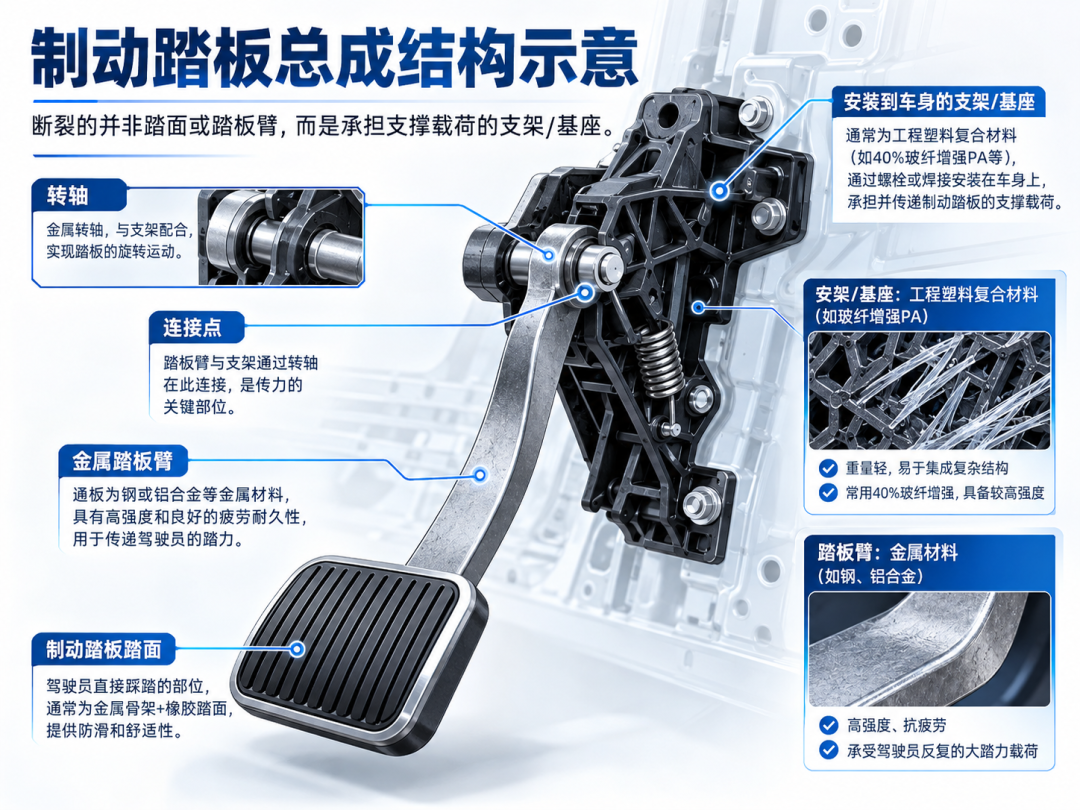
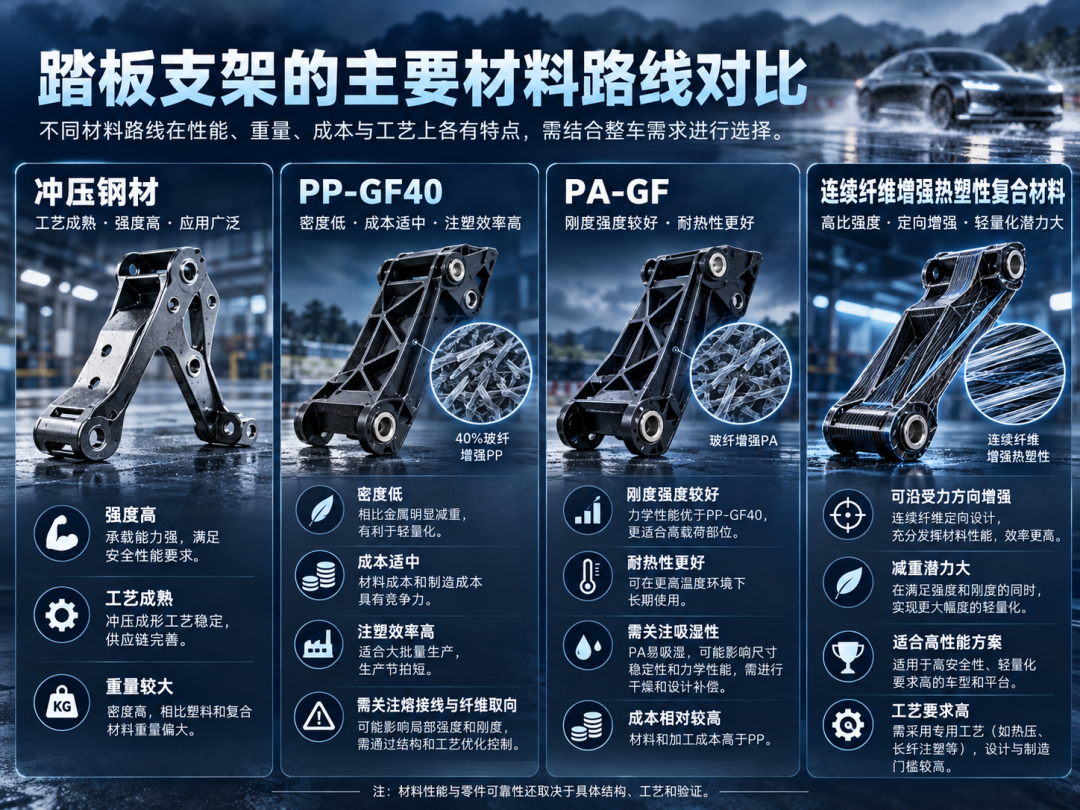
Traditional automotive pedal brackets primarily use stamped steel plates or welded steel structures, with material options including ordinary cold-rolled steel, high-strength low-alloy steel, and some dual-phase high-strength steels. Steel's outstanding advantages lie in its high stiffness, good ductility, and mature manufacturing processes, allowing it to absorb energy through plastic deformation under certain overload conditions. However, its high density and complex structures may necessitate multiple stamping, welding, and anti-corrosion processes.
Glass fiber-reinforced thermoplastics offer an alternative approach. By adding glass fibers to resins such as polypropylene (PP) or polyamide (PA), material stiffness and strength can be significantly enhanced. Simultaneously, injection molding integrates reinforcing ribs, mounting holes, spindle supports, and other functional structures into a single part, reducing assembly processes and achieving lightweighting.
Currently, typical material routes for pedals and related support structures include:
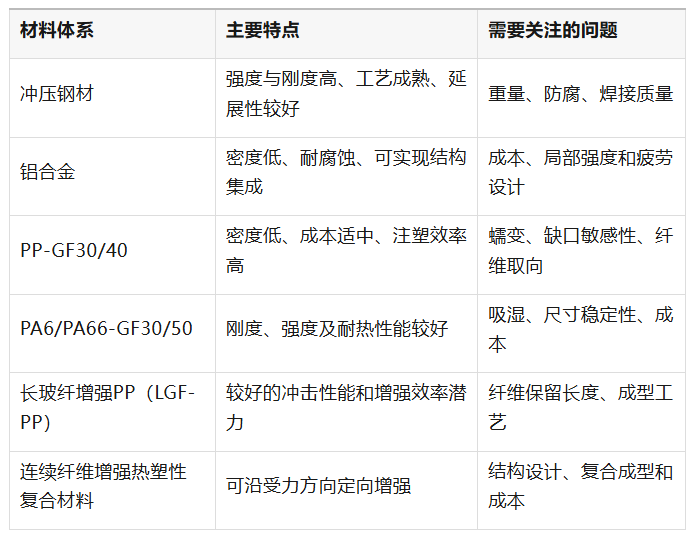
Note: The table compares material technology routes and does not represent that all materials have been mass-produced in brake pedal brackets for specific models. The actual performance of PA-GF, LGF-PP, and continuous fiber composites depends on grade, process, and structural form.
In public cases, the composite pedal technology of Porsche's related mass-produced electric sports cars is noteworthy. In 2020, LANXESS and BOGE Elastmetall jointly released a fully plastic brake pedal using Tepex dynalite continuous fiber-reinforced PA6 composite inserts, combined with unidirectional fiber-reinforced tapes for local reinforcement. According to LANXESS, this structure reduced weight by approximately 50% compared to comparable steel solutions. This case demonstrates that glass fiber-reinforced composites can indeed bear safety-critical loads. The key lies in establishing reliable load-bearing paths through material systems, fiber layups, and structural design.
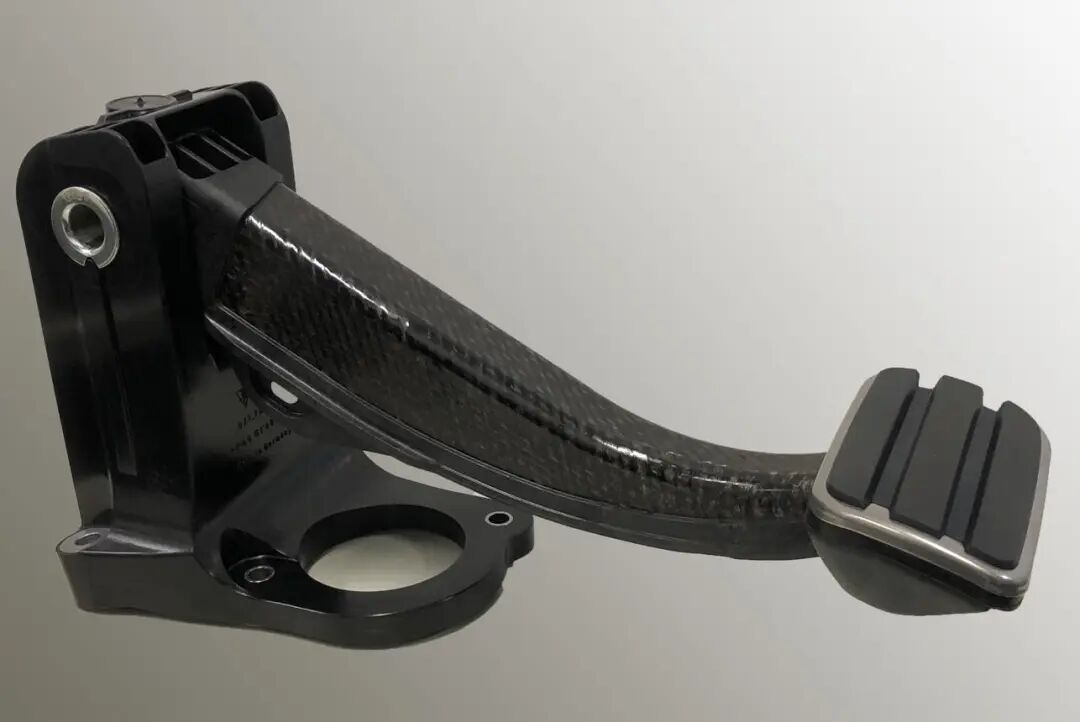 Continuous fiber-reinforced thermoplastic composite brake pedal developed by LANXESS and BOGE. Image source: LANXESS
Meanwhile, there are also real-world lessons from material substitution failures. In 2020, Ford initiated a recall due to potential brake pedal bracket fractures in some Mustang models. Formal documents from the U.S. National Highway Traffic Safety Administration (NHTSA) explicitly stated that when the pedal bracket material was changed from nylon to polypropylene in relevant automatic models, the original design's ability to withstand sudden high-intensity braking loads was insufficient. Ford's analysis concluded that the failure was related to inadequate design margins.
Together, these two cases reflect the same principle: Lightweighting automotive safety components is not a simple material substitution but a complete redesign of materials, structures, and validation systems.
II. What Makes PP-GF40 Strong? Why Doesn't 40% Glass Fiber Guarantee 40% Performance?
In PP-GF40, PP stands for polypropylene, GF for glass fiber, and 40 indicates that the nominal mass fraction of glass fiber in the material is 40%. Ordinary PP offers advantages such as low density, chemical resistance, and processing convenience, but its stiffness and long-term load-bearing capacity are limited. The addition of glass fibers allows them to act as a reinforcing phase, significantly improving the material's tensile strength, elastic modulus, and dimensional stability.
Taking common material performance ranges as an example, ordinary PP typically has a tensile modulus of about 1.0–1.8 GPa, while PP-GF40 can reach approximately 7–12 GPa, with some high-performance grades potentially higher. A 40% glass fiber addition is sufficient to transform PP from an ordinary general-purpose plastic into an engineering material usable in some load-bearing structures.
However, for complex injection-molded parts, an often-overlooked issue exists: The performance of standard material test specimens does not equal the performance at critical cross-sections of actual parts. First, PP-GF40 is merely a material category label and does not specify whether the glass fibers are short or long. The initial fiber length, retained length after screw shear, and distribution within the part can all affect final performance. Even with a 40% glass fiber label, the tensile, impact, creep, and fatigue properties of two materials may differ significantly. Second, more glass fiber is not always better. Increasing glass fiber content generally improves stiffness but may also reduce flowability, enhance anisotropy, and cause local toughness deficiencies. In special regions like injection-molded weld lines, more glass fibers may not necessarily yield higher local strength.
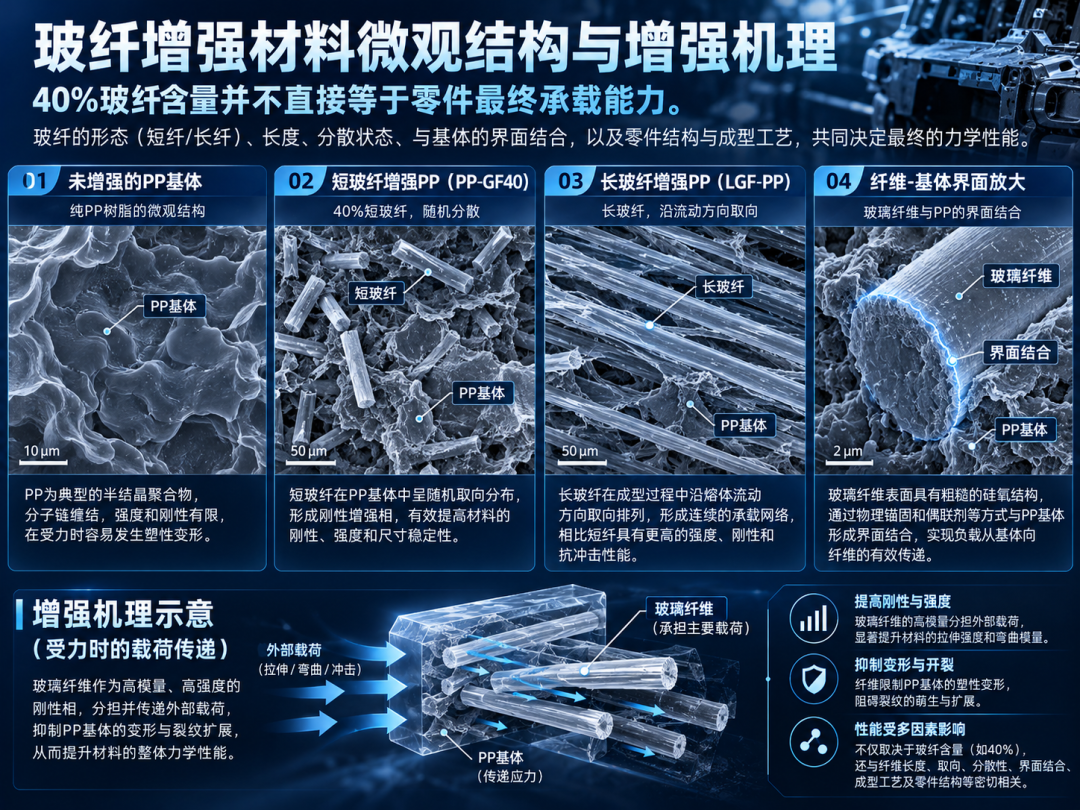
A 2019 study published in the International Journal of Solids and Structures showed that the weld line strength of short glass fiber-reinforced PP might decrease with increasing glass fiber content, with specific performance influenced by factors such as fiber-matrix interaction and molding residual strain. Therefore, while 40% glass fiber indicates the degree of reinforcement, it does not directly prove that a pedal bracket has sufficient safety load-bearing capacity.
III. What Truly Creates Performance Differences in PP-GF40?
In the Zunjie V800 incident, a particularly noteworthy detail for the materials industry is that the comparison model also used PP-GF40. Although the test load paths, geometric structures, and pedal lever arms differed slightly between models and cannot be directly attributed to material quality differences, it at least demonstrates that identical material labels do not guarantee identical overall part performance.
From a composite engineering perspective, these differences primarily stem from three aspects.
The first is the effective reinforcing capability of glass fibers. For short glass fiber-reinforced PP, material performance depends not only on glass fiber content but also on fiber effective length and orientation. When fibers align with the primary tensile direction, reinforcement effects are usually more fully realized; when fibers mismatch the primary load direction, load-bearing capacity may decline. In complex injection-molded parts, melt flow directions vary across regions, resulting in non-uniform reinforcement within the same bracket.
Long glass fiber-reinforced PP, under appropriate processing conditions, can generally improve impact performance, creep, and fatigue behavior. However, the prerequisite is that the material retains sufficient effective fiber length after injection molding. A 2020 study on long glass fiber-reinforced PP also pointed out that while long fibers benefit structural performance, weld lines formed by multi-gate injection molding can still significantly weaken part strength.
The second factor is the interface bonding between glass fibers and resin. Polypropylene is a non-polar resin, and glass fiber surfaces typically require treatment with special sizing agents, coupling agents, and resin-side compatibilizers to establish an effective interface load transfer system. Insufficient interface bonding may cause fiber pullout or debonding under load, preventing full reinforcement effects. Conversely, excessively high interface adhesion without considering matrix toughness may also hinder local stress release.
For automotive safety-critical load-bearing components, the ideal interface does not simply pursue the highest bond strength but achieves a reasonable balance between strength, toughness, fatigue, and long-term durability. This also means that glass fiber sizing systems suitable for ordinary PP-reinforced products may not be the best choice for safety-critical structures.
The third, and most easily underestimated, factor is injection-molded weld lines.
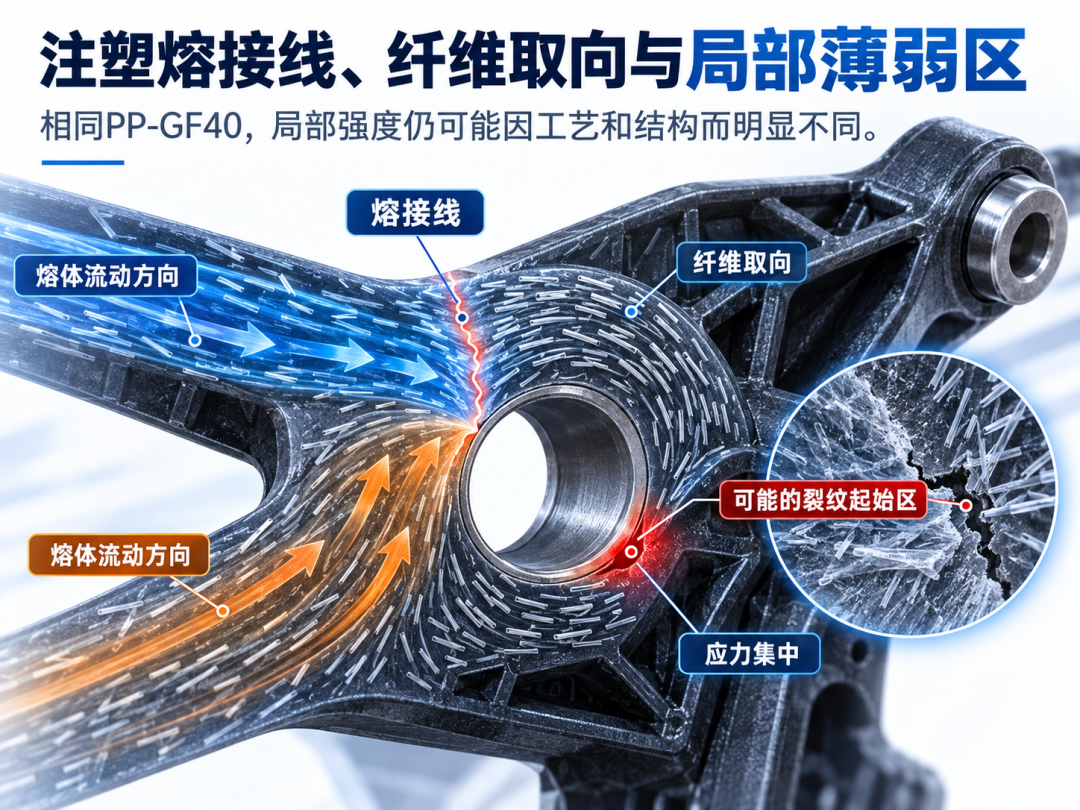
When molten plastic flows around obstacles like spindle holes or mounting posts and then rejoins, weld lines can form. For glass fiber-reinforced materials, weld lines involve not only resin fusion but also fiber reorientation in the convergence zone. If glass fibers primarily align along the weld line plane without effectively crossing potential crack interfaces, local load transfer capacity may be compromised. A 2025 study published in Composites Part A: Applied Science and Manufacturing (10.1016/j.compositesa.2025.109174) optimized processes for 20%, 30%, and 40% short glass fiber-reinforced recycled PP. In their 40% glass fiber system, using gas-assisted push-pull injection molding to improve fiber orientation increased the strength of specimens with weld lines by 64% and stiffness by 13%.
These data do not mean all PP-GF40 parts can achieve the same improvements but sufficiently demonstrate that under certain structural and process conditions, improving weld lines and fiber orientation can be more effective than simply increasing glass fiber content. For brake pedal brackets with complex geometries like spindle holes, reinforcing ribs, and support plates, this point warrants particular attention.
IV. Was the Brake Bracket Fracture a Material Issue or a Structural Issue?
From public test footage, the fractures in the Zunjie V800 primarily concentrated in the support area near the pedal spindle. External analyses have proposed various explanations regarding local reinforcing ribs, support forms, weld lines, and stress concentrations, but complete evidence to determine the root cause is still lacking.
From a mechanical perspective, brake pedal brackets do not simply bear the pressure applied by the driver. The pedal arm acts as a lever, and after the driver presses it, the pedal spindle and support structure must bear corresponding torques and reaction forces. This means that even if two models use the same PP-GF40, local stresses can vary significantly due to differences in pedal lever arms, spindle positions, bracket thicknesses, reinforcing rib layouts, and connection methods.
For metallic materials, local high stresses can sometimes be partially redistributed through plastic deformation under certain conditions. In contrast, the failure behavior of glass fiber-reinforced plastics relies more on matrix toughness, fiber orientation, and local geometric structure, potentially leading to sudden fractures at notches or weak cross-sections. Of course, metallic structures can also experience fatigue fractures, and glass fiber-reinforced plastics are not necessarily brittle; absolute judgments should not be made.
The continuous braking count in this test was relatively low, and from a failure analysis perspective, it is inappropriate to directly attribute the issue to long-term creep or fatigue. A more reasonable technical approach is to first verify the actual load and loading method at fracture, then combine fracture surface analysis, CT inspection, local fiber orientation, weld line positions, and finite element analysis to determine whether there was insufficient ultimate strength or local structural weakness.
It is especially important to note that even if raw material tensile strength fully meets specifications, it does not mean all positions in the molded bracket achieve the same strength. For safety-critical load-bearing components, raw material performance, the injection molding process, and the actual load-bearing capacity of the final structure must form a mutually verified complete system.
V. What Insights Can Be Gleaned from This Incident for the Glass Fiber and Engineering Plastics Industry?
Automotive lightweighting continues to be a definitive trend, with the integration of glass fiber-reinforced thermoplastic composites into more load-bearing structures demonstrating significant technical and industrial merit. However, transitioning from conventional materials to safety-critical components necessitates a reevaluation of assessment frameworks.
For glass fiber manufacturers, future competition is likely to transcend mere focus on glass fiber content, monofilament strength, or initial material tensile properties. The development of specialized glass fibers and sizing systems, tailored for automotive safety-critical load-bearing components—with an emphasis on long glass fiber retention, fiber dispersion, interface bonding, and effective reinforcement under complex molding conditions—will command greater value.
For modified plastic enterprises, material development must pivot from enhancing the performance of standard test specimens to optimizing real-world performance post-molding. Attention should extend beyond the strength, modulus, impact resistance, and heat resistance of PP-GF relative to PA-GF, to also encompass evaluations of weld line strength, notch sensitivity, long-term creep, and performance retention under varying temperature conditions.
For automotive OEMs and component suppliers, material selection must align seamlessly with structural design. Fiber orientation simulation, mold flow analysis, structural finite element calculations, along with ultimate load and durability tests on actual pedal assemblies, should constitute an interconnected verification process, rather than relying solely on a single material metric to ascertain structural safety.
A 2025 study published in Polymer Testing (10.1016/j.polymertesting.2025.109035) specifically scrutinized the short-term and long-term strength of weld lines in glass fiber-reinforced PP injection molding, further elucidating the impact of temperature, loading rate, and load history on plastic failure and crack propagation behavior. This underscores to the materials industry that the reliability of safety-critical components cannot be evaluated solely through a singular tensile test conducted at room temperature.
From a technological development standpoint, there exists no universally optimal solution among short glass fiber-reinforced PP, long glass fiber-reinforced PP, PA-GF, and continuous fiber-reinforced composites. Truly competitive technologies entail selecting appropriate materials based on component loading and failure criteria, while unlocking their full potential through structural and process design.
Conclusion: Material Strength ≠ Component Safety.
The definitive technical conclusion regarding the Zunjie V800 brake pedal bracket fracture incident remains subject to further validation. For the materials industry, it is inappropriate to assert that PP-GF40 is unsuitable for automotive safety structures based on a singular test, nor should it be presumed that sufficient safety redundancy has been achieved solely due to a high glass fiber content.
From steel to glass fiber-reinforced plastics, from short glass fibers to long glass fibers, and ultimately to continuous fiber-reinforced thermoplastic composites, the trajectory of automotive material lightweighting remains unaltered. However, as composite materials are increasingly employed in critical load-bearing components, the queries that material companies must address have become more intricate: Achieving superior performance in laboratory settings is insufficient; these properties must also be reliably manifested under real-world manufacturing conditions, complex structures, and extreme loads.
A 40% glass fiber content merely serves as the starting point for material formulation, rather than a guarantee of component safety. The true essence of automotive lightweighting has never been solely about weight reduction but about maintaining sufficient safety redundancy thereafter. This may be the most thought-provoking question that the brake pedal bracket incident poses to the entire materials industry.
#MaterialsTrends #ZunjieV800 #AutomotiveMaterials #GlassFiber #PPGF40 #EngineeringPlastics #LongGlassFiberReinforcement #AutomotiveLightweighting #InjectionMolding #Composites #MaterialFailureAnalysis
If you are interested in the trends, technological advancements, and industrial opportunities within the materials industry, follow "Materials Trends."
Disclaimer: This article is intended solely for industry communication and trend discussion purposes. The views expressed herein do not represent the stance of any organization, nor do they constitute securities, investment, or business decision advice. Readers are advised to approach this content with rationality. The information is compiled based on publicly available data and the author's understanding, and due to cognitive limitations, information sources, and observational perspectives, some viewpoints may contain biases or deficiencies. Industry experts and readers are welcome to engage in exchanges and corrections.
Note: This is an original article. If reposted, please credit the source.
-
![]()
BYD Takes the Lead, Li Auto Lags Behind: Are Joint Ventures Making a Comeback? September’s New Energy Vehicle Sales Data Reveals Stark Divisions
-
![]()
New Forces Top Annual List, Tesla Holds Three-Year Reign! September's Pure Electric Model Resale Value Rates: A Tale of Contrasts
-
![]()
Lei Jun’s Bold Claim Proven: Xiaomi Tops Resale Value Charts, with NIO and Li Auto Close Behind!
-
![]()
Has Zunjie 'Stumbled', Paving the Way for Xiaomi's Success?
-
![]()
Before Launch: How Does a Chinese Rocket Stand or Lie?
-
![]()
Zunjie V800 Brake Bracket Fracture: With the Same 40% Glass Fiber-Reinforced Plastic, Where Does the Disparity Arise?
-
![]()
Why Does Your Phone Slow Down After Long-Term Use?
-
![]()
The Comprehensive Guide to Tariffs on Chinese Automobile Exports: A Stark Contrast to Japan