ZTE: H1 Net Profit Plummets Over 40%, Computing Power Business Struggles to Escape Low-Profit Quagmire
 10/15 2026
 384
384
In the first half of 2026, ZTE (000063.SZ) released a financial report revealing a scenario where revenue increased, but profit failed to follow suit. The company's net profit attributable to shareholders plummeted by more than 40% year-on-year, landing at RMB 2.753 billion.
Securities Star pointed out that, due to the continuous reduction in operators' investments in communication infrastructure, ZTE witnessed a contraction in both revenue and gross margin from operator network services. Currently, the company is vigorously pushing forward its "Connectivity + Computing Power" transformation. Although its government and enterprise business has experienced rapid growth through computing power products like servers, it is still ensnared in a low-margin predicament. This is mainly because, as a midstream integrator in the industrial chain, ZTE has limited bargaining power. Moreover, the company's inventory and accounts receivable have climbed in tandem with revenue growth, which has taken a toll on cash flow and left the company in a "cash-draining" situation.
01. Operator Network Services Decline, Domestic and International Gross Margins Face Pressure
As a globally leading provider of integrated information and communications technology solutions, ZTE offers a comprehensive suite of end-to-end products and solutions across the ICT industry. Based on customer segments, the company divides its business into three major areas: operator networks, government and enterprise business, and consumer business.
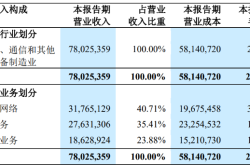
Securities Star observed that since 2024, ZTE's profitability has been under sustained pressure, a trend that persists to this day. The 2026 interim report shows that ZTE achieved revenue of RMB 78.025 billion, representing a 9.05% year-on-year increase. However, this growth rate was slower compared to the 14.51% rise in the same period the previous year. Net profit attributable to shareholders dropped 45.57% year-on-year to RMB 2.753 billion, while core net profit (excluding non-recurring items) fell 45.89% to RMB 2.221 billion.
In the second quarter, the company's revenue reached RMB 43.037 billion, up 11.54% year-on-year. Nevertheless, net profit attributable to shareholders decreased by 44.62% year-on-year to RMB 1.442 billion, and core net profit (excluding non-recurring items) also declined 44.62% year-on-year to RMB 1.285 billion, marking the eighth consecutive quarter of profit decline.
Securities Star noted that with domestic 5G network construction now in a mature stage, operators' capital expenditures are on a downward trend. This has put pressure on ZTE's revenue from wireless and wired network products, dragging down the overall performance of its domestic operator network services.
As the cornerstone of ZTE's revenue, operator network services generated RMB 31.765 billion in revenue in the first half of 2026, a 9.41% year-on-year decrease, accounting for 40.71% of total revenue. Meanwhile, affected by changes in the product revenue mix, the gross margin for this business segment fell 14.88 percentage points year-on-year to 38.06%.
The poor performance of domestic operator network services also contributed to a decline in ZTE's overall domestic market revenue. In the first half of 2026, ZTE's domestic market revenue reached RMB 50.154 billion, down 0.91% year-on-year, accounting for 64.28% of total revenue. The gross margin stood at 24.68%, a 9.01 percentage point year-on-year decrease.
Faced with growth bottlenecks in the domestic market, ZTE is concentrating on deepening relationships with existing customers while continuing to invest in next-generation communication technologies such as 6G, T-bit optical networks, and 200G PON to build technical capabilities for long-term business evolution. Simultaneously, the company is accelerating its expansion into overseas markets to offset the impact of the decline in domestic operator services.
It is reported that ZTE is giving priority to four core regions: Asia-Pacific, Europe, Latin America, and the Middle East & Africa. It is driving 5G upgrades for local mobile networks and broadband fiber transformations, which have boosted its international operator network revenue. At the same time, breakthroughs have been made in international government and enterprise business as well as international home terminals, collectively driving growth in international market revenue.
In the first half of 2026, ZTE's international market revenue reached RMB 27.872 billion, up 33.13% year-on-year, accounting for 35.72% of total revenue. However, as business development accelerates overseas, the quality of profitability has shown signs of weakening. In the first half of 2026, the gross margin for ZTE's international market stood at 26.92%, a 2.53 percentage point year-on-year decrease.
02. Insufficient Bargaining Power in Computing Power Industrial Chain, Negative Cash Flow
Against the backdrop of declining revenue from operator network services, ZTE is fully advancing its "Connectivity + Computing Power" transformation strategy.
In the first half of 2026, computing power products such as servers and storage saw increased adoption among leading clients in industries including the internet, finance, and power. This drove a 43.51% year-on-year increase in ZTE's government and enterprise business revenue to RMB 27.631 billion. This segment's share of total revenue rose from 26.91% in the same period last year to 35.41%. However, the growth rate of government and enterprise business has significantly slowed compared to the 109.93% increase in the same period last year.
Meanwhile, revenue from the consumer business reached RMB 18.629 billion, up 8.09% year-on-year, primarily due to growth in home terminals, mobile phones, and mobile internet products. The growth of these two major business segments has, to some extent, offset the impact of declining operator investments in communication infrastructure in China.
Securities Star noted that the government and enterprise business is currently stuck in a low-gross-margin dilemma. In the first half of 2026, the gross margin for this segment stood at 15.84%, lower than the 38.06% for operator network services and the 18.35% for consumer business. 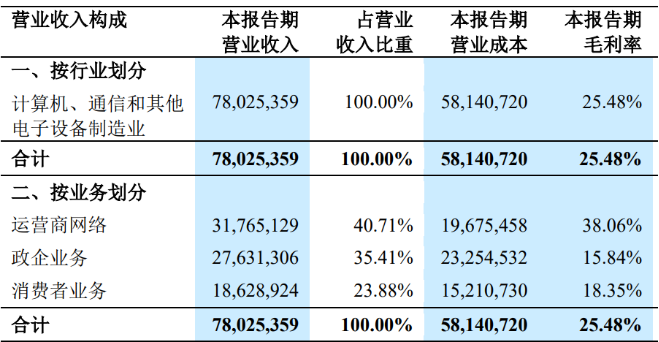
Further research reveals that insufficient bargaining power in the computing power industrial chain is the primary reason for ZTE's low gross margins in its government and enterprise business. As a midstream equipment integrator, the company has to procure core components such as chips, storage, and switches from upstream suppliers, assemble them into products like servers and intelligent computing cabinets, and then deliver them to downstream clients. This results in low-value-added hardware processing profits.
Some market observers argue that ZTE faces a double whammy in its computing power business. On one hand, the vast majority of costs for intelligent computing clusters are determined by core components such as GPUs and HBM, key resources and technologies over which ZTE has no control, leaving limited room for cost optimization. On the other hand, capabilities such as TCO optimization and liquid cooling cost reduction have become common selling points among peers, weakening ZTE's competitive edge. To break free from the low-margin trap in the computing power business, ZTE needs to continue investing in core technology R&D, achieve autonomous construction of core hardware, underlying software, and industrial ecosystems, and reduce reliance on external supply chains.
Notably, amid pressure on profitability, ZTE's R&D investment has decreased. In the first half of 2026, R&D expenses fell 13.7% year-on-year to RMB 10.93 billion.
Overall, with declining gross margins in operator network services and a rising share of low-margin government and enterprise business, ZTE's gross margin performance is under pressure. In the first half of 2026, the consolidated gross margin stood at 25.48%, a 6.97 percentage point year-on-year decrease.
In addition to declining gross margins, a significant increase in credit impairment losses has further squeezed profit margins. In the first half of 2026, credit impairment losses reached RMB 405 million, up 252.32% year-on-year, due to increased provisions for accounts receivable impairment.
Securities Star noted that as revenue has grown, ZTE's inventory and accounts receivable have also risen. As of the end of June 2026, the company's inventory and accounts receivable stood at RMB 54.646 billion and RMB 30.62 billion, respectively, up 29.93% and 4.86% year-on-year. The simultaneous growth in inventory and accounts receivable has impacted the company's cash flow. In the first half of 2026, net cash flow from operating activities turned negative at RMB -127 million, compared to a positive figure in the same period last year. (This article is first published by Securities Star, Author | Li Ruohan) - End -
-
![]()
Tax Rebate Cuts: SAIC Motor Emerges as Potential 'Weakest Link' in China's Auto Export Resilience Framework
-
![]()
ZTE: H1 Net Profit Plummets Over 40%, Computing Power Business Struggles to Escape Low-Profit Quagmire
-
![]()
Seven Key Statements Hit Headlines on the Same Day! Europe's Strategic Maneuver Puts Chinese Automakers in a 'Subtle Stranglehold'
-
![]()
Shocking! Is DCD Auto Really Set to Rake in 24.5 Billion Yuan with a 69% Gross Profit Margin in 2025?
-
![]()
Ren Zhengfei Once Playfully 'Teased' Yu Chengdong: Initially, All Family Members Used iPhones! Now, Yu Chengdong Laughs: They’ve All Made the Switch to Huawei!
-
![]()
Yu Chengdong Faces Scrutiny: Zhijie RX Logs Just 379 Units in Its Debut Month—Can It Still Challenge the YU7?
-
![]()
Why Do Intelligent Driving Vehicles Always Give Way During Cut-ins?
-
![]()
Apple Hits $5 Trillion Market Cap Threshold