Seven Key Statements Hit Headlines on the Same Day! Europe's Strategic Maneuver Puts Chinese Automakers in a 'Subtle Stranglehold'
 10/15 2026
 425
425
Authored by | Guanchejun
Global Expansion of Automakers Receives Latest Guidance!
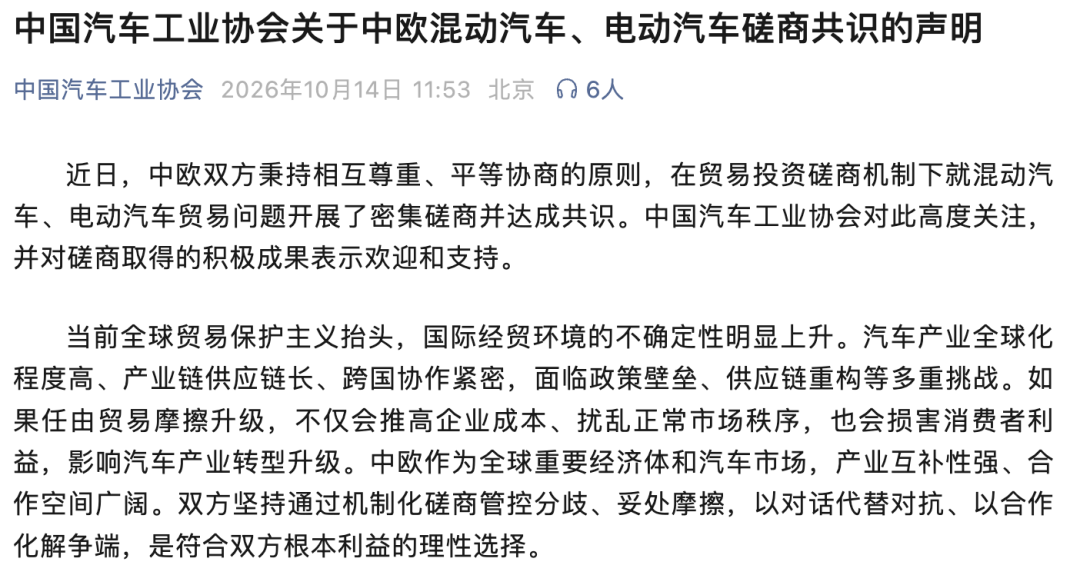
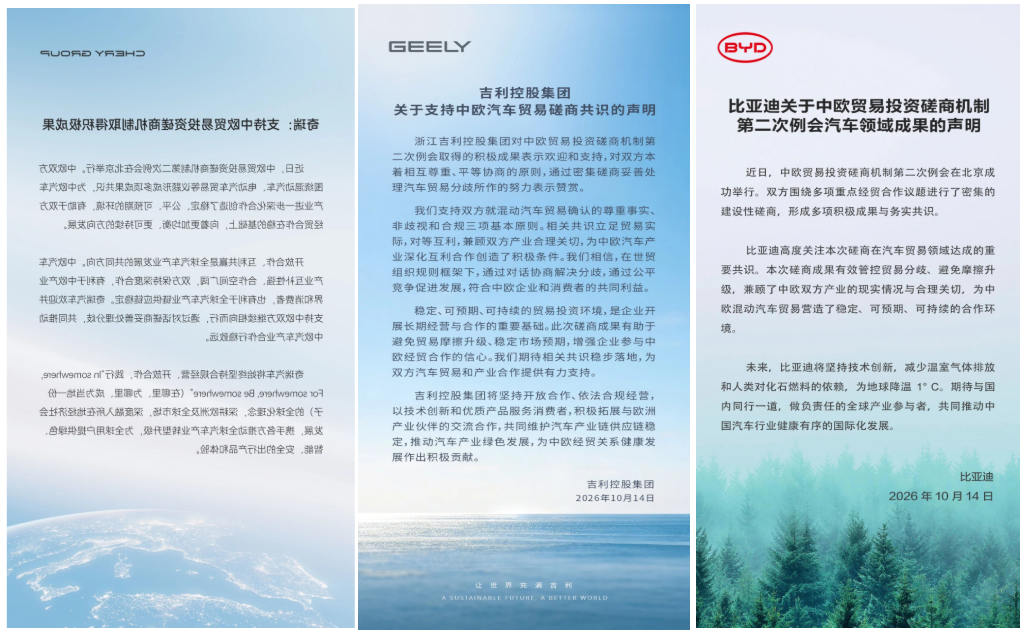
Recently, news about the consensus achieved during consultations between China and the EU on hybrid and electric vehicles has drawn significant attention. On October 14, the China Association of Automobile Manufacturers took the initiative to issue a statement, swiftly followed by announcements from BYD, Geely, and Chery. Subsequently, GAC, Great Wall, Changan, and others also released statements, flooding screens with multiple announcements on the same day.
The Ministry of Commerce had already set the stage on October 12, announcing that China and the EU had reached several consensus outcomes under the trade and investment consultation mechanism, which is beneficial for maintaining a stable and balanced key trade partnership between the two.
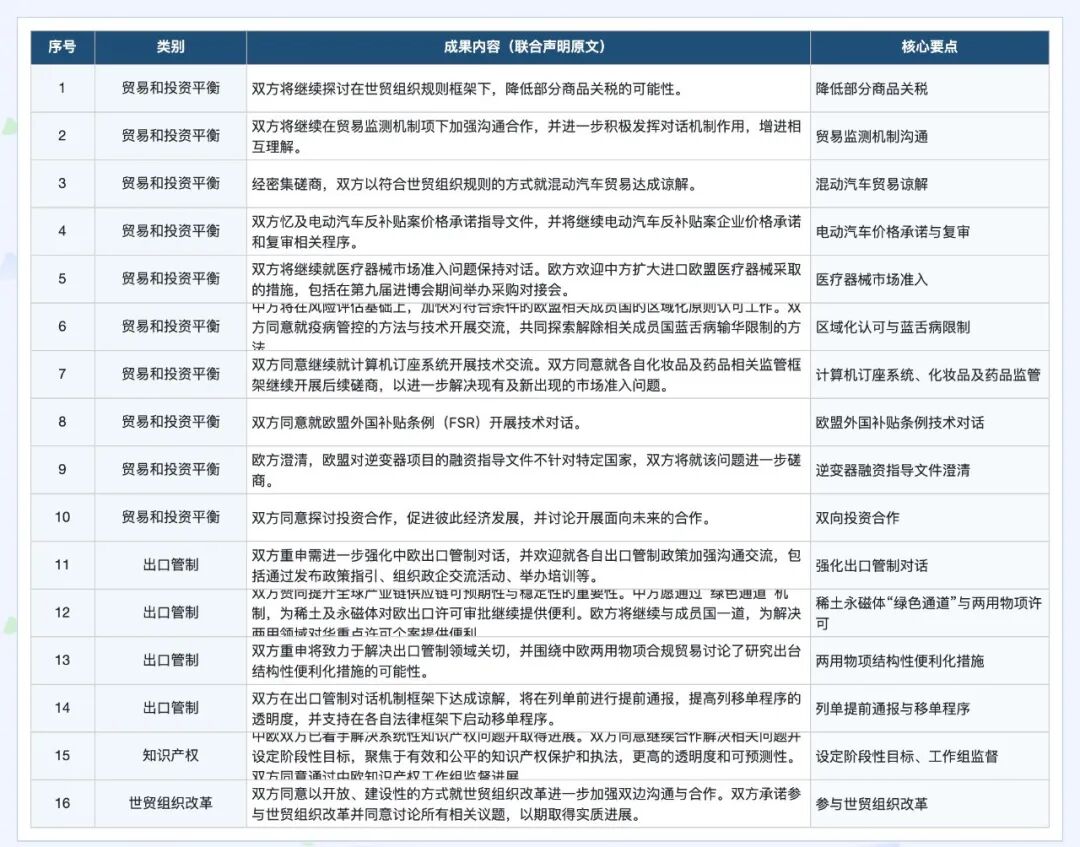
From October 8 to 9, the second regular meeting of the China-EU trade and investment consultation mechanism took place in Beijing, resulting in 16 specific outcomes. From Guanchejun's viewpoint, the two most crucial outcomes are:
1. Reaching an agreement on hybrid vehicle trade in compliance with WTO regulations;
2. Continuing to progress corporate price commitments and review procedures for electric vehicle anti-subsidy cases.
Subsequently, on October 12, the Ministry of Finance and the State Taxation Administration jointly announced that starting from April 1, 2027, the export tax rebate rate for new energy vehicles would be reduced from 13% to 9%.
On one hand, external constraints are being relaxed; on the other hand, internal support is being phased out. The message is clear: the rationale for global expansion is evolving.
Because every achievement on this 'victory list' comes with a price.
Firstly, hybrid quotas are essentially 'controlled growth.' According to Eurostat data, the EU imported 107,000 hybrid vehicles from China in 2024, surging to 302,000 in 2025. Although quotas are set to increase, they proactively curb the most aggressive growth rate of Chinese automakers, establishing a clear limit.
Secondly, price commitments are essentially 'voluntary price increases.' Replacing anti-subsidy taxes with minimum prices is akin to Chinese automakers voluntarily relinquishing their most potent pricing tool. In 2025, Chinese brands' European sales soared by 99% to 811,000 units, with market share doubling to 6.1%, relying precisely on cost-effectiveness.
The reduction in tax rebates obstructs the path of low-priced volume sales, while EU quotas hinder the rapid expansion of plug-in hybrids. Chinese automakers are left with only one option: either establish a local presence or exit.
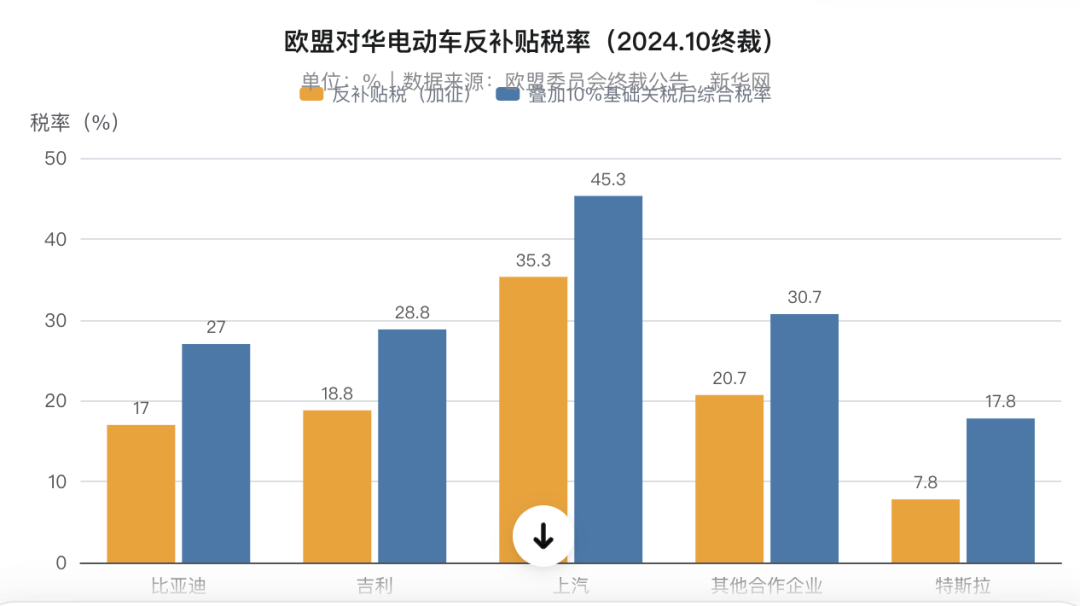
Recalling October 2024, the EU imposed a five-year anti-subsidy tax on Chinese-made pure electric vehicles, which, when combined with the 10% base tariff, resulted in BYD facing 17%, Geely 18.8%, and SAIC a staggering 35.3%, with some models' combined tax rates exceeding 45%. At that time, Chinese automakers encountered an almost insurmountable barrier.
In January 2026, the European side released the 'Guidance Document on Submitting Price Commitment Applications,' achieving a soft landing; in October, an agreement was reached on hybrid vehicle trade, with quotas set to increase based on 2025 levels to ensure export space and stable growth for Chinese enterprises, bringing the tariff war back within a rules-based framework.
From Guanchejun's perspective, the EU's strategy is evident: using tariffs to compel global expansion, quotas to force local production, price commitments to drive price increases, and FSR, battery regulations, and carbon footprints to pressure supply chain adjustments. The aim is to 'integrate' the Chinese industrial chain into Europe for its benefit.
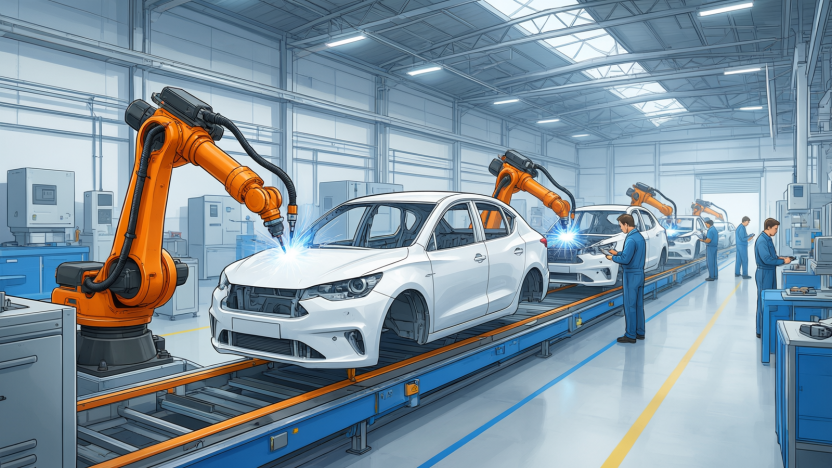
Chinese automakers, of course, recognize this: BYD's Hungarian factory plans to commence mass production in the fourth quarter of 2026, CATL's capacity in Arnstadt, Thuringia, Germany, is being expanded, Chery and Spain's EBRO are revitalizing a former Nissan plant, Leapmotor is utilizing Stellantis' Spanish factory for production, and XPENG is co-manufacturing with Magna in Graz, Austria... The path of Chinese automakers' global expansion is no longer merely about selling cars.
An ecosystem of Chinese R&D + Chinese supply chain + European production + European sales is replacing mere finished vehicle exports.
However, a reality check is necessary: localization is a costlier endeavor. Labor, energy, and compliance costs in Europe will test Chinese automakers' most fundamental cost advantages.
In conclusion: Whoever can strike the optimal balance between 'European identity' and 'Chinese efficiency' will truly remain competitive.
The charts in this article, unless otherwise specified, are publicly disclosed from various sources or AI-generated, for which we hereby express our gratitude! The views expressed herein are for reference only and do not constitute investment advice.
This article is original content from Leverage Auto Observations and is prohibited from being reproduced without authorization. For reproduction, please obtain authorization. Additionally, when authorized for reproduction, please also indicate the source and author at the beginning of the article. Thank you!
-
![]()
Tax Rebate Cuts: SAIC Motor Emerges as Potential 'Weakest Link' in China's Auto Export Resilience Framework
-
![]()
ZTE: H1 Net Profit Plummets Over 40%, Computing Power Business Struggles to Escape Low-Profit Quagmire
-
![]()
Seven Key Statements Hit Headlines on the Same Day! Europe's Strategic Maneuver Puts Chinese Automakers in a 'Subtle Stranglehold'
-
![]()
Shocking! Is DCD Auto Really Set to Rake in 24.5 Billion Yuan with a 69% Gross Profit Margin in 2025?
-
![]()
Ren Zhengfei Once Playfully 'Teased' Yu Chengdong: Initially, All Family Members Used iPhones! Now, Yu Chengdong Laughs: They’ve All Made the Switch to Huawei!
-
![]()
Yu Chengdong Faces Scrutiny: Zhijie RX Logs Just 379 Units in Its Debut Month—Can It Still Challenge the YU7?
-
![]()
Why Do Intelligent Driving Vehicles Always Give Way During Cut-ins?
-
![]()
Apple Hits $5 Trillion Market Cap Threshold