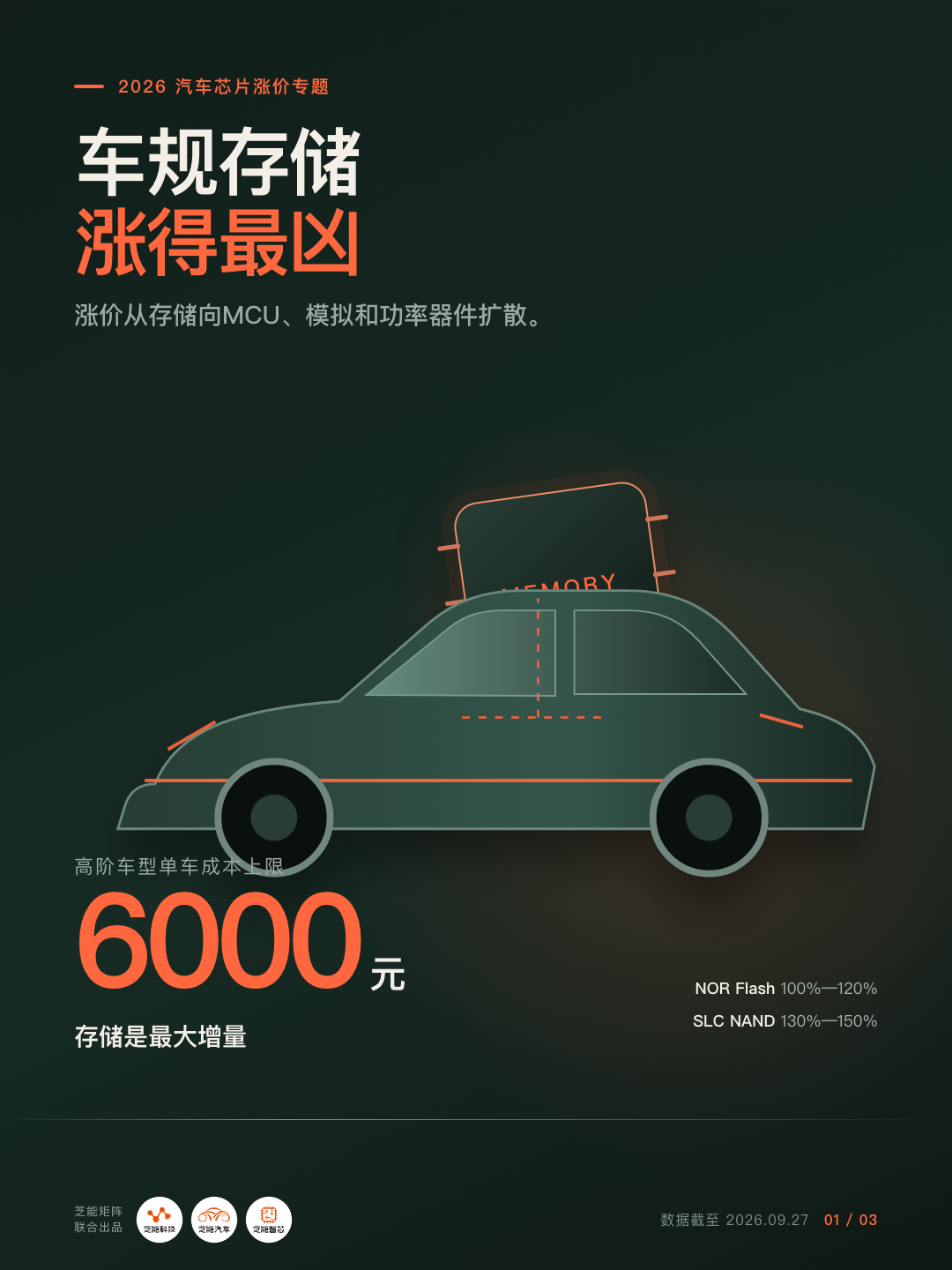
The automotive chips that have seen the most significant price hikes are automotive-grade memory chips, with the cost per vehicle increasing by up to 6,000 yuan
 09/29 2026
 356
356
In 2026, automotive chips will not experience a uniform price increase across the board. Instead, the price hikes will spread along the routes of memory, MCU, analog, and power semiconductors. Automotive-grade NOR Flash and SLC NAND have doubled in price since the beginning of the year, with mainstream MCUs and analog chips increasing by 5% to 25%. Intelligent driving SoCs and sensors have not yet seen a comprehensive price increase. For a single vehicle, entry-level fuel-powered cars will see an increase of 300 to 900 yuan, while high-end intelligent driving models may see an increase of up to 6,000 yuan.
Produced by Zhineng Zhixin
The most notable change in the automotive supply chain in 2026 is that price increases will spread along a clear route: first memory, followed by analog chips, MCUs, and power semiconductors. A uniform price increase across the entire industry has not occurred.
This round is different from the one in 2021.
The previous round was driven by a sudden recovery in automotive demand and supply chain disruptions. This round, AI servers have absorbed advanced memory, high-end packaging, and a portion of wafer capacity, while mature processes for automotive and industrial applications face rising costs in raw materials, energy, and packaging and testing.
What we need to assess is which types of chips are seeing price increases and how much these chips are worth in a single vehicle.
Part 1: Which Types of Chips Are Seeing Price Increases?
Memory Chips: Automotive-grade NOR Flash and SLC NAND See the Steepest Increases
In early 2026, contract prices for DRAM and NAND jumped first. TrendForce raised its first-quarter traditional DRAM contract price increase forecast to 90% to 95% in February, with NAND Flash prices increasing by 55% to 60%.
These figures represent the entire market and cannot be directly equated with automotive chip procurement prices, but they explain why automotive-grade memory costs have suddenly risen.
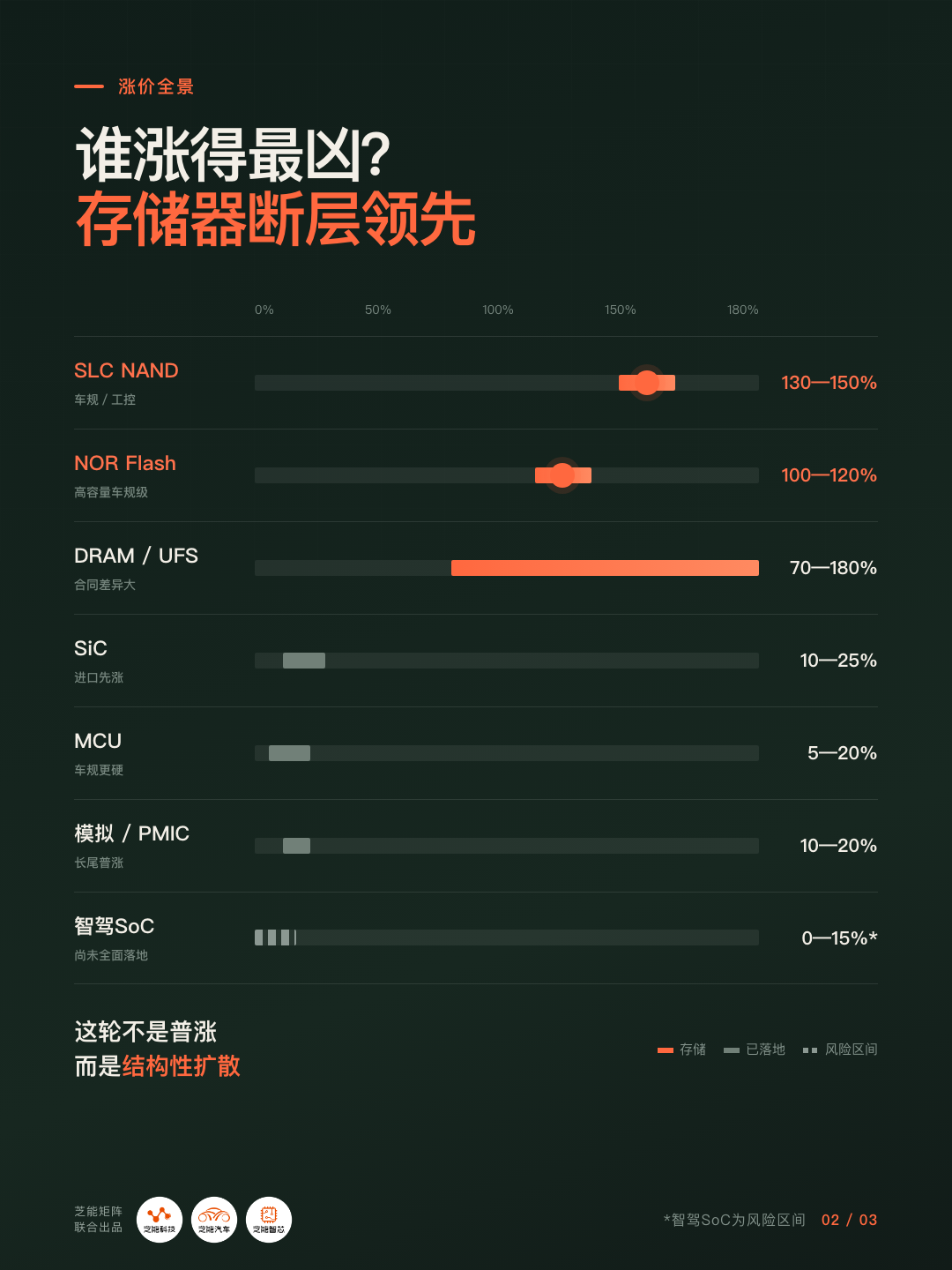
More directly related to automotive applications are NOR Flash and SLC NAND. TrendForce disclosed that contract prices for NOR Flash increased by approximately 100% to 120% cumulatively in the first half of 2026, with SLC NAND increasing by about 130% to 150%. High-capacity, industrial-grade, and automotive-grade products saw even stronger price increases. These are the chips experiencing the steepest hikes.
NOR Flash is used for ECU firmware and boot programs, while SLC NAND is employed in control systems with high requirements for lifespan, wide temperature ranges, and data reliability. Although their capacities are not large, they are the most difficult to replace on short notice.
In the second half of the year, the market keyword shifted from 'price increases' to 'allocation.' High-capacity NOR Flash and SLC NAND are still expected to continue rising, but these projections are separate from the price increases already realized by September.
◎ Since the beginning of the year, automotive-grade NOR Flash and SLC NAND have seen price increases of 100% to 150% as the primary range;
◎ Automotive-grade DRAM and eMMC/UFS have seen mainstream price increases of approximately 70% to 180%, with significant variations based on capacity and contract terms;
◎ High-end DDR5, scarce spot goods, and small-batch purchases may see even higher increases, but these do not represent the long-term procurement prices for all automotive companies.
MCUs: Automotive-grade and High-Performance Models Increase First, Low-End Consumer Models Do Not Face Comprehensive Shortages
MCUs are small controllers used in vehicles for lights, wipers, seats, motors, thermal management, BMS, chassis, and body control. Not a single one can be omitted in a vehicle.
In June 2026, MCU price increases shifted from scattered notices to industry-wide diffusion.
STMicroelectronics raised prices for some MCUs by approximately 7% to 14%, with NXP adjusting its automotive MCU quotes. Texas Instruments initiated a new round of price increases in July, while Infineon adjusted some industrial and automotive MCUs in the third quarter. Some domestic 8-bit and 32-bit MCUs saw price increases of approximately 5% to 20%.
Prices for automotive-grade, industrial-grade, high-performance 32-bit MCUs, and models already integrated into vehicle platforms and difficult to replace in the short term have held firmer. Mainstream automotive MCU price increases are approximately 5% to 20%, with 7% to 15% being the most representative range.
Analog Chips and Power Management: General Increase of 10% to 15%, with Some Scarce Models Rising More Sharply
Analog chips are among the most underestimated components in automotive applications, with an overwhelming number of part numbers. Power management, isolation, operational amplifiers, interfaces, transceivers, gate drivers, and signal chains all fall under this category.
In 2026, major international analog chip manufacturers implemented multiple price adjustments:
◎ ADI adjusted prices starting February 1, with commercial products increasing by approximately 10% to 15%, industrial products by about 15%, and the entire product portfolio averaging around 15%. A second round of adjustments began in September;
◎ TI raised prices for some digital isolators and PMICs by 15% to 85% in April, with a broader product portfolio adjustment starting July 1;
◎ NXP implemented two rounds of price adjustments in April and June, primarily affecting automotive, industrial, and IoT applications;
◎ Infineon also adjusted quotes for some power switches and power ICs in April and July.
85% represents extreme cases and should not be written as the price increase for the entire analog chip industry. Automotive analog and power management chips generally saw price increases of approximately 10% to 20%, with some isolators, PMICs, and scarce long-lead-time models reaching 30% to 85%.
Power Semiconductors: MOSFETs and IGBTs Increase First, SiC Shifts from Price Wars to Stabilization
For new energy vehicles, power semiconductors determine how electricity is transformed, delivered, and controlled, from the battery to the wheels. Main drive inverters, OBCs, DC-DC converters, air conditioning compressors, thermal management systems, and charging systems all rely on them.
Among the publicly announced price adjustments in 2026, let's first discuss domestic manufacturers: Jiejie Microelectronics raised prices for MOSFETs, IGBTs, and other products in multiple rounds by 10% to 20%. Yangjie Technology adjusted prices across its entire product line by 10% to 15% starting in July, while Silan Micro increased prices for some power chips by over 15%.
Some domestic SiC MOSFET, IGBT, and NOR Flash manufacturers collectively raised prices by 15% to 25% in July, with power wafer foundries also seeing price increases of 10% to 15%.
Over the past two years, domestic SiC production has expanded rapidly, leading to intense price competition. As a result, price increases for various devices in 2026 have not been uniform. Imported high-end devices have taken the lead in raising prices, domestic devices have stabilized after stopping declines, and automotive-grade modules have varied based on customers and platforms.
Automotive-grade MOSFETs and IGBTs have increased by approximately 10% to 20%; automotive-grade SiC devices and modules have seen mainstream adjustments of about 10% to 25%, with significant variations among manufacturers, packages, and customers; wafer foundry prices have increased by approximately 10% to 15%.
Intelligent Driving SoCs and Sensors: Cost Pressures Exist, but a 'Comprehensive Price Increase' Is Not Yet Supported
Qualcomm has confirmed price increases for some products starting in September, with market rumors suggesting double-digit percentage increases. However, publicly available information primarily points to mobile platforms, with the implementation timeline, vehicle model contracts, and specific part numbers for automotive and IoT products remaining unclear.
Automotive CIS, millimeter-wave radar chips, and MEMS sensors are also experiencing demand growth and manufacturing cost pressures. However, as of now, there is insufficient evidence to prove that they have formed a comprehensive, uniform price increase across all categories and magnitudes, similar to memory, MCUs, and power devices. The evidence is not yet sufficient.
These two categories are only considered risk factors in per-vehicle cost estimates and are not treated as already fully realized cost increases.
Part 2: How Much More Does a Single Vehicle Cost?
A 100% increase in chip prices does not equate to a 100% increase in overall vehicle costs. The calculation is not that straightforward. A single vehicle contains thousands of semiconductors of varying values, with the steepest increases seen in NOR Flash potentially accounting for only a small portion. High-value intelligent driving SoCs may not have seen price increases yet.
S&P Global Mobility estimates that the global average semiconductor value per vehicle was approximately $1,014 in 2025. Chinese vehicle models, due to differences in configuration, localization rates, and procurement models, cannot be directly compared but can serve as a total value anchor point.
Below are three scenario-based estimates, with the exchange rate roughly set at 1 USD ≈ 7.1 CNY. Only chip costs are considered, excluding lithium carbonate, copper, aluminum, passive components, and other raw materials.
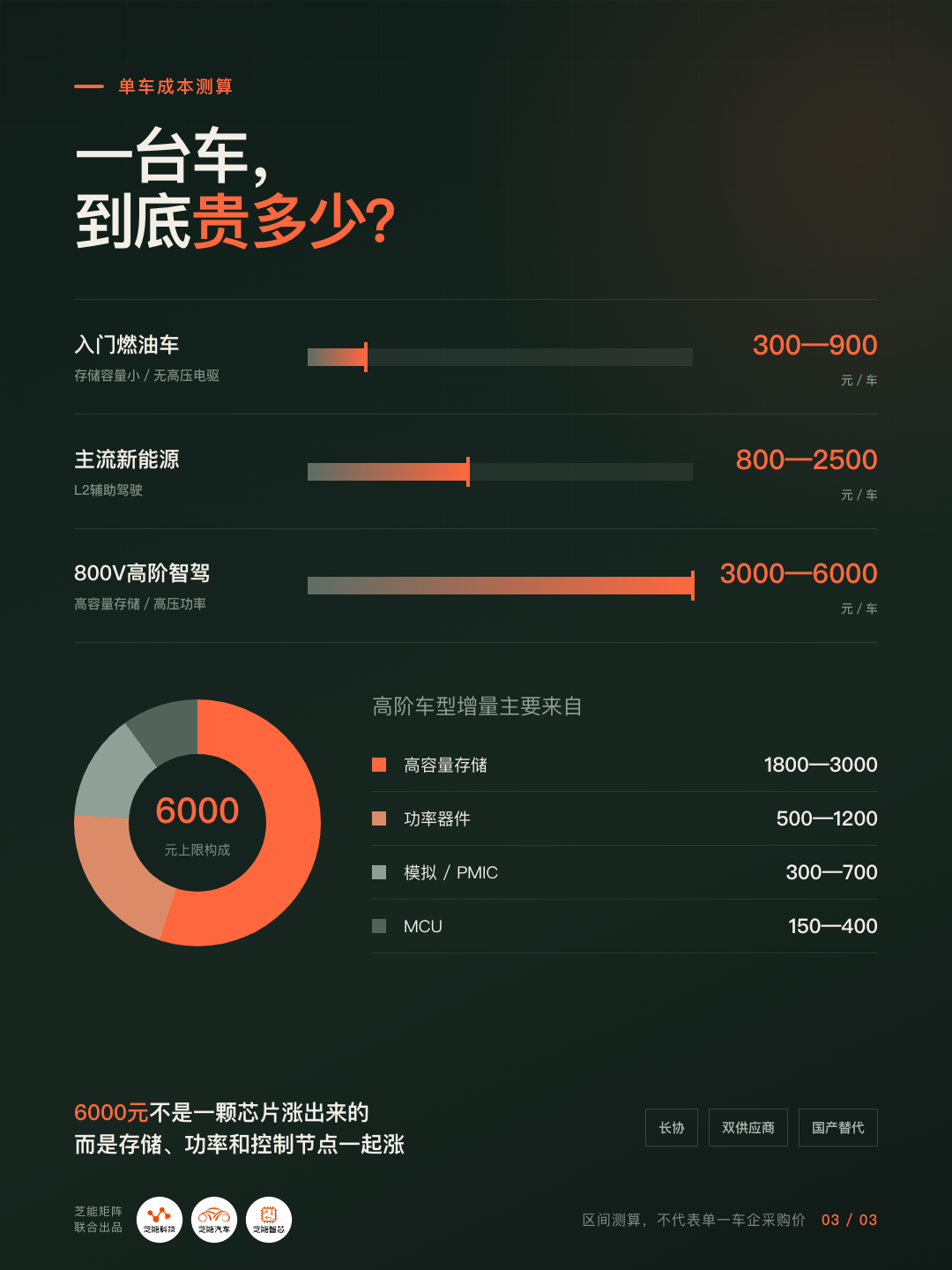
Entry-Level Fuel-Powered Cars: Increase of Approximately 300 to 900 Yuan
These vehicles have small memory capacities and lack high-voltage electric drives, primarily being affected by MCUs, analog chips, body power devices, and a small amount of memory. Fuel-powered cars face the lightest impact.
For fuel-powered cars, this round of chip price increases represents a pressure in the hundreds of yuan range, unlikely to alone push up terminal prices but will erode already thin per-vehicle profits.
Mainstream New Energy Vehicles with L2 Assisted Driving: Increase of Approximately 800 to 2,500 Yuan
Mainstream new energy vehicles are simultaneously affected by four lines: memory, MCUs, analog chips, and power devices.
This represents the most representative range. For a new energy vehicle priced between 150,000 and 250,000 yuan, chip price increases equate to absorbing approximately 0.4% to 1.7% of the vehicle price or directly consuming several percentage points of per-vehicle gross profit.
800V High-Voltage Platform with High-End Intelligent Driving: Increase of Approximately 3,000 to 6,000 Yuan
High-end intelligent electric vehicles have higher memory capacities, more cameras, more domain controllers, and higher-value high-voltage power devices. Public information shows that DRAM and NAND capacities in general vehicle models are rapidly increasing, with high-end models potentially reaching terabyte levels. The same percentage increase will be amplified on high-end models.
The high costs for high-end intelligent driving models stem from simultaneous increases in high-capacity memory, high-voltage power, and more control nodes, not just a single chip.
Why Does the Market Claim 'Per-Vehicle Increase of 7,000 to 10,000 Yuan'?
This claim cannot be outright denied but must be qualified.
It mostly corresponds to one or more of the following situations: automakers lack long-term agreements and can only replenish inventory in the spot market; models use high-capacity DDR5, LPDDR5X, UFS, or niche automotive-grade memory; other price increases, such as those for lithium carbonate, copper, aluminum, and passive components, are factored in; new models have added features, resulting in a combination of price increases and feature additions; a single extreme part number increase is extrapolated to the entire vehicle's procurement.
7,000 to 10,000 yuan is more suitable as an upper-bound scenario for high-end models, spot market procurement, or comprehensive raw material pressures and should not be written as an industry-wide average.
Public reports indicate that the average vehicle DRAM and NAND capacities will continue to increase in 2026, with high-end models potentially reaching 2TB. Automotive-grade memory also requires long-cycle verification and cannot be quickly replaced like consumer electronics, resulting in slower but potentially longer-lasting price increases.
A single price increase notice will not immediately change vehicle prices. However, when memory, MCUs, analog chips, and power devices all increase in the same quarter, the space for automakers to rely on annual cost reductions to absorb configuration upgrades will rapidly narrow.
Price increases have a lag of 1 to 2 quarters, with these costs becoming explicit in financial reports only in the second half of the year. This round of price increases tests far more than just the procurement department's ability to secure supplies.
Whether automakers have long-term agreements, dual-supplier designs, domestic substitution capabilities, and sufficient gross profits to withstand the new cost cycle will be the dividing line.
Automakers with locked-in long-term prices will face minimal impact this round; those relying on spot market replenishment without alternatives will see costs directly reflected in their financial reports. The previous round in 2021 was characterized by a shortage of capacity and automotive-grade certifications, while this round is characterized by a shortage of price-controlled supplies.
The domestic market share of automotive-grade MCUs, analog chips, and power devices has been increasing in recent years. However, high-end 32-bit MCUs, automotive-grade PMICs, and some isolators still rely on imports, leaving automakers with the least bargaining power during price increases. Automakers that implemented dual-supplier and local solutions during the model selection phase will experience slower cost increases this round.
Summary
The price increases of automotive chips in 2026 represent a structural reassessment, with no uniform increase across the entire industry. Overall, the situation remains manageable.
-
![]()
The automotive chips that have seen the most significant price hikes are automotive-grade memory chips, with the cost per vehicle increasing by up to 6,000 yuan
-
![]()
Flash Charging Era Approaches: Geely and NIO Forge Strategic Alliance
-
![]()
Harmony Intelligent Mobility Alliance’s Suspected 2027 New Product Launch: AITO Excluded, Shangjie and Luxeed Set to Dominate the 300,000-500,000 Yuan Market Segment | Mingjingpro
-
![]()
Save up to 12,000 RMB in Car Purchase Subsidies: Here's What You Need to Know
-
![]()
NIO and Geely Forge a 'Strategic Alliance'
-
![]()
Shenlong Technology Achieves in Just Over a Month What a 40-Year Joint Venture Couldn't
-
![]()
New Energy Vehicles Face a 'Scale Dilemma': Wan Gang and Zhu Huarong Offer Solutions!
-
![]()
What are the Eight Redundancies for L3 Autonomous Driving in the Qijing GX7?