Just 12 Minutes Post-Launch, Geely’s Warship 700 Racks Up 10,000 Orders! Geely Makes Inroads into BYD’s Fastest-Growing Market
 10/12 2026
 406
406
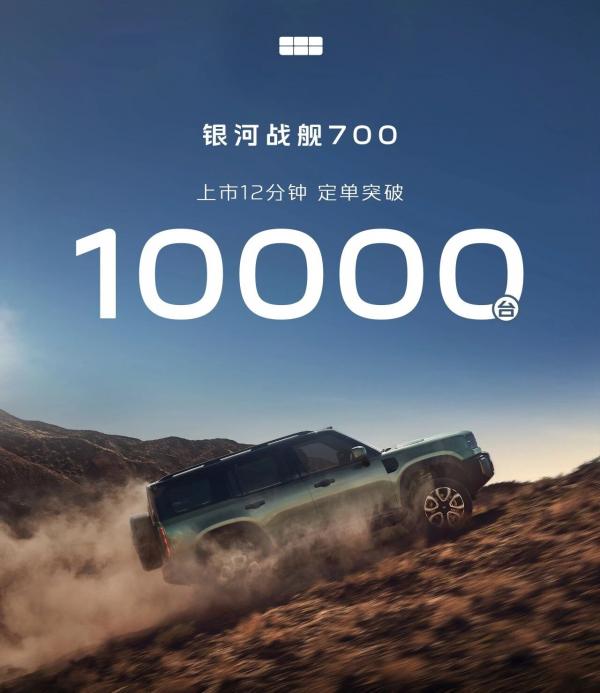
Geely has once again made a significant move in its quest to overtake BYD, launching a notable product. On October 10, the Geely Galaxy Warship 700 officially hit the market, offering six trim levels with limited-time renewal prices spanning from RMB 169,800 to RMB 359,800. During its global pre-sale phase, the vehicle garnered 43,900 orders within just 60 minutes. A mere 12 minutes after its official launch, it secured over 10,000 firm orders. The Warship 700 marks Geely’s inaugural foray into the boxy SUV segment, adopting a disruptive strategy that has placed substantial pressure on established market players, particularly the current best-seller, the Fangchengbao Titan 7.
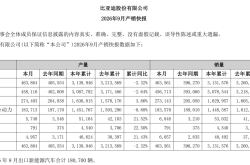
The Fangchengbao Titan 7 currently boasts both PHEV and EV variants, each surpassing 10,000 units in sales. Monthly sales consistently exceed 20,000 units, maintaining a leading position in the boxy SUV market. In contrast, other vehicles in the segment failed to exceed 10,000 units in August sales. Consequently, in the RMB 200,000 price bracket for new energy boxy SUVs, BYD has secured a dominant market position. Fangchengbao’s September sales reached 43,181 units, marking a 79% year-on-year increase and surpassing 40,000 units for three consecutive months. This has positioned Fangchengbao as a key growth driver for BYD.
Naturally, this success has drawn more competitors into the market. As one of BYD’s strongest contenders, Geely is clearly not going to ignore this segment. The Galaxy Warship 700 is purpose-built for this challenge. To compete with the Titan 7, which already enjoys a strong market presence, Geely’s strategy remains straightforward: offer lower pricing and higher value. The trim level configuration of the Galaxy Warship 700 is almost directly aimed at rivaling the Titan 7.
In terms of pricing, the Galaxy Warship 700’s limited-time renewal prices range from RMB 169,800 to RMB 359,800, generally undercutting Fangchengbao’s official prices by RMB 10,000. Simultaneously, it offers differentiated advantages in specifications, primarily through a longer all-electric range and enhanced off-road capabilities. BYD, in contrast, provides more intelligent configuration options. Thus, Geely’s strategy showcases differentiation while directly targeting the weak points of the Fangchengbao Titan 7.
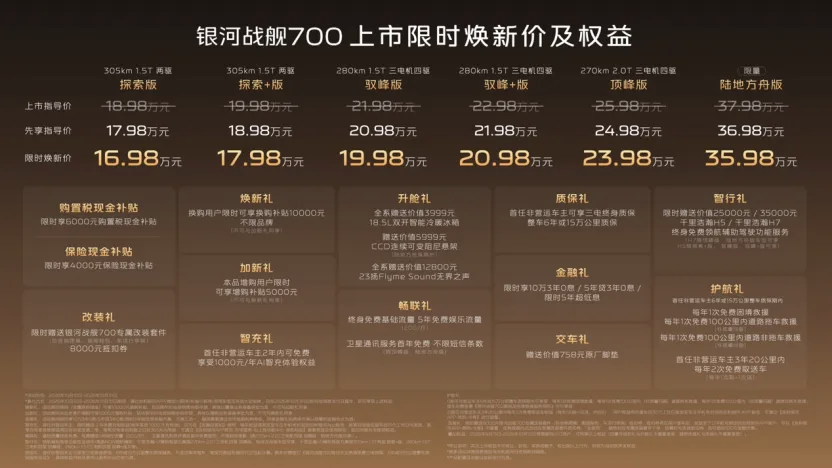
The plug-in hybrid version of the Galaxy Warship 700 commences with an all-electric range of 280 km, significantly surpassing that of the Fangchengbao, and all versions offer higher specifications than the Titan 7. It utilizes CATL battery cells, supports 800V high-voltage fast charging, with the two-wheel-drive version offering a CLTC all-electric range of 305 km and a maximum combined range of 1,770 km. Built on the GTA native new energy off-road architecture, it features a five-seat layout across all trims, with body dimensions of 5085/1999/1895-1925mm and a wheelbase of 2900mm, providing a slight size advantage over the Titan 7.
The powertrain offers three options: a 1.5T two-wheel-drive with a 305 km all-electric range; a 1.5T three-motor four-wheel-drive with a combined power of 700kW; and a 2.0T three-motor four-wheel-drive with a system combined power of 830kW (approximately 1,129 horsepower). The engine and motors hold slight parameter advantages, though these are not substantial.
The Geely Galaxy Warship 700’s standout feature is its off-road capability, equipped with a rear axle mechanical differential lock, closed dual-chamber air suspension, CCD dampers, a wading depth of 800mm, and a roof crush resistance of 16 tons. In terms of intelligence, it features the Qianli Haohan H7 intelligent driving system (700TOPS computing power) and the Flyme Auto 2 cockpit system. The top-tier “Land Ark Edition” is limited to 700 units, equipped with emergency floating escape, active hydraulic suspension, and diffuse oxygen supply functions, all of which sold out during the pre-sale phase.
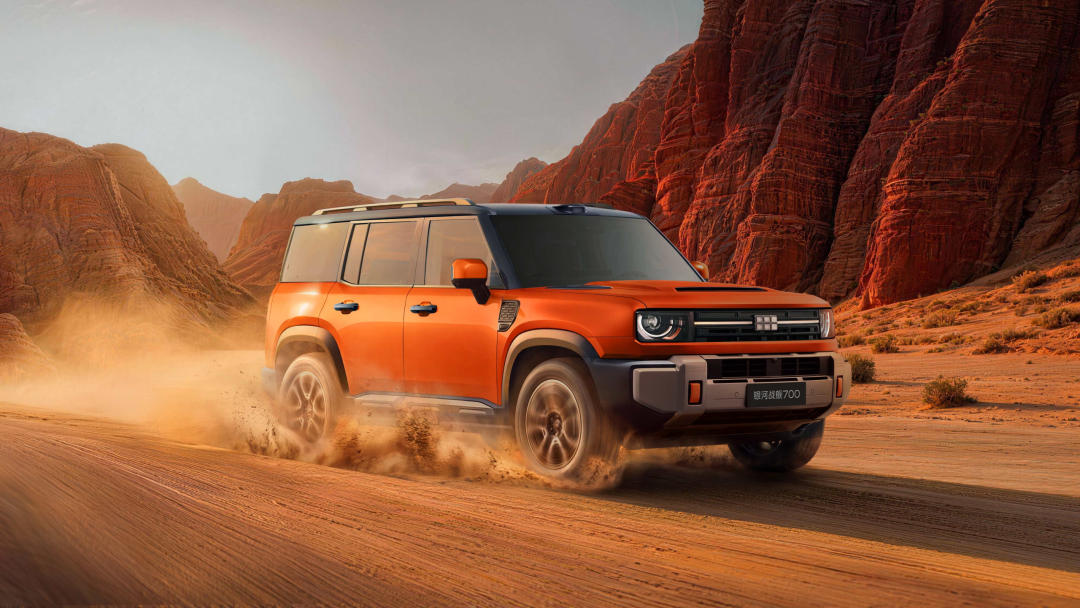
In comparison, the Titan 7 primarily targets urban users, with its four-wheel-drive version lacking a ladder frame chassis. This represents Fangchengbao’s differentiated approach in competing with Great Wall, focusing on its areas of strength. Geely, once again, adopts the opposite strategy, enhancing off-road capabilities in its RMB 200,000 four-wheel-drive version. With the launch of the Galaxy Warship 700, Geely officially completes its hardcore off-road product lineup, adopting a “more for the same price” strategy to enter the new energy off-road market dominated by Tank and Fangchengbao. Particularly for the Fangchengbao Titan 7, with its lower entry price and differentiated specifications, the Warship 700 is expected to deliver a direct impact.
Over the past two years, Geely has been vigorously pursuing BYD, attempting to reclaim its former title as China’s best-selling domestic automaker. Multiple products in its Galaxy series directly compete in BYD’s popular market segments. In terms of sales, Geely Auto sold a total of 292,168 vehicles in September this year, reaching a new single-month high for the year, up about 7% year-on-year and 8% month-on-month, achieving seven consecutive months of double-digit growth in both year-on-year and month-on-month terms. The cumulative sales for the first three quarters reached 2,235,481 units, a new historical high for the same period, up 3% year-on-year. The overall growth momentum remains strong, and the addition of the Warship 700 is expected to drive even greater growth.
Data reveals that from January to April this year, BYD sold approximately 567,300 vehicles domestically, while Geely Auto sold about 658,500 vehicles, surpassing BYD by 91,200 units. In terms of actual insurance registrations during the same period, BYD had 559,900 units, while Geely had 608,600 units, with Geely leading by 48,700 units.

At Geely’s 2025 full-year results briefing in March this year, Geely Group CEO Gan Jiayue stated, “In 2026, we aim to reach an annual sales target of 3.45 million units and strive to become China’s top seller domestically.” Deploying strategies in segmented markets is a necessary choice. Of course, BYD is not sitting idle. This year, through a series of moves like flash charging, BYD has achieved a new wave of growth. According to BYD Chairman Wang Chuanfu, sales in the first half of the year were constrained by the production capacity of the second-generation Blade Battery. However, starting in the second half, BYD is expected to maintain growth.
Nevertheless, Geely continues to unveil new trump cards. On September 23, Geely Auto announced its new charging technology, Ji Zhi Chong. This charging system reaches a power of 2.2 megawatts, the highest globally. In terms of charging speed, it takes four minutes to charge from 10% to 70%, achieving a full charge in four minutes, and 8 minutes and 37 seconds to charge from 10% to 97%, the highest in the industry. Meanwhile, the system excels in temperature control during charging, with a maximum recorded temperature of 62°C during on-site testing, 3°C lower than the national standard. The average charging temperature is 55°C, 10°C lower than the national standard. This is clearly a technical adjustment aimed at addressing the temperature rise issues associated with BYD’s flash charging.
Geely stated that it will begin large-scale deployment of its new Ji Zhi Chong megawatt-level charging stations next year, with plans to install 15,000 charging stations nationwide by 2027. Notably, in terms of charging performance, Geely’s system has surpassed BYD’s flash charging. However, BYD has already deployed 10,000 megawatt charging stations. For Geely, the focus now is on accelerating deployment and introducing relevant vehicle models.
-
![]()
BYD Takes the Lead, Li Auto Lags Behind: Are Joint Ventures Making a Comeback? September’s New Energy Vehicle Sales Data Reveals Stark Divisions
-
![]()
New Forces Top Annual List, Tesla Holds Three-Year Reign! September's Pure Electric Model Resale Value Rates: A Tale of Contrasts
-
![]()
Lei Jun’s Bold Claim Proven: Xiaomi Tops Resale Value Charts, with NIO and Li Auto Close Behind!
-
![]()
Has Zunjie 'Stumbled', Paving the Way for Xiaomi's Success?
-
![]()
Before Launch: How Does a Chinese Rocket Stand or Lie?
-
![]()
Zunjie V800 Brake Bracket Fracture: With the Same 40% Glass Fiber-Reinforced Plastic, Where Does the Disparity Arise?
-
![]()
Why Does Your Phone Slow Down After Long-Term Use?
-
![]()
The Comprehensive Guide to Tariffs on Chinese Automobile Exports: A Stark Contrast to Japan