When Are Automotive Companies Required to Issue a Recall? What Does a Recall Entail?
 10/12 2026
 457
457
According to the
This underscores that automotive recalls are no longer confined to part replacements; software upgrades have also emerged as a crucial method for rectifying defects.
However, the volume of recalls does not directly reflect the quality of an automaker's vehicles.
Why do certain automotive malfunctions necessitate only repairs, while others demand a recall? When issues involve software control or power batteries, how should companies evaluate risks and ascertain the scope of recalls?
01 Why Doesn't Every Automotive Malfunction Require a Recall?
An automotive malfunction does not automatically equate to a product defect warranting a recall.
As per Article 3 of the
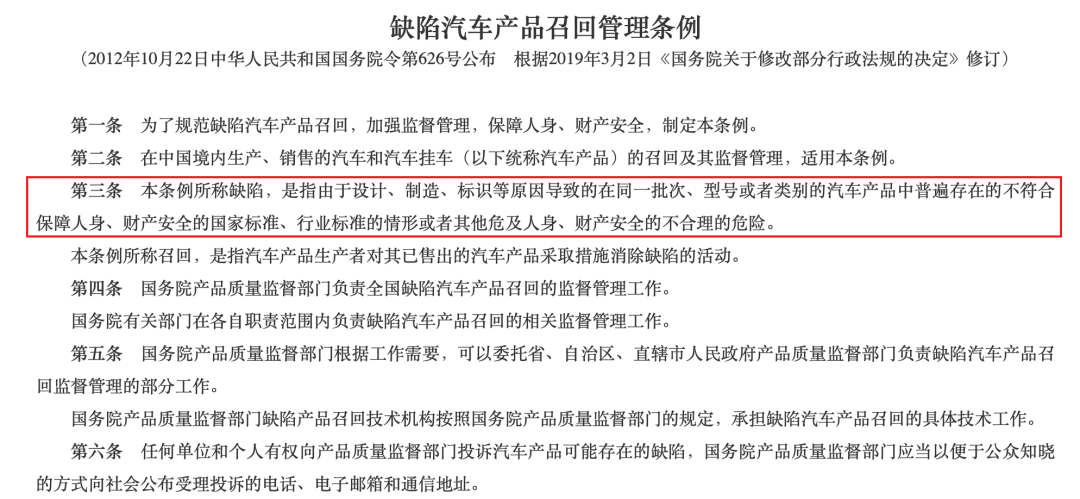
Image source: Screenshot of the regulations
The crux of this definition lies not in whether a vehicle has malfunctioned, but whether the issue pertains to product safety and meets the criteria for defect identification.
For instance, if a vehicle experiences prolonged braking distance, the cause could range from inadequate maintenance in the braking system, an anomaly in individual components, to a design or manufacturing flaw posing similar safety risks to vehicles of the same batch or type.
The initial two scenarios necessitate diagnosis and handling based on specific causes, but the possibility of a product defect cannot be dismissed solely because the malfunction occurred in a single vehicle.
If an investigation confirms the issue as a product defect under the regulations, the company must further ascertain the scope of affected vehicles and implement a recall in accordance with the law.
It is crucial to note that a recall does not necessitate the occurrence of an accident, nor does it imply that every affected vehicle must have already malfunctioned.
Product defects may only surface under specific temperatures, operating conditions, or usage scenarios. The absence of abnormalities in some vehicles does not negate the potential risk.
Hence, automakers must comprehensively analyze user complaints, after-sales maintenance records, failure data, component testing, and experimental validation to assess the failure mechanism, impact scope, and safety consequences of the issue.
For intelligent vehicles, analysis must also encompass software versions, electronic control strategies, and the operational status of related systems.
An often-overlooked distinction is that a low probability of failure does not equate to negligible risk; however, a single occurrence of an issue does not directly substantiate a defect necessitating a recall in the same vehicle model. Ultimately, judgments must hinge on technical investigations and regulatory requirements.
02 Why Must Automakers Sometimes Issue a Recall After Identifying an Issue?
The core of the recall system is to mandate producers to assume responsibility for product defects rather than awaiting accidents before taking action.
According to the
If an investigation confirms the presence of a defect, producers shall immediately halt the production, sale, and import of the defective automotive products and implement a recall.
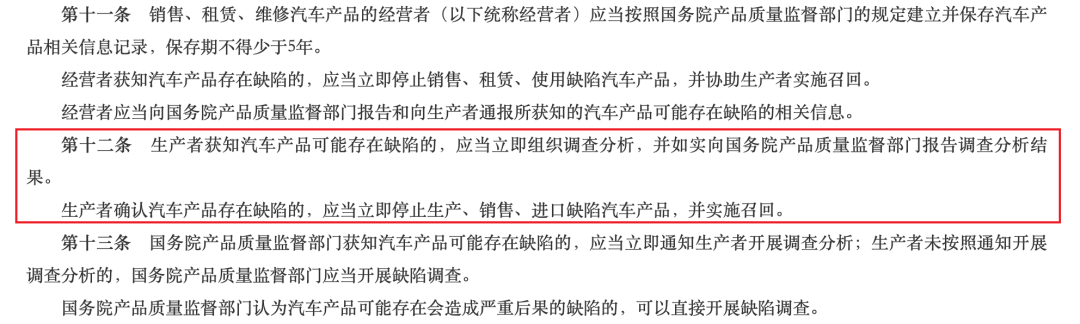
Image source: Screenshot of the regulations
If regulatory authorities investigate and confirm the existence of a defect, they may also notify or order producers to implement a recall in accordance with the law. In 2025, China witnessed 55 automotive recalls influenced by supervision from the State Administration for Market Regulation, involving 2.934 million vehicles and accounting for 42.9% of the total recalls for the year.
This data indicates that regulatory defect investigations are a pivotal mechanism driving automotive recalls, but it does not imply that the relevant companies had previously declined to recall or intentionally concealed issues.
For automakers, the truly arduous task after identifying an anomaly is determining which vehicles are affected by the defect and what measures should be taken.
An issue may pertain to a specific production batch or span multiple vehicle models or configurations. Companies need to trace vehicle production records, component supply batches, software and hardware versions, and related validation results to ascertain the scope of the issue.
If the recall scope is inaccurately defined, vehicles at risk may be overlooked; conversely, blindly expanding the scope without technical justification can increase the pressure on maintenance organization and resource allocation. In November 2025, BYD Auto Industry Co., Ltd. and BYD Auto Co., Ltd. each recalled certain Qin PLUS DM-i vehicles, totaling 88,981 units.
The announcement from the State Administration for Market Regulation stated that during the production process, consistency issues with the power battery packs could lead to restricted power output from the batteries, and in extreme cases, the inability to operate in pure electric mode, posing safety hazards.
This recall was initiated following a defect investigation by the State Administration for Market Regulation.
The remediation plan did not simply conclude with an OTA upgrade. The company initially provided a free OTA upgrade to the vehicle's detection software, which would illuminate a fault light and prompt users to return to the dealership if battery anomalies were detected. Subsequently, dealers would replace the power battery packs free of charge.
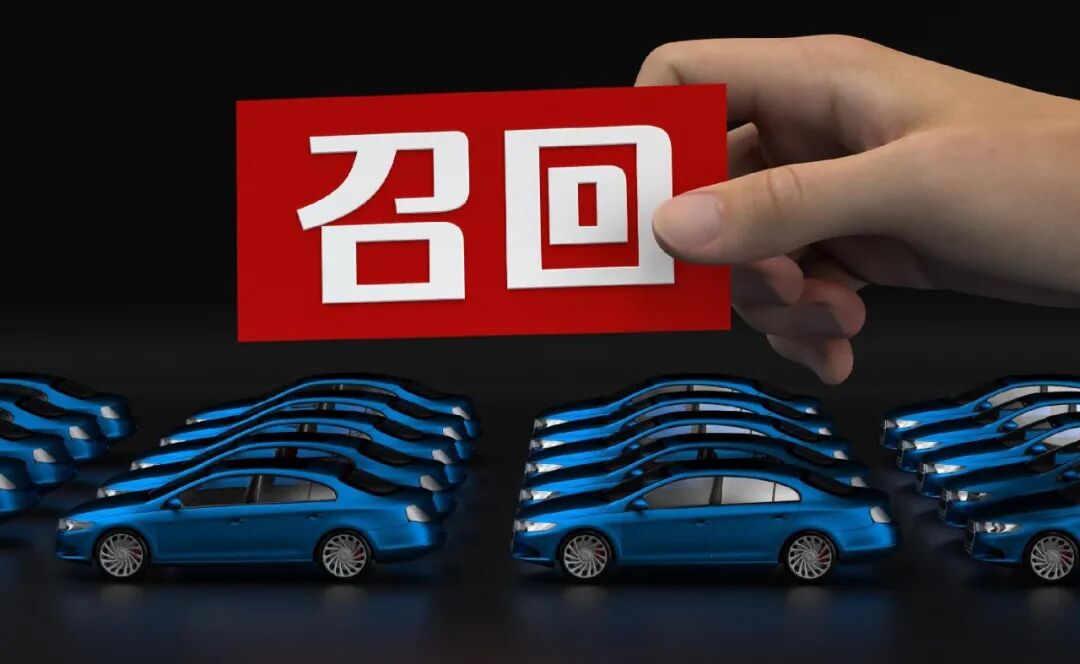
Image source: Internet
This case illustrates that defect investigations must not only identify exposed failures but also analyze potential risks and devise remediation plans based on the defect mechanism.
Software can aid vehicles in identifying anomalies, but if the root cause of the defect lies in the consistency of the power battery pack, a software upgrade alone cannot be deemed as having eliminated the defect. A recall does not terminate with the announcement.
Companies must notify vehicle owners, organize repairs or replacements, and submit related reports in accordance with the filed recall plan; regulatory authorities will also oversee the implementation of the recall and evaluate the effectiveness of defect elimination.
Even after the recall plan is completed, if any defective vehicles remain unrecalled, the company must persist with the recall process.
03 Why Are Recalls Still Imperative When Software Upgrades Can Resolve Issues?
The escalating software capabilities of intelligent vehicles have transformed the manifestation of defects and how companies address them.
Some defects in traditional vehicles necessitate part replacements or adjustments in manufacturing processes. For issues related to software control, companies may update control logic, rectify programming errors, or incorporate fault detection functions via OTA updates.
However, it must be emphasized that OTA is a technical means, while a recall is a mechanism for addressing product defects; the two cannot be amalgamated.
If a software issue constitutes a product defect under the regulations, companies must still fulfill their recall obligations in accordance with the law. The capability to perform remote upgrades does not signify that the recall process can be circumvented; similarly, an OTA upgrade does not necessarily indicate that a product recall has transpired.
In 2025, China implemented 13 automotive recalls via OTA, involving 1.756 million vehicles and accounting for 25.7% of the total recalls for the year. During the same period, companies reported 1,904 OTA upgrades, involving 140 million vehicle instances.
The initial set of data counts recalls implemented via OTA, while the subsequent set counts OTA upgrade activities reported by companies. The two should not be regarded as the same type of event.
However, viewing these two sets of data collectively demonstrates that OTA has become extensively integrated into the ongoing maintenance of automotive products, but regular functional updates still need to be distinguished from safety defect rectifications.
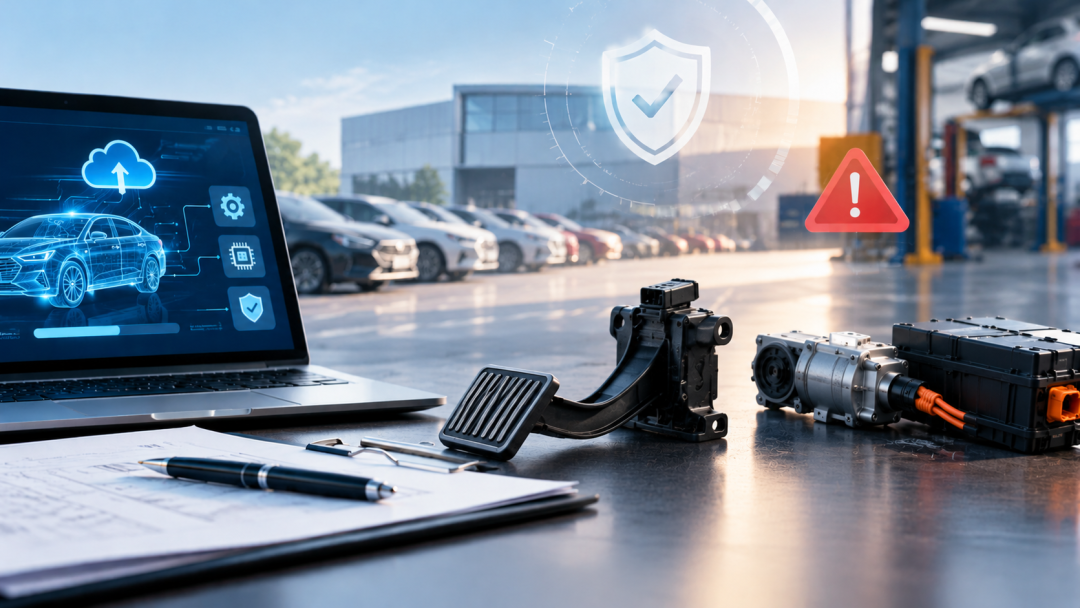
Image source: Frontiers of Intelligent Driving
The automotive defect clue data from the same year also provides an observation angle directly related to intelligent driving.
Information released by the State Administration for Market Regulation shows that in 2025, 31,000 reports of defect clues in automotive products were submitted by consumers, with issues related to driving assistance systems accounting for 3.2%.
This set of data warrants attention but requires accurate interpretation. Defect clues submitted by consumers are one of the sources regulatory authorities use to identify potential issues, but they do not represent confirmed product defects, nor can they be directly converted into failure or accident rates for driving assistance systems.
However, at the very least, it indicates that driving assistance systems have entered the scope of monitoring for automotive product defect clues, and related issues necessitate further investigation and technical analysis. For intelligent driving systems, this distinction is actually very significant.
Suppose a driving assistance function has a control logic defect in a specific scenario. The company needs to identify which vehicle models, hardware configurations, and software versions are affected, verify whether the remediation plan covers the problematic scenarios, and assess whether new risks are introduced after the upgrade.
If the defect involves hardware or cannot be fully resolved through a software upgrade to eliminate safety hazards, the company must take other necessary measures.
This also implies that automotive companies' quality traceability systems must extend from traditional component batch management to software and hardware version and functional state management.
Only by accurately identifying affected vehicles and verifying the effectiveness of remediation measures can companies complete the closed loop from defect discovery to risk elimination.
04 What Can Be Inferred About an Automaker from a Single Recall?
For companies, the most direct impact of a recall is cost.
Companies must bear the expenses for eliminating defects and necessary transportation costs, as well as invest research and development, quality, after-sales, and supply chain resources to complete failure analysis, component replacement, software development, user notification, and subsequent verification.
If a large number of vehicles are affected, pressure will arise in terms of maintenance capacity, component supply, and service network coordination.
Recalls may also influence user trust in the brand, but this impact is not inevitable, nor can a company's market performance be inferred solely based on the number of recalls.
Sometimes, how a company identifies issues, assesses risks, and whether it takes effective measures can better demonstrate its sense of responsibility.
In 2025, automotive recalls implemented in China due to design reasons involved 4.215 million vehicles, accounting for 61.6% of the total recalls for the year; recalls due to manufacturing reasons involved 2.502 million vehicles, accounting for 36.5%. The number of vehicles affected by design-related defects was significantly higher, but this does not directly prove that design defects are more severe than manufacturing defects.
Recall scale is also influenced by factors such as the scope of a single defect's impact, vehicle model sales volume, and investigation results. This set of data cannot be used to simply rank automakers' research and development capabilities or quality levels.

Image source: Internet
Frontiers of Intelligent Driving believes that recalls at least test a company's capabilities in three areas. The first is defect identification capability.
Whether a company can promptly detect anomalies and identify potential common issues through complaints, after-sales data, and vehicle operation data determines how early risks can be recognized. The second is problem traceability and remediation capability.
Whether a company can accurately determine the affected vehicles and software and hardware versions and find the root cause to devise effective measures determines whether the recall scope is reasonable and whether the remediation truly eliminates risks.
The third is quality closed-loop capability. After a recall, whether a company feeds back issues to product design, manufacturing processes, software development, and verification processes and can prevent the same issues from recurring determines whether the recall can translate into long-term quality improvements.
Therefore, a high number of recalls does not necessarily indicate poor quality management; conversely, a low number of recalls does not directly prove better product quality.
Proactive recalls are a testament to a company's commitment to shouldering responsibility for product safety. However, the gravity of the defect itself cannot be dismissed merely because the recall is initiated proactively.
In the automotive sector, recalls are not just about incurring post-sale expenses or equating to a public relations debacle.
Rather, they serve as a legal mechanism through which companies can pinpoint risks, rectify defects, and embrace oversight when safety concerns surface after a product has been launched in the market.
With the growing complexity of automotive technology, quality management cannot hinge solely on pre-delivery inspections. Once vehicles are deployed in real-world conditions, companies must persistently gather clues about potential issues, carry out technical analyses, and implement prompt corrective actions when defects are verified.
A recall truly assesses a company's ability not just to repair vehicles but also to discern risks, trace their origins, eradicate defects, and transform these challenges into enhancements for subsequent rounds of product development and validation. #AutomotiveRecalls
-
![]()
BYD Takes the Lead, Li Auto Lags Behind: Are Joint Ventures Making a Comeback? September’s New Energy Vehicle Sales Data Reveals Stark Divisions
-
![]()
New Forces Top Annual List, Tesla Holds Three-Year Reign! September's Pure Electric Model Resale Value Rates: A Tale of Contrasts
-
![]()
Lei Jun’s Bold Claim Proven: Xiaomi Tops Resale Value Charts, with NIO and Li Auto Close Behind!
-
![]()
Has Zunjie 'Stumbled', Paving the Way for Xiaomi's Success?
-
![]()
Before Launch: How Does a Chinese Rocket Stand or Lie?
-
![]()
Zunjie V800 Brake Bracket Fracture: With the Same 40% Glass Fiber-Reinforced Plastic, Where Does the Disparity Arise?
-
![]()
Why Does Your Phone Slow Down After Long-Term Use?
-
![]()
The Comprehensive Guide to Tariffs on Chinese Automobile Exports: A Stark Contrast to Japan