"Not Participating in the Paris Auto Show Means No Car Sales"
 10/12 2026
 541
541
Lead
Introduction
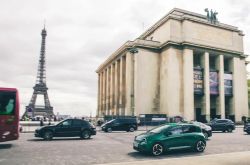
With the participation of over 20 Chinese brands, doubling that of the previous edition, the Paris Auto Show increasingly resembles a European stronghold for Chinese automobiles and serves as a crucial indicator for European cars.
"Not participating in the Paris Auto Show means no car sales."
On the eve of the media day at the Paris Auto Show on October 12, François Roudier, Secretary-General of the International Organization of Motor Vehicle Manufacturers (OICA), made a striking remark.
"For many years, consumers came to buy cars; now, automakers strive to sell cars," Roudier explained the shift from a seller's market to a buyer's market, adding that automakers who did not participate had "made a mistake."
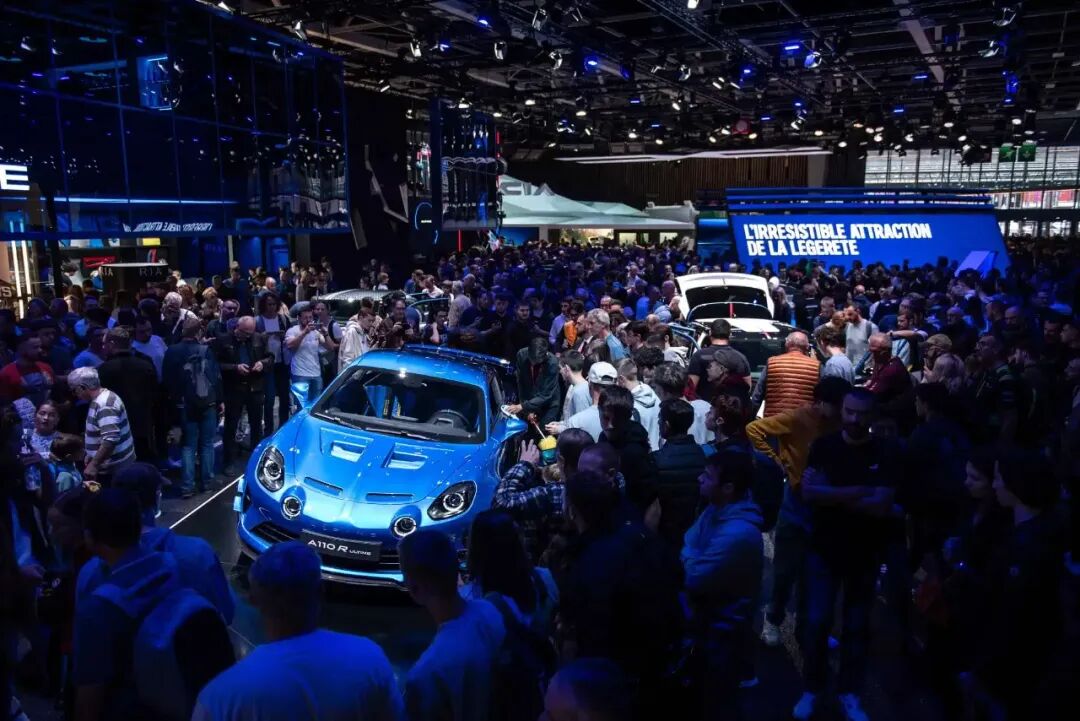
Auto Business News tallied the brands listed on the Paris Auto Show's official website and found that 20 Chinese auto brands will be featured at next week's event, double the number from 2024. Including sub-brands and acquired foreign brands, the count could reach 22.
However, a closer look at Roudier's statement reveals a double meaning. While the primary implication is that European automakers will struggle to sell cars without participating, it also subtly suggests to Chinese automakers, "You should participate more to seize the opportunity to enter Europe."
After nearly a decade of claims that "auto shows are dead" and "global auto shows have become regional," why is the Paris Auto Show gaining momentum again?
In fact, international auto shows like the Paris Auto Show are regaining vitality because they increasingly serve as a European hub for Chinese automobiles and a critical testing ground for European cars.
01 Europe: Imposing Tariffs While Embracing China
As Roudier noted, after some traditional European automakers showed diminished interest, the arrival of Chinese brands helped revitalize the auto show.
He stated that the high participation rate at the Paris Auto Show reflects the growing pressure on automakers from both sides to compete for buyers in an increasingly crowded market.
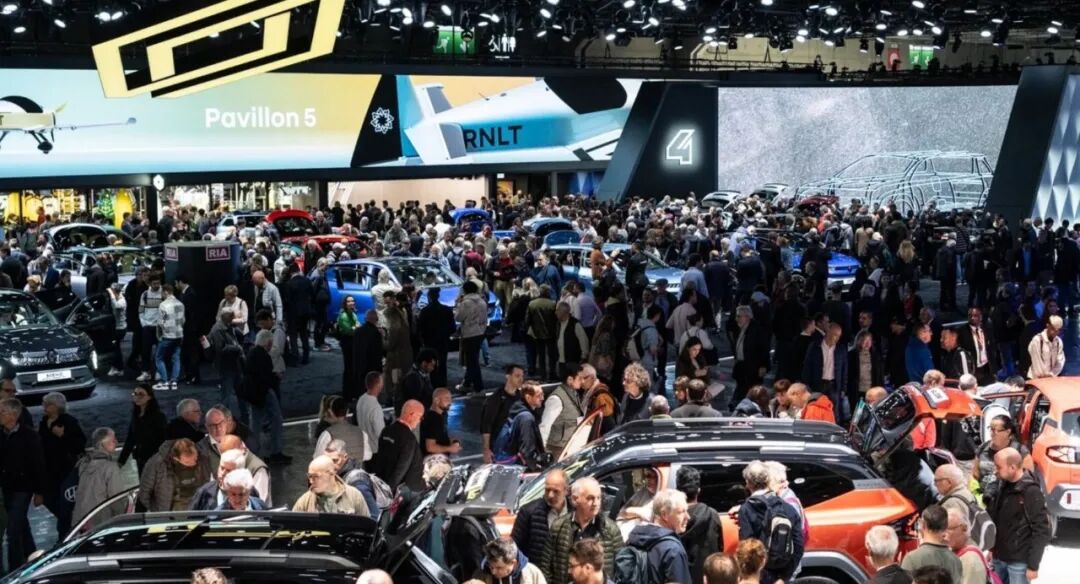
Half of the "popularity" of the Paris Auto Show can be attributed to Chinese automakers. The Paris Auto Show's official website is more direct: out of 65 vehicle and supplier booths, 20 are controlled by Chinese brands and Chinese capital. Geely alone occupies five halls.
Even major European auto shows are relying on China. This brings up a series of "double-edged sword" figures—Chinese car sales in Europe have not only revitalized the European market but also posed a significant threat to European domestic companies.
As the birthplace of automobiles, Europe was once a "pilgrimage" site for the Chinese auto industry. At the inception of China's contemporary auto industry, it relied heavily on the practical guidance of Volkswagen's joint ventures with FAW and SAIC.
However, the former students are now beginning to conquer territory in their former teachers' backyard.
In 2025, Chinese brand passenger cars will account for approximately 6% of the European market share. From January to August this year, SAIC's MG and BYD led the charge in "China's sweep of Europe," with cumulative sales of 913,703 vehicles, doubling year-on-year and capturing a 9.9% market share. In August alone, the monthly market share reached as high as 12%.
UBS's latest assessment suggests that if the current pace continues, Chinese brands' annualized market share in Europe could reach around 20% this year.
What kind of achievement is this?
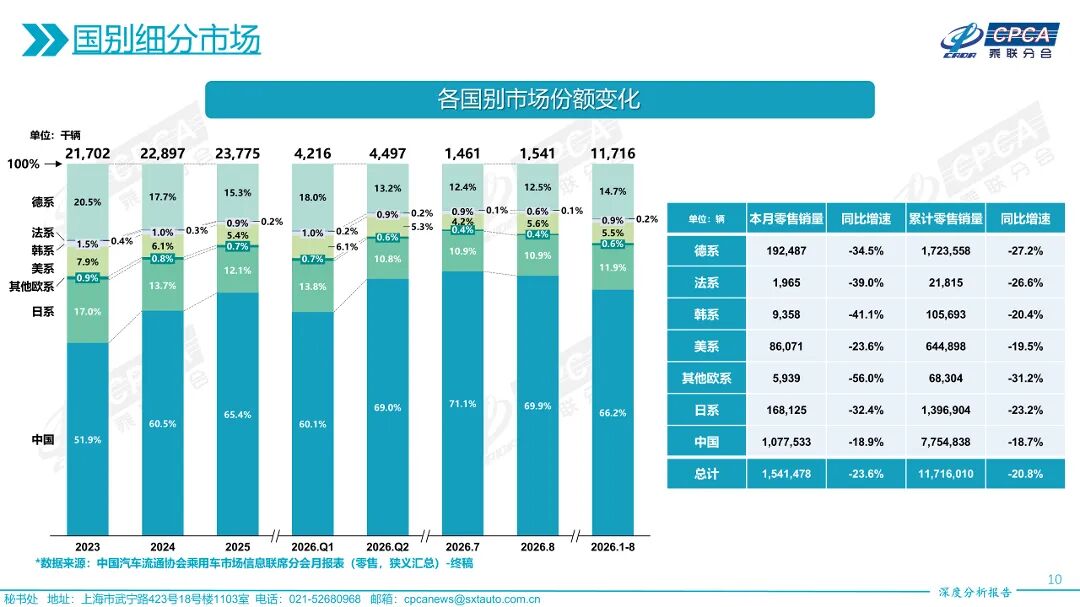
Auto Business News compiled market share levels for domestic and foreign auto brands:
- In July and August 2026, German cars accounted for 12.4% and 12.5% of China's passenger car market, respectively, equivalent to the market share level of Chinese cars in Europe in August;
- In 2020, German and Japanese cars accounted for 20.5% and 17.0% of the Chinese market, respectively. UBS predicts that Chinese cars will reach a 20% market share in Europe this year, the same level as German cars in China six years ago;
- Japanese cars, which entered Europe in the 1970s, are now being surpassed by Chinese cars. This year, in May, Japanese brands held an 11.32% share, while Chinese brands held a 12.01% share.
No wonder Europe began to defend itself two years ago.
At that time, the European Commission imposed tariffs on Chinese electric vehicles. Chinese automakers responded by expanding their internal combustion engine and plug-in hybrid offerings. Now, Europe is considering imposing tariffs on plug-in hybrids as well. The EU is also promoting "Made in Europe," requiring electric vehicles to meet local content standards to qualify for subsidies and government contracts.
On the other hand, European automakers cannot do without Chinese partners. Stellantis strengthened its cooperation with Dongfeng in Europe, utilizing idle factory capacity and adopting Chinese electric vehicle technology to buy itself time. Pedro Pacheco from Gartner said, "The Europeans are playing a double game."
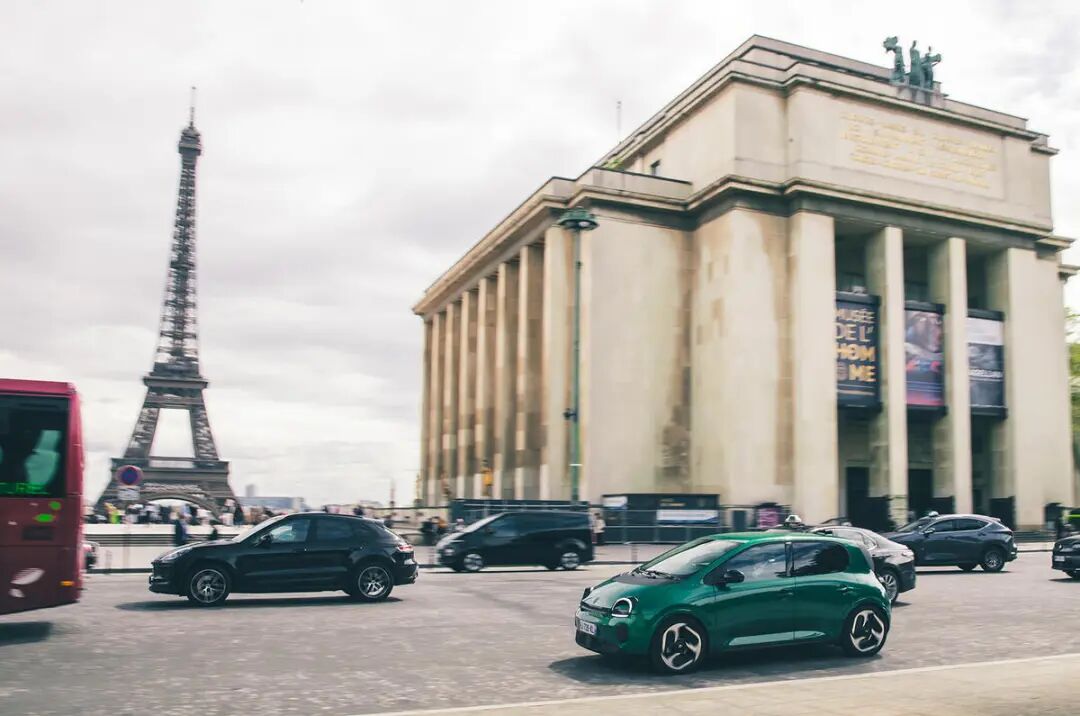
And indeed, it is a double game. Chinese cars have become formidable in electrification, and Europeans want to both block and learn from them. At the Paris Auto Show, Stellantis revived the Citroën 2CV and introduced an affordable electric vehicle concept car, essentially paving the way for "rules for making affordable EVs in Europe."
02 Who Says "Auto Shows Are Dead"?
Roudier's statement that "not participating in the Paris Auto Show means no car sales" is not just a scare tactic when considering European automakers' financials.
The Paris Auto Show comes at an inopportune time. After the pandemic, European cars are no longer selling well in China. Chinese cars, unable to enter the U.S. market and facing intense domestic competition, have no choice but to turn to Europe.
Brad Kunz, a partner at Grant Thornton Stax, put it bluntly: "The Chinese say, 'We must strive to dominate Europe because we can't do anything in the U.S.' If the U.S. allowed Chinese automakers to enter, Europe would not be such a fierce battleground."
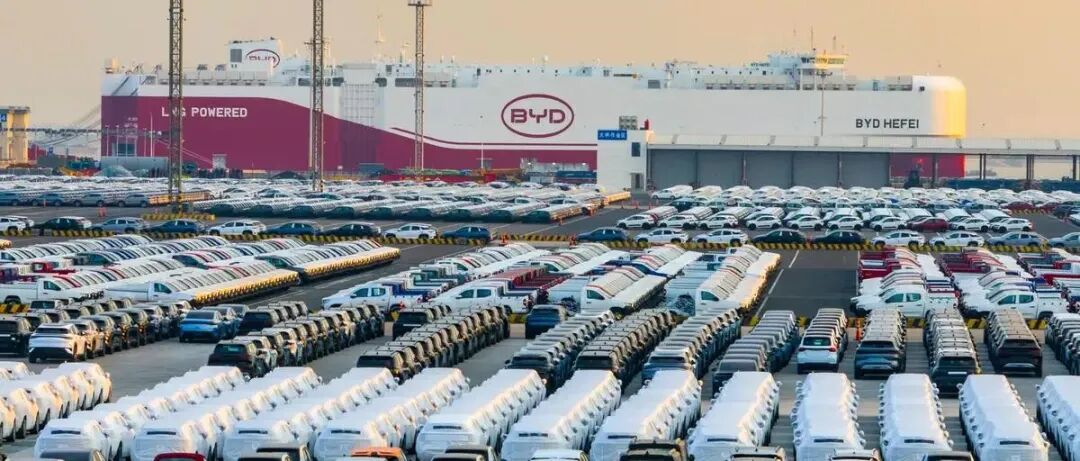
Pressure has mounted on European automotive giants.
Volkswagen Group plans to cut 50,000 jobs by 2030, reduce its global annual production target from 12 million to 9 million vehicles, and halt production at its "transparent factory" in Dresden by the end of 2025, marking the first closure of a domestic vehicle factory in 88 years. In 2025, Volkswagen's operating profit was €8.9 billion, down 53% year-on-year, and fell a further 14.3% in the first quarter of 2026.
Volkswagen's equity method earnings from its joint ventures in China, which accounts for one-third of its global market, have fallen by two-thirds from 2023 to 2025.
BMW issued a profit warning in June 2026, lowering its full-year automotive business EBIT margin forecast from 4%-6% to 1%-3%. Its stock price plummeted more than 11% that day, reaching a five-year low. This marked BMW's third consecutive year of issuing profit warnings.
BMW also became the only brand to officially announce its participation and then "backtrack," with both BMW and Mini not attending.
Stellantis's European region reported a €94 million loss in the second quarter, with an adjusted operating margin of -0.6%. Its European business accumulated a €86 million loss in the first half of the year, with sustained pricing pressure in the French, Italian, and German markets.
Weak European demand, U.S. tariffs, the costly transition to electrification, and Chinese cars blocking the way have made the Paris Auto Show a "home turf defense battle" for Europeans. Analyst Felipe Muñoz said, "This could be the most important auto show in the region since the pandemic. Europeans are using this platform to show the Chinese that they are still strong."
But strength is not just about making declarations. The complete logic behind Roudier's statement is that in a buyer's market, manufacturers must actively reach out to consumers to let them see, touch, and test their products. Not participating means not promoting, and not promoting means not selling.
The role of auto shows in the sales funnel is supported by data.
A 2026 survey by the New York International Auto Show revealed that 80% of attendees said the show influenced their car-buying decisions, 38% planned to purchase or lease a vehicle within 12 months, 42% added one or more brands to their consideration list at the show, and 92% of those with purchase intentions completed a purchase within the following year.
A tracking survey by the Canadian International Auto Show was even more direct: out of 100 attendees, 37 said they would purchase a vehicle within 12 months. An 11-month follow-up revealed that 27 had completed their purchase, and when combined with those about to buy, over 80% of purchase intentions were converted into actual purchases.
Auto show attendees are not casual visitors but active buyers in the final stages of their car-buying decision-making process. Giving up on the Paris Auto Show means forgoing the most concentrated opportunity to reach consumers in the European domestic market.
The cost of not attending is not just about selling fewer cars. The Paris Auto Show is one of the industry events with the highest media attention in Europe.
After BMW's withdrawal, Bloomberg attributed it to the new CEO's comprehensive cost-cutting plan following the profit warning, which was interpreted by the outside world as "BMW can no longer afford to participate in Europe's most important auto show." This perception does far more damage to the brand than the cost of the booth itself.
Of course, auto shows are just the starting point. Whether cars sell or not depends on the product, pricing, and distribution channels. But "not participating" means not even taking the first step. That is the true weight of Roudier's statement.
03 Must Chinese Automakers Participate in International Auto Shows?
The influx of Chinese automobile companies at the Paris Auto Show is inseparable from the strong momentum of Chinese cars in the French market.
In 2025, Chinese brands accounted for 3.4% of the French market with 22,227 vehicles; in the first half of 2026, this rose to 4.8% with 41,051 vehicles; in September, it doubled to 8%. MG France sold 35,108 vehicles in 2025, up 36.2%, ranking 14th; BYD sold 13,935 vehicles in France in the first half of the year, a surge of 136%.
Among the Chinese brands participating in the Paris Auto Show, some have already established themselves locally, while others have ambitious plans.
BYD Group, with strong sales, will showcase its BYD brand and Denza, Fangchengbao in Hall 6 and Hall 5.3, respectively. However, SAIC's MG will be absent. Geely's brands are spread across five halls: Geely in Hall 7.1, Lynk & Co in Hall 5.1, Lotus in Hall 6, Smart in Hall 5.3, and Volvo and Zeekr in Hall 5.2.
Among the brands planning to enter the French market, Seres's AITO will use Paris as its outpost, with the AITO 6, 7, 8, and 9 all making their debut at the show. Changan's Avatr, Qiyuan, and Shenlan are also participating. Chery will showcase the Tiggo new energy vehicle and Omoda 4. GAC Motor has announced deep localization in Europe. NIO will bring the revised Mega Home and i9. XPENG will display the G9L.
So, the question arises: Must Chinese automakers participate in international auto shows when going abroad?
The answer depends on the stage of development the automaker is in.
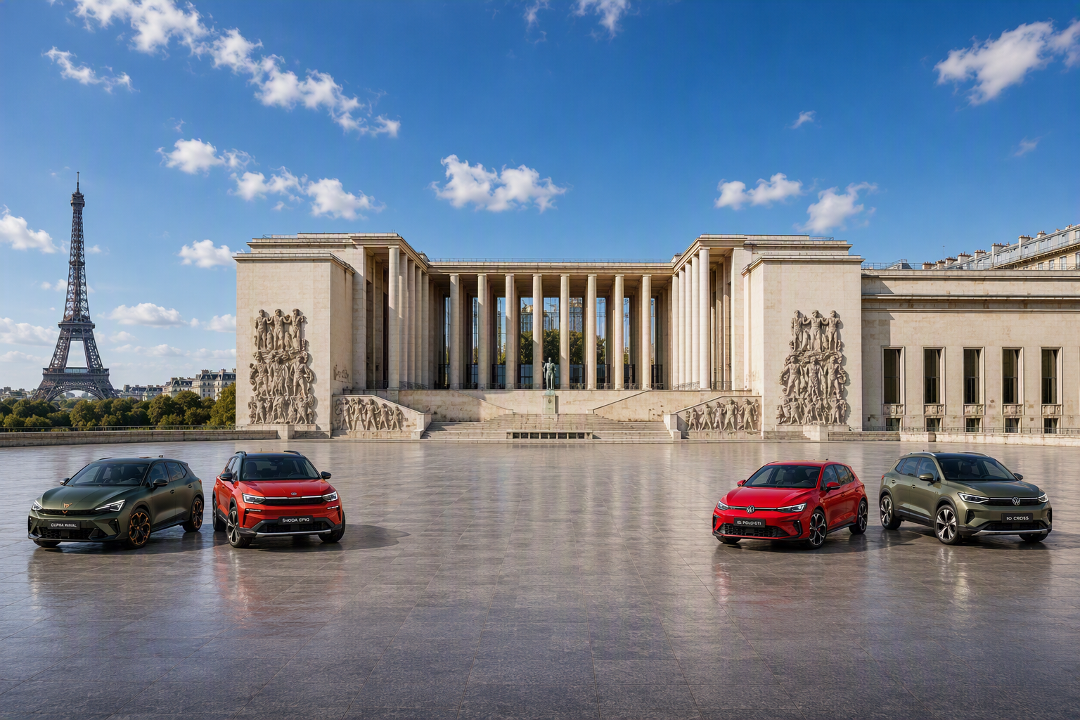
For brands just entering Europe or preparing to officially announce their entry—AITO, NIO, GAC Aion—auto shows are an irreplaceable starting point.
GAC plans to have Magna Steyr assemble the Aion V and Aion UT at its Austrian factory, aiming for full coverage of Europe by 2028. Such deep localization requires media attention, dealer confidence, and consumer awareness to be launched simultaneously, and auto shows accomplish all three at once. NIO's European debut of the revised Mega Home and i9 is a statement of product strength to Europe.
For brands with an established market presence, the value of auto shows shifts from "pioneering" to "deepening."
BYD, which already has a significant dealer network in Europe, participates in auto shows primarily to launch major new models and reinforce its brand image. BYD's Paris debut of the Shark plug-in hybrid pickup, with a 90-kilometer electric range and 2.5-ton towing capacity, precisely targets pickup truck enthusiasts.
MG's absence is another note.
In the first nine months of this year, MG sold over 280,000 vehicles in Europe, up 23% year-on-year, securing its position as the top-selling Chinese brand in Europe for the 11th consecutive year.
French media outlet Downshift mentioned MG's absence as "notable," but MG believes that after establishing sufficiently deep channels and brand recognition in Europe, the marginal benefits of auto shows diminish. As the Chinese brand with the deepest roots in Europe and the first to surpass one million sales, MG has the confidence to make this choice.
An often-overlooked dimension: International auto shows are not just venues for selling cars but also platforms for the global expansion of the supply chain.
At the 2025 Munich Auto Show, 116 Chinese exhibitors participated, including not only 11 vehicle manufacturers but also a large number of battery, electric drive, smart cockpit, and autonomous driving supply chain companies. Participating in international auto shows alongside vehicle brands is a crucial window to reach European automaker clients and establish cooperative relationships.
As Toyota's President, Akio Toyoda, remarked during his visit to China, ultimately, the focus should be on customer needs. Customers are seeking more satisfying and cost-effective products, which necessitates the discovery of component suppliers that are both more competitive and possess stronger design capabilities.
For Chinese supply chain companies to become the "preferred choice" for European automakers, it is crucial for them to allow European customers to see, touch, and validate their products firsthand. International auto shows offer the perfect platform for this.
Perhaps, in this cycle, complaints and dismissive comments about "auto shows being dull and insignificant" will gradually lose their relevance. After all, the stage on which Chinese automobiles now perform has undergone a monumental transformation—so busy are they earning money abroad, who has the leisure to complain?
Editor-in-Chief: Du Yuxin Editor: He Zengrong

THE END
-
![]()
"Not Participating in the Paris Auto Show Means No Car Sales"
-
![]()
BYD Takes the Lead, Li Auto Lags Behind: Are Joint Ventures Making a Comeback? September’s New Energy Vehicle Sales Data Reveals Stark Divisions
-
![]()
New Forces Top Annual List, Tesla Holds Three-Year Reign! September's Pure Electric Model Resale Value Rates: A Tale of Contrasts
-
![]()
Lei Jun’s Bold Claim Proven: Xiaomi Tops Resale Value Charts, with NIO and Li Auto Close Behind!
-
![]()
Has Zunjie 'Stumbled', Paving the Way for Xiaomi's Success?
-
![]()
Before Launch: How Does a Chinese Rocket Stand or Lie?
-
![]()
Zunjie V800 Brake Bracket Fracture: With the Same 40% Glass Fiber-Reinforced Plastic, Where Does the Disparity Arise?
-
![]()
Why Does Your Phone Slow Down After Long-Term Use?