Farewell to 'Bragging in the Name of Technology'
 10/12 2026
 401
401
Lead
Introduction
The essence of the strictest-ever innovation controls is that the automotive industry's misuse of technology claims has finally been halted.
'Hidden door handles are finally done for!'
'Zero-gravity seats are no longer a bragging point!'
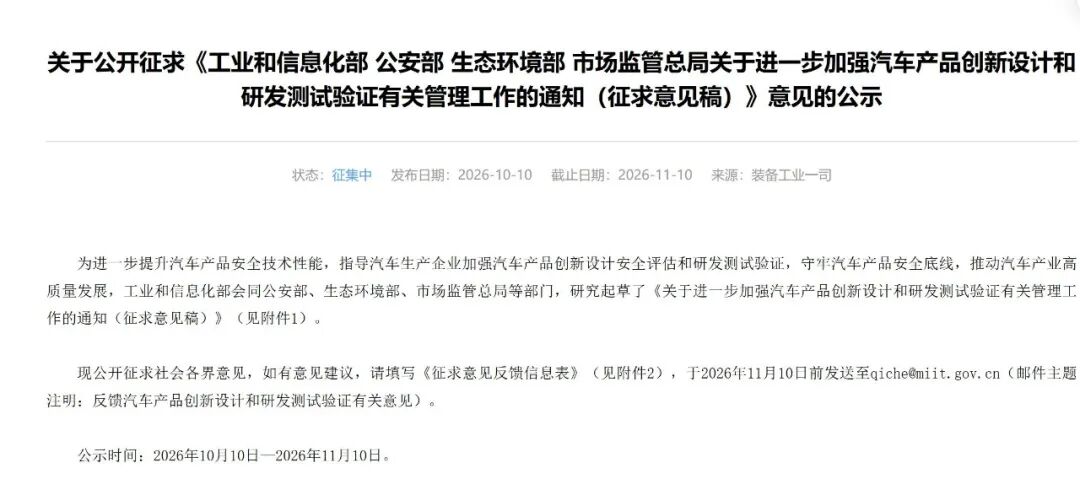
On October 10, 2026, the MIIT and three other departments jointly released a draft for comments on the management of innovative automotive product design, sparking a major uproar.
On social media, some called it 'the strictest-ever innovation controls,' while others joked that product managers were digging out old half-steering wheel and hidden door handle designs for a redo.
But from the perspective of the Automobile Commune, the significance of this document runs far deeper than a few visible prohibitions.
It truly touches on a fundamental issue obscured by rapid growth: as cars become more like consumer electronics and 'technology' becomes the loudest selling point, have we forgotten what a car is first and foremost?
The core labels of the automotive industry, honed over more than a century, can be summed up in three words: reliable, safe, and dependable. This is not conservatism but an industry consensus forged through countless accidents, recalls, and painful lessons.
However, in the past few years, swept up in the wave of intelligence, these three words have been replaced by 'iteration speed,' 'feature density,' and 'user experience.'
The geek mindset—a technical fervor that pursues extremes, breaks boundaries, and acts first before considering consequences—has spread from the internet industry to the automotive sector, bringing thrilling innovations but also unsettling risks.
If left unchecked and boundary-less, allowing geek extremism to dominate car manufacturing, the consequences are manifold: increased daily malfunctions, more accidents, losses to life and property, and, more profoundly, a shift in public sentiment toward technology from 'over-reliance' to 'aversion.'
Over-reliance and aversion, though seemingly opposite extremes, are two sides of the same coin—both treat technology as a religion or a devil, not as a tool. This is detrimental to the automotive industry's development and the integration of technology into cars in the long run.
This draft for comments seeks to recalibrate the industry's direction at this critical juncture.
01 The Pitfalls of 'Innovation' Are All Written into the Document
The draft's appendix lists 51 technical parameters, with items 1 to 41 targeting innovative designs and 42 to 51 focusing on R&D testing and verification. This is not merely a compliance checklist but more akin to an 'industry pitfall record.'
The Automobile Commune categorized them and found that most of the new features and heavily marketed objects championed by car companies in recent years have been 'called out.'
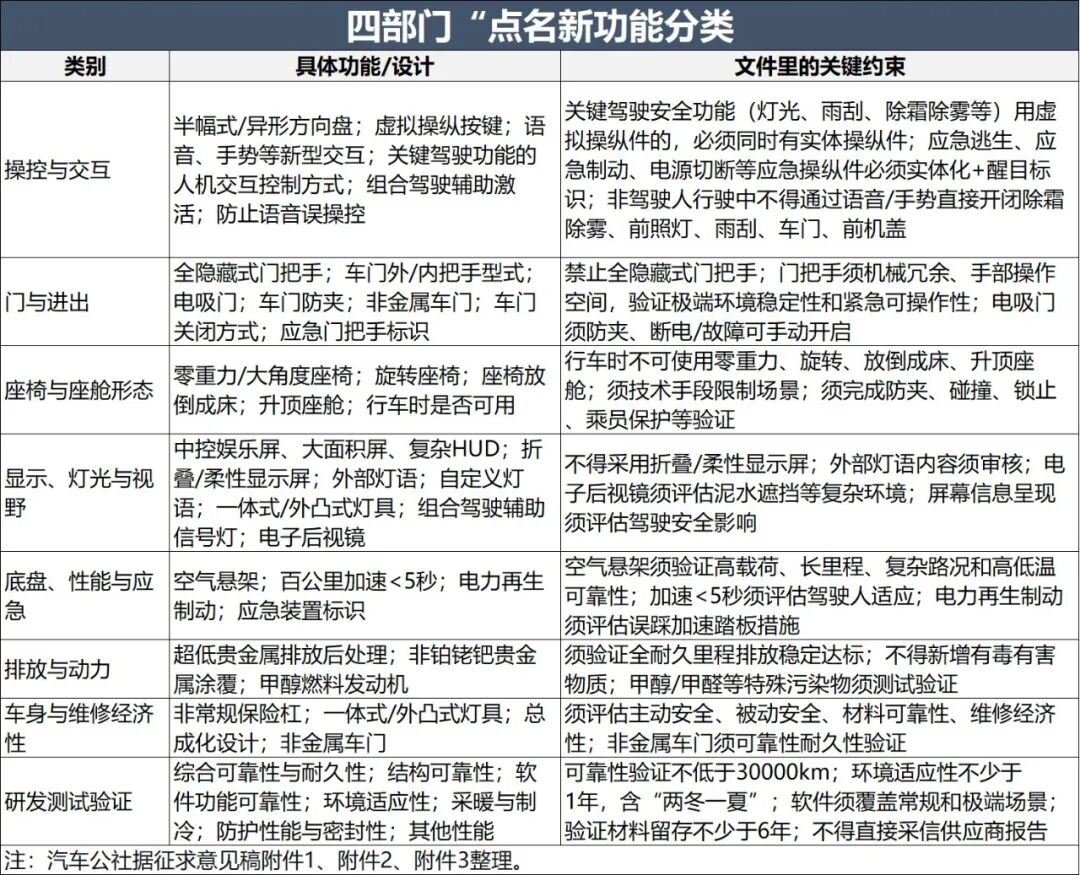
Hidden door handles top the list. The document explicitly states, 'Fully hidden door handles are prohibited' and requires 'mechanical redundancy design and hand-operation space.'
Such strong wording is rare in the document. Why? Because the cost has already been paid in lives.
In 2025, on Chengdu's Tianfu Avenue, a Xiaomi SU7 crashed and caught fire. Multiple bystanders attempted to rescue the occupants but could not open the doors from the outside. Firefighters eventually had to cut them open with electric saws, but there were casualties.
Finally, on August 21, 2026, nine automakers filed recalls on the same day, primarily due to issues related to hidden door handles, totaling over 4.27 million vehicles, including 2.976 million Teslas and 390,000 Xiaomis.
Crash tests by institutions show that models with electronic door handles have only a 67% success rate in door ejection after side collisions, compared to 98% for mechanical handles. Viewed together, who dares say 'aesthetics' matter more than 'being able to open the door'?
Now, seats. The document requires that 'zero-gravity seats, rotating seats, or seats that recline into beds must not be used while driving' and must pass 'technical means to restrict usage scenarios.'
Note, this is not about reminders in user manuals or warnings on the infotainment system but about technical restrictions. The implication is clear: stop shifting responsibility with 'please pay attention, drivers.'
Over the past year, the Automobile Commune has interacted with some automakers and parts suppliers and found that 'enabling zero-gravity seats to be used while driving through pre-tensioning and rapid adjustment mechanisms' has become a new selling point. However, without a mature regulatory framework and technical standards in place, this may be why a blanket ban was imposed this time.
Then there's the pop-up cabin. The document requires 'anti-pinch safety, collision safety, and wind resistance assessments' and explicitly states that 'the pop-up cabin function must not be used while driving.'
This directly relates to the dramatic marketing battle between Xiaomi Pengcheng and Seres G9 in July 2026. Both nearly simultaneously promoted 'factory-installed roof tents' as a core selling point, with Yu Chengdong's post about the Seres G9's pop-up tent garnering 230,000 likes. However, some automotive reviewers later found that Xiaomi's pop-up design was primarily to increase interior headroom and allow walking inside with a flat floor, with the 'tent' being more of an added bonus.
The center-of-gravity shift, high-speed stability, and occupant protection in a rollover caused by the pop-up cabin—these issues were systematically avoided in the 'outdoor lifestyle' marketing narrative.
If the above are safety hazards at the 'design level,' the brake pedal bracket fracture incident in the Zunjie V800 brings the issue back to the most basic engineering level. Besides insufficient stiffeners and poor angular stress design, the cross-sectional shape suggested possible melt marks and bubbles.
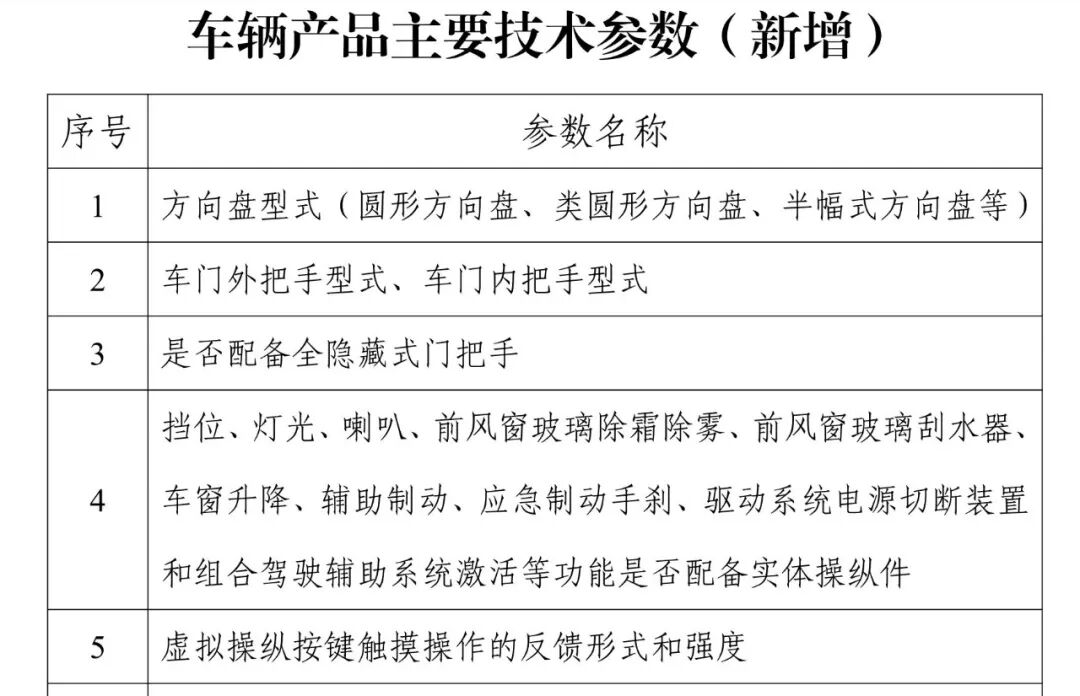
But that's not all. Intelligence is generally seen as the most concentrated expression of automotive technological advancement, with smart cockpits and autonomous driving being the two brightest modules.
This time, driving assistance or autonomous driving systems were called out, requiring compliance with standards such as 'Safety Requirements for Intelligent Connected Vehicles—Combined Driving Assistance Systems' (GB 47955) and 'Safety Requirements for Intelligent Connected Vehicles—Autonomous Driving Systems' (GB 44721), as well as establishing necessary R&D design, testing, and verification capabilities, along with various safety safeguards.
In reality, autonomous driving has already caused casualties and mass recalls. Tesla's AutoPilot was involved in incidents like Joshua Brown in the U.S. and Gao Yaning in China. Xiaomi recalled over 116,000 SU7 Standard Edition vehicles in September 2025 due to insufficient recognition, warning, or handling of extreme scenarios by the L2 highway navigation-assisted driving function.
Viewing these incidents together, the logic of the draft for comments becomes clear: when the iteration speed of innovative designs far exceeds the pace of building verification capabilities, the industry is using consumers' safety as open testing.
02 Strictly Prohibit Treating Industrial Products as Consumer Electronics
Returning to a more fundamental question: Why are so many products 'launched before verification'?
The answer lies in the narrative of China's automotive industry over the past five years.
China's automotive rise is essentially a 'lane-changing overtake.' Pure electrification alone was insufficient—the Nissan Leaf was no slouch in electrification, and the Chevrolet Bolt was once seen as the orthodoxy of automotive electrification. What truly disrupted the industry was Tesla's chemical reaction after combining electrification with intelligence.
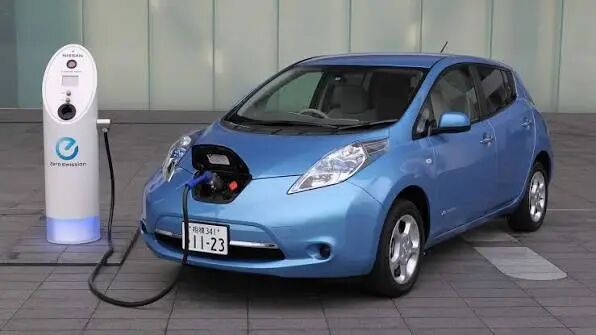
OTA transformed cars from fixed tools at ex-factory (factory exit) into evolvable terminals, while large screens and software ecosystems redefined the cockpit experience. Leveraging the world's strongest smart hardware supply chain and internet talent pool, China's automotive industry amplified this trend to achieve its current market position.
There is no doubt that intelligence is the core driver of this lane-changing overtake. The problem lies in 'overdoing it.'
When intelligence becomes the core competitiveness (competitive edge), the industry's thinking paradigm inevitably becomes deeply influenced by consumer electronics and the internet.
What is the logic of consumer electronics? Rapid iteration, small steps, launch first then optimize, and user feedback-driven improvements. This logic works in the smartphone industry because a crashed phone can simply be restarted, and a flashed app can be updated. But cars have a completely different tolerance for errors—a two-ton metal object traveling at 120 km/h on the highway can turn any 'small bug' into a fatal accident.
The 'gray release' and 'agile development' cultures of the internet industry are eroding the verification bottom line (bottom line) that the automotive industry should uphold.
Industry insiders point out that many automakers have compressed the complete vehicle (vehicle) R&D process, originally taking 3 to 5 years, into just over a year or even less. 'Three highs' (high temperature, high altitude, high cold) extreme testing is only done for promotional materials, full-cycle durability verification is compressed, and excessive reliance is placed on AI simulation instead of real-world road testing.
The old saying 'haste makes waste' accurately summarizes the current car-making logic of some automakers.
More alarmingly, this 'speed' is often accompanied by marketing exaggeration.
Calling 'assisted driving' 'autonomous driving,' packaging 'roof tents' as 'mobile homes,' and promoting half-steering wheels as 'future technology'—marketing rhetoric races ahead of product capabilities, creating a vast gap between consumers' perceptions of innovative features and their actual usage boundaries.
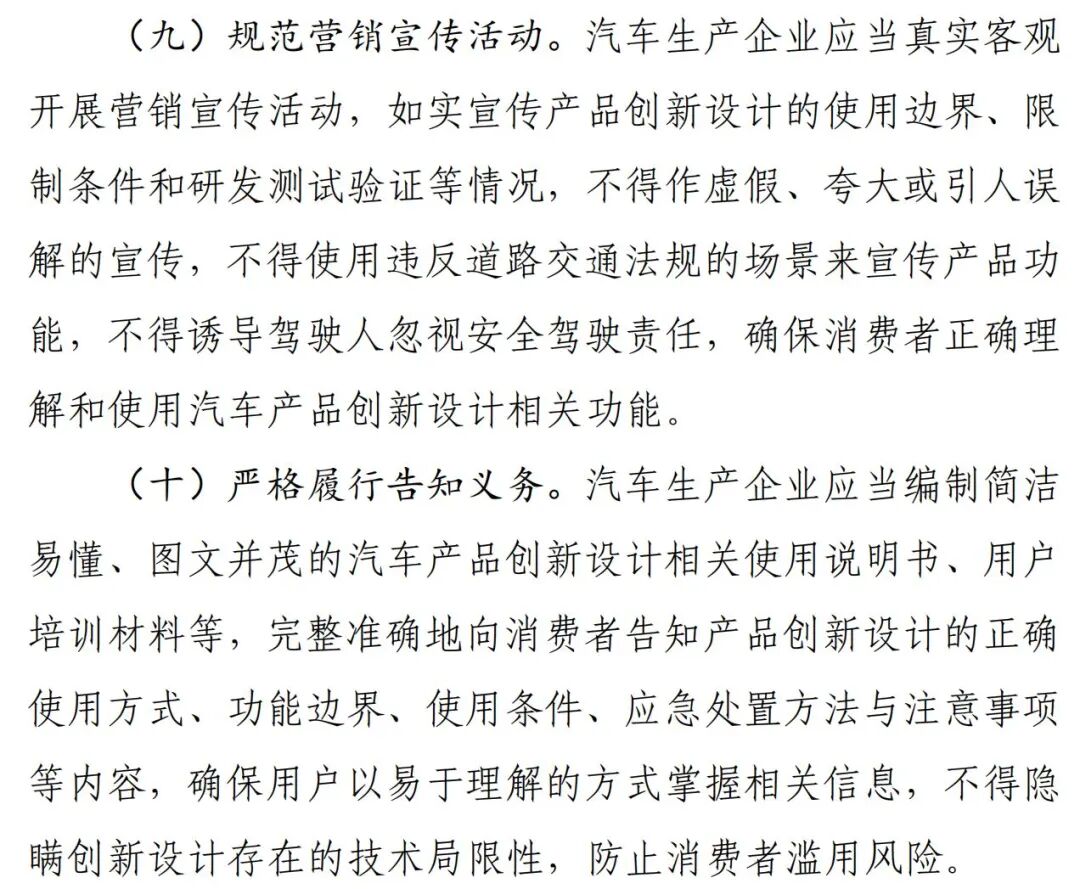
The draft for comments dedicates an entire section to 'standardizing marketing practices' and 'strictly fulfilling disclosure obligations,' requiring 'no false, exaggerated, or misleading publicity (propaganda), and no use of scenarios violating road traffic laws to promote product functions.' This is clearly not without cause.
03 Finding Balance Between Speed and Slowness
An easily overlooked but extremely important institutional design in the draft for comments is the dynamic updating of technical requirements. The document states that the MIIT will 'promptly incorporate software and hardware innovative designs affecting vehicle safety performance into the review and assessment scope based on industrial applications and standard revisions, and dynamically adjust the 'Guidelines for Innovative Design Technologies.''
What does this mean? Regulatory standards need an 'OTA-like evolution mechanism.'
In the past, automotive standard revisions took three to five years, and by the time a standard was issued, the cars on the market were already outdated. But now, technology iterates monthly. If standards still update annually, regulation will never catch up with innovation.
The establishment of a dynamic adjustment mechanism essentially equips the regulatory framework with the ability to evolve in sync with the industry—not a blanket ban on innovation nor a laissez-faire 'act first then discuss,' but a movable boundary between 'allowing trials' and 'upholding bottom lines.'
This reminds one of the line from the 'Dao De Jing': 'Governing a large country is like cooking a small fish.' Managing a vast industry is like frying a small fish—too much heat, and the fish falls apart; too much flipping, and it disintegrates.
China's automotive industry is currently struggling with 'heat control.' Innovation needs to burn, but not so hot that the pot burns through; iteration needs to be fast, but not so fast that safety verification lags.
The draft for comments includes another telling detail: for products already listed in the 'Announcement,' automakers must submit supplementary technical parameters and verification materials by July 1, 2027. Those failing to do so and posing safety risks must 'immediately halt production' and 'proactively initiate recalls.'
This provides a grace period for existing products, but after that, it's a hard landing. This 'new rules for newcomers, transitions for veterans' approach embodies the wisdom of cooking a small fish—not tearing everything down but giving the industry a window for self-correction.
We certainly cannot reject innovation. China's automotive industry rose from follower to leader by daring to explore. But 'daring' does not mean 'reckless,' and 'experimenting' does not mean 'using users as guinea pigs.'
True innovation should involve confidently crossing boundaries after fully understanding risk limits, not charging blindly without knowing where the boundaries lie.
A car's primary attribute is that of an industrial product. It carries not just travel needs but also life safety. The iteration logic of consumer electronics can be draw on (learned from) but not copied wholesale. Screens can be replaced yearly, but brake pedals cannot. Apps can be updated next week, but collision safety verification cannot.
The deeper significance of this draft for comments lies not in banning specific features but in attempting to recalibrate a severely imbalanced scale—one side holds innovation speed and market noise, the other holds safety bottom lines and industrial regularity (laws). Over the past few years, the scale has tilted heavily. Now, it's time to level it out.",
-
![]()
Can JAC Motors Withstand Further Challenges?
-
![]()
NIO Achieves Three Consecutive Quarters of Profitability: Is Li Bin Walking on Air?
-
![]()
FAW Toyota and GAC Toyota Merge: FAW Leads the Exit! What’s the Real Value Behind the FAW-GAC Alliance?
-
![]()
Luxury Electric Cars Falter: Those Who Spent 1 Million Yuan Reconsider the Allure of Fuel Cars
-
![]()
Farewell to 'Bragging in the Name of Technology'
-
![]()
Is Li Auto's L Series Poised to Embrace Pure Electric? Is Range Extension on Its Way Out?
-
![]()
The Price is 30,000 Yuan Lower Than the Pre-sale Price: Who is the Galaxy Warship 700 Targeting?
-
![]()
Energy Storage Revenue Surges 8470%, A 60 Billion Giant Emerges with a New Gamble