September SUV Sales Analysis: Two Toyota Fuel-Powered Models Make It to the Top 10
 10/19 2026
 545
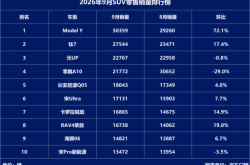
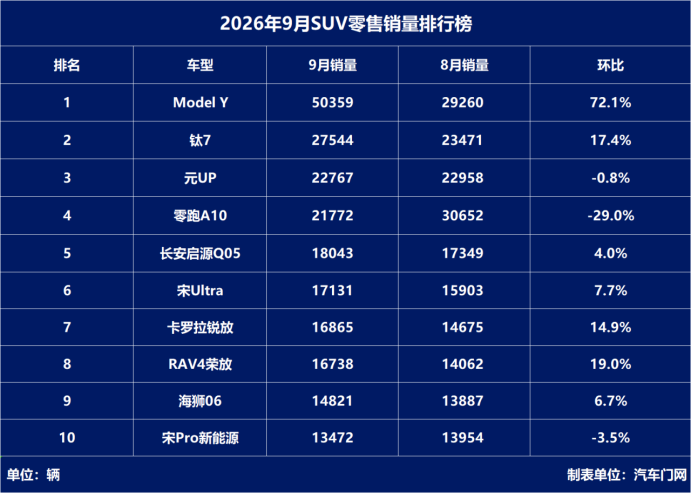
Early in September, numerous automakers rolled out diverse promotional campaigns. Now, with the release of September sales figures, the SUV rankings have been duly updated. New Energy Vehicles (NEVs) continue to dominate the top positions, yet fuel-powered vehicles have not entirely bowed out, still managing to secure spots within the top 10.
Notably, the Model Y emerged as the clear leader, topping the charts with a staggering 50,359 units sold. Its sales volume nearly matched the combined total of the second and third-place models, marking a significant 72.1% month-over-month surge. The Titan 7 showcased robust momentum, climbing to the second spot with 27,544 units sold in September, a 17.4% increase from the previous month, as its market appeal continues to soar. The Yuan UP and Leapmotor A10 ranked third and fourth, respectively, each exceeding 20,000 units in monthly sales. The Changan UNI-K iDD and Song Ultra also delivered steady performances in September, each selling over 17,000 units.
Meanwhile, fuel-powered vehicles such as the Corolla and RAV4 demonstrated resilience, ranking seventh and eighth, respectively, thereby securing a foothold for traditional fuel vehicles amidst the NEV surge. The Haishi 06 and Song Pro NEV successfully entered the lower echelons of the top 10.
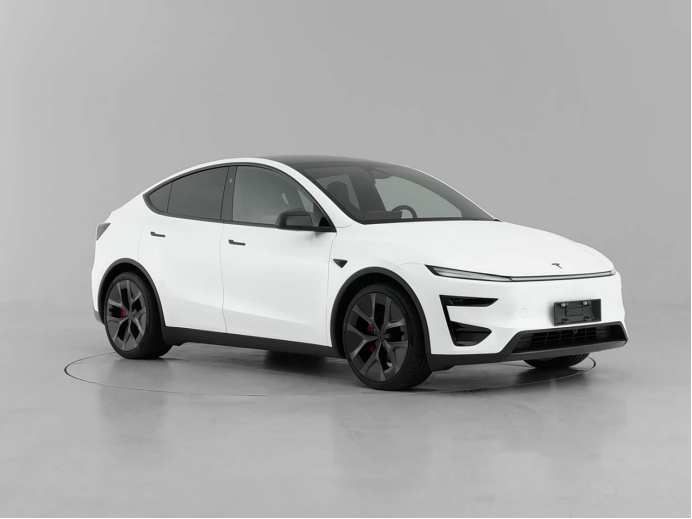
Rank 1: Model Y – 50,359 units
In the September SUV sales rankings, the Model Y stood out with 50,359 units sold, experiencing a remarkable 72.1% month-over-month increase and widening the gap with the second-place model by over 20,000 units.
Its mature battery electric vehicle system and extensive supercharging network significantly alleviate consumer concerns about pure electric travel. Moreover, after years on the market, the brand enjoys high user recognition, with strong resale value in the second-hand market, ranking among the industry's best. Additionally, September's promotional activities further boosted the Model Y's sales.
Rank 2: Titan 7 – 27,544 units
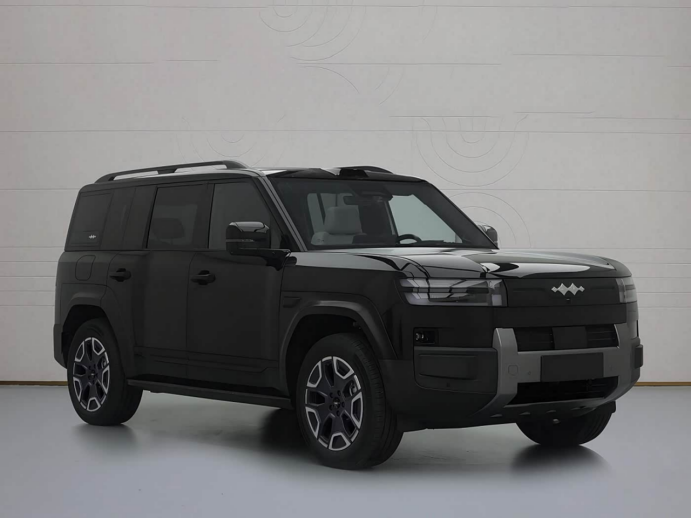
The Titan 7 surged into the top three, ranking second with 27,544 units sold in September. This "boxy" SUV continues to gain traction.
The Titan 7's Fangzheng Hardcore design (square and rugged) offers high recognizability, while BYD's hybrid technology strikes an excellent balance between power output and fuel efficiency. Additionally, its spacious interior provides strong practicality, suitable for both daily family use and light off-road adventures on weekends. Combined with brand endorsement and competitive pricing, the Titan 7 boasts clear overall cost-effectiveness.
Rank 3: Yuan UP – 22,767 units
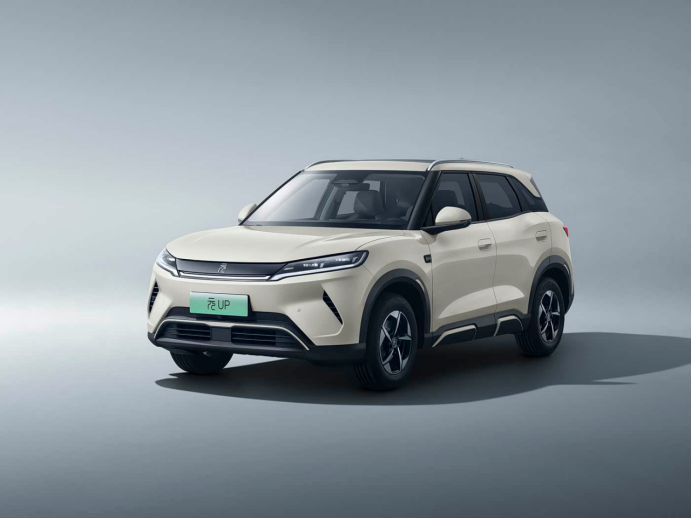
The Yuan UP secured third place in the September SUV rankings with 22,767 units sold, experiencing a slight 0.8% month-over-month decline but maintaining overall stability.
This model achieves a balance between flexibility and space utilization through its short overhang and long wheelbase design, measuring 4,310mm in length with a wheelbase of 2,620mm. Its minimum turning radius of 5.25 meters allows for easy maneuvering in narrow city streets and regular parking spaces. The rear space and expandable trunk (up to 1,320L when the rear seats are folded) also meet daily commuting and short-trip needs.
The newly launched Feichi version in September extended the vehicle's range to 501km, while the limited-time starting price dropped to 69,800 yuan, further enhancing the Yuan UP's cost-effectiveness in the entry-level pure electric market.
Rank 4: Leapmotor A10 – 21,772 units
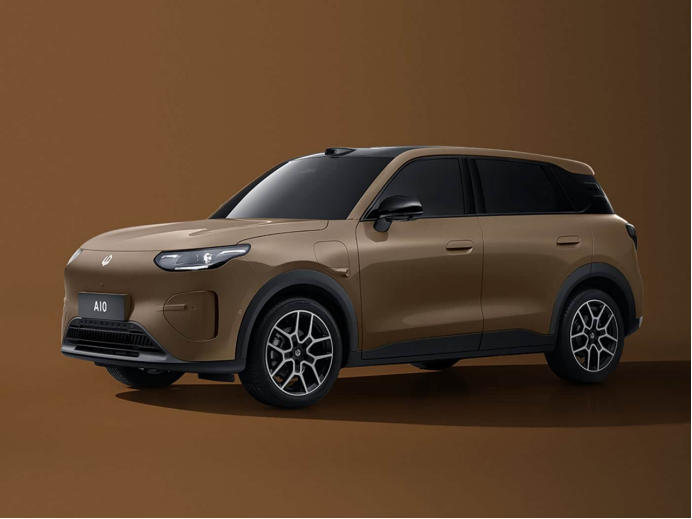
In September, the Leapmotor A10 sold 21,772 units, experiencing a 29% month-over-month decline—the only significant drop among the top 10. Nevertheless, as a domestic newcomer, Leapmotor has made rapid strides in recent years and remains a dark horse in the current auto market.
As the first product from Leapmotor's new A platform, the A10 brings features like LiDAR, point-to-point navigation-assisted driving, dual flagship chips (Qualcomm 8295+8650), a 505km long range, oil-cooled electric drive, an 88.1% space utilization rate, and versatile interior space to the pure electric SUV market under 100,000 yuan. Its exterior design and interior craftsmanship are also highly commendable.
While these features are not groundbreaking individually, the challenge lies in Leapmotor offering them all together in a pure electric SUV priced under 100,000 yuan.
Rank 5: Changan UNI-K iDD – 18,043 units
The Changan UNI-K iDD sold 18,043 units in September, up 4% month-over-month, and has topped the compact SUV sales rankings for six consecutive months.
The UNI-K iDD's popularity stems from its cost-effectiveness and product strength. Its 2,735mm wheelbase provides ample rear-seat space, while the standard CATL battery cells ensure range stability. The 15-minute fast-charging capability (30%-80%) meets daily energy replenishment needs. Coupled with a starting price of 79,900 yuan, it presents strong competitiveness in the 100,000 yuan pure electric family market.
In Conclusion:
Overall, NEVs remain the dominant force in market sales, but traditional fuel-powered vehicles have not completely bowed out amidst the NEV surge. Leveraging their long-established user reputation and low entry barriers, they continue to hold their ground in niche markets.
In the September SUV rankings, the Model Y in the premium segment established a clear lead with over 50,000 units sold. The 100,000 yuan segment sees fierce competition, with models from Leapmotor, Changan, and BYD vying for users through configurations, space, and pricing. While fuel-powered vehicles' market share continues to shrink, established models like the RAV4 and Corolla retain a loyal consumer base due to their reliable reputation.
With "Golden September" behind us and "Silver October" underway, followed by marketing events like Singles' Day and Double 12, automakers are likely to roll out various promotions, leaving room for potential ranking changes. As models continue to iterate and price wars intensify, competition in the SUV segment will further escalate. To maintain sales positions, automakers must continue to enhance product strength, pricing strategies, and delivery capabilities.
(Images sourced from the internet; removal upon infringement notice)
-
![]()
【Intelligentization】Li Auto’s Chip Subsidiary Secures RMB 1.625 Billion in First-Round Financing
-
![]()
Weekly Stock Review | Chinese Automakers Shine at Paris Auto Show, Auto Stocks Rally from Low Points
-
![]()
What Is Porsche's Strategy Behind Layoffs and a Re-emphasis on Fuel-Powered Vehicles?
-
![]()
Is the Claim ‘US AI Enhances Productivity, Chinese AI Focuses on Entertainment’ Misleading?
-
![]()
September SUV Sales Analysis: Two Toyota Fuel-Powered Models Make It to the Top 10
-
![]()
Can Car Companies Achieve Their Annual Sales Targets in Under 80 Days?
-
![]()
Is the 2027 Qiyuan Q05 with Enhanced Range a Good Purchase?
-
![]()
Liu Pei, XPENG’s Ex-VP of Sales, Makes a Comeback at Dongfeng Peugeot Citroen