Qualcomm Reports $2 Billion Quarterly Net Profit Amidst Plans for Global Layoffs: 61% Surge in Automotive Chips Fails to Offset Smartphone Sales Decline
 10/26 2026
 381
Produced by Zhineng Zhixin
On October 20, reports surfaced regarding Qualcomm's intention to conduct global layoffs.
As reported by Reuters, Qualcomm's CEO, Cristiano Amon, disclosed in an internal memo that the company would undertake performance-based staff reductions, with notifications slated to commence in November. Details regarding the number of layoffs, the proportion affected, and the specific departments involved remain undisclosed.
Despite these challenges, Qualcomm continues to demonstrate robust profitability, posting revenue of $9.947 billion and a net profit of $2.002 billion in the third quarter of fiscal year 2026. Notably, automotive chip revenue witnessed a significant 61% year-on-year increase, reaching $1.588 billion.
What is the underlying reason for the adjustments at this chip behemoth, which employs 52,000 individuals?
Part 1: Qualcomm Maintains Profitability, Yet Faces Challenges in Smartphone Chip Sector
To comprehend Qualcomm's staffing adjustments, it is essential to examine its primary business: smartphone chips.
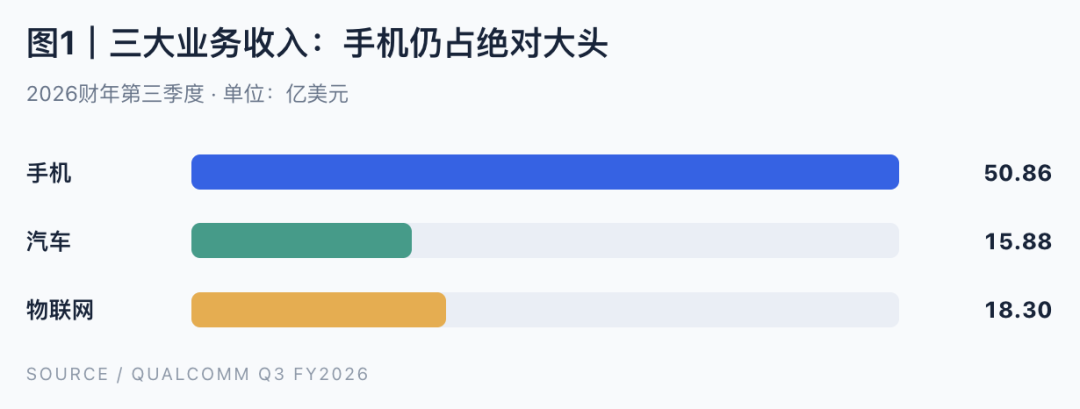
Third Quarter of Fiscal Year 2026:
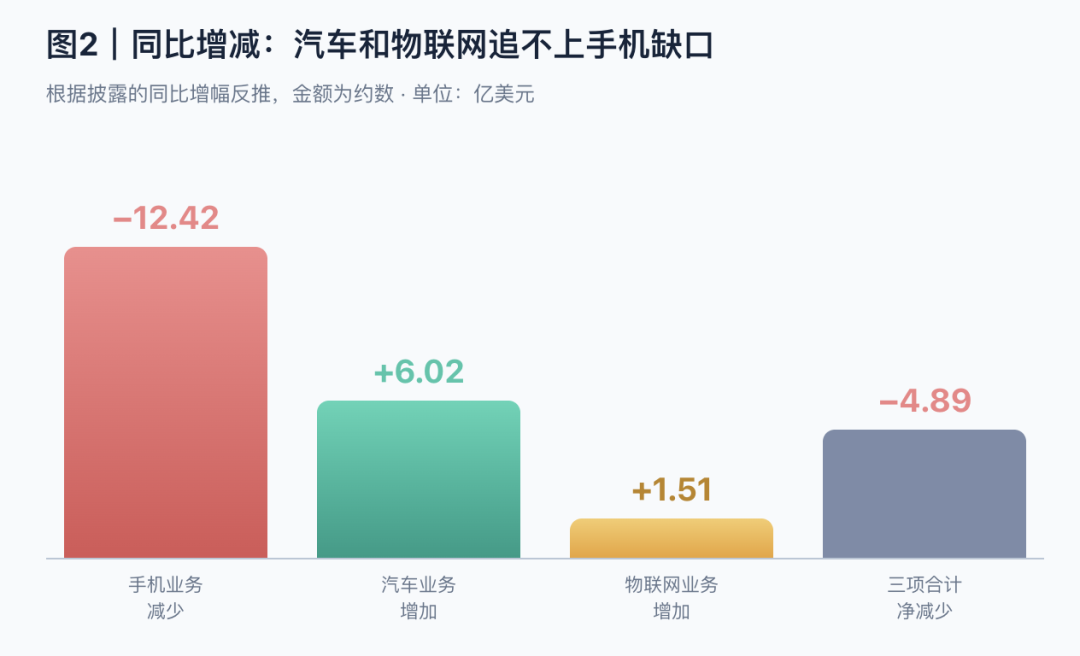
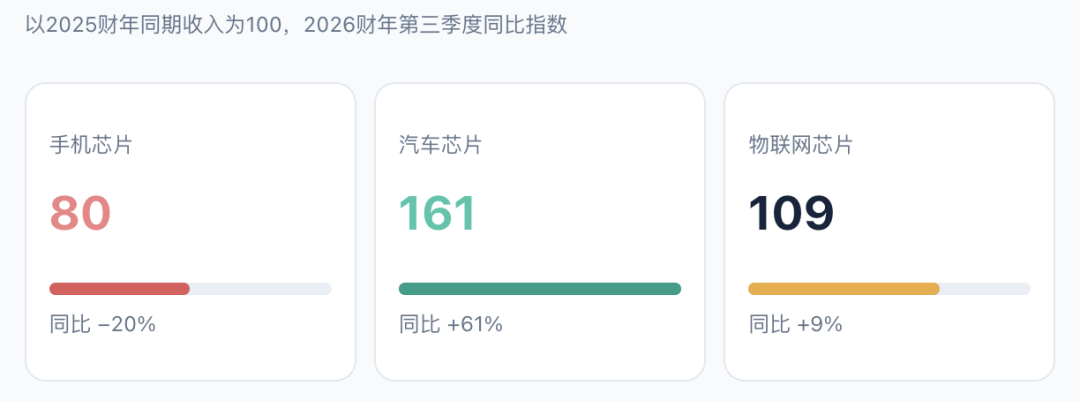
◎ Qualcomm's smartphone chip revenue stood at $5.086 billion, marking a 20% year-on-year decrease, or approximately $1.242 billion less.
◎ Conversely, automotive chip revenue surged by 61% during the same period, contributing an additional $604 million.
◎ IoT chip revenue experienced a 9% growth, adding roughly $149 million.
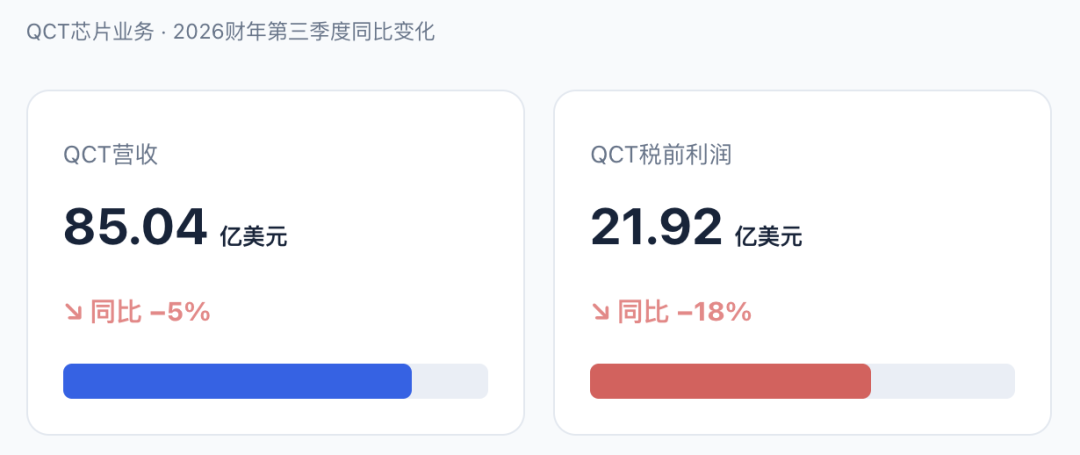
Despite the combined revenue increase of approximately $753 million from automotive chips and IoT business, it was insufficient to counterbalance the $1.242 billion decline in smartphone chip revenue. Consequently, Qualcomm's QCT chip business revenue witnessed a 5% year-on-year decrease, with pre-tax profit declining by 18%.
While the smartphone chip business remains substantial in scale, achieving growth is becoming increasingly arduous.
The global smartphone market has reached a saturation point, with users extending their device replacement cycles and terminal manufacturers becoming more cost-conscious regarding chip procurement. The escalation of memory prices in 2026 has further exacerbated cost pressures on smartphone manufacturers. Additionally, Qualcomm must adapt to the evolving landscape where clients are developing their proprietary chips.
Apple, for instance, is advancing its proprietary communication chips, implying a gradual reduction in Qualcomm's revenue from chips supplied to Apple. Similarly, Chinese smartphone manufacturers are pursuing varying degrees of chip self-development and supply chain diversification.
Although Qualcomm retains a strong technical edge in high-end smartphone SoCs, baseband communications, and wireless connectivity, the revenue and profit pressures stemming from its mature businesses are evident in its financial statements.
For a company with a substantial R&D and technical workforce, any deceleration in the scale of its legacy businesses necessitates a reevaluation of its staffing strategy.
Part 2: 61% Surge in Automotive Chips Insufficient to Sustain Qualcomm's Entire Operations
Qualcomm's automotive business is experiencing impressive growth, with automotive chip revenue reaching $1.588 billion in the third quarter of fiscal year 2026, representing a 61% year-on-year increase. Compared to the same period in fiscal year 2025, this equates to a single-quarter revenue increase of over $600 million.
Qualcomm primarily penetrates the automotive market through in-vehicle infotainment and digital cockpits, with products encompassing smart cockpits, assisted driving computing, in-vehicle communications, and other domains.
Automakers' demand for computing platforms is also becoming more centralized, with computing tasks previously distributed across various electronic control units now shifting towards higher-integration platforms.
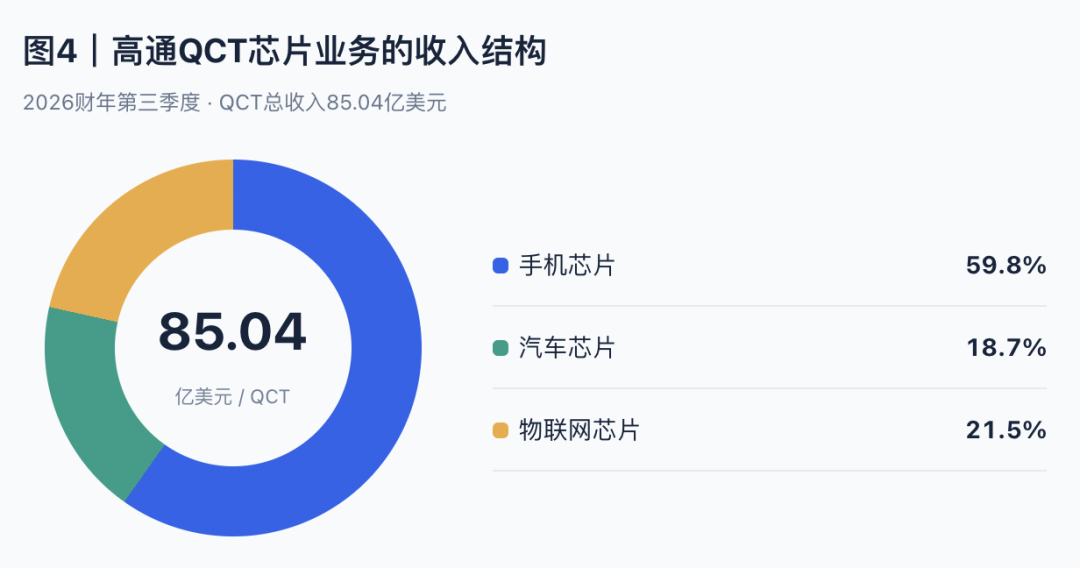
This trend presents Qualcomm with opportunities to continually enhance the value of chips per vehicle. However, the automotive chip business still constitutes only approximately 18.7% of QCT revenue, while smartphone chips account for nearly 60%.
Although Qualcomm's automotive business is expanding rapidly, it still has a considerable journey before it can fully supplant the revenue scale of smartphone chips.
Automotive chips also possess a unique characteristic: R&D investment typically precedes revenue realization.
From chip architecture design and functional safety verification to automaker fixed-point (customer designation), software adaptation, and mass production delivery, an automotive platform project can span several years.
Investments in R&D personnel, software engineers, and customer support teams must commence early in the project lifecycle.
Part 3: Qualcomm Sets Sights on AI Servers, Necessitating Reallocation of R&D Resources
Qualcomm's next strategic market is AI data centers.

In its third-quarter fiscal year 2026 financial report, the company established a non-smartphone business revenue target of $40 billion by fiscal year 2029.
Management also anticipates that the growth rate of non-smartphone business revenue, including data centers, will escalate from 24% in fiscal year 2026 to over 60% in fiscal year 2027.
These targets underscore Qualcomm's accelerated efforts to diminish its reliance on the smartphone market.
The data center business markedly differs from the smartphone chip business.
◎ Smartphone SoCs prioritize power efficiency, area, cost, communication capabilities, and end-user experience.
◎ AI data center chips, in addition to computing performance, must address large-scale memory access, inter-chip interconnectivity, server system integration, software ecosystems, and long-term stable operation.
While Qualcomm can leverage its expertise in Arm architecture, low-power computing, chip design, and communications technology, establishing a data center business necessitates distinct engineering capabilities.
In July 2026, Qualcomm announced the completion of its acquisition of Modular, further bolstering its capabilities in generative AI and agent-based AI software.
For Qualcomm, the number of R&D directions necessitating future investment is on the rise.
Smartphones, automobiles, industrial IoT, PCs, and AI servers all require dedicated engineering teams, yet the technical requirements, customer bases, and business cycles vary across product lines.
The layoff memo specifically highlighted that as the company expands its business, its requirements for staff skills and expertise have evolved. Qualcomm will take into account business priorities, organizational needs, and the capabilities essential for future growth.
Summary: The Pressures of High Growth in the Chip Industry Are Unevenly Distributed
News of Qualcomm's layoffs emerges amidst ongoing global expansion in AI chip investment.
NVIDIA, TSMC, and advanced packaging supply chains are ramping up capacity and capital expenditures, while automotive chips and data center power supplies are exploring new avenues for growth.
Conversely, the smartphone, traditional consumer electronics, and certain mature chip markets continue to face pressure.
The operating conditions within the semiconductor industry vary significantly across companies; even within Qualcomm, its smartphone, automotive, and data center businesses are at disparate stages, each confronting its unique set of challenges.
-
![]()
Tesla Roadster: Soaring Beyond Gravity—A Call for Automakers to Rise Above Price Wars
-
![]()
Exclusive: iPhone Duo 2 Details Unveiled
-
![]()
Qualcomm Reports $2 Billion Quarterly Net Profit Amidst Plans for Global Layoffs: 61% Surge in Automotive Chips Fails to Offset Smartphone Sales Decline
-
![]()
Has NIO’s Battery Swap Strategy Suddenly Gained Broad Acceptance?
-
![]()
Why Should Car Owners Be Held Accountable When the Self-Parking System Fails?
-
![]()
The Second Half of Intelligent Driving: Automakers Must Prove Safety and Then Get Users to Pay
-
![]()
The ultimate intelligence of a car is to ensure the safety of its occupants.
-
![]()
Post-2000s Beauty Product Manager Issues Apology; He Xiaopeng Embraces Being Labeled an 'Old Fogey.' Should Car Buyers Purchase MONA to Prove Their Youth?