Chinese Cars Force Down Prices in Europe's Niche Off-Road Market
 11/16 2026
 417

Introduction
A domestic entry-level off-road vehicle undercuts the Land Rover by 230,000 yuan, and European media say it has ignited a price war in Europe. Yet a low price is no sin.
"Why has the price offensive of Chinese car brands in Europe reached the niche off-road vehicle market?"
That was the exact headline Automotive News Europe ran after 212, a domestic entry-level hardcore off-road brand, officially entered the European market.
One passage read: "It is pursuing a strategy of 'fully loaded features at an affordable price.' That same strategy has nearly doubled Chinese automakers' market share in Europe this year; now 212 is bringing it to the off-road segment long dominated by established manufacturers trading on brand heritage."
Fittingly, the established manufacturers in question are Jeep and Land Rover.
In other words, by comparing an entry-level hardcore off-roader priced at 139,900–219,900 yuan in China with the Wrangler starting at 389,900 yuan and the Defender starting at 639,900 yuan, the article concluded that Chinese car brands had spread the wildfire of price war to Europe's niche segments.
In the first nine months of this year, Chinese brands sold a total of 1.1 million new cars in Europe, with market share rising from 5.5% in the same period last year to 10.5%.
And throughout the arduous process of market expansion, questions about Chinese automakers stirring up a price war in Europe have never let up.
01 Low-priced domestic off-roaders take aim at Land Rover and Jeep
Shaped by land area, road conditions and consumer habits, European consumers have long favored hatchbacks; the SUV boom arrived relatively late, and hardcore off-road vehicles remain an even more niche segment.
A 2022 in-depth report by Northeast Securities Co., Ltd. showed that among major automotive markets such as the United States, Russia, India, Japan, China and Europe, Europe had the lowest share of hardcore off-road vehicle sales.
Even Japan, similarly small in territory, relied on domestic models from Toyota and Suzuki to drive annual hardcore off-road sales of 96,000 units that year. Over the same period, total SUV sales in Europe reached 4.897 million units, of which hardcore off-road vehicles accounted for only 43,700, less than 1%.
Although sales are modest, the European hardcore off-road market has distinct characteristics: it is dominated by luxury hardcore off-roaders. The Land Rover Defender, Mercedes-Benz G-Class, Toyota Land Cruiser and Jeep Wrangler were the best-selling off-road models in Europe in the 2022 survey.
That dominance by luxury hardcore off-roaders may, however, simply reflect a lack of cost-effective low-priced off-road vehicles.
Dataforce data shows that the Chery Jaecoo 7, offered with fuel, hybrid and plug-in hybrid powertrains and priced at £29,000–35,000 (about 257,800–310,500 yuan), sold 15,400 units in September, ranking among the top ten European models by sales that month.
More importantly, its sales in the UK market alone exceeded 10,000 units, topping the UK's September best-seller list. And the UK happens to be the birthplace of the Land Rover brand.
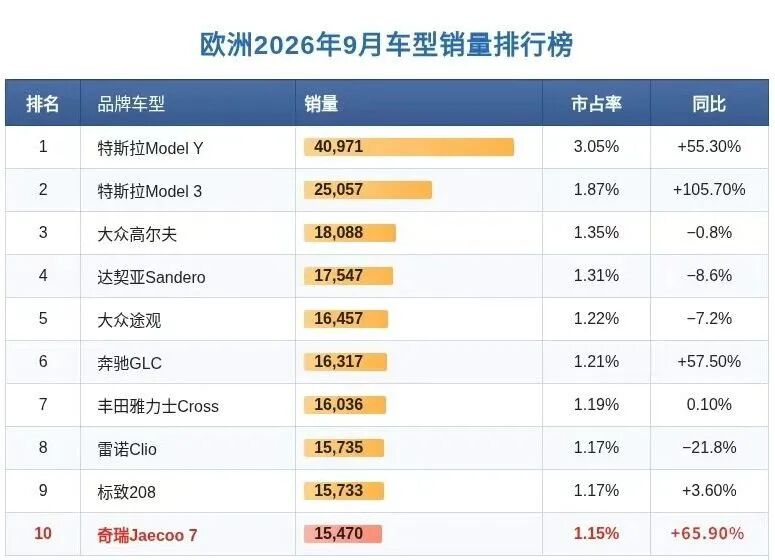
For reference, Land Rover's total European registrations in September were 15,200 units, while Jeep's were 10,600 — both lower than the sales of a single model from Chery's sub-brand.
The Jaecoo 7, however, is positioned as a compact light off-road SUV rather than a hardcore off-roader. By comparison, the entry of genuine hardcore off-road vehicles represented by the 212 — and its impact on traditional players such as Land Rover and Jeep — is more worth observing.
The brand's head of international business also said in an interview that its target customers are outdoor enthusiasts, hunters and industry users, including those in rescue and mining operations. Lower pricing is also expected to attract buyers who love off-road performance but are unwilling to pay a premium for established brands.
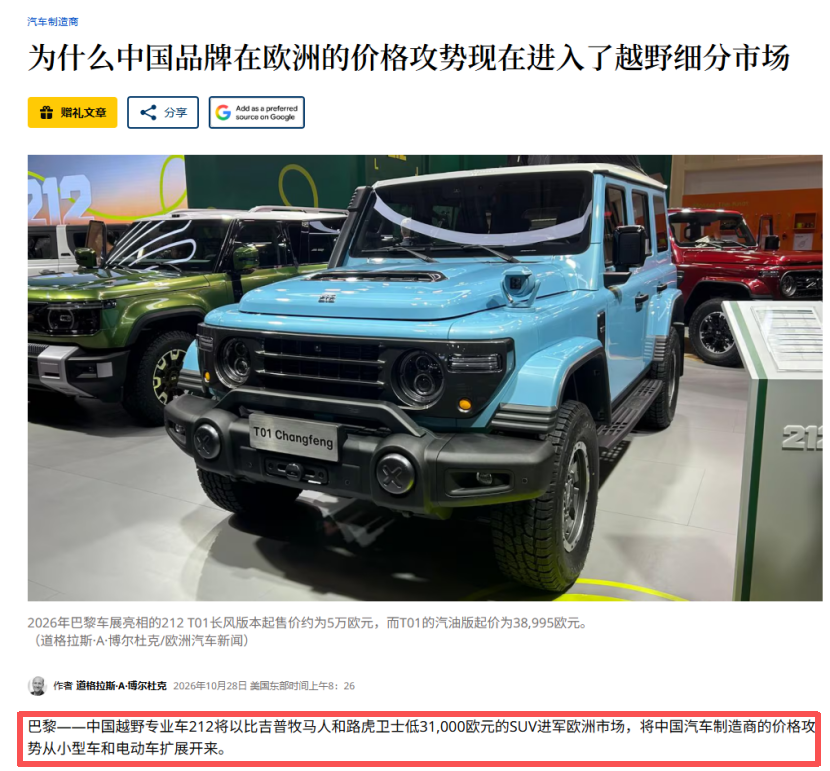
In the eyes of the European auto market, however, regardless of model positioning, a lower price means dragging the price war into the niche off-road market: "A Chinese off-road specialist brand has landed in Europe, with its SUV priced up to 31,000 euros (about 228,400 yuan) lower than the Jeep Wrangler and Land Rover Defender. This marks that the price offensive of Chinese automakers is no longer limited to small cars and new energy models." The article states this right at the outset.
But on closer examination, this conclusion is not rigorous.
On the one hand, this pricing retains reasonable profit space.
The gasoline and diesel versions mentioned above are priced at 194,800 yuan and 198,800 yuan in China, with corresponding European starting prices of 38,995 euros (about 287,700 yuan) and 41,850 euros (about 308,800 yuan), respectively.
Since the vehicle is not a pure electric model, imports only require a 10% tariff. Even after adding freight costs and exchange rate fluctuations, this pricing still leaves commercial profit and is not loss-making dumping to seize market share.
In fact, on reflection, the European hardcore off-road market is inherently very niche, and relying on low prices to seize the market is more likely to backfire.
On the other hand, the Wrangler and Defender are luxury hardcore off-road models, and the corresponding independent brands should be Mengshi, Xiangjie and others. The 212 is not in the same price tier as them, and direct competition is limited. Rather than directly poaching existing users of luxury off-road vehicles, it is filling the gap in affordable hardcore off-road vehicles.
02 Selling low-priced cars in Europe is not a sin
It is not just the off-road market. The "price offensive" of independent brands has long been regarded by the European auto industry as an important means for independent brands to seize market share.
The original Automotive News Europe article also gave examples: "Other Chinese brands have already adopted the same approach in the mainstream passenger car market (here referring to the method of 'fully loaded features and affordable pricing'). The Geely pure electric E2 starts at 19,990 euros in Germany, 6,300 euros lower than the Renault 5 and 5,005 euros lower than the Volkswagen ID Polo, while adopting rear-wheel drive, whereas both competitors are front-wheel drive. The BYD Atto 2 DM-i plug-in hybrid small SUV is listed at 35,990 euros, and after a 11,350 euro dealer discount, the actual transaction price is 24,640 euros, lower than the Toyota Yaris Cross and Volkswagen T-Roc."
In terms of price, some Chinese models are indeed cheaper, but the cost advantages brought by large-scale production capacity and a mature supply chain behind them cannot be ignored, and this cannot be directly equated with malicious low-price competition.
Profit can, to some extent, distinguish reasonable pricing from dumping-style price wars. Take BYD, which was named, as an example. Its average net profit per vehicle in the third quarter was 6,900 yuan. According to disclosures at its earnings communication meeting, the profit per vehicle in the domestic market was about 2,000 yuan, while in overseas markets it exceeded 16,000 yuan. Overseas profit per vehicle is eight times that in China, which also shows that its overseas pricing has ample profit space and is not sacrificing losses for market share.
In addition, the pricing strategies of Chinese automakers going global are highly differentiated, and not all of them follow a low-price route. Models such as Denza, Yangwang and BYD Tang are significantly more expensive in Europe than in China, and Denza even benchmarks Porsche locally.
Similarly, overseas brands also adopt differentiated pricing strategies: the newly launched pure electric models of Mercedes-Benz and BMW are generally priced higher in their home European market than in the Chinese market. This also shows that it is normal industry practice for multinational automakers to price flexibly according to costs, environments and users in different regions.
From this perspective, the entry of independent brands' entry-level hardcore off-road models into the European off-road vehicle market is less about launching a "price offensive" than about a niche market that has long lacked low-priced supply finally welcoming a new player willing to load up on features and set prices within a reasonable profit range.
Editor in charge: Shi Jie Editor: Wang Yue

THE END
-
Auto Market News: October NEV Penetration Exceeds 50% Across All Segments
-
![]()
Avatr's Valuation Under the Microscope: Monthly Sales Fall Below 3,000 Vehicles
-
![]()
Big Tech's Hunt for "ByteDance Time"
-
![]()
Mazda's Struggle and Transformation: A Case Study in Survival for Second-Tier Automakers | Cover Story: Japanese Automakers at the Crossroads of Transformation (Part VI)
-
![]()
Top 10 SUVs by Sales Are All Feeling a Bit Nervous Now
-
![]()
Eldest Son Returns with a Price Hike: Is AITO Using the New M8 to Take On the 9 Series?
-
![]()
Cerebras: Supply and Demand Are Both Fine — the Fab Is the "Big Headache"
-
![]()
Waymo vs. Tesla: How Far Has the Robotaxi Battle Come—and Will Automakers Become the Foxconn of Cars?