New Automakers Enter the Countdown to Integration
 11/16 2026
 376
Introduction
Amid the sweeping trend of mergers and restructuring in the auto industry, new automakers are left with few choices.
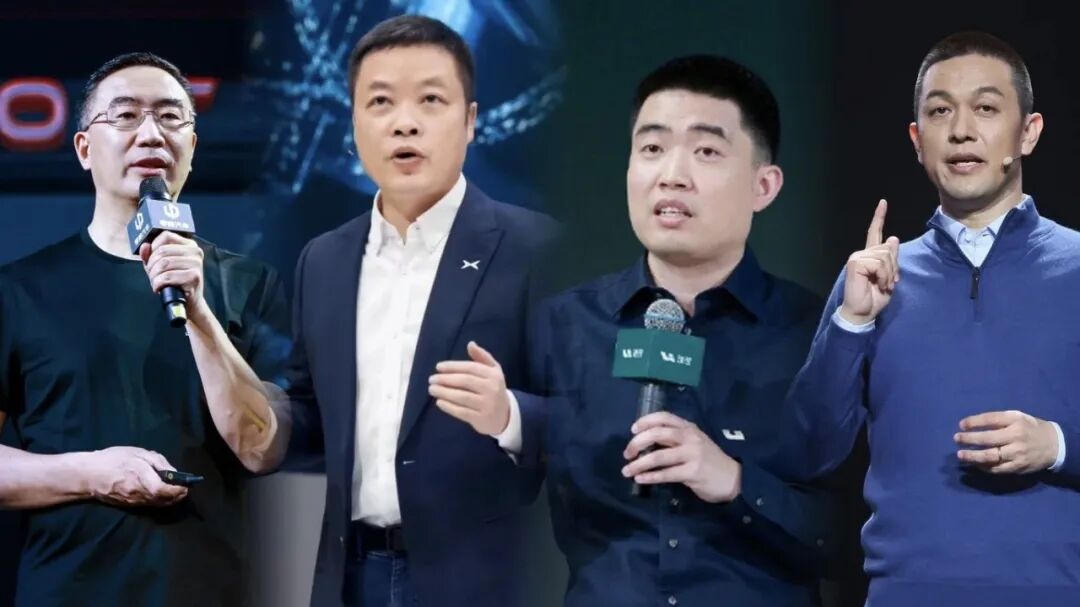
To be fair, the new automakers still standing today all have something going for them. NIO, Li Auto, Xpeng, and Leapmotor have essentially become forces to be reckoned with in China's new energy vehicle market.
In terms of product sales, they have already built considerable market scale; in terms of technology R&D, each has core capabilities to showcase; and in terms of capital reserves, supply chain management, and market experience, they are no longer the new car companies of years past that relied on fundraising and storytelling.
From a business perspective, then, NIO, Xpeng, Li Auto, and Leapmotor absolutely rank among the few high-quality assets in the auto market.
In other words, for traditional automakers struggling with electrification, rather than taking over brands like X Horse and X Neta that have already been eliminated by the market, trying every means to bring NIO, Xpeng, Li Auto, and Leapmotor into the fold is the lower-risk play.
Traditional automakers are not short on factories, supply chains, capital, or channels. What they truly lack is a new energy product development system proven by the market, as well as the technical and organizational capabilities to adapt to the era of intelligent vehicles.
But that is exactly where the problem lies.
The new automakers represented by NIO, Xpeng, Li Auto, and Leapmotor have carried the mission of overturning the traditional auto industry since birth. After more than a decade of struggle, competition, and investment, they have finally gained a foothold in the new energy vehicle era—who would be willing to hand over control and change banners so easily?
Unless—pay more! Pay a lot more!
So, standing on the era-defining issue of "the great integration of China's auto industry," a question emerges: do traditional automakers really need to integrate the new automakers? And what choice should NIO, Xpeng, Li Auto, and Leapmotor make?
01 Leapmotor and Xpeng Are Already Ahead
If the relationship between traditional automakers and new automakers in the past was more like mortal enemies locked in a life-or-death struggle, then now, after repeated market baptisms, the two sides are becoming shareholders, partners, and even technology suppliers and customers, huddling together for warmth.
Leapmotor and Xpeng are two very representative examples.
In 2023, Stellantis invested about 1.5 billion euros in Leapmotor for roughly a 20% stake. The two sides then established Leapmotor International, with Stellantis responsible for sales and channel operations outside China, while Leapmotor provides product and technical support.
The value of this cooperation goes far beyond a single financing round—it laid a solid foundation for Leapmotor's overseas expansion.
For Leapmotor, Stellantis has brands, dealer networks, and production resources around the world, which can be leveraged to further reduce the capital investment and operating costs of going overseas.
For Stellantis, Leapmotor's market-validated electrification technology and product development capabilities provide a faster path into China's new energy technology system.
The cooperation between the two sides continues to deepen. From vehicle sales to component supply, and further to electric drive system development and platform technology cooperation, Leapmotor is turning its technical capabilities into commodities it can sell externally.
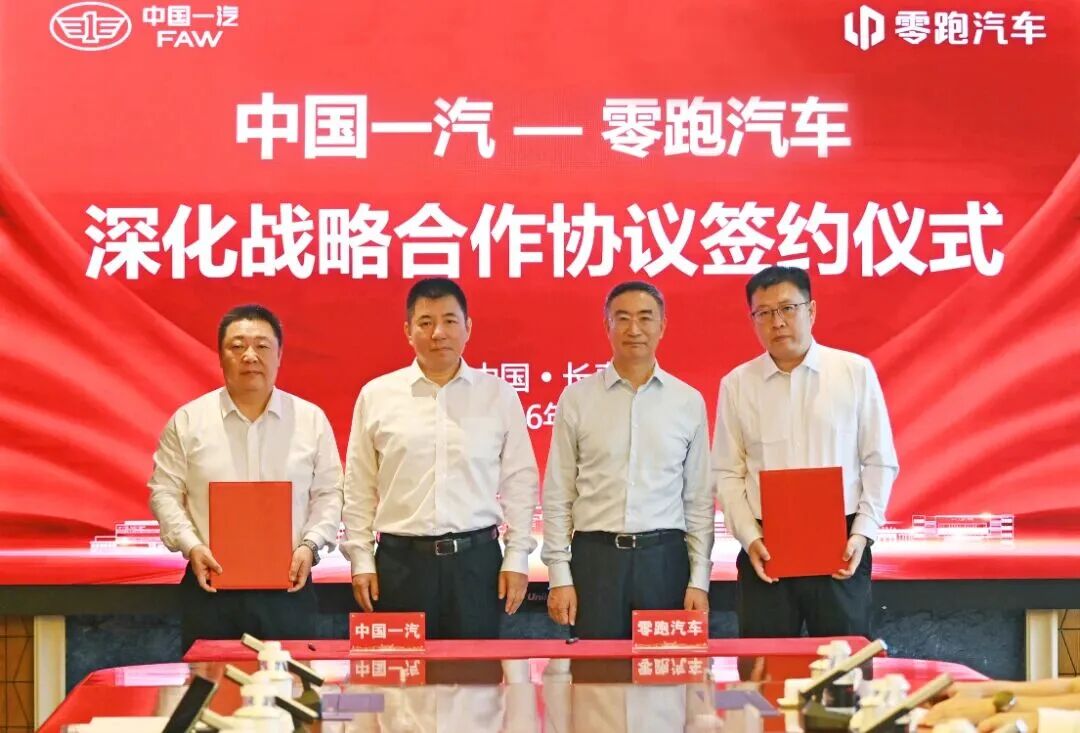
On the other side, China FAW is also moving closer to Leapmotor.
At the end of 2025, FAW and Leapmotor reached an equity investment cooperation. In August 2026, the two sides further signed a deepened strategic cooperation agreement, expanding the scope to new energy vehicles, intelligent driving, powertrains, power batteries, intelligent chassis, and other fields.
In September, Leapmotor also planned to participate in the financing of FAW's Qixin Power and conduct technical cooperation with FAW's battery company.
This is no longer just a simple procurement relationship. Leapmotor opens its technical capabilities to FAW, while FAW builds deeper ties with Leapmotor through capital, industrial resources, and its component system.
For Leapmotor, the shares bring not only funds but also an entry point to overseas markets and industrial orders from a large auto group; for FAW, it gains a market-tested new energy technology and product development capability at a relatively low time cost.
Now look at Xpeng and Volkswagen.
In 2023, Volkswagen acquired a 4.99% stake in Xpeng for about $700 million, and the two sides subsequently launched cooperation in platforms, software, and electrical/electronic architectures.
In March 2026, the first jointly developed model, the ID.UNYX 08, officially rolled off the production line. From reaching the cooperation to model production, it took only about 24 months.
This means Xpeng's technology has already begun entering Volkswagen's product system.
More importantly, the cooperation has not stopped at a single car. The CEA electrical/electronic architecture that Xpeng participated in developing has expanded from Volkswagen's pure electric models to other model platforms.
For Volkswagen, this is an important step in shortening the technology iteration cycle in the Chinese market; for Xpeng, it means its technology has a chance to achieve another form of commercialization through Volkswagen's massive model scale.
In the second quarter of 2026, Xpeng's services and other revenue reached 2.7 billion yuan, up 93.9% year on year, mainly driven by technology R&D services provided to automakers and increased component sales. During the same period, the company's overall gross margin reached 20.7%.
It was once rare for automakers to export technology to other automakers. But in the era of intelligent electric vehicles, this is becoming increasingly common.
Of course, Xpeng also has its own global business and is laying out new directions such as humanoid robots and autonomous driving. Its business boundaries are constantly expanding.
But this also raises a new question: when a new automaker's technology can be sold to Volkswagen, and when its R&D achievements can serve more automakers, must it still rely on selling cars itself to prove its commercial value?
From this perspective, it is not impossible for Xpeng to be further integrated by a large auto group in the future.
But it must be emphasized that technology cooperation, equity investment, and the acquisition of the vehicle business are completely different matters. Volkswagen has not publicly announced an acquisition of control over Xpeng, and the claim that Xpeng will take over Volkswagen's closed German plants should also be given more time to play out.
02 NIO and Li Auto Are Seeking New Growth
Compared with Leapmotor and Xpeng, NIO and Li Auto have made different choices. They also need to find new growth, but they have not handed their vehicle businesses to other companies.
Over the past few years, NIO has been building its own battery swapping system. This system requires huge investment, and in the short term it is difficult to achieve scale effects relying solely on NIO's own sales.
But from another angle, if this battery swapping network could serve more brands, the situation would be completely different.
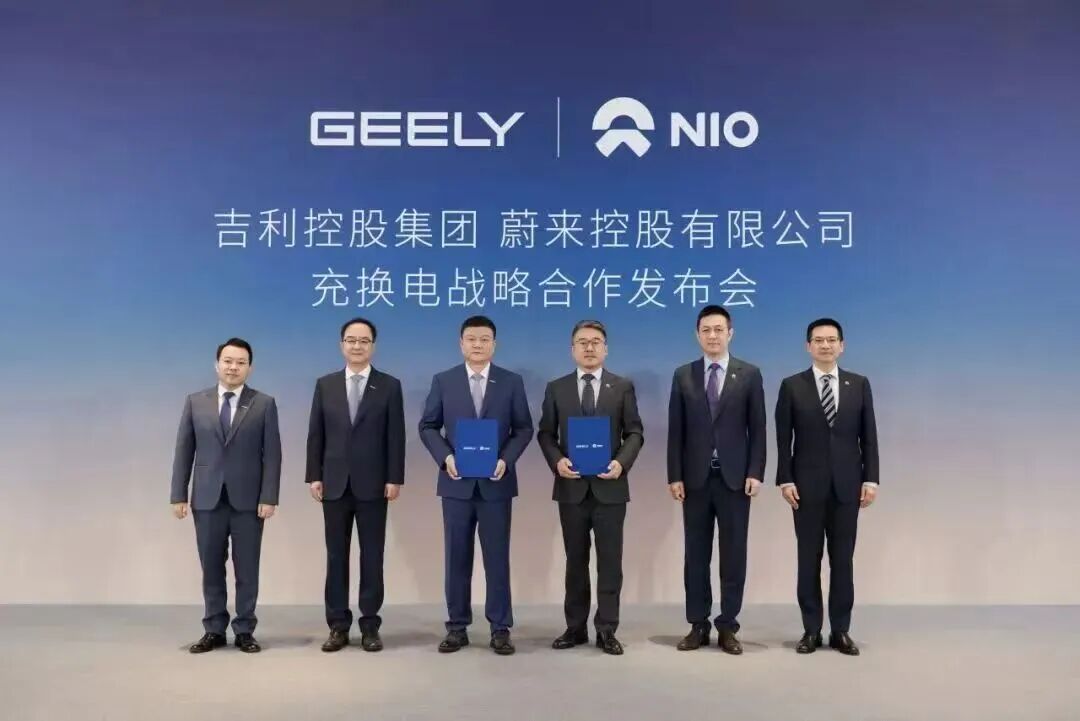
On September 28, NIO and Geely announced comprehensive strategic cooperation in the charging and battery swapping field. Geely will take a stake in NIO Energy with 100% equity of Yiyi Interconnect and 640 million yuan in cash, holding a 30% stake in NIO Energy after the transaction is completed; NIO will hold a 10% stake in Geely's Haohan Energy, and the two sides will promote interconnection of charging resources.
This is a very interesting form of integration.
NIO did not hand over its vehicle business, and Geely did not acquire NIO Auto, but through equity cooperation in the energy business, the two sides connected their respective infrastructure and operating resources.
For NIO, Geely brings capital, battery swapping business for operating vehicles, and more potential users, which can improve the utilization efficiency of the battery swapping network.
For Geely, it can use NIO's existing battery swapping technology and service system to reduce the cost of entering the battery swapping market.
This account is relatively easy to calculate.
If more automakers join in the future, NIO's battery swapping network has the opportunity to transform from a supporting facility of one automaker into energy infrastructure shared by the entire auto industry.
This may have more imaginative potential than simply selling cars.
Li Auto's approach is different.
Li Auto's most successful business model in the past was to enter the family user market through extended-range products, relying on a relatively concentrated product matrix and high per-vehicle profitability to build its own operating system.
After entering the pure electric era, Li Auto began to extend further upstream in the industrial chain to fill the gap left by extended-range models.
This year, Li Auto has accelerated its self-developed battery strategy, and some models have already begun to carry self-developed batteries. Li Auto also made clear that the goal of self-developed batteries is not only to reduce costs, but more importantly to connect the data and technology systems among battery cells, vehicles, and battery management systems.
Perhaps because its "blood" is thick enough, Li Auto has not yet officially announced cooperation with any automaker. However, BAIC has already extended a hand.
On September 10, BAIC Group visited Li Auto for exchange and discussion, and the two sides explored cooperation possibilities in areas such as batteries and intelligent driving.
In the past, Li Auto was more accustomed to keeping technology within its own product system. Now, as R&D investment continues to increase, how to make these technologies generate value beyond vehicle sales has become a question it needs to consider.
Obviously, both NIO and Li Auto are looking for new growth beyond car sales.
They are not without the possibility of being integrated—at least BAIC and JAC would probably be very willing. But compared with directly selling the vehicle business, it may be a more realistic solution for NIO and Li Auto to first spin off their advantageous resources and seek partners.
03 Integration Has Begun, but It May Not Be Acquisition
Looking beyond the four new automakers—NIO, Xpeng, Li Auto, and Leapmotor—to the entire auto industry, this great integration in China's auto era has long ceased to be only a matter between new automakers and traditional automakers.
State-owned and central enterprises have taken the lead in shouldering responsibility. The integration of Changan and Dongfeng previously attracted a great deal of attention. Although related progress has entered a relatively quiet stage, the cooperation between FAW and GAC has already taken a substantive step.
In October 2026, China FAW, Toyota Motor, and GAC Group signed a new strategic cooperation framework agreement. According to the agreement, GAC Group plans to acquire the 50% stake in FAW Toyota held by China FAW by issuing shares.
After the transaction is completed, FAW Toyota will continue to exist as an independent operating entity, and China FAW will become an important strategic shareholder of GAC Group. In the future, FAW Toyota and GAC Toyota will strengthen synergy in R&D, procurement, production, and sales.
The logic behind this is not complicated. Competition in the auto industry is becoming increasingly fierce, and companies need to reduce duplicate investment and use limited funds and resources in more efficient places.
This kind of resource restructuring has also extended to the new energy brands under traditional automakers.
On November 12, Changan Automobile listed for transfer a 10% stake in Avatr held by the company through the Shanghai United Assets and Equity Exchange, with a floor price of 3.1828 billion yuan. Based on the listing price, Avatr's overall valuation is about 31.828 billion yuan.
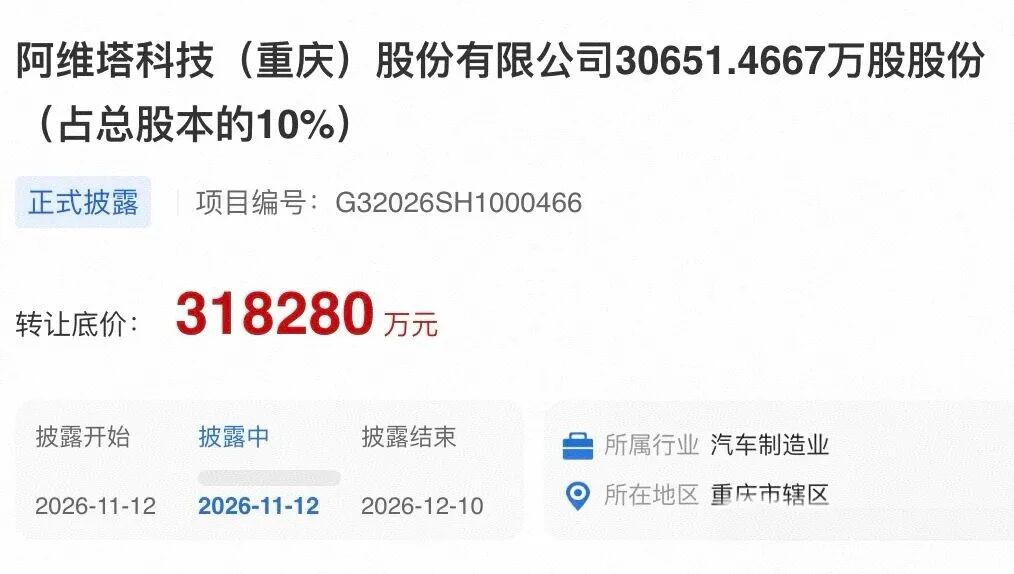
It should be noted that what is being transferred this time is the Avatr shares held by Changan Automobile, not Avatr actively selling its own shares. After the transaction is completed, Changan will remain Avatr's largest shareholder.
Avatr also stated that it hopes to introduce strategic investors that can help with high-end brand channel building and overseas market expansion.
Changan has not exited Avatr; rather, it hopes to introduce new industrial resources to the brand through a partial equity transfer. This is consistent with the thinking behind FAW investing in Leapmotor and Volkswagen investing in Xpeng—leveraging external forces.
In the past, when people talked about auto industry integration, they often thought of acquiring brands, taking over factories, and merging companies. But judging from the cooperation that has already taken place, the scope of integration is becoming broader.
Technology can be licensed, platforms can be shared, supply chains can be coordinated, battery swapping networks can be opened, and equity can be recombined. Companies do not necessarily have to merge, and they can still connect the most valuable resources.
Obviously, the boundaries of the industry will continue to blur, and between new automakers and traditional automakers, the identities of ally and rival may switch at any time.
So, will NIO, Xpeng, Li Auto, and Leapmotor definitely be acquired in the future?
For now, FAW and Leapmotor, Volkswagen and Xpeng, Geely and NIO, and BAIC and Li Auto all have connections to varying degrees. But it is still too early to talk about acquisition.
However, one thing is certain: in the auto world to come, there will be no permanent rivals and no permanent lone players. Because "integration" has already begun.
Editor in charge: Shi Jie; Editor: Wang Yue

THE END
-
Auto Market News: October NEV Penetration Exceeds 50% Across All Segments
-
![]()
Avatr's Valuation Under the Microscope: Monthly Sales Fall Below 3,000 Vehicles
-
![]()
Big Tech's Hunt for "ByteDance Time"
-
![]()
Mazda's Struggle and Transformation: A Case Study in Survival for Second-Tier Automakers | Cover Story: Japanese Automakers at the Crossroads of Transformation (Part VI)
-
![]()
Top 10 SUVs by Sales Are All Feeling a Bit Nervous Now
-
![]()
Eldest Son Returns with a Price Hike: Is AITO Using the New M8 to Take On the 9 Series?
-
![]()
Cerebras: Supply and Demand Are Both Fine — the Fab Is the "Big Headache"
-
![]()
Waymo vs. Tesla: How Far Has the Robotaxi Battle Come—and Will Automakers Become the Foxconn of Cars?