48 Hours, 17 New Cars: The Auto Industry's Year-End Sales Frenzy—When Will the Rat Race End?
 11/17 2026
 459
The time for year-end KPI crunching has arrived.
Rolling out 17 new cars in just two days—is the auto industry's year-end sales push really this intense?
This past Thursday and Friday—November 12 and 13—the auto industry collectively held 12 launch events and unveiled 17 new vehicles. Dianchetong (ID: dianchetong233) has compiled a table for detailed reference.
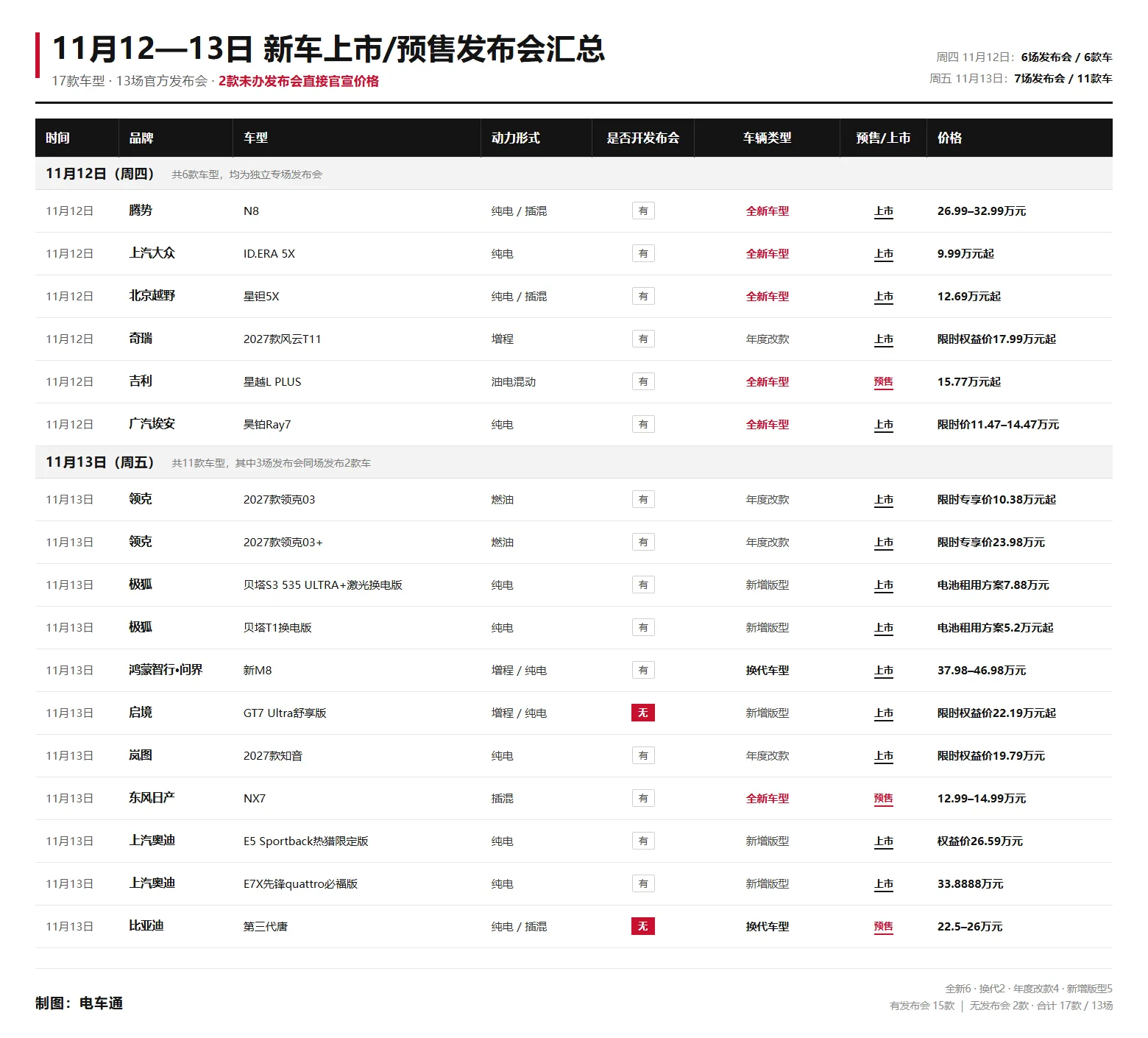
(Image source: Dianchetong chart)
As the chart shows, of these 17 new cars, 6 are all-new models, 2 are mid-cycle replacements, 4 are annual facelifts, and 5 are newly added variants. In other words, even at the end of 2026—with auto sales continuing to decline year-on-year—automakers are still rolling out all-new models.
What's more, among these vehicles, only the BYD third-generation Tang and the Qijing GT7 Ultra Comfort Edition skipped launch events and went straight to presale/launch announcements. That means the remaining 12 brands and 15 new cars all held launch events. Such launch density is genuinely staggering.
In Dianchetong's view, this high-density wave of launches stems mainly from the approaching Guangzhou Auto Show and automakers' year-end sales push. In the one or two weeks before the Guangzhou Auto Show opens, this breakneck pace of new car launches is likely to continue.
So why are automakers so keen on clustering new car launches? What's the point of releasing so many vehicles in such a short window? Today, Dianchetong will discuss this with you.
As the Year Winds Down, Automakers Lean on New Cars to Hit Sales KPIs
We can dig deeper into the launch event data from the past two days.
For instance, among the launch events during these two days, the ratio of independent to joint venture brands is roughly 3:1, while the ratio of new energy to fuel models is about 5:1. Notably, the models released by several joint venture brands are all new energy vehicles.
These figures reveal a clear trend: the auto industry is now dominated by independent brands and new energy, with joint venture brands accelerating their new energy transformation. Among them, those launching all-new and mid-cycle replacement models are primarily independent brands.
But it's worth noting that among these 12 launch events and 17 new cars, none came from new force brands.
According to Dianchetong's research, among new force brands (excluding Harmony Intelligent Mobility Alliance), NIO, XPeng, Li Auto, and Xiaomi have all wrapped up their new car releases for the year. Only Leapmotor's Lafa5 annual facelift will debut at the Guangzhou Auto Show. For the remainder of the year—apart from the routine Guangzhou Auto Show launches and Leapmotor's Guangzhou Auto Show event—the remaining new forces' events include only NIO's annual NIO IN (NIO Tech Day), NIO Day, and XPeng's annual XPeng Tech Day.
(Image source: NIO)
Therefore, the brands that concentrated their new car releases before the Guangzhou Auto Show are essentially traditional independent brands and joint venture brands. Their concentrated year-end launches also reflect the anxiety pervading the entire auto industry.
In a year when the "Golden September and Silver October" lost its luster, automakers hoping to rally another wave of sales and polish their annual numbers have only this last month and a half to work with. On top of that, the Guangzhou Auto Show itself is a minor peak for year-end new car launches. Together, these two factors have created the clustered launch phenomenon.
It's worth mentioning that in the one or two weeks before the 2025 Guangzhou Auto Show, some automakers also chose to stagger their new car launches—but back then, launches were spread over several weeks, and there was no situation like this year's clustering within two days.
From the changes between 2025 and the eve of the 2026 Guangzhou Auto Show, one can clearly sense that the competitive tension among automakers has intensified. Automakers want to release new cars before the Guangzhou Auto Show to avoid the dense launches at the show and maximize exposure. On the other hand, they want to beat other brands to consumers' attention. The result is the phenomenon of "avoiding the auto show crowd, only to create a crowd before the show"—which is both amusing and exasperating.
In a Downturn, Where Does Industry Involution End?
The phenomenon described above also reflects how automakers' anxiety about the industry's future and their own sales has, to some extent, morphed into industry-wide involution.
Against the backdrop of "too many monks and too little porridge," automakers and their brands can only seize the few remaining windows to compete for consumers and make the numbers on monthly sales rankings look better at the start of each month. As a result, competition between companies and between brands has only grown fiercer this year.
Many friends will surely ask: since market demand has declined, why do automakers keep launching new cars? At a time like this, shouldn't they stabilize the status quo and wait for demand to recover?
The problem is that the auto industry is a heavy-asset business. A car goes through a fairly long process from project approval to launch.
For example, new cars launched this year may have been approved two or even three years ago. After completing "one winter and one summer"—or even "two winters and two summers"—of testing, these models are basically close to mass production. At this point, cutting them because of industry changes would mean swallowing too large a sunk cost, and most automakers would not make such a decision.
For another example, some large auto groups have many sub-brands and project teams. Automakers not only have to make enterprise-level business plans but also balance internal competition among various "factions" under their umbrella—which naturally leads to the situation of "a big ship is hard to turn around."
Therefore, when facing declining market demand, new forces have responded more nimbly. Even XPeng, Xiaomi, and Leapmotor—which have grown relatively rapidly—have not chosen to continue developing large numbers of new cars, but have maintained steady iteration of current models and moderate new car launches. As for NIO and Li Auto, one cut the ES7, and the other cut the L7 and added the i9, with overall development trending toward stability.
However, many automakers have also realized this. Judging from the number of new car filings with the Ministry of Industry and Information Technology in the second half of the year, more and more automakers are consciously reducing the launch of all-new models and beginning to focus on protecting their existing markets.
Dianchetong predicts that in the next one to two years, the number of newly added all-new models will continue to decrease, and some optional annual facelifts or variant additions will also be abandoned by some automakers. Moreover, with regulators cracking down on "quickly built cars" and requiring proper testing, the R&D and testing cycles for some models will lengthen, which may further reduce the number of all-new models in the next one to two years.
In such an environment, industry involution may ease somewhat. Automakers may shift from simply competing on sales and iteration speed to competing on who earns more—or loses less.
The degree of involution may decrease, but competition among automakers and brands may become even more intense. At present, the elimination round in the auto industry has already begun, and some brands have shown signs of dropping out. Which brands will regrettably exit in the next one or two years will depend on whether they can stage a bottom-up rebound.
Returning to the topic of clustered new car launches: is releasing so many models in two days ultimately a good thing or a bad thing for brands?
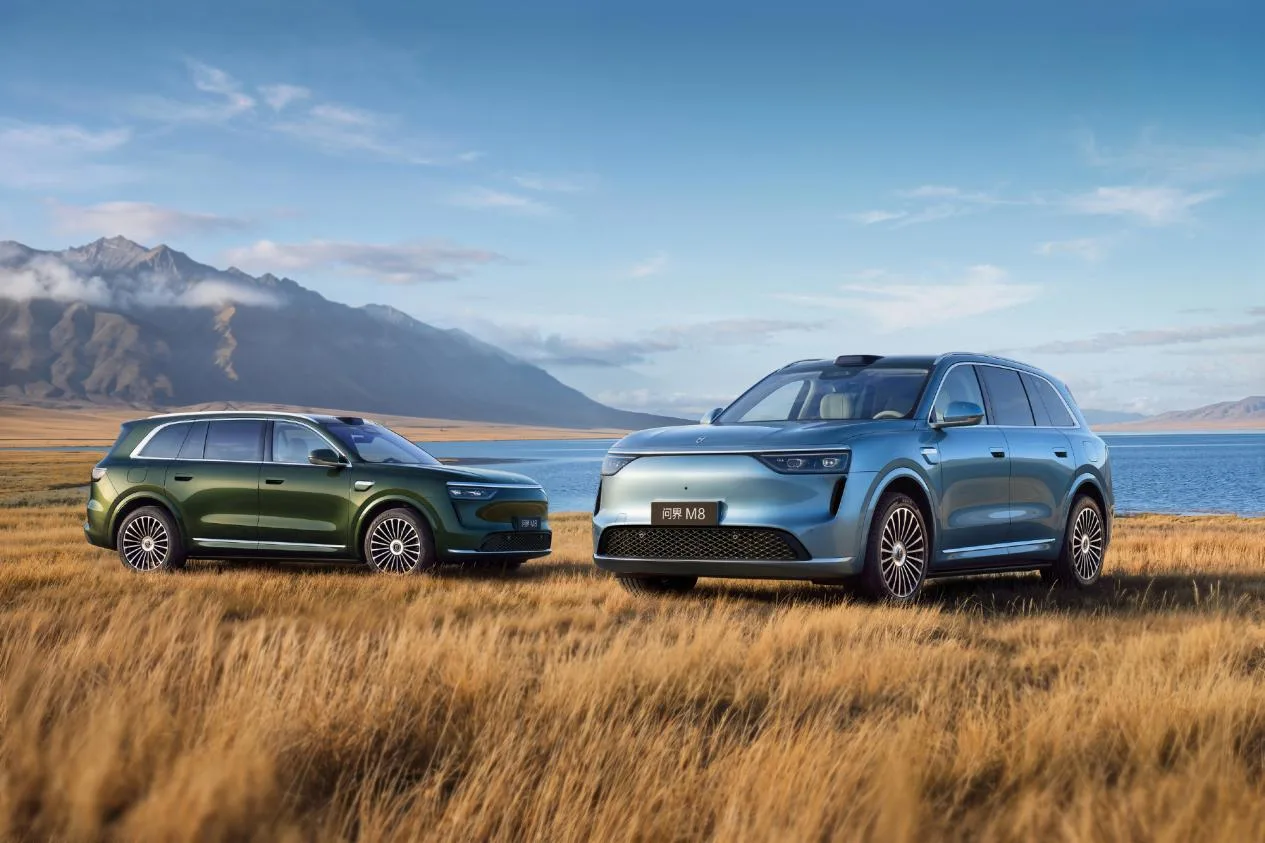
In Dianchetong's view, this needs to be viewed case by case. If a brand has sufficiently strong strength and the model itself commands enough attention, then even if it's released alongside other models, it won't affect its sales performance—for example, models launched last week such as the AITO new M8, Denza N8, and BYD third-generation Tang. But if the brand itself is slightly weaker and product competitiveness is relatively average, then choosing to launch in a crowd will instead put it at a disadvantage.
(Image source: AITO)
So overall, brands still need to find a set of tactics more suitable for themselves rather than following others blindly. If they end up in the awkward situation of imitating others poorly, the loss will outweigh the gain.
Source: Leitech
The images in this article are from: 123RF licensed image library Source: Leitech
-
![]()
GAC Group Sells 143,687 Vehicles in October: How Should Aion and the Joint Ventures Redistribute Roles?
-
![]()
2.5x More Light Intake: Why Mobile Phone Cameras Need to Retire the 1974 Filter
-
![]()
What Chinese Automakers Look Like in the Eyes of European Policy Circles
-
![]()
Huawei Doesn't Build Robots, Yet 80% of Robot Companies Run on Its Cloud
-
![]()
Breaking! Changan Automobile Sells 10% Avatr Stake for 3.2 Billion Yuan—What's the Real Reason?
-
![]()
2-Year 80% Buyback: How Does SAIC Volkswagen Pull This Off?
-
![]()
Two Years Into End-to-End: How Far Has Each Automaker's Intelligent Driving Really Come?
-
![]()
iPhone 18 Ditches the Mute Button! Why Is Apple Fighting So Hard to Keep the Camera Button?