2-Year 80% Buyback: How Does SAIC Volkswagen Pull This Off?
 11/17 2026
 573
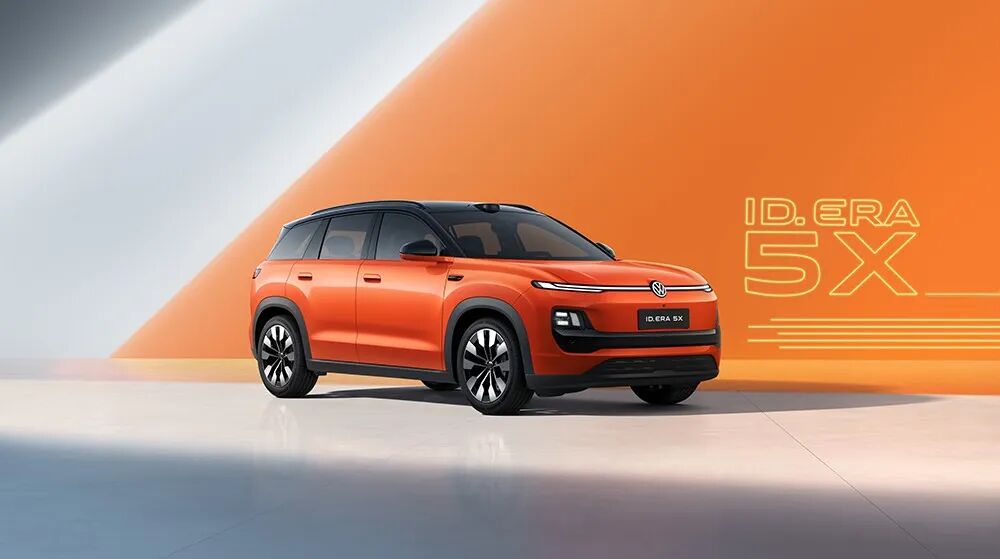
A Volkswagen EV priced at 99,900 yuan—after two full years, Volkswagen will buy it back for up to 80% of its value.
That's the deal SAIC Volkswagen offered for the ID. ERA 5X on November 12: after two full years, a buyback of up to 80% of the limited-time benefit price; after three full years, up to 70%.
▲ Image source: SAIC Volkswagen
You might think this is nothing special—until you look at used EV prices.
According to figures presented at SAIC Volkswagen's launch event, after two years a pure EV on average retains only 53.4% of its value. And after three years? The China Automobile Dealers Association's October report puts it at 45.1%. A 200,000-yuan EV sells for only about 90,000 yuan after three years.
For many would-be EV buyers, this is the biggest sticking point: sell after two years and you lose nearly half the car's value. Volkswagen has now written that worry directly into its purchase benefits.
How does an automaker dare to shoulder the used-car price risk for its users? Where does its confidence come from?
▲ Image source: SAIC Volkswagen
Why do EVs depreciate so much?
First, the background. Low used EV prices are mainly not the battery's fault—they're the new cars' fault.
Ralf Brandstätter, CEO of Volkswagen Group China, cited a figure: since the beginning of this year, more than 500 new models have been launched in the Chinese market. New cars are cutting prices while adding features. A car bought two years ago, compared with today's new cars, has outdated features and an even higher price—so dealers naturally push down the acquisition price.
On the association's list, for one-year-old pure EVs, the Xiaomi YU7 ranks first with 82.3% value retention; the new car requires queuing, while nearly new cars are instead in high demand. For three-year-old cars, the top three are all Teslas; those models have not undergone major changes for several years, and their price systems are also stable.
When it comes to value retention, how new the car is is secondary; what matters is whether new-car prices are stable and whether the car remains reliable after several years. Remember these two points; they'll come up again later.
How solid is this 80%?
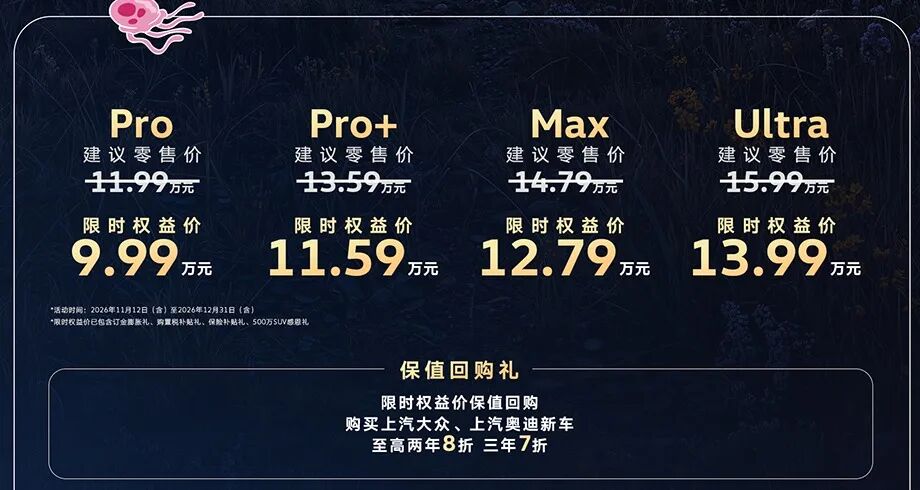
The 5X's guide price is 119,900 to 159,900 yuan, and the limited-time benefit price is 99,900 to 139,900 yuan. The buyback is calculated based on the benefit price, while the association uses the guide price to calculate value retention. Let's recalculate using the stricter guide-price basis:
▲ Image source: SAIC Volkswagen official launch poster (partial)
For the entry-level Pro version, the two-year buyback price is 79,900 yuan—66.7% of the guide price; the three-year price is 69,900 yuan, or 58.3%. For the top Ultra version, the two-year price is 111,900 yuan, about 70%; the three-year price is 97,900 yuan, about 61%.
Even using the strictest basis, this figure is still very competitive.
In the same October report, the highest three-year pure EV value retention rate belongs to Tesla: Model 3 at 61.3%, Model Y at 53.9%. The 5X's three-year buyback price falls right between the two.
Volkswagen is essentially locking in a Tesla-level three-year residual value in advance for a new car in the 100,000-yuan class.
Calculating with the entry version is more intuitive: buy at 99,900 yuan, buy back at 79,900 yuan after two years—depreciation over two years is 20,000 yuan, about 833 yuan per month. If calculated at the industry average two-year retention of 53.4%, this car would be worth about 64,000 yuan after two years; the buyback gives about 16,000 yuan more, roughly 15% of the car price.
SAIC Volkswagen also ran the numbers for the top trim itself: after two years, the buyback amount is 111,900 yuan, while for competitor models at the same price, the residual value after two years is about 74,700 yuan—a difference of about 37,000 yuan.
Where does Volkswagen's confidence come from?
The most direct point: this car is cheaper to build than before, and selling it can make money.
▲ Image source: SAIC Volkswagen
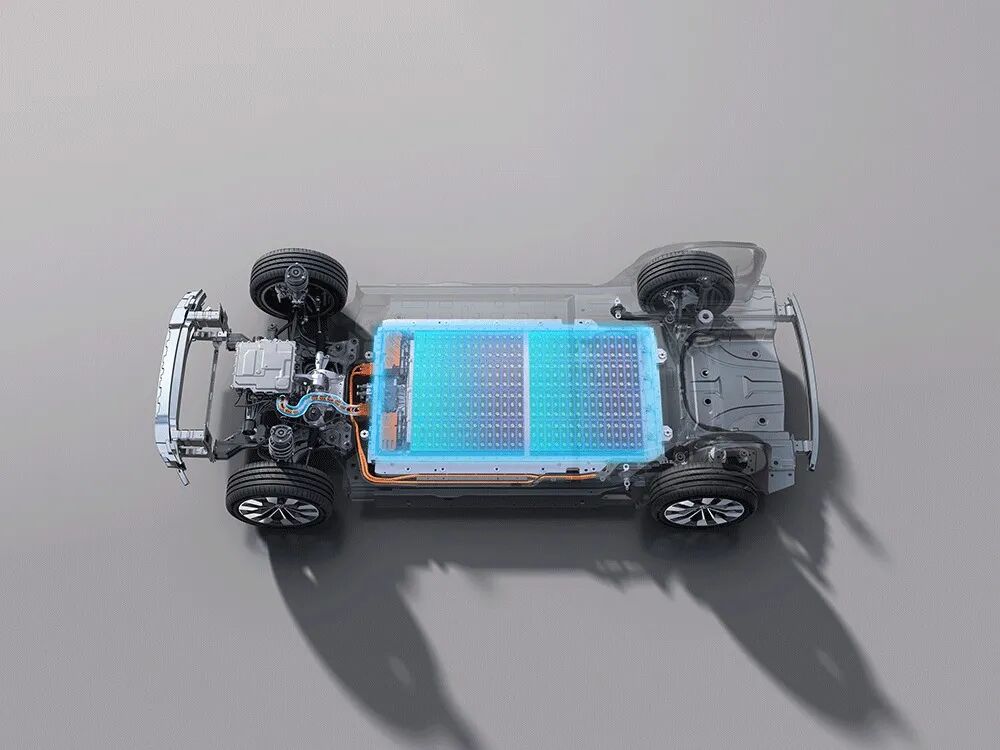
The 5X is Volkswagen's first mass-produced vehicle globally to use the CMP platform plus the CEA electronic and electrical architecture. CMP is Volkswagen's first new energy platform fully developed locally in China; CEA is an electronic and electrical architecture developed by Volkswagen China, CARIAD China, and XPeng, which can reduce the vehicle's control units by about 30%. With fewer control units, wiring harnesses, costs, and places where software can go wrong are all reduced. Volkswagen also plans to launch 6 CMP-platform models in China over the next 18 months; spreading one platform across six cars is what allows per-vehicle costs to come down.
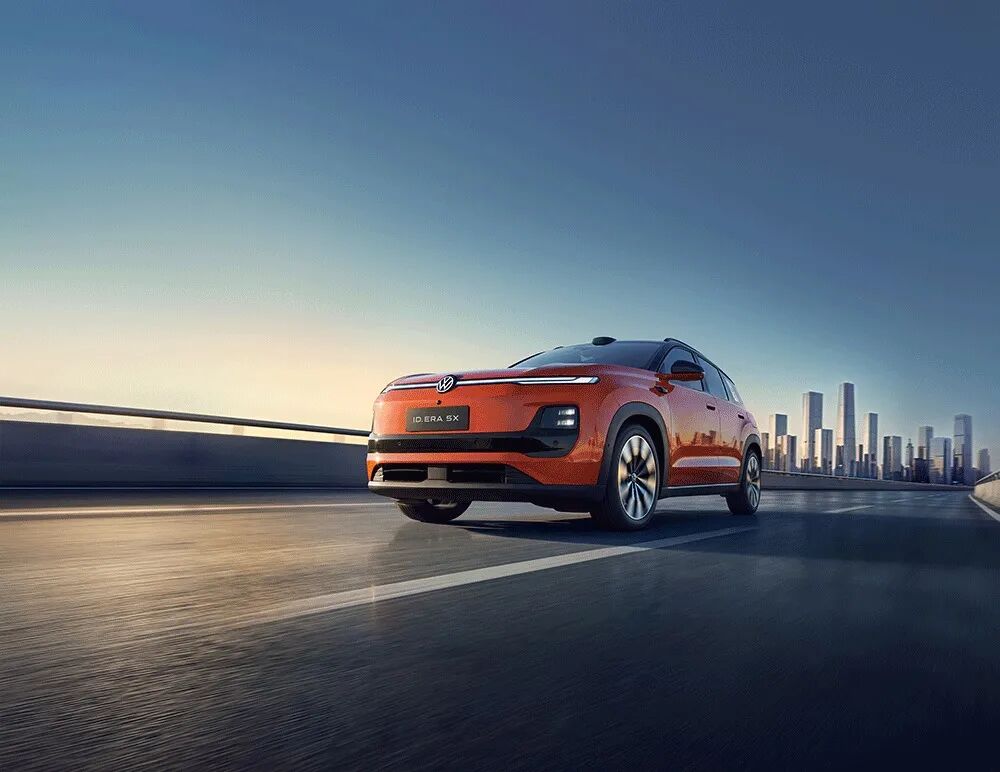
The money saved is not saved on equipment: the car is 4560 mm long, with a 2815 mm wheelbase, and offers two range options of 415 km and 520 km. All versions come standard with the 4nm MTK8676 cockpit chip and Doubao large model 2.0. The top Ultra version has a 192-line lidar and Horizon Journey 6H chip, with urban and highway navigation assist.

▲ Image source: SAIC Volkswagen
Fu Qiang, executive deputy general manager of sales and marketing at SAIC Volkswagen, said in October that the three models in the already-launched 985 series are all profitable. Only by making money can one have the confidence to underwrite a buyback bill two years down the road.
The second source of confidence is Volkswagen's assurance about the durability of its cars.
According to Volkswagen, the 5X is developed under the same standards as the flagship 9X and 8X, has passed more than 8,000 validation items, run more than 10 million kilometers of road testing, and undergone durability validation simulating 15 years and 300,000 kilometers. The 5X's battery bottom impact resistance is up to 2,000 joules—13 times the national standard requirement—and cuts off high voltage within 2 milliseconds in a collision.
SAIC Volkswagen is truly confident in this. On October 12, the day the 8X was launched, it livestreamed a jump test: driving the car onto a ramp, and after landing it continuously hit rocks and curbs; the battery pack did not smoke or catch fire. In another high-slope rollover, the doors could still be opened and the emergency call connected normally. Fu Qiang later revealed that from the marketing team proposing the livestream idea to the decision being made, it took only one day. The R&D and quality assurance teams dared to nod because they had already tested it repeatedly internally.
Fan Biou, deputy general manager of Shanghai SAIC Volkswagen Automobile Sales Co., Ltd., put it more bluntly: development can be accelerated, but validation cannot be cut.
The used price of an EV ultimately depends on whether the car remains reliable after several years—which happens to be where established automakers are most willing to spend and most skilled.
The third is discipline.
Wu Yun, general manager of SAIC Volkswagen, stated in a group interview in October that the company will participate in price competition, but does not accept a continuous-loss involution approach. Remember the earlier point? Only when new-car prices remain stable can used prices remain stable. With the buyback promise written out, "once the rules are established, using it won't burn your heart." If prices are not cut recklessly within two years, existing owners' cars will hold their value.
For buyers, what does this bill mean?
For first-time EV buyers, the biggest threshold is uncertainty: will the battery degrade, how much will it be worth after two years, and to whom will it be sold then?
The 5X's package of benefits addresses these questions together: a lifetime warranty for the three electric systems covers the battery, 3 million yuan in intelligent driving worry-free protection covers driver assistance, and the value-retention buyback covers the used price.
The buyback is also linked to car replacement: the limited-time benefit price value-retention buyback applies to purchasing new SAIC Volkswagen and SAIC Audi cars; SAIC Volkswagen's official statement is that if users want to change cars after two or three years, it will "meet user needs with continuously launched new products."
For families already planning to change cars every two or three years, this is equivalent to locking in the old car's price in advance. When the time comes, drive it back to the store, the old car is taken at the agreed price, and a new one can be swapped directly—saving the back-and-forth haggling with dealers.
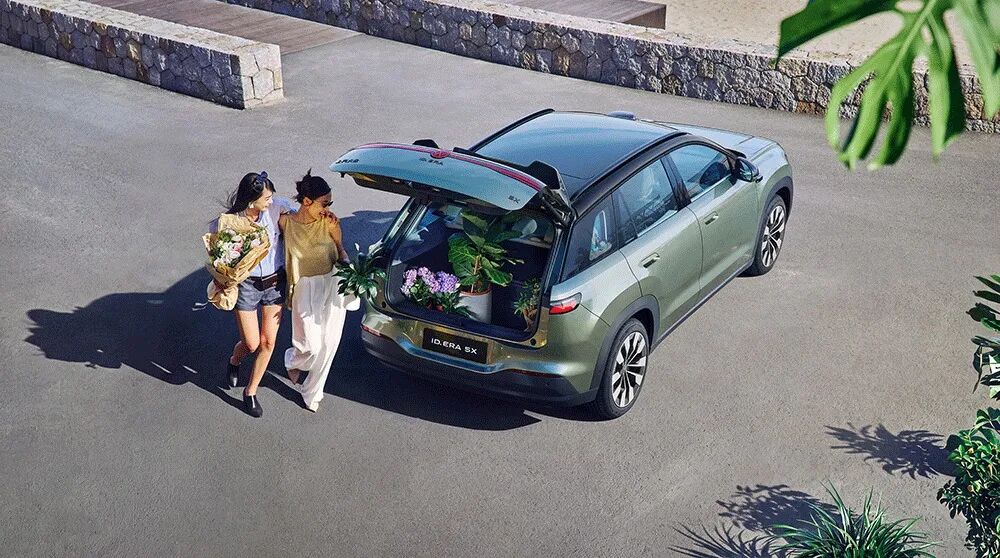
▲ Image source: SAIC Volkswagen
Volkswagen indeed has new cars to offer for replacement. The ID. ERA 5S launched in August this year has more than 20,000 orders; in September, SAIC Volkswagen sold 13,100 new energy vehicles, up 174.1% year on year; the flagship 9X locked 11,079 orders in the first hour of launch—a record for first-hour locked orders among joint-venture brand new energy models.
A few points to note
Whether maintenance must be done at authorized stores, whether there are insurance requirements, and what the mileage cap is—these details are not yet fully stated in currently public materials. Before placing an order, ask the store for written terms.
The campaign period marked on the poster is November 12 to December 31. After this window, it may no longer be available.
The 5X interior comes in three colors, with names chosen by user voting: Biying White, Wenying Black, and Tangying Gray.
This time, Volkswagen wants buyers to win steadily too.
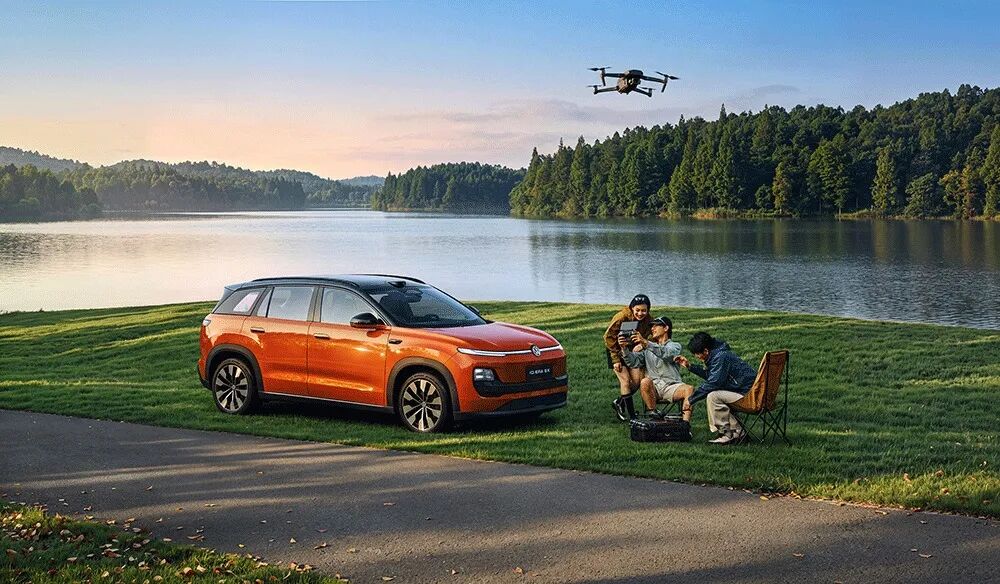
▲ Image source: SAIC Volkswagen
— End —
Smart Car Interstellar · Frontline observation of the intelligent vehicle industry
Follow Smart Car Interstellar to see the real accounts of the intelligent vehicle industry
Click "Wow" so more peers can see it · See you in the comments
Reference sources
[1] SAIC Volkswagen ID. ERA 5X launch press release, 2026-11-12 (reprinted by Leiphone and Sina Auto)
[2] NetEase Auto, 2026-11-12, ID. ERA 5X launch report (guide price 119,900–159,900 yuan)
[3] Sina, 2026-11-13, "What additional conditions are there for the Volkswagen ID. ERA 5X's three-year 70% value-retention buyback?" (benefit image: for users purchasing new SAIC Volkswagen or SAIC Audi cars; event period November 12 to December 31)
[4] Autohome Chejiahao, "SAIC Volkswagen ID. ERA 5X on sale from 99,900 yuan; what is scarcest is its certainty" (industry two-year pure EV residual value 53.4%, competitors' two-year 74,700 yuan, lifetime three-electric warranty, 3 million yuan intelligent driving worry-free protection)
[5] China Automobile Dealers Association, "October 2026 China Automobile Value Retention Rate Report," 2026-11-02; Kuai Technology, 2026-11-10
[6] NetEase Hao, 2026-11-13, "Has Volkswagen's second 'god-making era' arrived?" (CMP is Volkswagen's first fully locally developed new energy platform, 6 models in 18 months; Brandstätter: more than 500 new cars launched this year)
[7] Cover News, 2026-11-13, "Can be bought back at 70% after 3 years, SAIC Volkswagen ID. ERA 5X starts under 100,000 yuan" (CEA reduces control units by about 30%)
[8] Phoenix Net, 2026-10-15, "For joint-venture automakers, the era of making easy money is over" (Fu Qiang: all three 985 models are profitable)
[9] Sina Auto, 2026-10-14, "Behind the launch of ID. ERA 8X, SAIC Volkswagen rebuilds new energy competition coordinates" (Wu Yun group interview; 5S orders exceed 20,000)
[10] Sohu, 2026-10-19, SAIC Volkswagen September new energy sales 13,100 units, up 174.1% year on year
-
![]()
GAC Group Sells 143,687 Vehicles in October: How Should Aion and the Joint Ventures Redistribute Roles?
-
![]()
2.5x More Light Intake: Why Mobile Phone Cameras Need to Retire the 1974 Filter
-
![]()
What Chinese Automakers Look Like in the Eyes of European Policy Circles
-
![]()
Huawei Doesn't Build Robots, Yet 80% of Robot Companies Run on Its Cloud
-
![]()
Breaking! Changan Automobile Sells 10% Avatr Stake for 3.2 Billion Yuan—What's the Real Reason?
-
![]()
2-Year 80% Buyback: How Does SAIC Volkswagen Pull This Off?
-
![]()
Two Years Into End-to-End: How Far Has Each Automaker's Intelligent Driving Really Come?
-
![]()
iPhone 18 Ditches the Mute Button! Why Is Apple Fighting So Hard to Keep the Camera Button?