AI Competition Falls into "Verbal War": Why Do Enterprises Always Make Noise Instead of Polishing Products?
 12/01 2025
 678
678


The AI industry is at a critical juncture that will determine its future landscape. The choice between investing budgets in R&D to refine product experiences or squandering resources on creating noise and mutual attacks not only determines the success or failure of individual companies but also influences the development trajectory of the entire industry.
Content/Dilao
Edited by/Yonge
Proofread by/Mangfu
The history of business is replete with far more "primary school-style squabbles"—such as pouring boiling water on a competitor's money tree—than one might imagine.



Behind these seemingly absurd behaviors lies companies' anxiety over market share. When normal competitive means fail to yield quick results, some companies begin to seek shortcuts.
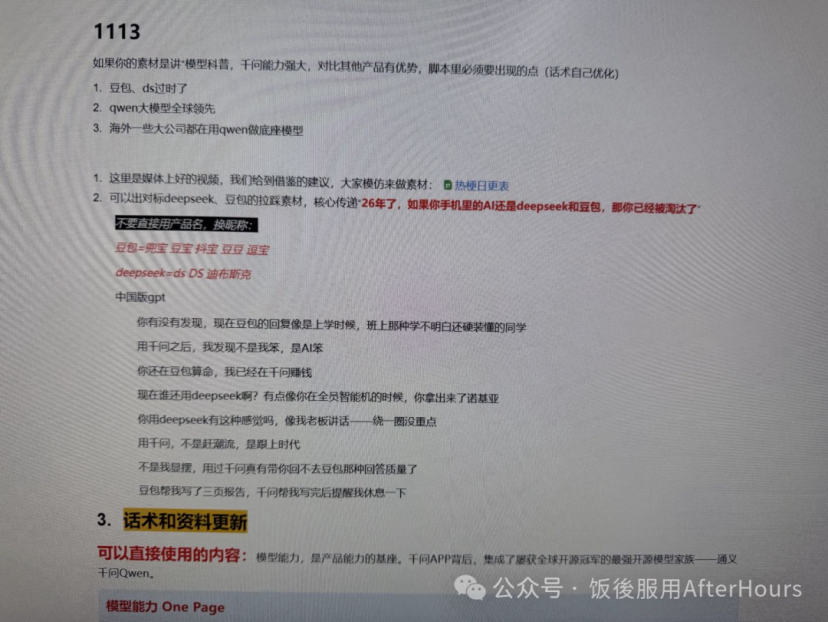
Today, in the AI field, such shortcuts take on a more sophisticated form. A circulating PR brief, packaged with professional jargon but following the same underlying logic, seeks to establish its position by belittling two competitors with hundreds of millions of monthly active users.
Part.1
AI Business Warfare
Dimensional Reduction from Technological Competition to Verbal Warfare
Compared to traditional industries, AI should represent a more advanced form of business civilization. However, certain competitive tactics exhibit a surprising "atavistic phenomenon."
Early business wars were closer to physical attacks, with direct and obviously destructive means. The furniture industry once saw anecdotes of "undercover" agents being hired to work as salespeople in rival flagship stores, driving away three store managers within a month. During the fierce battle of shared bicycles, extreme cases also occurred, such as throwing a large number of rival bicycles into rivers. The commonality of such competitions is that they attempt to gain an advantage by influencing or disrupting the physical operations of rivals. Although crude, their objectives are clear, and their actions are legally easy to define and hold accountable. With the advent of the digital age, the main battlefield of business wars has shifted from offline to online, and competitive tactics have upgraded to more covert psychological and cognitive warfare. Influencing consumer perceptions through public opinion guidance, reputation manipulation, and information smearing has become a new competitive weapon.
In the circulating brief, the most controversial aspect is not the affirmation of its own products but the direct belittlement of competitors. Labeling products with hundreds of millions of monthly active users as "obsolete" not only severely contradicts the facts but also crosses the bottom line (dixian, moral bottom line ) of business ethics.
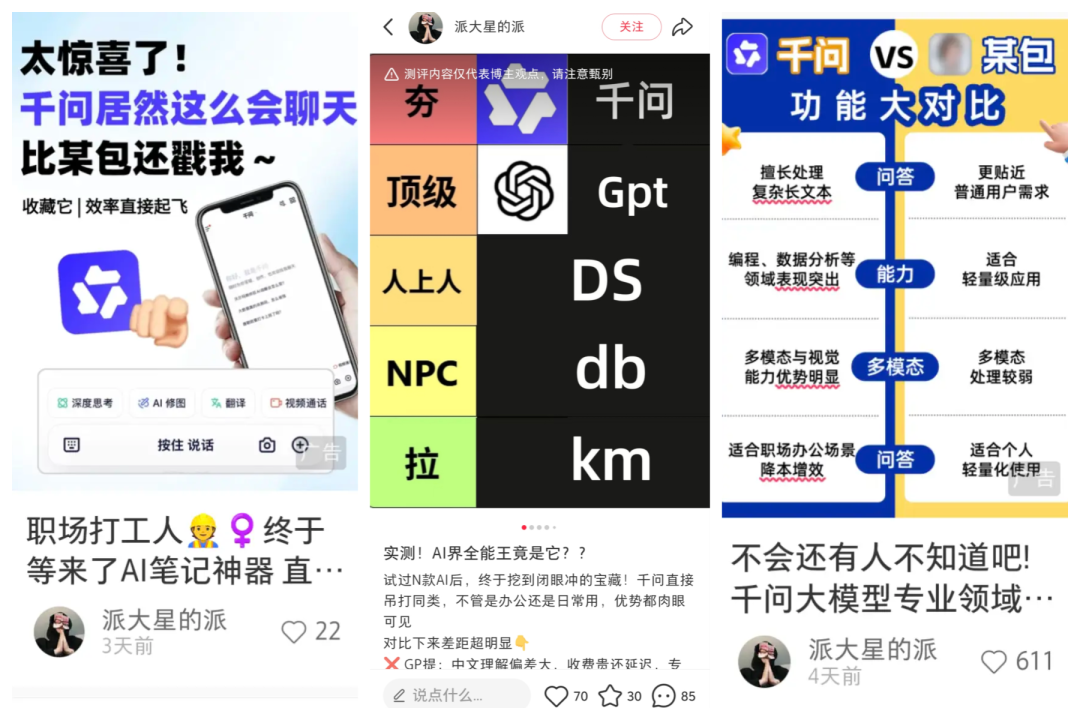

Both DeepSeek and Doubao serve hundreds of millions of users. Simply defining these products as "stupid" and "outdated" neither aligns with industry realities nor shows basic respect for the efforts of peers.
What's even more ironic is the analogy to "Nokia." Today, Nokia remains one of the world's top three telecommunications equipment vendors, with annual revenues exceeding 200 billion yuan. Such a simplistic and crude analogy reveals ignorance of industry history and disdain for competitors.
Part.2
Budget Misallocation
Why Does Noise Always Drown Out Substance?
Business competition should ideally be a contest of products and technologies, a fair game of user experience and market choice. However, under market competition pressures, some companies choose shortcuts. The "business warfare" behavior reflects companies' multiple anxieties over market share, capital expectations, and public attention. Especially in an industry like AI, characterized by rapid technological iteration, capital intensity, and high public scrutiny, companies often face a survival pressure of " No progress means regression. " (bu jin ze tui, fail to advance and you'll fall behind). When technological breakthroughs are hard to achieve overnight and product experiences cannot be surpassed in the short term, some companies turn to creating noise, highlighting themselves by belittling rivals, and attempting to seize a high ground in user perception. However, this shortcut logic essentially underestimates users' judgment and harms the industry's long-term development. AI is not a fast-moving consumer good; users will not stick with a product lacking substantive value just because of temporary public opinion trends. When companies pour resources into sounding better rather than performing better, they have actually deviated from the original intent of technological innovation. Given limited resources, every budget allocation by a company represents its strategic focus and value orientation. When a company invests heavily in creating noise rather than solidifying its internal capabilities, it is essentially engaging in strategic short-sightedness and speculation.
"Pouring boiling water on a money tree" requires sneaking into a rival's company at night, while researching competitors may involve wall-climbing. However, belittling rivals, to some extent, only requires a PR brief and a corresponding channel placement budget. From an execution cost perspective, verbal wars are undoubtedly a more economical choice.
However, this economy is a typical short-sighted behavior. When companies invest heavily in creating market noise rather than solidifying technological capabilities, they are essentially engaging in speculation. Users may be temporarily attracted by noisy marketing, but they will ultimately only pay for tangible product value. When the tide recedes, companies without technological moats, relying solely on marketing rhetoric, will eventually be exposed in the cruel (canku, brutal) market competition.
Especially in high-tech fields, where technological iteration is rapid, today's leaders may be overtaken by new technological routes tomorrow. In the AI race, which is destined (zhuding, destined) to be a marathon, maintaining an open and learning mindset, respecting every serious competitor, and drawing nourishment from others' successes and failures are key to winning in the long run.
As an industry observer noted, "You can say your model performs better in certain dimensions, but you have no right to judge that a competitor 'should be eliminated.'" This judgment always lies with users, the market, and time.
Part.3
Levels of Competition
Technology, Products, or Vision?
China's AI industry is at a critical development stage, needing not internal friction but synergy; not mutual sabotage but common progress. Every move by leading companies sets a benchmark for the entire industry, influencing capital, policy, and public perception.
When a company chooses "belittling" as its primary competitive tactic, it actually reveals a lack of confidence in its own products. Truly powerful products do not need to prove themselves by belittling rivals.
The innovative value of DeepSeek, Doubao's deep cultivation in application scenarios, and Qianwen's efforts in model open-sourcing all deserve recognition. Diversified technological routes and product approaches are precisely what makes China's AI industry vibrant.
This incident also prompts deeper reflection: What kind of competitive ethics should we establish in the emerging AI industry?
Competition should be based on facts and data, engaging in transparent and professional contests on objective dimensions such as technical parameters and user experience, rather than relying on subjective judgments and emotional belittlement. Second, competition must adhere to the bottom line (dixian, moral bottom line ) of business ethics, meaning not only complying with explicit laws and regulations like the "Anti-Unfair Competition Law" but also safeguarding the industry's overall image and fundamental interests, avoiding negative-sum games that harm all.
Furthermore, companies need to possess a true sense of vision, recognizing that the current competition dimension has already elevated. The real competitors are not domestic peers but how to unite China's strengths on the grand global AI stage, securing a crucial position in technological frontiers, standard-setting, and ecosystem construction.
Fortunately, the market will ultimately deliver the fairest judgment. Users will choose products that truly create value for them, and time will prove which companies can go further.
END
-
![]()
Chery's 'Audi Suit Gangster' Makes Waves with Unbeatable Pricing. Netizens React: 'Is This the Aorui A6L?'
-
![]()
AITO Takes a Bold Leap, Forms Joint Venture with BMW and Mercedes-Benz
-
![]()
How Does the Cloud Data Engine Transform Physical Labor into Technical Work for Autonomous Driving Annotators?
-
![]()
Historic Strongest Mercedes-Benz GLE L Faces Intense Competition from Domestic 9 Series
-
![]()
Jeff Dean's First Entrepreneurial Venture After Leaving Google: Why Launch an AI Company 'Not Aiming to Make Money' at This Juncture?
-
![]()
Caught in the Traffic 'Web'
-
![]()
Alibaba's AI Offensive: Over Half of Investment Allocated, Time to Reap Returns
-
![]()
Alibaba’s AI Push: Over Half of Investments Made, Time to Harvest Returns