Hot Spot丨Quark AI Glasses Unveil Six Models, Merging QianWen + Alibaba Ecosystem for [All-Round] Capabilities
 12/01 2025
 737
737
Preface:
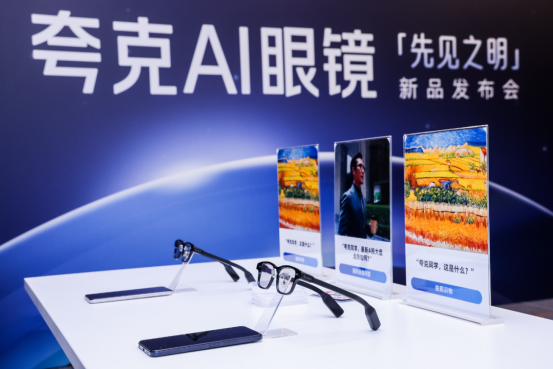
Alibaba has officially introduced Quark AI Glasses, launching six models across two distinct series—S1 and G1. This isn't merely a product unveiling; it marks a significant stride in Alibaba's AI-to-consumer strategy, extending its reach from software to hardware realms.
Facing competition from industry giants like Meta, Xiaomi, and Baidu, the arrival of Quark AI Glasses signals the commencement of an ecosystem battle within the AI glasses sector.
Redefining the [All-Strength] Experience in AI Glasses
In the AI glasses industry, the "[Impossible Trinity]"—balancing performance, battery life, and functionality—remains a formidable challenge for manufacturers. They often face tough choices: prioritizing performance at the cost of battery life, pursuing portability by sacrificing functionality, or piling on hardware while overlooking user experience.
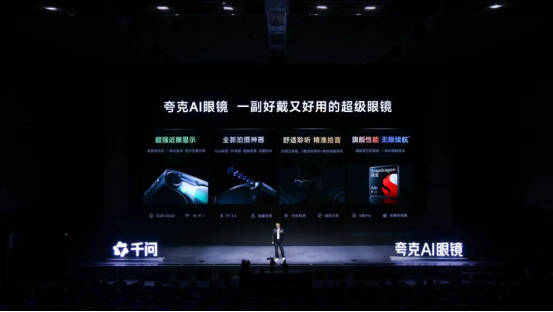
The hardware configuration of Quark AI Glasses S1 sets a new industry standard, featuring a dual-chip architecture: Qualcomm AR1 and BES2800 from BES Technic.
The Qualcomm AR1, a professional-grade processor for mixed reality devices, delivers robust graphics rendering and AI computing capabilities, enabling real-time computation for complex AR scenarios.
The BES2800, with its low-power advantage, manages voice interaction and sensor fusion, striking a perfect balance between performance and battery life.
This dual-chip design isn't a simple stack; it's a coordinated hardware-software scheduling system that ensures seamless multitasking while effectively controlling power consumption.
For display technology, the S1 boasts a JBD monochrome green Micro-LED light engine and a diffractive waveguide from ZHIG Technology, featuring a dual-optical-engine binocular display design.
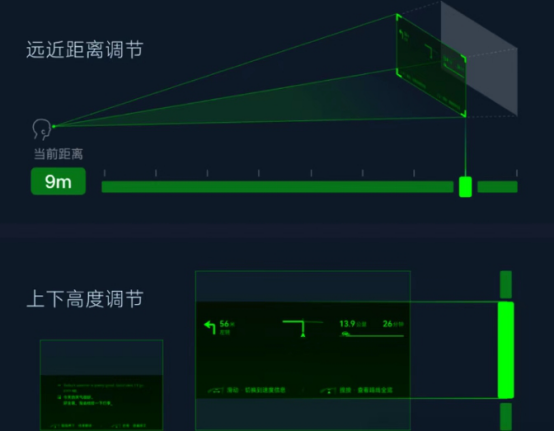
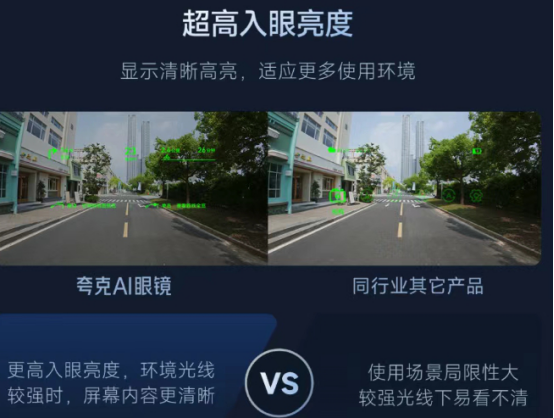
It introduces an adjustable focal distance function, allowing display distances to be freely adjusted between 2-10 meters, with a brightness of up to 4000nits.
Imaging capability is another standout feature of Quark AI Glasses. Equipped with a Sony IMX681 flagship sensor and a 12-megapixel ultra-wide-angle lens, it supports 0.6-second rapid capture and 3K video recording. Post-processing via super-resolution and super-framing technologies ensures 4K-quality output.
The Super Raw low-light enhancement technology brings smartphone-grade imaging algorithms to smart glasses. Paired with a dual stabilization system, it captures detailed, color-accurate photos even in low-light conditions, revolutionizing the "[daytime-only, nighttime-useless]" shooting dilemma of AI glasses.
Quark AI Glasses introduce an innovative dual-battery swappable design, with hot-swappable battery support in the temple arms and a MiniBag battery pack enabling seamless "[one-use, one-replace]" transitions. This fundamentally addresses the battery life pain point of smart devices.
Additionally, the product supports POGO magnetic charging and case charging, offering three charging solutions to cover various usage scenarios and ensure all-day battery life.
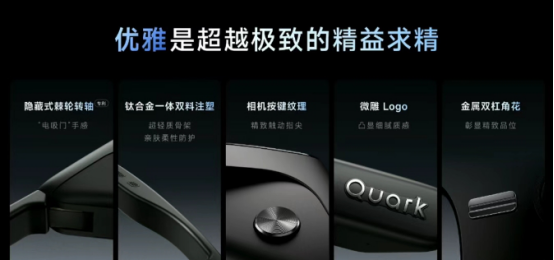
It features ultra-thin temple arms and a slim frame design, with temple arms measuring just 7.5mm wide and frame thickness at 3.3mm—25% thinner than industry mainstream products—closely resembling the visual appearance of regular glasses.
Alibaba's Full-Link Empowerment: The Differentiated Edge
While the AI glasses industry generally grapples with the dilemma of "[easy hardware stacking but difficult ecosystem integration]," Quark leverages Alibaba's ecosystem advantages to build a competitive barrier that's hard to replicate.
Quark AI Glasses integrate core Alibaba applications, constructing a full-scenario service matrix covering payments, travel, shopping, entertainment, and office tasks.
Alipay's contactless payments, Gaode Maps' near-eye navigation, Taobao's instant price comparison via image recognition, Fliggy's travel reminders, and Alibaba Travel's business trip management—these high-frequency applications require no additional downloads and can be instantly activated via voice commands, enabling "[phone-free]" operation.
Take the "[travel-consumption]" journey as an example: users can activate Gaode navigation via voice, ride to their destination, and directly scan the merchant's QR code with their glasses to complete Alipay payment.
When shopping, the camera recognizes products and automatically matches Taobao prices, generating cost-effectiveness recommendations. On business trips, Fliggy's synchronized flight information seamlessly connects with Alibaba Travel's schedule, providing proactive reminders for important events.
This closed-loop experience of "[hardware + software + services]" is unmatched by competitors like Meta Ray-Ban, which lacks localized payment capabilities, or Xiaomi, which focuses solely on the "[human-car-home]" ecosystem.
To break free from application scenario limitations, Quark AI Glasses will support the MCP protocol in the future, fostering a developer ecosystem.
Currently, the product has partnered with high-quality third-party platforms like NetEase Cloud Music, QQ Music, and Flight Manager to further enhance information services for music listening and travel scenarios.
In the future, as more developers join, AI glasses will expand into practical scenarios in education, health, office tasks, and more.
The Trillion-Dollar Market: From Nurturing to Explosive Growth
The rise of AI glasses is no accident; it's the result of technological advancement, market demand, and ecosystem maturity.
According to IDC data, global smart glasses shipments reached 4.065 million units in the first half of 2025, up 64.2% year-on-year, with the Chinese market surging by 116.1%.
Omdia research indicates that driven by accelerated entry from leading manufacturers, the AI glasses market is expected to exceed 10 million units by 2026 and reach 35 million units by 2030, with a compound annual growth rate (CAGR) of 47% from 2025-2030, forming a trillion-dollar market scale.
The technical challenges in the AI glasses industry lie not in hardware but in AI empowerment and ecosystem integration.
Large model companies will become the core players in this track, with Alibaba, ByteDance, and Tencent holding the tickets to industry advancement.
Continuous technological upgrades are the core driving force. Display technologies like waveguides and MicroLED will keep breaking through, pushing devices toward thinner, lighter forms with clearer image quality.
Improvements in on-device AI chip computing power and reduced power consumption will significantly enhance device responsiveness and local processing capabilities. Material innovations will address bottlenecks like glass transmittance and battery energy density, enabling more compact product forms.
On the consumer side, AI glasses will gradually replace some high-frequency smartphone functions, becoming portable terminals for payments, navigation, and photography.
Industry-wise, they will find applications in industrial inspection, medical surgical navigation, logistics sorting, and more, enabling practical scenarios like AR remote annotation for equipment maintenance.
Leading manufacturers will continue to strengthen ecosystem closed-loop construction, attracting more third-party developers. Multimodal interactions like voice, eye-tracking, and touch will keep fusing, and future devices may even integrate brain-computer interfaces for more natural control experiences.
AI glasses will evolve from "[passive command responders]" to "[proactive demand perceivers]," becoming the core terminal for "[human intelligent sensory extension]."
Conclusion:
Currently, the AI glasses industry is in a stage of "[hype and prosperity coexisting]." The hype stems from the disconnect between experience and expectations, while the prosperity arises from users' genuine demand for "[hands-free]" convenience.
In the future, competition in AI glasses will no longer be a single hardware battle but a comprehensive contest of ecosystem integration capabilities, technological innovation speed, and user experience refinement.
The core competitiveness of the next-generation computing platform lies in its ability to translate technological capabilities into perceivable life value for users and to build an open, win-win ecosystem.
Partial references: AGI Interface: "[We Tried Quark's Latest AI Glasses—Can They Help Alibaba Win the Battle for Traffic Entry?]," China Business Network e-Circle: "[Quark AI Glasses Enter the Fray with QianWen—Giants Bet Big on the Next Mobile Entry Point]," EEO.com: "[Luo Zhenyu Endorses—Alibaba Enters a New Frontier!]," XR Vision: "[Alibaba Takes a Key Step in AI-to-C—Releases the Best AI Entry Point, Firsthand Experience Review]," Financial Associated Press AI Daily: "[Quark Glasses Deliver—Alibaba's [Full-Stack AI] Strategy Forms a Closed Loop]"
-
![]()
"Tech Ferrari" Xiangjie RX: Yu Chengdong’s Glowing Review Sparks Wild Netizen Speculation: Is It the YU7?
-
![]()
Chery's 'Audi Suit Gangster' Makes Waves with Unbeatable Pricing. Netizens React: 'Is This the Aorui A6L?'
-
![]()
AITO Takes a Bold Leap, Forms Joint Venture with BMW and Mercedes-Benz
-
![]()
How Does the Cloud Data Engine Transform Physical Labor into Technical Work for Autonomous Driving Annotators?
-
![]()
Historic Strongest Mercedes-Benz GLE L Faces Intense Competition from Domestic 9 Series
-
![]()
Jeff Dean's First Entrepreneurial Venture After Leaving Google: Why Launch an AI Company 'Not Aiming to Make Money' at This Juncture?
-
![]()
Caught in the Traffic 'Web'
-
![]()
Alibaba's AI Offensive: Over Half of Investment Allocated, Time to Reap Returns