Is Qianwen Set to Take Center Stage, Leaving Kuake as the Fall Guy?
 12/03 2025
 704
704
Once a major corporation undergoes strategic shifts, anyone within its ranks can become a scapegoat.
When it comes to who will spearhead Alibaba's AI ambitions on the consumer front, Kuake was once the undisputed choice.
There are two main reasons for this. Firstly, Kuake boasted a claimed user base of 150 million, providing a solid foundation. Secondly, Alibaba lacked a standout AI product, Tongyi Qianwen included.
As a result, Kuake's role as a browser and its strong ties to search within the ecosystem made it Alibaba AI's cornerstone on the consumer side for a time.
But the landscape has since evolved.
Alibaba recently unveiled two AI assistant products, Qianwen and Lingguang, with subtle shifts in their positioning and promotion. Qianwen has now emerged as the frontrunner, seemingly leaving Kuake out in the cold.
▌1. Racing Horses or Strategic Shifts?
Alibaba's multi-pronged approach to AI on the consumer side raises questions: Is it a horse race, a diversified strategy, or an ecological positioning? This is tricky to answer because, after two and a half years of the "Hundred Models War," neither approach seems to be favoring Alibaba AI at present.
In mid-November, Alibaba introduced the Qianwen AI assistant, reaffirming Qianwen as the linchpin of Alibaba's AI strategy on the consumer side.
In fact, Qianwen is not a newcomer but a rebranded version of Tongyi Qianwen, which was launched two years ago.
In April 2023, as one of the early entrants in the Hundred Models War, Alibaba rolled out the Tongyi Qianwen large model, alongside offerings from 360 Zhinao and iFlytek Spark.
However, Tongyi Qianwen's growth was sluggish.
Compared to the rapid rollouts of large model products by Baidu, ByteDance, and Tencent for consumers, as well as the explosive self-growth of Kimi and DeepSeek, Tongyi Qianwen remained largely under the radar for an extended period.
QuestMobile data reveals that among the top three AI applications by monthly active users in China in September this year, Doubao, DeepSeek, and Tencent Yuanbao claimed the first, second, and third spots, with MAUs of 172 million, 145 million, and 32.86 million, respectively. Tongyi ranked tenth, with a mere 3.06 million monthly active users.
In contrast, Alibaba's AI presence on the consumer side has been primarily carried by Kuake. In QuestMobile's data, there's an In-APP AI ranking where Kuake AI Search secures the tenth spot, with 63.59 million monthly active users.
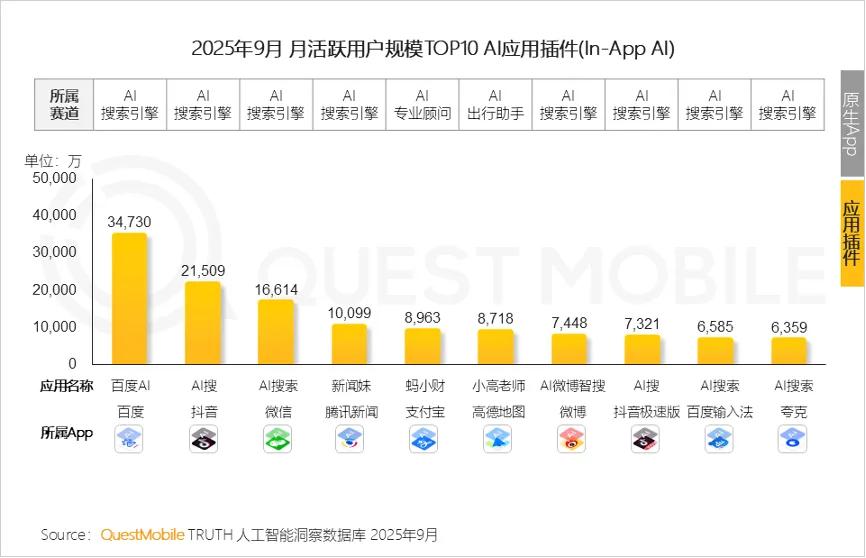
In-APP AI differs from native AI applications in that it involves built-in AI plugins. Kuake's search, which leverages a large model, can thus be classified as AI search.
So far, it's evident that Alibaba AI lacks a dominant presence on the consumer side. Despite a plethora of products, there's no clear leader. To date, Alibaba's consumer-side AI applications encompass Tongyi Qianwen, Qianwen, Lingguang, Kuake, and AQ, a medical vertical.
The relaunch of Qianwen also signifies that Alibaba is essentially starting from scratch.
After more than two years of the Hundred Models War, Alibaba's AI still lacks a solid foundation and clear positioning on the consumer side. For instance, Tongyi Qianwen underwent a name change to Qianwen after previously being renamed "Tongyi" for a period.
Prior to Qianwen's launch, reports surfaced that Alibaba had mobilized hundreds of engineers to work in secret, designating two floors of its Hangzhou headquarters as an exclusive project area. Simultaneously, it was developing an international version of the Qianwen APP for the global market, aiming to compete with ChatGPT for overseas users.
There were also dramatic rumors suggesting that Alibaba's secret project was AI-related, fueled by "long queues at the Cantonese cuisine window in the cafeteria, with roast duck rice selling out," a quirky anecdote reminiscent of historical lore. This was based on the industry rumor that "China's AI scene looks to Guangdong," with AI luminaries like the founder of DeepSeek and the head of the Qwen large language model hailing from the region.
▌2. What Ails Kuake?
Ultimately, Alibaba still finds itself significantly behind.
Within a week of Qianwen APP's public beta, downloads surpassed 10 million. Another domestic AI assistant, Ant Lingguang, exceeded 2 million downloads in just six days. Alibaba claimed both outperformed ChatGPT, Sora, and other products during their respective launch periods.
But in reality, Doubao now boasts 170 million active users, DeepSeek 150 million, and Tencent Yuanbao 32.86 million. The products are not even in the same league.
Why did Alibaba shift its AI focus on the consumer side from Kuake to Qianwen?
There are three primary reasons for this.
Firstly, Kuake cannot escape its positioning as a search tool, leaning heavily towards being just that;
Secondly, its user base is predominantly young. Over the years, in its external promotions and product acquisitions, Kuake has overly emphasized video viewing and quiz-solving functions, akin to Thunder in the PC era and CamScanner in the mobile internet era, indicating its user demographic;
Thirdly, Kuake is not a native AI application and cannot fully realize the ambitions of AI large models.
Initially, Kuake was a browser product under Alibaba, primarily targeting young users with features like photo quiz-solving, video search, document scanning, and cloud storage, blending tool and browser functionalities.
In March, Kuake underwent a comprehensive overhaul, launching the "AI Super Frame," with the core idea of achieving "ALL in One." At the time, Kuake CEO Wu Jia mentioned that the new Kuake completely abandoned the traditional search box concept, with the "AI Super Frame" infinitely approaching a personal super all-around assistant.
During the AI application boom, Alibaba once promoted Kuake as the mainstay product in the search scenario.
Simply put, Alibaba equated AI competition with search, and Kuake was search.
However, as AI entered the era of widespread adoption, the role of AI assistants expanded beyond search. Kuake could no longer satisfy the mental positioning of a large model assistant in a multimodal context.
Latepost reported on the differing positioning of Qianwen and Kuake,
"Kuake has its original user and product base and is a product used by young people. With the enhancement of AI capabilities, we believe conversational AI assistants are a superior form. Next, Alibaba will focus on developing Qianwen and integrate it into Kuake. Kuake's positioning is AI search and AI browser."
Qianwen represents the AI Alibaba aspired to pursue, while Kuake is confined to the search scenario.
As its consumer-side applications gained traction, Alibaba began to reevaluate how AI should be applied. Initially, Alibaba treated AI on the consumer side as mere search but later realized that competitors had already surpassed this narrow view.
▌3. Will Kuake Be the Fall Guy?
In comparison, ByteDance and Tencent are far ahead of Alibaba in their consumer-side AI deployments.
Today (December 2), ByteDance launched the Doubao Mobile Assistant, once again igniting the market.
It is understood that the Doubao Mobile Assistant is an AI assistant software developed in collaboration with mobile phone manufacturers at the operating system level, leveraging the capabilities of the Doubao large model and authorized by mobile phone manufacturers. Currently, this version can be experienced on the engineering prototype nubia M153, a collaboration between Doubao and ZTE.
Doubao explicitly stated that this is a product requiring collaboration with mobile phone manufacturers and is currently in talks with several mobile phone manufacturers for assistant collaborations.
Since the widespread adoption of large models, Doubao has repeatedly set the market ablaze and even popularized the Doubao concept due to its strong consumer appeal.
In fact, the market pays less attention to the fact that, besides the Doubao APP, ByteDance has also developed related products like the Doubao Input Method, with its rapid voice input recognition capabilities being quickly enhanced.
Behind ByteDance's status as a traffic giant lies its ability to excel at identifying usage scenarios for ordinary users. For instance, Doubao has always prioritized speed and practicality from the outset, never focusing on reasoning capabilities.
Thus, ByteDance's approach is entirely distinct from Alibaba's. ByteDance's seed has even encountered repeated setbacks, far from the influence of Alibaba's Qwen in the model domain.
Another leading AI company, Tencent, has a layout similar to ByteDance's.
After waging a lightning war early in the year, besides Yuanbao not gaining traction, WeChat, Tencent News, and WeChannel have all funneled their traffic towards Yuanbao.
Furthermore, after Tencent Yuanbao transferred from TEG (Technology Engineering Group) to CSIG (Tencent Cloud and Smart Industry Group) earlier this year, more products and applications like QQ Browser, Sogou Input Method, and AI Smart Workstation IMA will also be integrated into CSIG.
We find that Tencent and ByteDance have essentially formed a similar product matrix, both adopting a vertical layout from the input end to the tool end and then to the product end. Besides their flagship products, they generally cover all mainstream tools of the current AI large models.
However, Alibaba adopts a horizontal layout, with AQ in the health sector, Kuake in the search sector, and Lingguang differentiated from Qianwen, utilizing Ant's Bailing large model.
Amidst the confusion, a thread of logic emerges.
Just like Kuake integrating Qianwen, allowing users to directly access Qianwen products within Kuake, this approach seems both plausible and somewhat amiss.
This feeling becomes clearer when we examine another Alibaba product.
Alibaba did not directly transform Ele.me for food delivery but added a Flash Sale channel to Taobao, launching the Taobao Flash Sale brand.
Ele.me and Taobao Flash Sale operate concurrently, and when consumers enter merchant stores through the Flash Sale channel, they still utilize Ele.me's system, pages, and infrastructure, including its delivery capabilities.
Later, when Alibaba introduced new uniforms for Taobao Flash Sale, there were situations where two sets of uniforms coexisted: blue Ele.me uniforms and "racing" Taobao Flash Sale uniforms.
Subsequently, Ele.me riders collectively switched to Taobao Flash Sale uniforms, and there were even rumors that the Ele.me APP would officially be renamed Taobao Flash Sale, with the two systems eventually merging.
This operational logic follows a similar path in the AI product matrix. Then, the question arises: Isn't Kuake the "Ele.me" that will ultimately be sacrificed in the food delivery ecosystem?
-
![]()
Alibaba's AI Offensive: Over Half of Investment Allocated, Time to Reap Returns
-
![]()
Alibaba’s AI Push: Over Half of Investments Made, Time to Harvest Returns
-
![]()
Chinese Enterprises Going Global 3.0: From World Factory to AI Infrastructure Builder
-
![]()
Honor RobotPhone Review: Half Movie Camera, Half Robot
-
![]()
AI-Driven Cheating Surges in Universities! Online Exams Reduced to Mere Formalities, Degree Credibility on the Line
-
Insta360’s Decade in Panoramic Imaging: Making Cameras ‘Invisible’ and Returning Creation to the Masses
-
![]()
Foreign Media Claims Apple is Concentrating Resources on AI Development: Vision Pro and Siri Teams Lay Off 200 People
-
Big News! Huaneng and Huawei Hold Talks in Shenzhen with Ren Zhengfei in Attendance; Huawei Emerging as the 'Second Brain' of China's Energy System