Doubao's Capabilities and Boundaries
 12/04 2025
 642
642
Article by Zhe Zongming
Often, the future is a continuation of the past. Looking back through history's rearview mirror can, from a unique vantage point, serve as a telescope into what lies ahead.
More than a decade ago, Zhang Yiming stated in a speech, "The crux of information distribution isn't the information itself, but the method of distribution. Baidu's search engine, Tencent's social networking, and Alibaba's e-commerce are all, in essence, forms of information distribution. Information distribution must cater to personalized needs based on human requirements."
This raises the question: How can information distribution address the challenge of personalization?
Zhang Yiming's solution was to leverage algorithms to shift from 'people seeking information' to 'information finding people'.
The subsequent developments are well-documented: Today's Headline and Douyin (TikTok) rose to prominence, transforming how Chinese people access information and establishing ByteDance as an internet behemoth.
Now, it appears ByteDance aims to replicate its success in redefining information distribution platforms by doing the same for AI-powered smartphones.
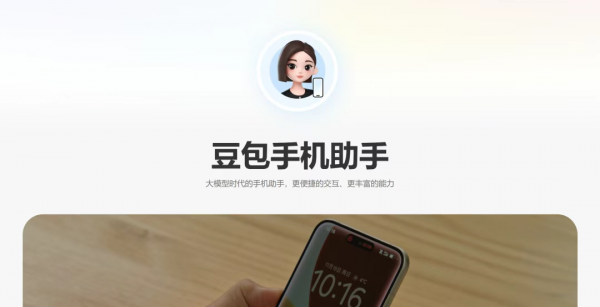
The recent buzz surrounding 'Doubao and ZTE collaborating to launch an AI smartphone' and 'the debut of the Doubao mobile assistant' serves as testament to this ambition.
In today's landscape, where 'redefinition' has itself been redefined, claiming that Doubao is redefining AI smartphones may seem cliché.
However, Doubao offers a glimpse into what the 'iPhone moment' for AI smartphones might entail. Its essence can be distilled into two words: user-centric service.
01
They say, 'No supernatural beings for animals in the modern era,' but the AI age should allow smartphones to transcend ordinary capabilities.
A glimpse of this future can be seen in the prototype video demonstration released by Doubao:
When a user intends to shop online, there's no need to individually open Taobao, JD.com, or Pinduoduo. A single verbal command suffices, and Doubao automatically compares prices, reminds the user to place an order, and fills in the address.
Similarly, ordering food delivery doesn't require opening Meituan, Taobao Flash Sale, or JD Food Delivery. Booking hotels doesn't necessitate opening Ctrip, Fliggy, or Qunar. A single verbal command handles everything, with Doubao taking care of the rest.
Envision this scenario:
Zhang Mazhi asks Tang Shiye, "Can you translate what 'surprise' means?" Tang Shiye pulls out the nubia M153 (the engineering prototype of Doubao's collaboration with ZTE) and operates it seamlessly: eating hotpot and singing, with all tasks managed by the Doubao mobile assistant.
Then comes an interstitial ad: Online shopping, traveling, hailing a ride, buying medicine, ordering food delivery... Just use Doubao!
At this juncture, someone might remark, "Oh, it's just a System-level Agent with High-privilege access, right?"
This comment is akin to mocking Steve Jobs for introducing the iPhone over a decade ago with, "It's just a capacitive touchscreen with multi-touch gestures and integrated hardware and software."
Don't underestimate an interaction revolution, just as you shouldn't dismiss the refactoring (restructuring) of information distribution methods as mere paradigm shifts.
When compared to commonly seen AI smartphones on the market today, the difference becomes stark.
Many current AI smartphones incorporate 'large models on smartphones,' but the synergy between AI and smartphones usually stops at voice assistants or local inference by small models, representing a superficial level of 'integration'.
Doubao's embedded AI smartphone, on the other hand, enables 'large models to take over the smartphone,' allowing AI to directly invoke services across applications.
The former represents mere addition, while the latter signifies true restructuring.
02
So, what's the most significant difference brought about by the Doubao mobile assistant?
I believe it's the transformation from 'people seeking services' to 'services finding people'.
After entering the mobile internet era, we've become accustomed to using App A for online shopping, App B for food delivery, and App C for travel... These apps excel in their respective domains, with their mental anchor points often tied to their high-frequency uses.
Consequently, people have grown accustomed to addressing different needs through different apps, often switching between multiple apps for multifaceted requirements.
Essentially, when people open a specific app to use its services, it's 'people seeking services'.
So, what changes will occur in the AI era?
The 'Flash Sale Wars' initiated by Alibaba, Meituan, and JD.com have already provided an indirect answer: In the future, people will demand one-stop services covering all life scenarios, corresponding to a 'super entrance'.
Thus, these companies will address their shortcomings based on their strengths, focusing on the two core pieces of the puzzle: 'e-commerce' and 'local life services'.
In fact, both Taobao's AI Universal Search and Meituan's 'Ask Xiaotuan AI' have realized 'services finding people' within their apps.
Similarly transforming from 'passive response' to 'proactive service,' this is limited to within their respective apps. Taobao can help you with 'services finding people,' but you must first open the Taobao app.
Doubao bypasses apps, elevating 'services finding people' to the terminal level. It's not just a widget component but embedded at the system's core. With a simple voice command, it can utilize GUI Agent (Graphical User Interface Agent) to get things done for you.
While other apps strive to become 'super entrances,' allowing you to fulfill multiple needs within a single app,
Doubao transcends individual apps, becoming the ultimate unified entrance on your smartphone. With a single command, it leverages capabilities like full-screen reading (Vision), simulated touch (Action), and cross-app invocation (Orchestration) to meet your needs.
In other words, it achieves a more profound and extensive 'services finding people' through system-level AI integration.
To some extent, if Pinduoduo can be seen as the 'Today's Headline' where 'products are information,' then the AI smartphone Doubao aims to create embodies the concept of 'services are also information'.
Reflecting on the past, many content platforms utilized technology to alter content creation modes, whereas Today's Headline reshaped information distribution methods through technology. Compared to the former, the latter represents a more 'fundamental' restructuring.
At this moment, it's as if history is repeating itself.
03
The next two questions are also of great concern to many: Why smartphones? Why ZTE?
Let's address the first question: Why smartphones?
In the AI era, the notion that 'an AI company that doesn't venture into hardware isn't a true giant' is far from absurd.
No matter how strong your AI capabilities are, if they're confined to another's terminal, your AI can only manifest in the form of an app.
Why are companies like Alibaba and Xiaomi promoting AI glasses, while Huawei and Tencent have their respective smart wearable devices?
Because to become the hub of users' digital lives, software and hardware must work in tandem.
The essence of software-hardware synergy is that you can't just have 'software'; you must also possess 'hardware.' You need both.
However, it's undeniable that while many major players aspire to launch 'the next smartphone-level terminal,' most devices fall short due to limited usage scenarios, low interaction frequency, and short battery life, making it difficult to deliver a truly all-day intelligent experience.
Smart speakers and earphones can hear but not see; VR headsets must first address motion sickness issues; AI glasses, like those from Kuake, have resolved battery life and aesthetic concerns, but their widespread adoption remains uncertain.
At least for now, smartphones, equipped with a full suite of modules including cameras, microphones, positioning, communication, and sensors, remain the most intimate and frequently used digital terminals for the masses. They are the only devices capable of perceiving user intentions around the clock and executing complex tasks.
With over 54 million daily active users (DAU), Doubao firmly holds the top spot in China's AI native app market.
Its ambitions clearly extend beyond being a quiet AI assistant in app form.
Thus, ByteDance, after exploring various 'end-side intelligent hardware' paths, inevitably returns to smartphones as the focal point of the 'AI entrance battle'.
04
Now, let's tackle the second question: Why ZTE?
Doubao needs a smartphone to serve as its 'infrastructure' ambition, but which smartphone would willingly 'cooperate'? That's the question.
Should ByteDance develop its own smartphone or revive 'Smartisan'?
Can it shake up established players like Huawei, Xiaomi, Oppo, Vivo, and Apple?
Even Dong Mingzhu would caution, "Let me give you some advice. The waters are deep here; you might not be able to handle it."
Partnering with Vivo, Huawei, or Xiaomi?
These smartphone manufacturers might echo the sentiment of Chen Hong, the former chairman of SAIC Motor, who once said, "We can't hand over our soul to Huawei."
In the fuel vehicle era, the soul of a car lay in its 'three major components' - engine, transmission, and chassis. In the new energy vehicle era, it's the 'smart cockpit'.
Similarly, for smartphones, the soul used to be communication technology. For AI smartphones, it's undoubtedly AI.
These leading smartphone manufacturers all have their AI large models. Why should they pave the way for Doubao?
This approach seems unviable. So, what's the solution?
Huawei's foray into the automotive sector provides a clue.
Leading automakers are unwilling to surrender their souls, but those on the brink of collapse, like Seres, are desperate for a lifeline. For Seres, clutching onto Huawei's intelligent driving technology was better than having nothing at all.
The result? A remarkable turnaround for Seres when it partnered with Huawei.
Doubao seeks its own Seres.
Looking around, ZTE, perched on the edge of the smartphone 'Others' category, seems like the perfect candidate for Doubao.
Before collaborating with Doubao, ZTE's smartphones faced widespread dismissal: "Your OS is useless, even when given a chance."
After the partnership, some have had a change of heart: "With its powerful screen display technology, RedMagic-level cooling solutions, mature supply chain management, and now Doubao's AI capabilities, it's quite appealing."
05
Formally, the Doubao-ZTE collaboration resembles the AI smartphone version of 'Huawei + Seres.' But can they replicate Huawei and Seres' mutually beneficial outcome?
Geoffrey A. Moore proposed the 'Technology Adoption Curve' theory, suggesting that the acceptance of technological innovations by the masses follows a normal distribution bell curve, divided into five stages with corresponding consumer groups: Innovators (tech enthusiasts), Early Adopters (non-tech experts eager to try new things), Early Majority (consumers who adopt after market validation), Late Majority (trend followers), and Laggards (the most conservative, who only switch when old products no longer meet their needs).
Judging by the initial 30,000 units being snapped up, at least the 'Innovators' are highly enthusiastic. Now, we await subsequent feedback.
Can Doubao follow Huawei's lead in applying intelligent driving to its 'Four Realms (Aito, Luxeed, Enjoy, and Utopic)' and persuade more smartphone companies to adopt the Doubao mobile assistant?
It's safe to say that promoting the Doubao mobile assistant will be even more challenging.
The smartphone industry is more concentrated than the automotive sector. While the automotive industry has numerous mid-to-lower-tier manufacturers, the smartphone industry, apart from Huawei, Xiaomi, Oppo, Vivo, and Apple, lacks significant brand presence.
These leading smartphone brands all possess robust AI capabilities and have little incentive to surrender their souls to Doubao.
Honor's Magic OS previously introduced 'simulated operation' technology, somewhat resembling that of the nubia M153.
Lin Ke, a tech observer, believes that the Doubao mobile assistant may fall into the same trap as 'Peapod' in the AI era. Peapod once seized distribution channels, but apps still ran on smartphones, making smartphone manufacturers wary. Once they established their 'app stores,' they promptly abandoned Peapod. The Doubao mobile assistant, which threatens to take away a significant portion of smartphone manufacturers' livelihoods, faces an even more daunting challenge.
This assertion might be absolute. One shouldn't underestimate ByteDance's ability to find win-win solutions with smartphone manufacturers.
However, before such solutions are found, smartphone manufacturers' sentiments towards the Doubao app assistant are bound to be 'complex'.
Even if a leading smartphone manufacturer wants to leverage Doubao to complement its AI capabilities, opting for partial API collaboration during the immature stages of self-developed technology to avoid Doubao's brand overshadowing its own is a more likely scenario.
06
A greater challenge lies in the resistance from app developers, particularly those behind super apps.
Imagine this: Once the Doubao mobile assistant rises to prominence, all apps become mere 'service providers.' Even super apps like Taobao, Meituan, Pinduoduo, and Didi are 'demoted' to service modules that can be invoked. Can they accept this?
Consider this scenario:
Taobao: "We aim to be the gateway to consumption."
Meituan and JD.com say, "So do we."
But Doubao interjects, "You control your apps, but I'm reshaping the gateway. Here, I call the shots."
When users shop online, order food delivery, or plan trips not through Taobao, Meituan, or other apps as their first touchpoint, but through Doubao as the unified entrance,
these platforms lose control over their traffic.
With their traffic sources cut off, they're naturally displeased.
You see, user consumption data is a core asset for platforms, used to support merchants, aid decision-making, etc. They're unwilling to relinquish it easily.
Why do these platforms forbid the utilization of third - party software, plugins, and crawlers for accessing, scraping, and processing their data? The reason is that such data is the fruit of their arduous efforts in system development, on - the - ground promotion, and operational endeavors.
The rights to traffic allocation are a vital resource for platforms. Once relinquished, many of their business models will lose the necessary support.
Lin Ke anticipates that Doubao's endeavor to break through the barriers set by hardware manufacturers and leading platforms through software - defined logic might be commercially feasible, but it represents a dead - end in terms of game theory.
Is there a viable way forward?
I raised this question to Doubao.
The solutions proposed by Doubao are as follows:
ByteDance could take inspiration from Huawei's commitment of "not engaging in car manufacturing." It could clearly state its stance of "not getting involved in proprietary e - commerce or local life services" and promise that Doubao AI will function solely as a traffic hub and service entrance, without competing with platforms like Meituan and Alibaba. Based on this, it could sign preferential cooperation agreements with major platforms.
However, this approach is entirely unfeasible.
07
In a nutshell, Doubao's journey to "redefine AI smartphones" is still in its early stages, having only covered a small portion of the road ahead.
Addressing technical challenges is of fundamental importance. Moreover, gaining the acceptance of more smartphone manufacturers and app developers (especially leading platforms) is of paramount significance.
This can only be accomplished through mutually beneficial relationships and win - win situations.
In essence, AI smartphones are not just a technological issue but a systemic one. They are deeply embedded in complex social structures and industrial ecosystems.
Nevertheless, at the very least, Doubao has taken the initiative to embark on this exploration.
As we all know, when it comes to "stepping out into the world," the most crucial aspect is simply to "take that first step."
-
![]()
Alibaba's AI Offensive: Over Half of Investment Allocated, Time to Reap Returns
-
![]()
Alibaba’s AI Push: Over Half of Investments Made, Time to Harvest Returns
-
![]()
Chinese Enterprises Going Global 3.0: From World Factory to AI Infrastructure Builder
-
![]()
Honor RobotPhone Review: Half Movie Camera, Half Robot
-
![]()
AI-Driven Cheating Surges in Universities! Online Exams Reduced to Mere Formalities, Degree Credibility on the Line
-
Insta360’s Decade in Panoramic Imaging: Making Cameras ‘Invisible’ and Returning Creation to the Masses
-
![]()
Foreign Media Claims Apple is Concentrating Resources on AI Development: Vision Pro and Siri Teams Lay Off 200 People
-
Big News! Huaneng and Huawei Hold Talks in Shenzhen with Ren Zhengfei in Attendance; Huawei Emerging as the 'Second Brain' of China's Energy System