Three Years After ChatGPT's Launch, OpenAI Still Falls Short of Absolute Dominance
 12/04 2025
 525
525

"When mistakes happen, the onus is on us."
Author: He Jian
Editor: Jiang Jiao
Cover Image: Rogue One: A Star Wars Story
On November 30, 2022, OpenAI made ChatGPT publicly available, setting off a transformation that has swept the globe over the past three years.
Today, more than 800 million people worldwide engage with ChatGPT weekly, seeking advice or completing tasks. It stands as the fastest-growing application in human history in terms of user base. Despite massive ongoing losses, the recently restructured OpenAI has emerged as a behemoth valued at over $500 billion. Global tech giants are heavily betting on the future of artificial intelligence, investing hundreds of billions of dollars in model training, computing infrastructure, and even operating system-level overhauls.
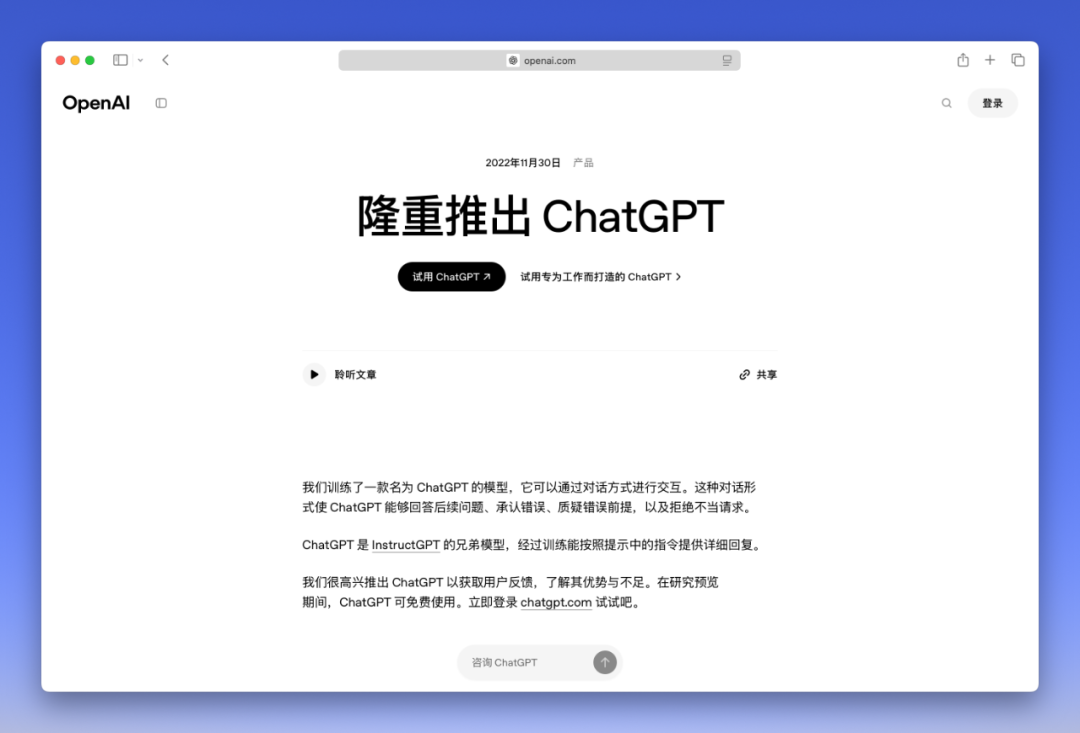 ChatGPT was released on November 30, 2022.
OpenAI serves as the benchmark for all companies, but its leadership is far from secure. Earlier this year, DeepSeek's emergence demonstrated that, even with limited computing power, Chinese tech firms remain competitive and hold visible leads at key technological nodes. Even traditional tech giants, once overshadowed by the threat of ChatGPT, are now gradually catching up.
Leading this charge is Google. On November 18, Google officially unveiled the Gemini 3 series of models, claiming it to be their most intelligent and factually accurate model to date, entirely trained on their self-developed TPU chips. The Gemini 3 Pro immediately topped various model testing charts, surpassing OpenAI's newly released GPT-5.1 model. Over the past month, Google's stock price has surged by over 11%, with its market value nearing $4 trillion at one point.
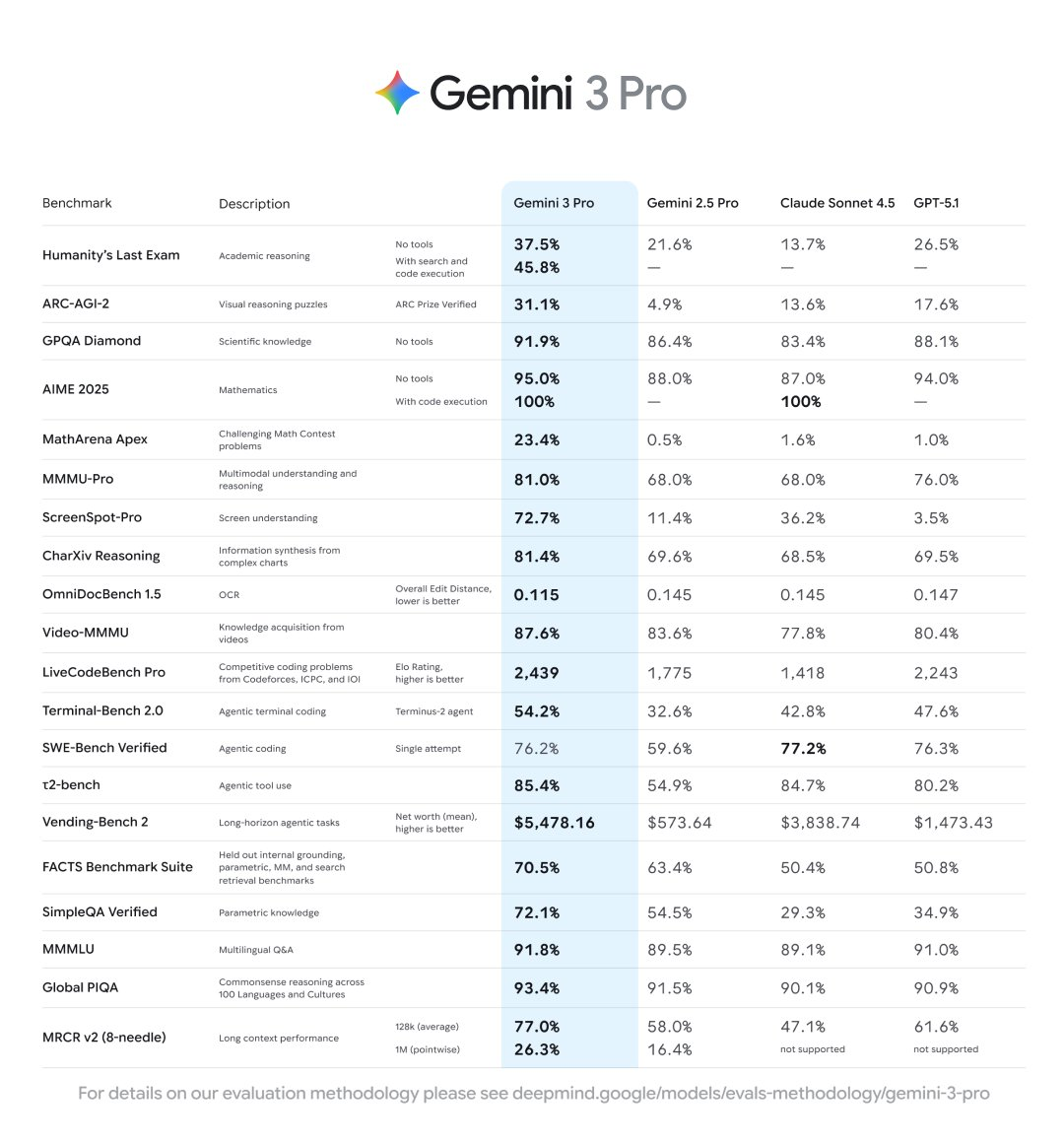
Gemini 3 Pro tops various model testing charts.
In response to Gemini 3's launch, OpenAI founder and CEO Sam Altman tweeted, "Congrats to Google on Gemini 3! Looks like a great model." Google CEO Sundar Pichai and Logan Kilpatrick, head of Google AI Studio products and former head of developer relations at OpenAI, engaged in the comments.
While this was Altman's public stance, internally, he was far more tense. On Monday (December 1), local time, Altman issued an internal memo declaring a 'Code Red' state, calling for the mobilization of all company resources to focus on enhancing ChatGPT and postponing other projects, such as advertising, Agents, and even personal assistants.
'Code Red' is a common crisis expression in Silicon Valley. Companies also use yellow, orange, and other alerts based on urgency, with red representing the highest threat level.
Three years ago, when ChatGPT debuted, Pichai declared a 'Code Red' internally at Google, urging the entire company to bet on AI R&D and even recalling founders Larry Page and Sergey Brin. Now, the tables have turned, and OpenAI is feeling the heat.
However, 'Code Red' should not be overhyped. Compared to external threats, it primarily serves as a management tool to convey urgency internally and motivate employees. If applied to Chinese internet companies, Alibaba—which has nearly announced a 'strategic project' every month for the past half-year—would have declared 'Code Red' countless times, not to mention Alibaba Cloud's massive mid-year outage.
In his internal memo, Altman revealed plans to release a reasoning model outperforming Gemini 3 next week. Additionally, according to The Information, OpenAI is accelerating development of a new model codenamed Garlic, which has achieved breakthroughs in pre-training, enabling large model knowledge to be packaged into smaller architectures. The Garlic model is expected to debut as early as next year.
Code Red and Product Companies
Before declaring 'Code Red,' OpenAI's focus on productization and commercial monetization was significantly more intense than iterating its underlying models. This shift has made it increasingly resemble a traditional internet product company rather than a cutting-edge AI research firm.
In just the past two months, OpenAI has rolled out a series of application-layer updates, including the Atlas browser, ChatGPT's conversational app, group chat and shopping research features, and the Agentkit intelligent agent building tool. Users can now buy Walmart products, create Spotify playlists, and even book flights and hotels within ChatGPT, covering nearly every aspect of life.
Most of these dense product updates are attributed to Fidji Simo, an internet executive who joined OpenAI in May this year. Simo previously led the Facebook app at Meta and later served as CEO of Instacart, specializing in building consumer-grade super apps.
At OpenAI, Simo became CEO of the newly formed Applications Division, overseeing product and business implementation and reporting to Altman. More directly, Simo's role is to accelerate OpenAI's monetization.
According to The Information, among LinkedIn users indicating prior employment at OpenAI, approximately 630 had worked at Meta, accounting for about 20% of OpenAI's current workforce. Except for a few technical staff, the vast majority are concentrated in commercialization areas like product development, market growth, and advertising monetization.
A few days ago, OpenAI was found to have added new advertising and commercial content references in the Android beta version of ChatGPT. Some users also shared screenshots of shopping ads pushed by ChatGPT during chats, with ad content unrelated to the conversation.
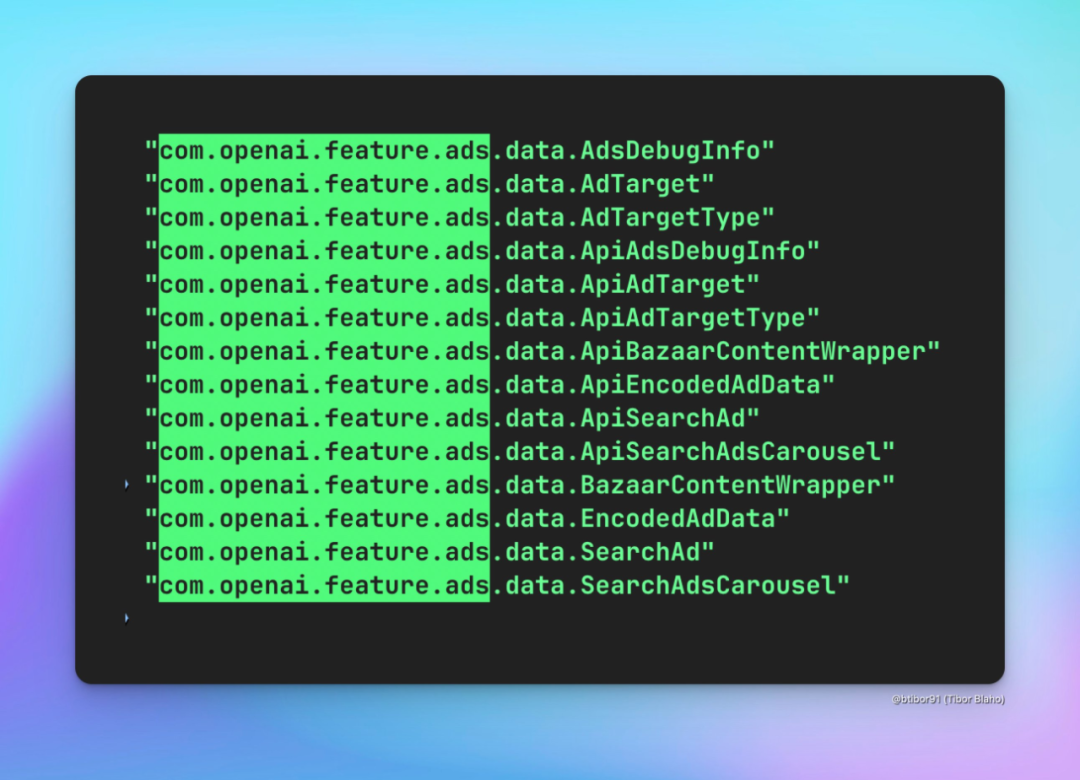

Advertising code and chat ads in the ChatGPT Android beta version.
While OpenAI accelerates product monetization, other tech firms are intensively catching up at the model level. Google's Gemini 3 series is just one example. Anthropic, a startup founded by former OpenAI executives, recently updated and released its flagship model, Claude Opus 4.5. The domestic DeepSeek team also launched the DeepSeek-V3.2 series.
Unlike competitors emphasizing performance breakthroughs, OpenAI's recently updated GPT-5.1 model offers only minor improvements over GPT-5, focusing on smarter and more conversational dialogues. The official blog did not even include comparative performance tests.
Merely focusing on personalized experiences is insufficient for OpenAI to maintain its lead. Google Gemini's rapid growth over the past few months proves that model capabilities remain the key to AI competition. In March, Gemini had 350 million monthly active users, surging to 650 million by October. Nano Banana is believed to be a key driver behind Gemini's rapid rise in monthly active users.
Given Google's massive user base, the impact of Gemini 3's integration into the Google ecosystem is far greater. Unlike previous versions, Gemini 3 was immediately integrated into Google Search upon launch. Given similar model capabilities, this distribution advantage may prompt more users to switch from ChatGPT to the Google ecosystem.
Deedy Das, a partner at Silicon Valley investment firm Menlo Ventures, cited Similarweb data stating that since Gemini 3's launch two weeks ago, ChatGPT's daily independent active users (7-day average) have declined by 6%. During the same period, Gemini's usage has significantly increased, with its traffic share rising from 22% to 31% of ChatGPT's.
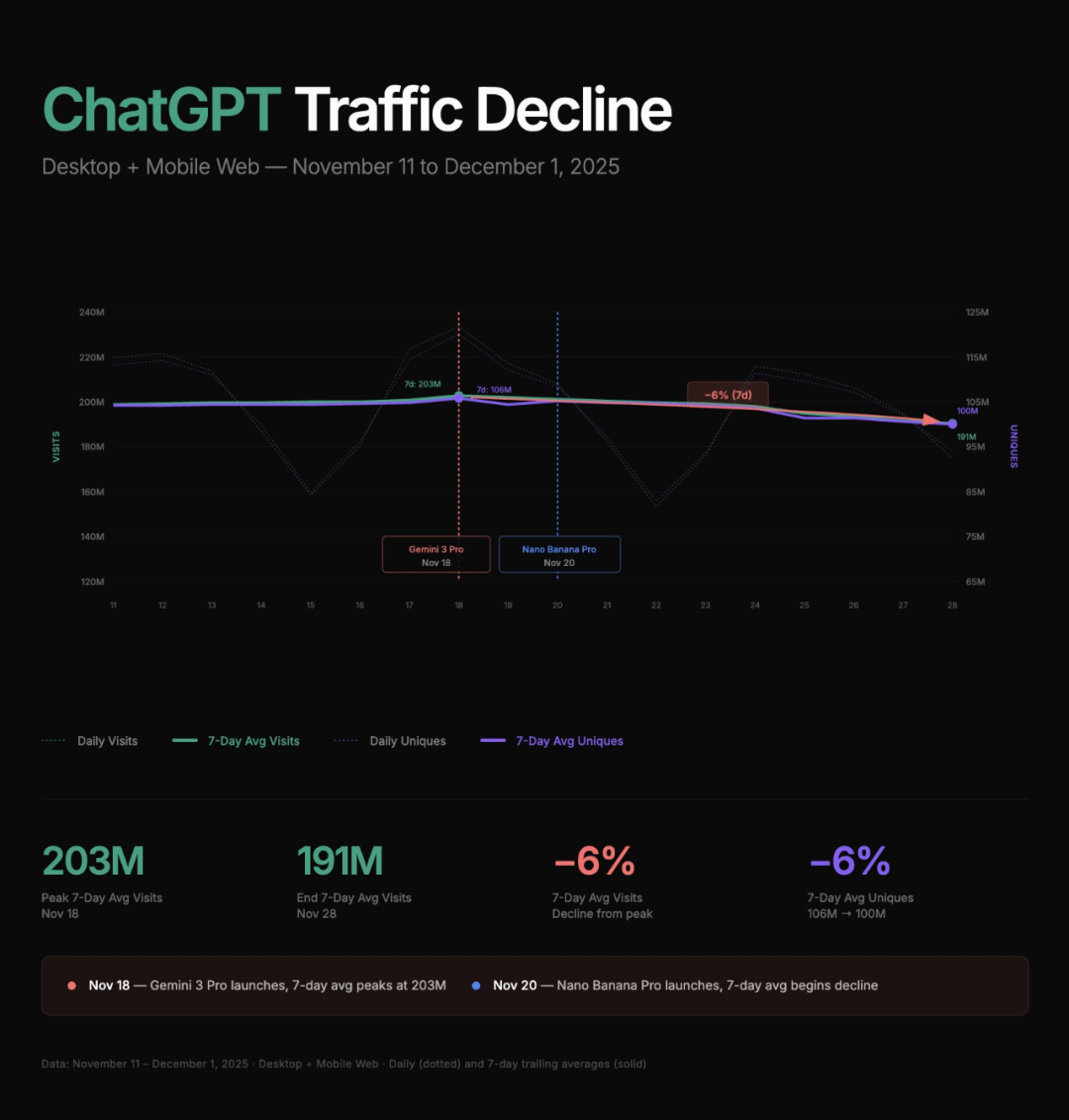
Screenshot shared by Deedy Das.
In summary, under the dual pressure of model performance and user growth, Altman declared an internal 'Code Red' state. The Wall Street Journal stated that this notice is the clearest sign of OpenAI facing competitive pressure, noting, "These competitors have narrowed the startup's lead in the AI race."
Previously, OpenAI's aggressive product updates may be temporarily paused. In his internal memo, Altman announced that all company resources would focus on enhancing ChatGPT's user experience, postponing unnecessary projects like the advertising business, AI agents for health and shopping, and a personal assistant named Pulse.
Altman's priorities all revolve around ChatGPT, including enhancing personalization, improving image generation capabilities, increasing speed and stability, reducing excessive model rejections, and, of course, improving GPT's ranking on public testing charts like LMArena.
OpenAI Has More Realistic Concerns
It is difficult to argue that OpenAI currently faces disruption risks. Even with fierce competition from rivals like Gemini 3, ChatGPT remains the AI application with the largest global user base.
According to Nick Turley, head of ChatGPT, ChatGPT currently accounts for 70% of global AI assistant usage and 10% of search activities. "Our current focus is on continuously enhancing ChatGPT's capabilities, growing stronger, and expanding its reach globally," Turley said.
However, all of this hinges on OpenAI maintaining its lead in model performance. Since GPT-5's release, the gap between OpenAI and other tech firms has narrowed, and ChatGPT's user growth has slowed.
According to Apptopia, the growth of ChatGPT's mobile daily active users has significantly slowed since April and stalled since September. Meanwhile, the average daily usage time of ChatGPT in the United States has decreased by 22.5% since July, and the average number of conversations has dropped by 20.7%.
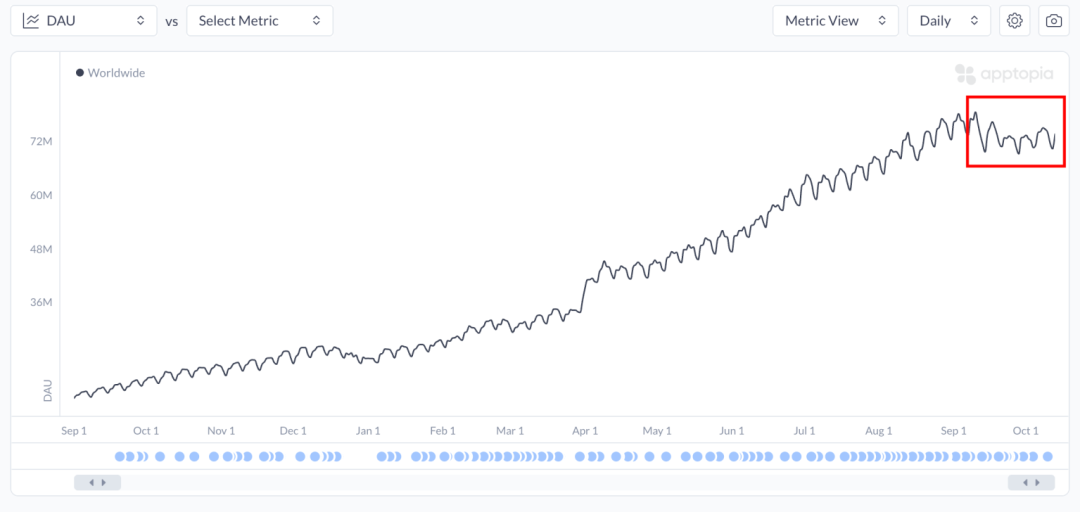
Apptopia statistics.
Deutsche Bank previously tracked financial transaction data in the European market and found that the monthly growth rate of ChatGPT's consumer spending has significantly slowed since May 2025, suggesting that ChatGPT's paid user growth in Europe may have stalled. This could explain OpenAI's gradual acceleration of commercial monetization efforts over the past year.
At the same time, OpenAI is maintaining unprecedented AI infrastructure spending. After completing its for-profit restructuring, Sam Altman announced that OpenAI would significantly expand its infrastructure investment, aiming to invest $1 trillion annually in infrastructure.
To date, OpenAI has committed approximately $1.4 trillion to infrastructure construction. Its partners include giants like NVIDIA, AMD, Oracle, and Broadcom, whose stock prices have often soared due to transactions with OpenAI.
American tech media outlets are particularly concerned about whether OpenAI's financial situation can support such massive capital expenditures. Unlike traditional giants like Google, which have existing businesses to provide financial support, almost all of OpenAI's funds come from venture capital, and the company is still incurring massive losses.
Some time ago, Sarah Friar, CFO of OpenAI, expressed support for government financial backing for AI infrastructure, sparking significant controversy in the United States. Critics accused OpenAI of attempting to have the government foot the bill for its massive AI investments. Subsequently, Friar issued a special clarification, emphasizing that OpenAI was not seeking government guarantees.
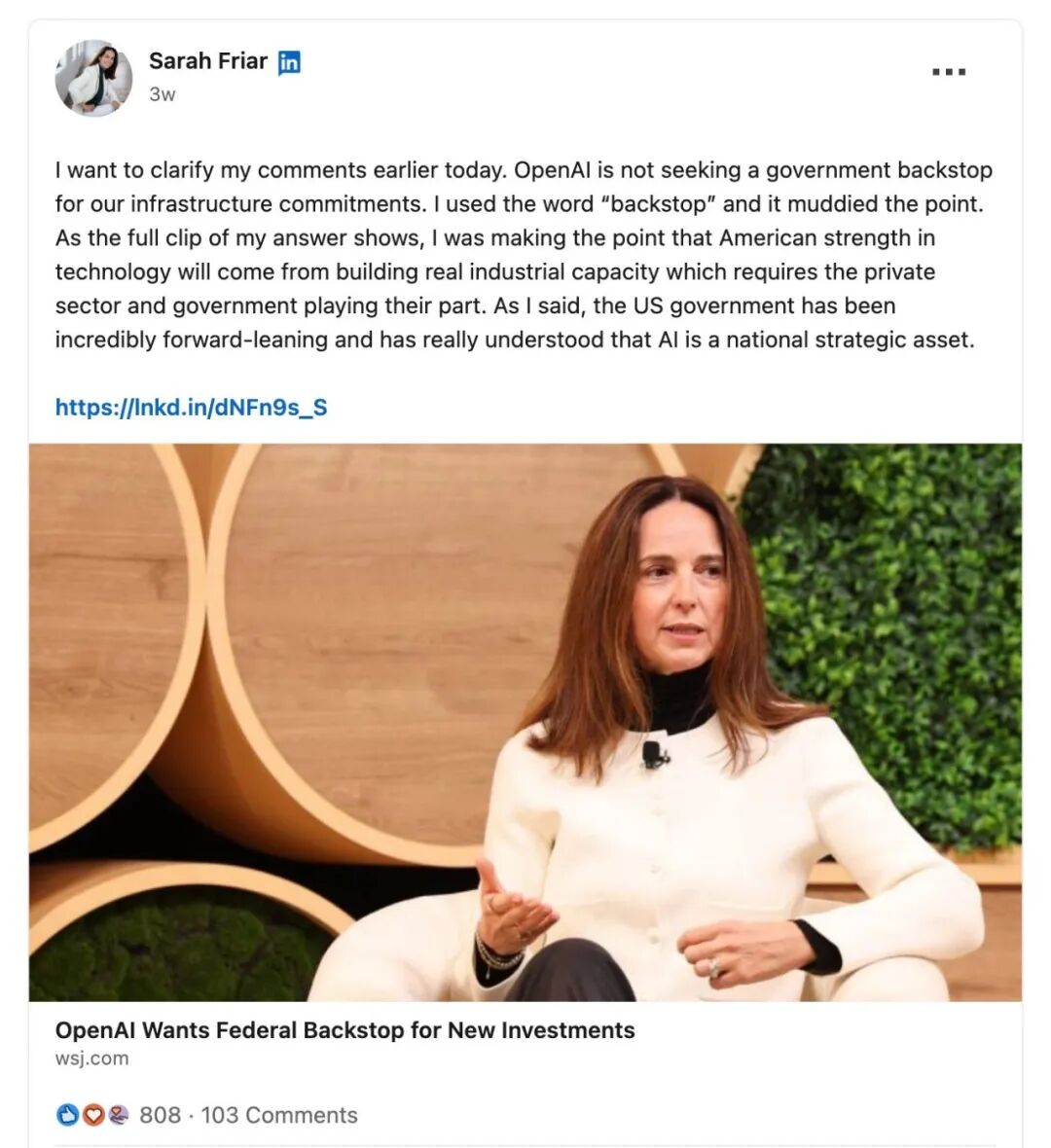
Clarification statement released by Sarah Friar.
Sam Altman also released a lengthy response, stating, "We do not need nor do we want the government to provide guarantees for OpenAI's data centers." Altman said that OpenAI would rely on its own revenue growth, external investments, and future sales of computing power to support its investments.
According to him, OpenAI's revenue is expected to exceed $20 billion this year and grow to hundreds of billions of dollars by 2030. However, even with these figures, the revenue still cannot cover OpenAI's current capital expenditures.
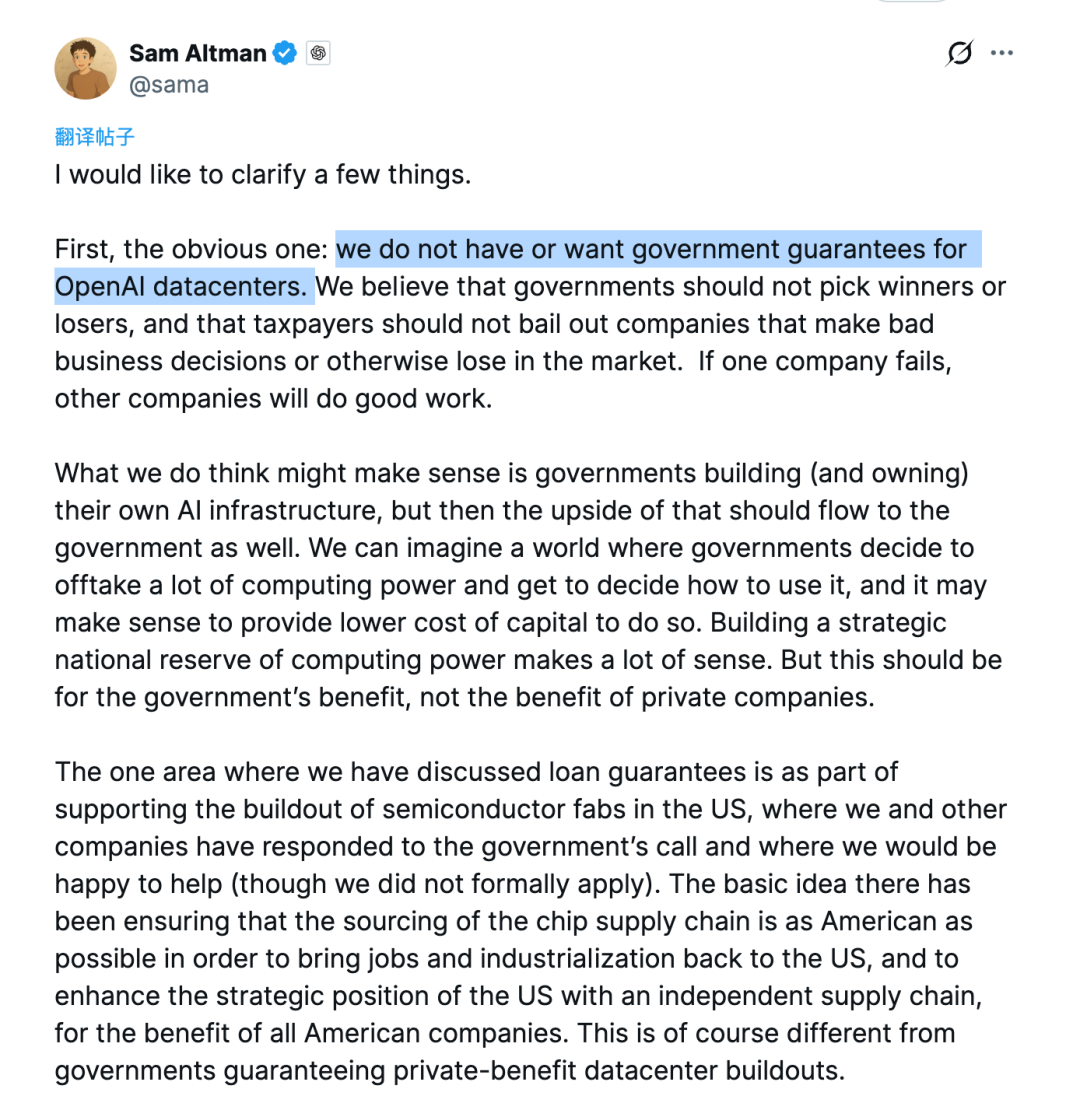
Lengthy clarification released by Sam Altman (the original text is long; the screenshot shows only a portion).
Altman believes that the current period is crucial for OpenAI to expand its investment in AI infrastructure. It is necessary to invest substantial funds now rather than developing gradually. "Large-scale infrastructure construction takes a considerable amount of time to complete, so we must act," he said.
He stated that the risk of insufficient computing power faced by OpenAI is greater and more likely to occur than the risk of excess computing power. "Everything we have seen so far indicates that the world's demand for computing power will far exceed our plans."
The birth of ChatGPT itself is a manifestation of 'putting in tremendous effort to achieve remarkable results.' Before ChatGPT, most mainstream models had parameter counts below 300 million. In 2022, OpenAI increased GPT-3's model parameter count to 175 billion, and large models finally demonstrated the ability for emergent intelligence. At the end of the year, OpenAI released ChatGPT based on the GPT-3.5 model, marking the official arrival of the AI era.
At present, Sam Altman is striving to uphold OpenAI's leading position by amassing an even greater magnitude of computing power. With the situation still in flux, it's challenging to determine whether OpenAI's strategic decisions are on the right track. Nevertheless, the company has, at the very least, managed to rally a substantial number of supporters to its cause.
"Our ambition is to evolve into a highly prosperous enterprise. However, should we falter along the way, the onus will rest squarely on our shoulders," remarked Sam Altman.
© All rights reserved by Shanshang. Any unauthorized reproduction is strictly prohibited.
-
![]()
Alibaba's AI Offensive: Over Half of Investment Allocated, Time to Reap Returns
-
![]()
Alibaba’s AI Push: Over Half of Investments Made, Time to Harvest Returns
-
![]()
Chinese Enterprises Going Global 3.0: From World Factory to AI Infrastructure Builder
-
![]()
Honor RobotPhone Review: Half Movie Camera, Half Robot
-
![]()
AI-Driven Cheating Surges in Universities! Online Exams Reduced to Mere Formalities, Degree Credibility on the Line
-
Insta360’s Decade in Panoramic Imaging: Making Cameras ‘Invisible’ and Returning Creation to the Masses
-
![]()
Foreign Media Claims Apple is Concentrating Resources on AI Development: Vision Pro and Siri Teams Lay Off 200 People
-
Big News! Huaneng and Huawei Hold Talks in Shenzhen with Ren Zhengfei in Attendance; Huawei Emerging as the 'Second Brain' of China's Energy System