"Brother and Sister" Team Secures Nearly 2 Billion Yuan in Funding, Serving 250,000 People Daily in KTVs
 12/05 2025
 591
591
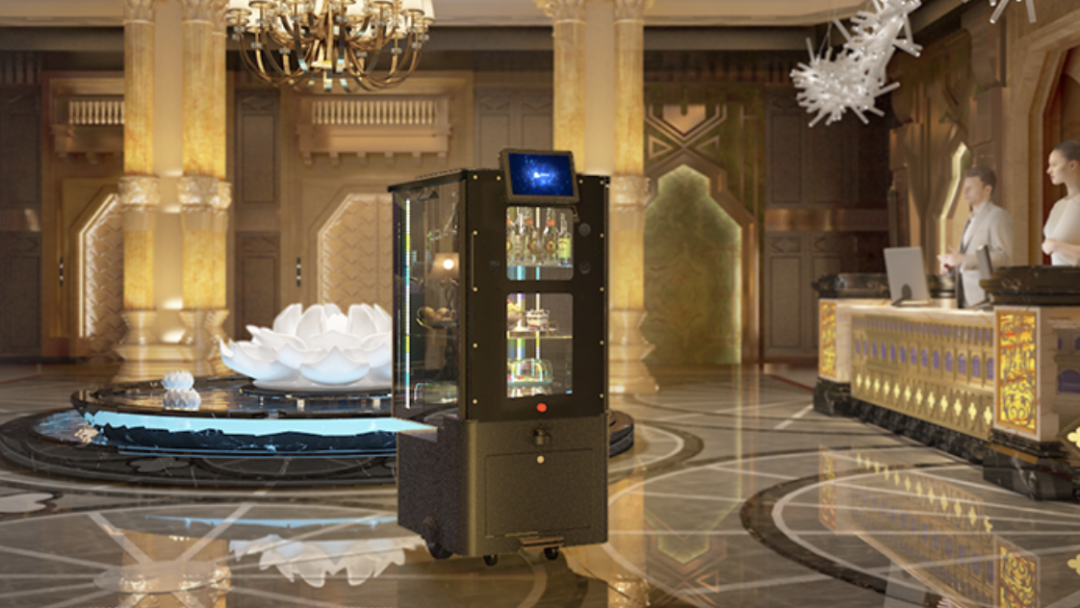
You've probably seen delivery robots in hotels: order takeout, and soon a small robot arrives at your door with your meal. Recently, UDI Robotics, a company specializing in such robots, has been approved for listing in Hong Kong.
UDI Robotics focuses on "commercial service robots," developing delivery and cleaning robots designed to operate in various public spaces such as hotels, restaurants, campuses, shopping malls, and entertainment venues.
Founded in 2013, the company originated as the terminal business division of UTStarcom (China). Today, few remember UTStarcom, but you've likely heard of its famous product—the "Xiaolingtong" (a low-cost mobile phone service). UDI Robotics emerged from this team and secured angel investment from its former parent company in the same month it was established.
Over the next decade, the company completed 11 consecutive rounds of financing, with its latest milestone being the completion of Series E funding. Investors include local lifestyle giants like Alibaba-backed Ele.me, industrial capital such as BTG Homeinns, AI companies like iFLYTEK, and several "national team" capital firms.
While humanoid robots are gaining popularity, what business opportunities lie behind seemingly "silly" service robots?
- 01 -
The founders of UDI Robotics, Lu Ying and Gu Zhenjiang, were core engineers at UTStarcom with extensive experience in telecommunications and smart hardware. In 2013, Lu Ying led a group of colleagues from the former terminal business division to start UDI Technology.
Initially, the company focused on technical services related to autonomous driving and was even NVIDIA's sole domestic partner in this field. However, they soon faced a practical issue: while the technology was cutting-edge, generating revenue was too slow, with project cycles spanning years—something the company couldn't sustain.
In 2016, the company pivoted: they decided to first develop products for immediate, real-world needs—indoor autonomous navigation robots. They targeted two specific locations: KTVs and hotels. The reasoning was simple—these places had frequent delivery needs, and if robots could handle the legwork, bosses would be willing to try them out as a cost-effective alternative to hiring staff.
In 2017, UDI launched its first product, "Youxiaodi," designed specifically for beverage delivery in KTVs. The robots could move and deliver without complaining of fatigue, yielding immediate results.
However, despite rapid technological progress, the company's finances were tight. In 2019, Shenzhen High-Tech Investment stepped in with a 10 million yuan financing guarantee and helped secure policy subsidies. This funding was crucial in helping the company survive its most challenging cash flow period.
UDI's business model was also highly practical: instead of selling robots, they offered them on a monthly rental basis. The cost was roughly half that of a human service employee's salary. One "Youxiaodi" robot could handle two-thirds of the delivery volume for an entire KTV floor, making it an incredibly cost-effective solution for bosses. The model quickly gained traction.
That same year, the company introduced "Youxiaomei" for hotels. By 2022, BTG Homeinns, a subsidiary of BTG Group, invested again, helping UDI rapidly expand its robot deployments across more hotels.
A team of autonomous driving experts venturing into indoor delivery—a relatively simpler scenario—was like a "dimensionality reduction strike." Seventy percent of UDI's team consists of R&D personnel who independently master core technologies like navigation and obstacle avoidance.
"Youxiaodi" and "Youxiaomei" now operate in over 600 cities, serving more than 9,000 clients. Every day, they provide services to over 250,000 people.
Since its inception, UDI Robotics has completed 11 rounds of financing, backed by a representative group of investors.
In 2016, it secured tens of millions of yuan in Series A funding from New Hengji and iFLYTEK.
In 2018, it raised tens of millions of yuan in Series B funding from Legend Capital and Origin Capital.
In 2019, it completed two rounds of financing in quick succession: Series B2 funding of tens of millions of yuan from Suodao Investment, followed by Series B3 funding of 100 million yuan led by Snowball Capital.
2021 was a pivotal year: Yunfeng Capital and Ele.me co-led a 300 million yuan Series C round, followed by a 200 million yuan Series C2 round jointly invested by Chengding Capital and Yunfeng Capital.
In 2025, it completed its largest strategic financing round to date: 1 billion yuan jointly invested by Fluidra, Yunqi Capital, and other institutions.
Based on publicly available data, UDI Robotics' cumulative funding nears 2 billion yuan.
Observing the investor composition reveals three key forces:
Industrial Capital: BTG Homeinns, Ele.me, etc. These companies represent UDI's most critical application scenarios, and their investments are essentially bets on their own future operational models.
Renowned VC/PE Firms: Legend Capital, Yunfeng Capital, Snowball Capital, 58 Industrial Capital, etc. These firms are betting on growth and technological advancements.
"National Team" Capital: Chengding Capital, Xinshang Capital, China Merchants Capital, etc. These investors provide UDI with opportunities for larger-scale deployments in campuses, public spaces, hospitals, and other projects.
UDI Robotics has earned recognition from across the industrial chain, capital markets, and policy resources, which is why it has advanced to the pre-IPO stage in such a capital-intensive and time-consuming industry.
Notably, UDI Robotics has a strong "Alibaba flavor," with Ele.me and Yunfeng Capital collectively holding nearly 15% of its shares.
- 02 -
In 2024, China's service robot market reached approximately 73.8 billion yuan, a 22.9% increase from the previous year. Among all segments, commercial service robots—such as those for delivery, cleaning, and public services—accounted for the largest share.
China is also a dominant player in terms of production volume. In 2024, the country produced 10.519 million service robots, a 34.3% year-over-year increase. Globally, Chinese manufacturers accounted for approximately 85% of commercial service robot shipments, essentially making China the world's supply chain hub for these devices.
However, despite the industry's vibrancy, profitability remains elusive. Service robots have long faced a common challenge: growth falls short of expectations. Why? The reasons are pragmatic:
·Many robots are limited to a few scenarios and lack versatility;
·High costs make customers hesitant to adopt them;
·Diverse user needs often require extensive customization;
In other words, robots are not yet ready to become mass-market products.
Against this backdrop, UDI Robotics has avoided competing in the "home robot" market and instead focused on three essential scenarios:
·Delivery needs in hotels and KTVs;
·Public cleaning in campuses and commercial districts;
·Human replacement for greeting services in commercial venues;
These scenarios share a common trait: high frequency, genuine labor shortages, and willingness among bosses to pay.
In terms of market structure, China's service robot industry has not yet reached a stage of "giant domination," but some leading companies have emerged, such as UDI, Keenon Robotics, Yunji Technology, Dakuo Technology, Ninebot Robotics, and Orion Star. Few have gone public yet, with most still in the funding stage, and the industry remains fragmented.
Are these robot companies profitable? Let's compare with another publicly listed company, Yunji Technology. From 2022 to 2024, Yunji Technology reported revenues of 161 million yuan, 145 million yuan, and 245 million yuan, respectively, with net losses of 365 million yuan, 265 million yuan, and 185 million yuan. Over three years, its cumulative losses reached 800 million yuan.
This highlights another issue: after specializing and refining their offerings, service robot companies become highly dependent on a limited number of scenarios for revenue generation.
- 03 -
The service robot industry has long been stuck in a fundamental contradiction: scenarios demand "human-like generalized intelligence," but commercial realities only allow businesses to afford "low-cost, specialized devices."
This has left service robots either not useful enough, not affordable enough, or unable to scale over the past decade.
For service robot companies, successful commercialization hinges on a simple formula: labor cost savings > hardware costs + deployment costs + maintenance costs.
The reality is: robot hardware costs are high and cannot be reduced to below 1,000 yuan like robotic vacuums; corporate clients have strict ROI requirements and care more about "value" than "coolness"; robot deployment costs are high due to vastly different scenarios; and maintenance costs persist long-term.
As a result, common scenarios include: food delivery robots that fail to save the cost of a waiter's salary in a year; hotel robots that still require human supervision during peak hours; and hospital robots that face extremely high adaptation costs due to complex workflows.
Consequently, most products remain "display pieces, gimmicks, or marketing assets" rather than "production tools."
Some may wonder: Why are robots still struggling to deploy despite AI advancements?
Robots lack not AI but the engineering systems capability to complete tasks at the lowest possible cost.
This manifests in three key challenges:
1. Insufficient cognitive ability to handle real-world environments
Robots cannot generalize their understanding of the real world as humans do. These are not algorithmic issues but stem from the complexity of the real world.
2. Fragmented scenarios lead to poor economies of scale
Hotels ≠ Restaurants ≠ Hospitals ≠ Shopping Malls
Workflows, maps, tasks, voices, and standards vary entirely. Robot companies cannot amortize development costs across significant volumes, making profitability elusive.
3. Hardware represents rigid costs and does not price reduction (reduce in price) as quickly as users expect
Unlike algorithms or SaaS, motors, batteries, structural components, and manufacturing processes involve small supply chains with limited cost reduction potential.
So, is there a future for robots?
The answer is not a simple "yes" or "no." The real judgment lies in when robots "stop being compared to humans."
As long as robots are seen as "replacing humans for cheaper labor," they will struggle.
The true opportunity lies in robots performing tasks "humans cannot do," such as:
·Autonomous warehousing and nighttime logistics;
·Automated medical supply delivery;
·Smart commercial space operations;
These scenarios do not replace humans but expand new efficiency frontiers.
In the future, the robot industry will explode, but only a handful of high-value, high-standard, and high-ROI scenarios will be fully taken over by robots.
Service robots should not be compared to "human labor replacement" but should create efficiency gains that humans cannot achieve directly.
This article does not constitute any investment advice.
-
![]()
Alibaba's AI Offensive: Over Half of Investment Allocated, Time to Reap Returns
-
![]()
Alibaba’s AI Push: Over Half of Investments Made, Time to Harvest Returns
-
![]()
Chinese Enterprises Going Global 3.0: From World Factory to AI Infrastructure Builder
-
![]()
Honor RobotPhone Review: Half Movie Camera, Half Robot
-
![]()
AI-Driven Cheating Surges in Universities! Online Exams Reduced to Mere Formalities, Degree Credibility on the Line
-
Insta360’s Decade in Panoramic Imaging: Making Cameras ‘Invisible’ and Returning Creation to the Masses
-
![]()
Foreign Media Claims Apple is Concentrating Resources on AI Development: Vision Pro and Siri Teams Lay Off 200 People
-
Big News! Huaneng and Huawei Hold Talks in Shenzhen with Ren Zhengfei in Attendance; Huawei Emerging as the 'Second Brain' of China's Energy System