Doubao 'Clashes' with WeChat: The Ecological Battle Unleashed for All AI Smartphone Makers
 12/05 2025
 758
758


The fleeting yet impactful appearance of the Doubao Assistant on WeChat served as a stark flash of lightning, revealing the concealed obstacles lurking in the industry's murky depths. Priced at 3,499 yuan but commanding a hefty premium of a thousand yuan, this smartphone has emerged as a litmus test for an era, probing not only the limits of technology but also the boundaries of commerce.
Content/Dilao
Editor/Yonge
Proofreader/Mangfu
Today, a group of Nubia M153 users stumbled upon an issue: when attempting to use the Doubao Mobile Assistant for tasks involving WeChat, the app would unexpectedly crash or even fail to log in.
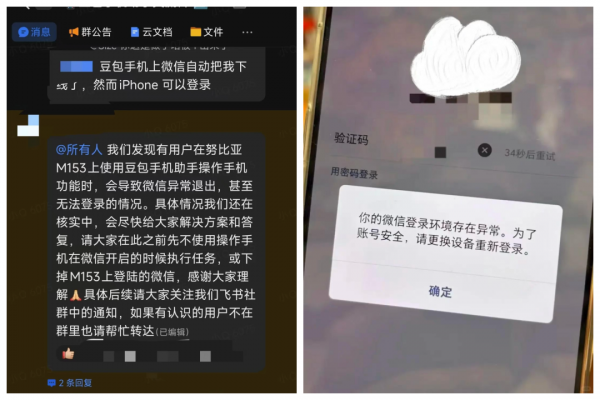
WeChat's response was swift, citing that the incident 'may have triggered security risk controls.' Meanwhile, Doubao announced that its mobile operation feature 'no longer supports WeChat operations.'
This brief but intense clash, though seemingly a technical compatibility issue on the surface, actually unveils the underlying disputes over ecological control in the age of AI smartphones.
Part.1
The Temptation and Price of Permissions
The Doubao Mobile Assistant's ability to perform impressive feats like 'price comparison across the entire network and placing orders' hinges on its acquisition of the system-level permission INJECT_EVENTS.
This permission empowers an application to mimic user actions such as clicks and swipes, seamlessly navigating between multiple apps. However, within the Android ecosystem, it has long been regarded as a 'high-risk operation,' as it breaches the sandbox isolation principle between applications, enabling one app to manipulate others.
While native assistants from smartphone manufacturers like Xiaomi Mi AI and Honor Yoyo also possess similar permissions, their usage is typically confined within their own ecosystems.
Doubao's approach stands out as it seeks to leverage this permission to orchestrate the entire mobile internet ecosystem, including national-level apps like WeChat.
Hence, the conflict arose: Why does Doubao have the authority to redefine these boundaries?
Part.2
WeChat's Fortifications and Doubao's Aspirations
WeChat's robust reaction was both anticipated and profound.
WeChat has evolved beyond a mere social platform into a comprehensive ecosystem encompassing payments, mini-programs, and official accounts. This ecosystem operates under its own set of rules, permission systems, and data boundaries. When an external AI assistant attempts to 'invade' this ecosystem with system-level permissions, it triggers more than just the alarm of the risk control system.
Historically, app stores have served as toll booths for traffic, but now AI assistants aspire to become traffic control centers. This role transformation signifies a complete restructuring of the value distribution system.
Doubao's direct intervention in the core processes of third-party applications through system-level permissions, without prior coordination, while technically feasible, disrupts the long-established tacit understanding in the business world.
An astute observer noted, 'This is very much in line with ByteDance's approach: first create user value, then handle business relationships.'
However, when it comes to fundamental issues like ecological control, the technology-first strategy encounters harsh realities.
Part.3
The Shared Dilemmas Facing All AI Smartphone Makers
The Doubao incident sheds light on the triple dilemmas that must be navigated in the development of AI smartphones.
The first dilemma revolves around the conflict between technical permissions and user privacy. System-level permissions grant AI access to more user data and enable more user operations. While this capability brings convenience, it also poses unprecedented challenges to data security and privacy protection. How can users be reassured that their chat records and payment information will not be misused?
The second dilemma arises from the contradiction between AI efficiency and fair mechanisms. When AI assistants can 'book appointments with one click' and 'intelligently snatch tickets,' technological advantages may translate into de facto privileges.
The third dilemma centers on the game between ecological control and open collaboration. If major applications fortify their services to prevent external AI orchestration, the vision of cross-application intelligent services will remain unattainable. However, if scheduling permissions are completely opened up, application developers fear losing control over their own service experiences.
These dilemmas are not unique to Doubao but are questions that all manufacturers attempting to build AI smartphones must confront. Every technological breakthrough is accompanied by new ethical inquiries and business conflicts.
Therefore, the clash between Doubao and WeChat can be viewed as a rite of passage for the concept of AI smartphones. It marks the transition of this field from the technical demonstration stage to the real ecological game stage.
All AI smartphone makers will glean valuable lessons from this incident: in the highly mature and entrenched ecosystem of mobile internet, any disruptive innovation is not merely a technical issue but also an ecological, interest, and trust issue.
The challenges faced by Doubao will also be encountered by Xiaomi, Huawei, OPPO, and Vivo. And when users are willing to pay a premium to snap up 'Doubao smartphones,' they are essentially casting a vote with real money on the future mode of interaction.
This conflict will not conclude with Doubao disabling the WeChat feature. As more AI smartphones enter the market, similar clashes will recur. Each conflict redraws boundaries, and each compromise reshapes rules.
The future will not witness a scenario where one company's AI assistant replaces all applications but rather a more complex, hierarchical, and dynamically balanced intelligent ecosystem.
When the dust settles, what remains on the battlefield will not merely be victory or defeat but also the industry's renewed understanding of the essence of intelligence.
-
![]()
Alibaba's AI Offensive: Over Half of Investment Allocated, Time to Reap Returns
-
![]()
Alibaba’s AI Push: Over Half of Investments Made, Time to Harvest Returns
-
![]()
Chinese Enterprises Going Global 3.0: From World Factory to AI Infrastructure Builder
-
![]()
Honor RobotPhone Review: Half Movie Camera, Half Robot
-
![]()
AI-Driven Cheating Surges in Universities! Online Exams Reduced to Mere Formalities, Degree Credibility on the Line
-
Insta360’s Decade in Panoramic Imaging: Making Cameras ‘Invisible’ and Returning Creation to the Masses
-
![]()
Foreign Media Claims Apple is Concentrating Resources on AI Development: Vision Pro and Siri Teams Lay Off 200 People
-
Big News! Huaneng and Huawei Hold Talks in Shenzhen with Ren Zhengfei in Attendance; Huawei Emerging as the 'Second Brain' of China's Energy System