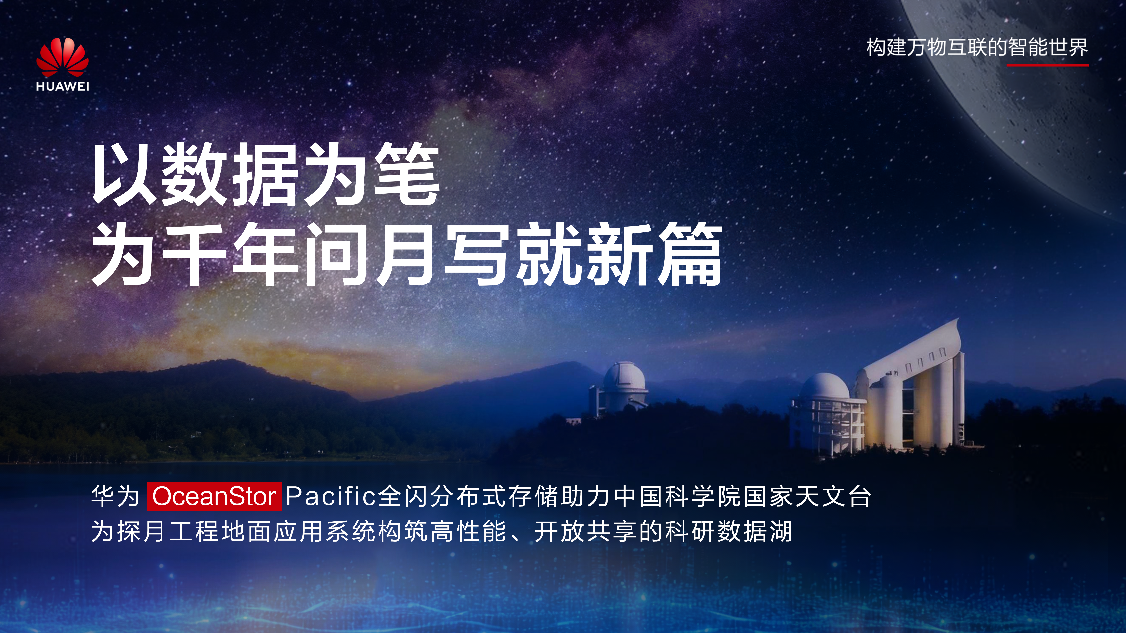
Penning a New Chapter for the Millennium-Old 'Moon Inquiry' with Data as the Quill
 12/07 2025
 623
623
Article by | Intelligent Relativity
'When did the moon first grace the sky? I pause my cup now to ponder.' A millennium ago, Li Bai raised his goblet to the moon, posing celestial questions in his poem 'Asking the Moon While Holding My Cup.' That sliver of moonlight, suspended in the heavens, carried the unreachable romantic fantasies of the ancients. 
Today, the Chang'e probes embark on a 380,000-kilometer interstellar odyssey, ceaselessly returning a wealth of exploration data on lunar surface topography, elemental makeup, mineral content, subsurface shallow structures, and the lunar-terrestrial space environment. Chinese lunar exploration has transitioned from the poetic musings of 'pausing the cup to inquire' to the scientific realm of 'answering with data.'
The ground application system for the lunar exploration program, constructed by the National Astronomical Observatories of the Chinese Academy of Sciences, serves as the 'chief scribe' of this millennium-spanning quest. It transforms vast swathes of raw lunar information into precious scientific achievements, continuing the modern exploration narrative for the ancients' 'moon inquiry.'
From Myth and Legend to Precision Cartography: A Paradigm Shift in Lunar Exploration
'The white rabbit pounds medicine year after year, Chang'e dwells alone—who is her neighbor?'
In ancient times, constrained by observational tools, people relied solely on naked-eye observation and imagination, giving rise to enchanting myths such as Chang'e's flight to the moon and the Jade Rabbit's medicinal concoctions. The advent of the telescope era revealed that images like the 'Moon Rabbit' were merely optical illusions created by lunar surface features. Today, the precise data brought back by the lunar exploration program has propelled lunar research into an unprecedented era of accuracy.
As one of the five pillars of the lunar exploration program, the ground application system, built and operated by the National Astronomical Observatories of the Chinese Academy of Sciences, is hailed as the 'data custodian' of the lunar exploration endeavor. During mission execution, the system orchestrates satellite observation targets and mission timelines, receives copious amounts of scientific data from the moon via large-aperture ground antennas, processes raw data into standardized scientific products directly usable by researchers, and organizes in-depth studies.
Unlike the early 'broad coverage, low precision' exploration model, this system provides refined support throughout the entire lifecycle of exploration missions. In the pre-mission phase, it optimizes payload configuration requirements based on scientific goals, formulates precise exploration plans, sampling strategies, and operational blueprints. During execution, it implements full-process management—from status monitoring and instruction compilation to data injection, relying on parallel reception of probe downlink data at the Beijing Miyun and Tianjin Wuqing ground stations for real-time local storage and backup. Post-mission, it continues data processing, scientific interpretation, and applied research, while also overseeing sample reception, long-term storage, and subsequent unsealing, processing, preparation, testing, and analysis. It manages and disseminates exploration data products and samples globally in accordance with program requirements.
The system's value extends far beyond the realm of profound scientific inquiry. Processed lunar high-definition imagery and lunar soil composition data can be transformed into diverse formats such as 3D models, science documentaries, and immersive interactive exhibits. Through digital modeling techniques that reconstruct lunar crater landscapes, the public can intuitively experience the true visage of our nearest celestial neighbor.
Globally, the standardized scientific products output by the ground application system not only serve domestic research teams but are also openly shared with international researchers through a dedicated data and information dissemination platform. A millennium ago, we 'inquired of the moon'; today, we share the answers with the world, fostering the common advancement of global lunar science.
Massive Data Brings New Challenges: Storage Systems Face Triple Trials
As lunar exploration missions progress, data volumes have surged, presenting unprecedented storage challenges for the ground application system:
Challenge 1: Balancing Security, Reliability, and Open Sharing. Lunar exploration data represents irreplaceable core scientific assets. Any loss, damage, or leak could cause irreparable harm. Simultaneously, to foster global lunar scientific development, data must be openly shared. This necessitates the storage system to construct a multi-layered security protection framework while implementing efficient and convenient shared access mechanisms.
Challenge 2: Long-term Preservation of Petabyte-Scale Data. Precision sensors aboard lunar probes, such as high-resolution cameras, imaging spectrometers, and detection radars, continuously generate vast amounts of scientific data, already reaching petabyte-scale volumes. Given the high cost and lengthy duration of lunar missions, every piece of data is invaluable, representing crucial scientific research resources and national strategic assets that must be preserved intact and securely over the long term. As detection technologies advance and data retention periods extend, storage space demands continue to rise. Therefore, the storage system must possess versatile protocol interfaces to adapt to diverse application scenarios while maintaining strong elastic scalability to accommodate future growth.
Challenge 3: Extreme Demands for High-Performance Computing. During scientific research and data analysis phases, single computations often require reading and writing hundreds of gigabytes or even terabytes of datasets. This necessitates a storage system capable of matching hybrid workload scenarios involving high-performance computing, big data analytics, and artificial intelligence, with sustained throughput capabilities of at least 30GB/s and extremely low access latency to meet research progress requirements and avoid storage becoming a bottleneck for research efficiency.
Innovative Storage Solutions: Building a Robust Foundation for Lunar Exploration Data
Facing these multifaceted challenges, the National Astronomical Observatories of the Chinese Academy of Sciences opted for a deep collaboration with Huawei, adopting Huawei's OceanStor Pacific storage system to create a secure, reliable, efficient, and flexible storage foundation for lunar exploration data.
Security and Reliability: Multi-Dimensional Protection Ensures Data Integrity
Huawei's OceanStor Pacific distributed storage incorporates advanced reliability technologies such as dynamic erasure coding (EC), end-to-end data integrity verification (DIF), and sub-health active detection, constructing a multi-layered data protection framework to safeguard lunar exploration data comprehensively. Meanwhile, its industry-unique capability for seamless interoperability among file/object/big data protocols enables smooth open sharing of data under stringent security controls, meeting diverse needs for global lunar research collaboration.
Elastic Scalability: Gracefully Handling Continuous Data Growth
The solution employs industry-leading high-density hardware design, with a single cabinet providing petabytes of storage capacity. Combined with intelligent tiering capabilities between SSD and HDD models, it automatically allocates storage resources based on data access frequency—hot data stored on high-performance SSDs, warm/cold data migrated to high-capacity HDDs—meeting vast capacity demands while optimizing storage efficiency and total cost of ownership (TCO).
Extreme Performance: Supporting Efficient Scientific Analysis
Utilizing the OceanStor Pacific all-flash distributed storage solution, with its ultra-high IOPS, microsecond-level latency, and DPC (Distributed Parallel Client) high-performance architecture, it achieves high-speed real-time disk writing of pre-inspection data from ground stations, meeting the ground application system's demands for high-throughput, low-latency data reception. This ensures timely and complete receipt of every precious frame of lunar data from 380,000 kilometers away. Simultaneously, it provides ample performance reserves for scientific computing, significantly shortening data processing and analysis cycles and accelerating scientific achievement output.
From Lunar to Cosmic Exploration: Venturing Deeper into the Stars and Oceans
'Bright as a flying mirror descending upon the red palace, its clear radiance emerges as green mists dissipate.'
The mission of the ground application system has never been confined to lunar exploration alone. The comprehensive technical framework it has established—'payload operation management -> data reception -> processing -> management and dissemination -> scientific research and application'—along with its continuously upgraded reception and processing capabilities through practice, has become the 'core cornerstone' of deep-space exploration, laying a solid foundation for deep-space missions such as Mars exploration and asteroid detection.
From the moon to Mars, from within the solar system to more distant deep-space targets, China's deep-space exploration endeavors are advancing step by step into greater depths. Amidst the vast expanse of stars and seas, with data as the quill and advanced storage technology as the foundation, China continues to pen its chapter of space exploration.
When Li Bai's poetic imagination of 'pausing the cup to inquire' meets modern technology's precise detection, the millennium-old 'moon inquiry' has finally obtained definitive data-driven answers. And this is merely the beginning.
[Editor's Note] This article showcases the innovative practices of China's lunar exploration program ground application system in data processing and storage, reflecting the historic leap of China's deep-space exploration endeavors from 'gazing at the stars' to 'data-driven exploration.' Through the application of advanced storage technologies, it provides a solid data infrastructure guarantee for continuously advancing the deep-space exploration strategy.
*All images in this article are sourced from the internet
-
![]()
Alibaba's AI Offensive: Over Half of Investment Allocated, Time to Reap Returns
-
![]()
Alibaba’s AI Push: Over Half of Investments Made, Time to Harvest Returns
-
![]()
Chinese Enterprises Going Global 3.0: From World Factory to AI Infrastructure Builder
-
![]()
Honor RobotPhone Review: Half Movie Camera, Half Robot
-
![]()
AI-Driven Cheating Surges in Universities! Online Exams Reduced to Mere Formalities, Degree Credibility on the Line
-
Insta360’s Decade in Panoramic Imaging: Making Cameras ‘Invisible’ and Returning Creation to the Masses
-
![]()
Foreign Media Claims Apple is Concentrating Resources on AI Development: Vision Pro and Siri Teams Lay Off 200 People
-
Big News! Huaneng and Huawei Hold Talks in Shenzhen with Ren Zhengfei in Attendance; Huawei Emerging as the 'Second Brain' of China's Energy System