Is Baidu Set to Reconstruct a "Cambrian" Moment?
 12/09 2025
 554
554
Prior to this, we indeed didn't hold high expectations for Baidu's AI interfaces. However, it's difficult not to feel optimistic about Baidu's AI foundation.
Multiple media sources report that Baidu's AI chip company, Kunlunxin, is gearing up for a listing in Hong Kong.
An investor with close ties to Kunlunxin informed Tencent News that the company had initially planned to prepare for a listing on the Science and Technology Innovation Board. After consulting with several securities firms, it opted to switch to a Hong Kong listing in the latter half of this year. Previously, Kunlunxin had embarked on a funding round with a pre-investment valuation surpassing 25 billion yuan.
The news broke on Friday, and a clarification followed on Sunday evening: "Under evaluation." There was barely any time for the capital market to react, with positive news poised to be released on Monday. This is a clear signal: "We're planning this, not misleading the market. Believe in it and you'll reap the rewards; if not, we wish you well."
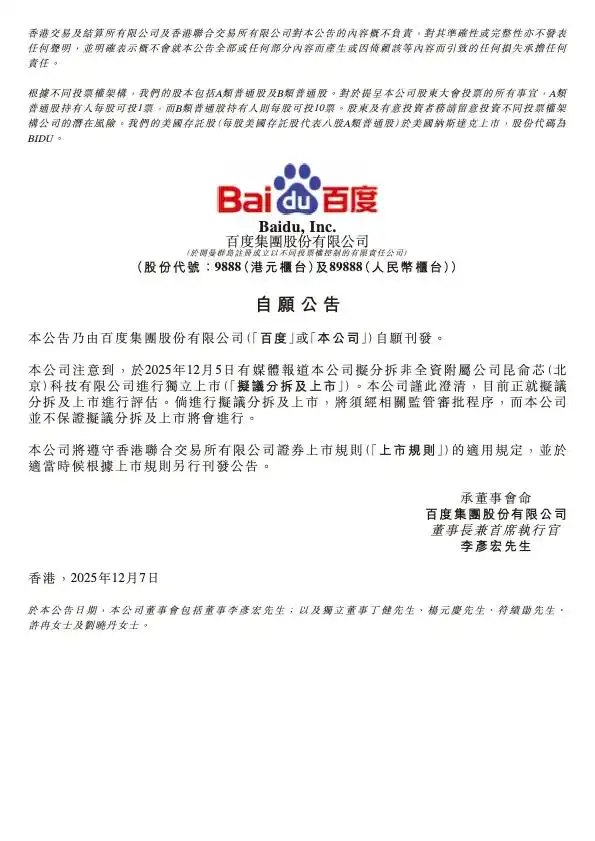
What a strategic move by Baidu's PR team, with PR and IR (Investor Relations) working in tandem, this time with a strong rationale.
Previously, in our discussion about Baidu's missed opportunities with its C-end products and the incomplete development of its large models, we highlighted the lag in Baidu's C-end offerings. Interestingly, shortly after the content was published, the head of the Wenxin App was replaced. A few days later, reports surfaced that Baidu had established new basic model R&D and applied model R&D departments, reporting directly to CEO Li Yanhong.
It's hard to establish a direct link, but it's evident that internally, Baidu is dissatisfied with the current state of its C-end entry points and is in need of a robust reform. Thus, adjustments began with the organizational structure of C-end products and large models. Meanwhile, AI infrastructure like chips, which has already been performing well, is now poised to generate revenue independently.
Regarding the spin-off of Kunlunxin, let's first explore whether it should be done, and then delve into the reasons.
If the question is whether Kunlunxin should be spun off, the answer is a resounding yes. The mismatch between foundational capabilities and upper-layer applications necessitates unbundling to allow Kunlunxin to operate freely.
In fact, skepticism about C-end products stemmed from high expectations for the foundation. Hence, there's a sense of "misfortune and unfulfilled potential" surrounding Wenxin. The most frustrating aspect isn't failure but the feeling of "I could have done better." Baidu's AI foundation is undervalued.
The intensity of domestic substitution in computing hardware is palpable. Moore Threads' IPO witnessed a net gain of 270,000 yuan per lot, with its market cap soaring to 300 billion yuan on the first day, nearly matching Baidu's value. Without external interference, 300 billion won't be the ceiling for Moore Threads. Ignoring complex capital operations and focusing on value, Baidu, with Kunlunxin and Apollo Go, seems undervalued at 300 billion.
Consider another benchmark: Cambrian, with a market cap hovering around 600 billion yuan. As a chip company spun off from Baidu's chip and architecture department, if Baidu can incubate one, why not another?
Thus, it's plausible that Baidu's 300 billion yuan market cap conceals another 300 billion. From a capital perspective, allowing Kunlunxin to operate independently makes perfect sense.
After discussing whether it should be done, let's delve into the reasons. The rationale behind Kunlunxin's spin-off is straightforward: commercializing AI hardware for domestic substitution.
Firstly, the structural narrative of domestic substitution is self-evident. Under the current macro backdrop, independent R&D in technology, especially AI, holds immense potential. However, domestic computing demand isn't just about a temporary lag in domestic production; it involves ecosystem migration costs for enterprises.
We know NVIDIA is the "temporary deity" of computing servers, not just for its hardware leadership but for its CUDA ecosystem, which spans almost all high-performance computing fields, from AI to scientific computing, medical imaging, autonomous driving, and graphics rendering. This comprehensive coverage builds a formidable moat, allowing NVIDIA to lock in customers. In the face of domestic substitution, migration costs will inevitably add to computing hardware costs.
Baidu's technical route of deep adaptation with PaddlePaddle and CUDA-like interfaces enables 70% seamless conversion via API compatibility and code migration tools, offering lower migration costs than more independent ecosystems. This reduction will undoubtedly influence enterprise decisions during the "card-swapping trend." Kunlunxin is poised to benefit from domestic substitution.
Regarding commercialization, independence is even more crucial for Kunlunxin. If its primary buyers were government-enterprise clients or companies without market competition with Baidu, independence broadens its potential buyer base. Domestically, major model companies need not worry about competition. Abroad, an independent brand can pave the way for global expansion—perhaps an unspoken ambition of Baidu's.
Don't underestimate the value of an independent brand for corporate cooperation. TSMC's success in securing orders from major clients through foundry services stems from its focus on being Fabless, avoiding competition with any client, and excelling in its industrial chain role, thus alleviating commercial concerns from industry players.
Next, Baidu is likely to witness a significant expansion in B-end revenue. As a Baidu subsidiary, Kunlunxin's client expansion was often labeled as "Baidu-affiliated." As an independent listed company, endorsements from state-owned shareholders like China Reform Fund and adherence to Hong Kong's international disclosure standards can help it access more government and central enterprise clients—core users of the domestic computing ecosystem.
For a long time, Kunlunxin was primarily used by Baidu, and due to limitations in Baidu's large models, external perception was low. BOC International's research report states: "Based on market research feedback, Kunlunxin has matched or surpassed many industry leaders in various aspects, especially in CUDA compatibility." Clearly, Kunlunxin's commercialization is accelerating: public data shows its 2024 revenue was about 1 billion yuan, expected to exceed 3.5 billion yuan in 2025 and achieve break-even. External client contributions jumped from under 30% in 2024 to over 50% in 2025.
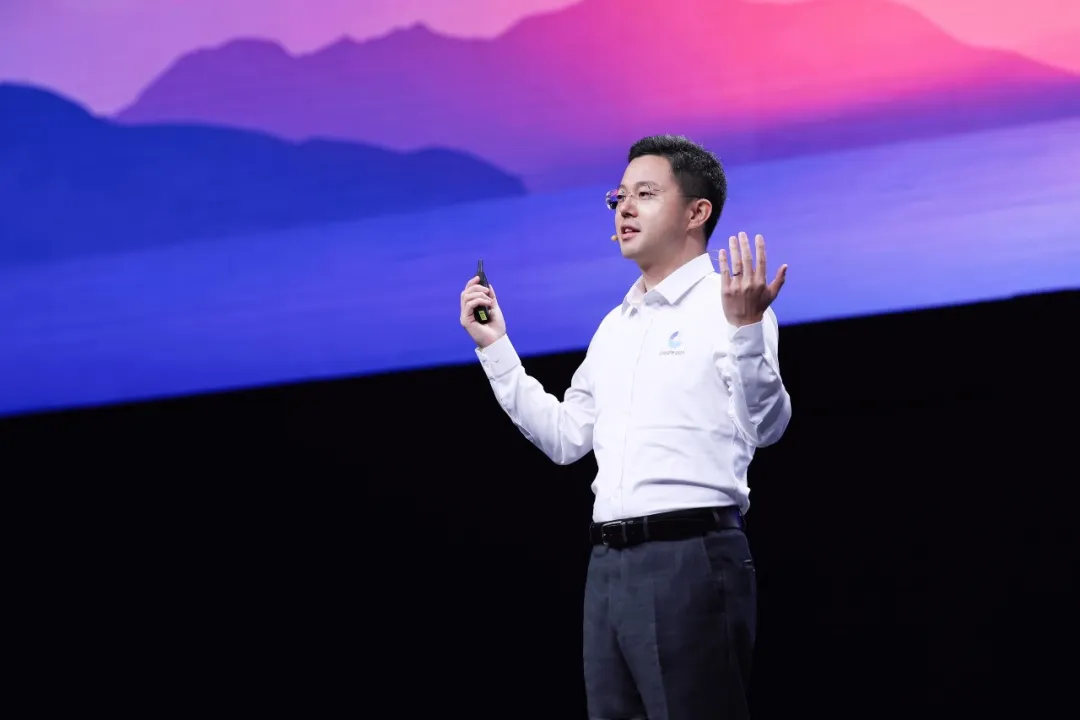
At the Baidu World Conference, Shen Dou, Executive Vice President of Baidu Group, revealed that Kunlunxin's "dual-flagship" chips are under development: the M100 for inference scenarios is expected in early 2026, and the M300 for training scenarios in early 2027. These are Kunlunxin's official figures. Baidu insiders also disclosed that Baidu's AI performance growth heavily relies on Baidu Intelligent Cloud's rise, closely tied to strong demand for Kunlunxin chips. Some orders for Baidu Intelligent Cloud stem from urgent client needs for Kunlunxin chips. Insiders suggest that given current domestic chip supply-demand conditions, Kunlunxin's sales are expected to continue rising in the coming years, further boosting Baidu Intelligent Cloud's performance.
Previously constrained by Baidu's financial policies, Kunlunxin can now, post-independence, raise funds through IPOs to intensify toolchain R&D—such as filling gaps in debugging and performance analysis tools. An independent Kunlunxin can also collaborate more freely with third-party cloud providers (e.g., Alibaba Cloud, Tencent Cloud) without worrying about competing with Baidu Intelligent Cloud, rapidly expanding its ecosystem and avoiding the "Baidu internal closed loop" limitation.
JPMorgan is bullish on Baidu, projecting Kunlunxin's sales to surge sixfold, from about 1.3 billion yuan in 2025 to 8.3 billion yuan in 2026. Cathie Wood's renewed purchase of Baidu reflects her confidence in its autonomous driving leadership. Thus, Baidu holds promise at every turn.
Though often criticized for arriving late, Baidu may yet have the last laugh.
Patience often pays off.
-
![]()
Alibaba's AI Offensive: Over Half of Investment Allocated, Time to Reap Returns
-
![]()
Alibaba’s AI Push: Over Half of Investments Made, Time to Harvest Returns
-
![]()
Chinese Enterprises Going Global 3.0: From World Factory to AI Infrastructure Builder
-
![]()
Honor RobotPhone Review: Half Movie Camera, Half Robot
-
![]()
AI-Driven Cheating Surges in Universities! Online Exams Reduced to Mere Formalities, Degree Credibility on the Line
-
Insta360’s Decade in Panoramic Imaging: Making Cameras ‘Invisible’ and Returning Creation to the Masses
-
![]()
Foreign Media Claims Apple is Concentrating Resources on AI Development: Vision Pro and Siri Teams Lay Off 200 People
-
Big News! Huaneng and Huawei Hold Talks in Shenzhen with Ren Zhengfei in Attendance; Huawei Emerging as the 'Second Brain' of China's Energy System