The Three Core Drivers Behind QianWen's Three Consecutive Rollouts
 12/09 2025
 515
515

Written by | Hao Xin
Edited by | Wu Xianzhi
Following a brand overhaul, Alibaba's AI assistant, QianWen, has swiftly embarked on a cycle of product enhancements.
In December, it unveiled three updates within a single week, introducing entirely new iterations of QianWen tailored for office, learning, and video applications. This move clearly signals to the outside world a rhythm reminiscent of a 'startup' within a major corporation—agile, intensive, and fully committed.
'QianWen's open-source large model already holds certain leading advantages. The next step is to apply this technology to specific use cases in work, study, and daily life, catering to user needs across diverse scenarios,' the QianWen team explained.
Photon Planet has learned that, unlike other products, QianWen's recent upgrade did not focus on a single assistant capability. Instead, it uniformly enhanced capabilities across office, learning, and daily life domains. Behind new features like 'question-answering,' 'PPT creation,' and 'homework grading' on the QianWen conversation page lies Alibaba's seasoned learning product team, office team, and writing team.

Specifically, the office scenarios encompass the entire workflow, including writing, PPT generation, AI editing, intelligent layout, and multi-format conversion, with all capabilities freely accessible. A document generated by QianWen can further be transformed into a PPT, aiming to enable users to complete all operations within a single AI assistant, meeting their 'one-stop, full-process' office needs.
In learning scenarios, two key functions—'question-answering' and 'homework grading'—have been updated. It can accurately scan and analyze even blurry, abstract, or complex questions. During explanations, it simulates a teacher's thought process, emphasizing guidance and inspiration. The 'homework grading' function now supports full-page grading, automatically generating intelligent learning summaries and providing in-depth analysis of incorrect answers for precise identification of knowledge gaps.
Furthermore, QianWen has integrated the latest model from the Wanxiang series, Wan2.5, elevating its video creation capabilities to a new level with improved motion accuracy and limb coordination.
After this upgrade, QianWen has taken another stride forward from being a Q&A assistant to achieving task completion. In the future, it will continue to evolve along the theme of 'not just chatting, but also getting things done.'
One-Stop Office Solution
Market-educated users are no strangers to AI assistants. Occasionally, they might open the app, ask a few questions, and then forget about it in a corner of their phone. Brief usage followed by switching between several similar AI products has become the current norm.
Why does QianWen emphasize 'capabilities' over 'functions'?
The user open rate and retention of AI products fundamentally depend on the nature of the needs they meet, rather than purely on technological capabilities. QianWen's focus on 'capabilities' is precisely a strategic choice based on demand analysis.
Shuyao, the head of QianWen's office AI, believes that from college students and newly employed individuals to corporate staff, office capabilities are intertwined in everyone's daily work, representing a typical high-frequency, fragmented, yet complex demand. In contrast, needs such as casual chatting and emotional companionship are low-frequency, resulting in inevitable low retention and open rates.
'Ultimately, because these needs naturally and frequently arise among users, using the product becomes a natural behavior. As long as QianWen specifically addresses these user needs, it can naturally maintain a high open rate,' Shuyao explained.

'Working on a phone' is not a pseudo-demand. The QianWen office team's research found that among students and the workforce, writing content on a phone and then exporting it as a document has become a common practice. In today's context, 'office work' does not necessarily require sitting at a computer to type. Through a single QianWen app and a natural language dialogue box, it is possible to achieve a 'one-stop' office process.
The simple understanding of 'one-stop' is completing all operations within a single AI assistant. The QianWen office team hopes that 'QianWen can not only provide ideas but also help users complete their work.'
In QianWen, users can generate a document with a single sentence, which can then be used to generate a PPT. The PPT can automatically match templates, and if unsatisfied, can be further modified and edited before being exported with a single click. This means that from initial draft generation to refined editing, format adjustments, and finally full-format document export or even format conversion, all operations can be completed within a single QianWen app through dialogue.
A very intuitive case is shown in QianWen's demo video: when a user needs to write an annual summary, the entire process is seamless.
The user only needs to specify their identity, such as 'an administrative manager in the comprehensive department of a large manufacturing enterprise,' and QianWen will prompt them on which angles to approach based on their actual identity, forming an annual summary accordingly. If the user wants to make minor adjustments to the content, they can directly click the edit option and use the 'local polishing and editing' function within QianWen's writing editor to add personal creative ideas. Notably, the generated documents and PPTs are already formatted, eliminating the need for users to spend time adjusting them, greatly improving efficiency.
For example, the 'direct layout output' function starts from the user's needs, insightfully identifies the core demands in specific scenarios, systematically collects a wealth of layout paradigms, and provides high-quality learning materials for the model. Meanwhile, leveraging QianWen model's continuously improving understanding capabilities, it accurately distinguishes different elements in the generated content, such as titles and body text, and intelligently matches them with the accumulated layout paradigms, achieving real-time, efficient, and visually appealing layout processing.
'AI Tutor'
The traditional education model is akin to a 'one-size-fits-all' approach for students, with one teacher, one set of questions, and one assessment standard. However, breakthroughs in AI technology have made personalized education possible, enabling customized teaching plans, tailored instruction, and learning guidance through AI.
Currently, the market for intelligent education products is mixed, with many still relying on the outdated approach of overwhelming students with practice questions, pretending to be AI through question banks and algorithm matching. Many companies lacking a technological foundation often fail to break through the initial barriers.
In this regard, QianWen's learning products have a natural advantage. QianWen recently integrated a learning large model, Qwen3-Learning, specifically trained for learning scenarios.
Based on Qwen3, this model is trained with trillion-level educational data, incorporating examination systems and a vast number of real questions from over 30 countries worldwide. It possesses cross-cultural and multilingual problem-solving abilities, capable of deeply analyzing complex knowledge systems and answering techniques. It is Alibaba's strongest learning large model to date, achieving excellent results in exams from different systems, difficulty levels, and countries.
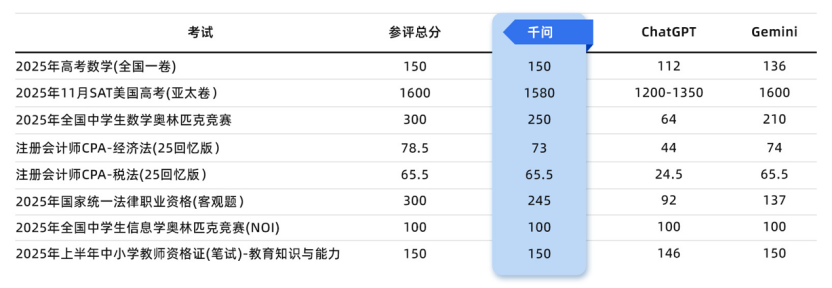
The large model's capability serves as the technological foundation, but for AI to truly become a teacher, the QianWen learning team believes it needs to overcome three major thresholds: vision, reasoning, and efficiency.
Through multimodal capabilities, it achieves full-scenario visual understanding, accurately extracting complex content such as handwriting and charts. In reasoning, it focuses on guiding thought processes, using structured thinking chains for step-by-step analysis to help students master methods from multiple angles. Meanwhile, the system dynamically adjusts the depth of reasoning to enhance response speed while ensuring accuracy, striving to provide a 'fast and accurate' learning experience.
In educational scenarios, the demand for 'questions' is always present, whether it's students seeking answers or teachers grading assignments. For this update, the QianWen learning team focused on 'question-answering' and 'homework grading' based on these essential needs.
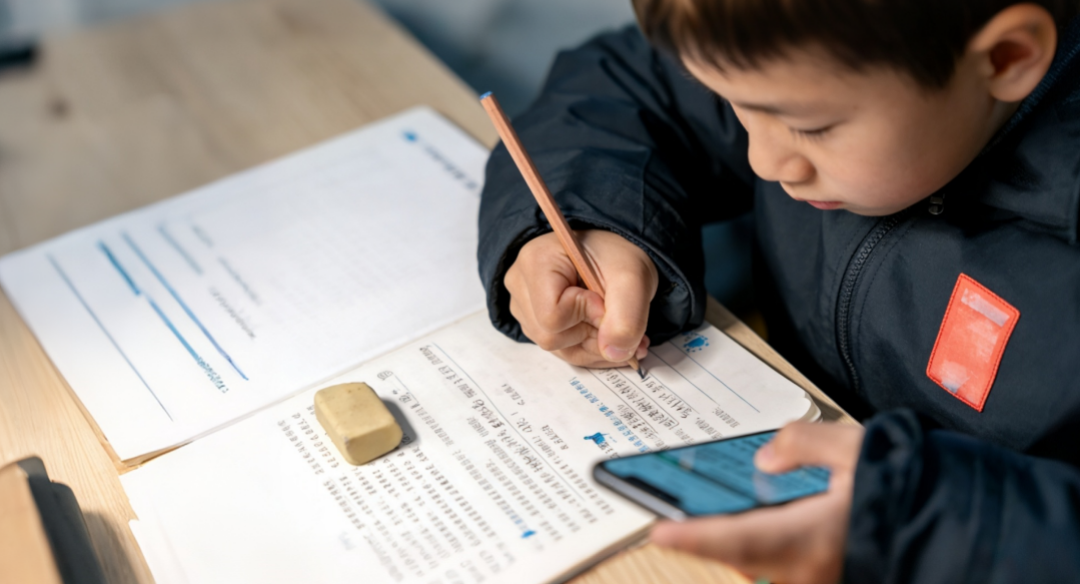
The function of taking photos to search for questions has been around for a long time, primarily relying on image scanning and question bank matching to quickly provide students with answers and complete assignments. QianWen's 'question-answering' has improved in terms of question recognition accuracy and depth of explanation. Whether it's handwritten text on paper, blackboard writing, classroom PPTs, or PDF scans, it can accurately recognize them in one go. It can also fully read and identify the key points of abstract content such as chart questions, geometry questions, and function questions. Especially for K12 students, QianWen is deeply compatible with China's high school and college entrance exams, primary and secondary school prestigious school real questions, and textbook systems.
In terms of explanation depth, QianWen no longer stops at merely finding the answer but presents the problem-solving thought process and thinking methods, inspiring students to explore problems and think about answers. The QianWen learning team hopes that users can not only learn how to solve a specific question but also master the methods and thought processes for a category of questions, which has become their starting point for thinking.
QianWen's 'homework grading' supports full-page grading of assignments and test papers across all subjects in primary, junior high, and high school, compatible with both printed and handwritten text recognition. Currently, QianWen can automatically grade a rich variety of question types, including Chinese from pinyin fill-in-the-blanks to reading comprehension, mathematics from mental arithmetic and calculations to application problems, and English from multiple-choice, translation fill-in-the-blanks to cloze tests. It generates intelligent summaries that include diagnosis of weaknesses and in-depth explanations of incorrect answers, forming a closed learning loop from diagnosis to improvement.
The QianWen learning team believes that homework grading should not merely stop at static right or wrong judgments but hopes to make horizontal and vertical comparisons based on students' past academic performance and error analysis, thereby more comprehensively and intelligently grasping changes in students' learning situations.
The Continuously Evolving QianWen
With this phased upgrade, QianWen aims to achieve two major visions:
Firstly, it seeks to bridge the gap between cutting-edge large model technology and products. Having mastered advanced model algorithms and engineering capabilities, QianWen needs to gain a deeper understanding of user scenarios and transform technology into usable functions, thereby filling the gap between technology and practical applications.
Secondly, based on QianWen's positioning as a general-purpose assistant, it aims to further refine and deepen product functions, continuously bridging the link between functions and task completion.
More importantly, QianWen wants to form a continuously reinforcing growth loop. Powerful model capabilities support rich and practical product functions, attracting users and traffic. The feedback and data generated by users during usage, in turn, continuously train and optimize the model, driving its performance to improve.
This positive cycle of 'capabilities - functions - data - capabilities' will enable QianWen to continuously evolve, establishing a dynamic and stable competitive advantage in the process.
When users stay for the long term due to its depth and precision and form dependencies and habits in core scenarios such as learning, work, and daily life, QianWen will gradually upgrade from a 'usable tool' to a 'trustworthy companion.' The establishment of this relationship means a stronger bond and trust between users and the product, significantly increasing the cost of replacement.
However, it should be noted that there is still a long way to go to reach QianWen's final form.
Zichao, the head of QianWen's office AI, stated, 'From content generation to content delivery, one-stop office is our first step. Next, we will refine user customization and personalization needs, further deepening atomic capabilities within dialogues to achieve personalized delivery in office scenarios.'
Cheng Fei, the product leader of QianWen's learning products, also revealed that the next generation of learning products will focus on multimodal and interactive explanations, providing users with a more intuitive and immersive learning experience through diversified methods.
'This update is just a starting point. Our ultimate goal in the future is to build a lifelong learning ecosystem centered around 'AI Tutor,' with enhancing personal capabilities as the foundation.'
'The functions on QianWen are iterating daily, and new products are already in development.' It points not to a static endpoint but to a continuously evolving future—where AI will deeper understand each specific individual and more naturally integrate into the fabric of work and learning.
Where QianWen's future ultimately leads and what form it will ultimately take remains to be seen.
Public Account | Photon Planet
-
![]()
Alibaba's AI Offensive: Over Half of Investment Allocated, Time to Reap Returns
-
![]()
Alibaba’s AI Push: Over Half of Investments Made, Time to Harvest Returns
-
![]()
Chinese Enterprises Going Global 3.0: From World Factory to AI Infrastructure Builder
-
![]()
Honor RobotPhone Review: Half Movie Camera, Half Robot
-
![]()
AI-Driven Cheating Surges in Universities! Online Exams Reduced to Mere Formalities, Degree Credibility on the Line
-
Insta360’s Decade in Panoramic Imaging: Making Cameras ‘Invisible’ and Returning Creation to the Masses
-
![]()
Foreign Media Claims Apple is Concentrating Resources on AI Development: Vision Pro and Siri Teams Lay Off 200 People
-
Big News! Huaneng and Huawei Hold Talks in Shenzhen with Ren Zhengfei in Attendance; Huawei Emerging as the 'Second Brain' of China's Energy System