Not Following Tesla's Path, China's Embodied AI Companies Are Rewriting the Rules of the Game
 12/09 2025
 695
695

Author | Xiang Xin
If we abstract the current competitive paradigms in the tech industry into two models, the answers may lie in the world's two highest-valued companies: Apple represents technological closed-loop integration and hardware-software synergy, while NVIDIA symbolizes open ecosystems and foundational empowerment.
The same dichotomy applies in robotics. Shi Fan, an assistant professor at the National University of Singapore, identifies two viable paths for robotic deployment:
Apple Model: Hardware-software integration with deep technological convergence to achieve ultimate product performance and high technical barriers.
Android Model: Standardized hardware foundations, open toolchains, and developer communities enabling bottom-up, scalable innovation.
Overseas, the embodied AI landscape is relatively clear. NVIDIA, Intel, and others build unified technical foundations and open ecosystems, laying the groundwork for foundational computing. Meanwhile, Tesla, Figure AI, and other robotics manufacturers resemble Apple, focusing on closed-loop technological integration for complete machines.
But China's embodied AI story is more complex and intriguing, featuring a multi-layered ecosystem:
Domestic chip manufacturers, similar to NVIDIA, are building open ecosystems;
Robot manufacturers pursue both closed-loop technology and open ecosystem strategies.
A clear trend is that more companies are prioritizing technological ecosystem development as a core strategy.
Recently, Diguah Robotics, a provider of universal hardware and software foundations for robots, hosted a developer conference, launching the S600, a high-computing-power development platform for embodied AI robots, and a one-stop development platform.
This year, several humanoid robot manufacturers, including Xinghaitu and Zhuriji Dynamics, have introduced or upgraded their standardized robot bodies and open toolchains.
Today, China's embodied AI industry is shedding external dependencies to jointly build its own 'Android ecosystem,' extending its influence globally. From foundations to robot bodies, China is establishing an 'ecosystem pyramid' for embodied AI:
Bottom layer: Builders of unified foundations;
Middle layer: Platformization of robot manufacturers;
Top layer: Prosperity of the developer ecosystem.
The significance lies in that the first to occupy these ecological niches will gain the defining power over the next global tech product—robots. Chinese manufacturers are determined to seize this opportunity.

The Deep-Seated Reasons Behind China's Shift Toward Open Embodied AI Ecosystems
Compared to overseas counterparts, Chinese robot manufacturers are more strongly moving toward ecosystem development, driven by both industrial structural factors and technological and market pressures.
First, China's application scenarios are excessively numerous and fragmented, with a level of segmentation far exceeding most countries globally.
Facing such a complex market, no single company can cover all needs with one product, making ecosystem development essential for driving demand and reaching niche scenarios.
Take industrial scenarios as an example: China is the only country with a complete range of industrial categories in the UN's Industrial Classification, encompassing 41 major industries, 207 medium industries, and 666 minor industries. Data from different industries contains unique process mechanisms and knowledge; even adjacent production lines may have entirely different operational procedures.
Second, unlike overseas embodied AI, which is concentrated among a few star companies, China's landscape features widespread participation with a high proportion of small and medium-sized teams.
On one hand, while these teams possess R&D capabilities, they have limited resources and need unified hardware foundations and open toolchains to lower development barriers.
On the other hand, China has the world's largest pool of R&D talent and startups, crucial 'potential forces' for embodied AI development, requiring an open ecosystem to activate technological innovation.
China's R&D personnel count has ranked first globally for years, exceeding 10 million in 2023. According to the New Strategy Humanoid Robot Industry Institute, as of December 2024, Chinese companies account for over half of the world's 220-plus humanoid robot manufacturers, with more than 110 firms.
Third, unlike overseas capital willing to make long-term 'technological faith' investments and await maturity, China's capital market demands more immediate and practical commercialization.
A key example is that Chinese embodied AI startups generally have lower valuations than their U.S. counterparts. The highest-valued Chinese embodied AI company, Zhiyuan Robotics, is valued at approximately RMB 18 billion.
However, the highest-valued U.S. embodied AI company, Figure AI, is valued at USD 39.5 billion (approximately RMB 279.3 billion), with a valuation gap exceeding 15 times.

Figure 03 Humanoid Robot
This pressure forces Chinese embodied AI companies to quickly identify paying scenarios. Currently, many focus on scientific research and education as commercialization breakthroughs due to less stringent product requirements and relatively stable spending power.
Under greater commercialization pressure, domestic manufacturers must rapidly drive applications, accumulate developers, and gather data through open ecosystems to accelerate technological validation and commercialization.
Modular toolchains, low barriers to entry, and a culture of rapid validation collectively form the cultural foundation for China's ecosystem approach.
Overall, whether closed-loop or open, both models aim to keep core capabilities in-house; the difference lies in external expansion and developer integration.
In a fragmented, rapidly iterating, multi-scenario, and high-pressure market, ecosystem development has become a natural choice for domestic manufacturers.

Emergence of Unified Foundation Providers for Embodied AI
This year, humanoid robot orders have surged. UBTECH's Walker series humanoid robots have accumulated over RMB 1.1 billion in orders, while Zhiyuan Robotics has mass-produced over 2,000 robots offline. Companies like Zhongqing Robotics, Yinhe General, and Leju Robotics expect to mass-produce thousands of humanoid robots this year.
Against this backdrop of increasing Large scale mass production (large-scale mass production) by robot manufacturers, a unified, stable, and scalable robot foundation has become more critical than ever.
The foundation of embodied AI includes chips, controllers, sensor systems, middleware, operating systems, and simulation toolchains—infrastructure that determines whether robot manufacturers can achieve rapid and efficient mass production.
Historically, China has lacked order in this area, with manufacturers often needing to develop in-house or combine solutions from various suppliers, resulting in insufficient ecological synergy and heavy reliance on foreign technological ecosystems and core hardware.
In other words, China lacked domestic players comparable to NVIDIA, Microsoft, or Intel.
However, in recent years, this disordered market has begun to organize. Domestic unified foundation providers have emerged, forming two main approaches:
Hardware Empowerment with Software Support: Represented by Diguah Robotics, this approach provides ecological support for full-link development infrastructure, including robot operating systems, one-stop development platforms, and algorithm centers, centered around core components like chips and controllers.
Software Empowerment with Resource Support: Represented by Tencent, Huawei, JD, and the Zhiyuan Research Institute, this approach builds public software foundations through open-source models, algorithms, standard toolchains, data platforms, and unified interfaces.
Diguah Robotics, spun off from Horizon Robotics, aims to be the 'Wintel' of the robotics field. Their ecological strategy involves building a rich software resource ecosystem around their chip hardware, creating a full-link development infrastructure for robotics technology. This hardware-software integration aligns with the high coupling characteristics of embodied AI robot development.
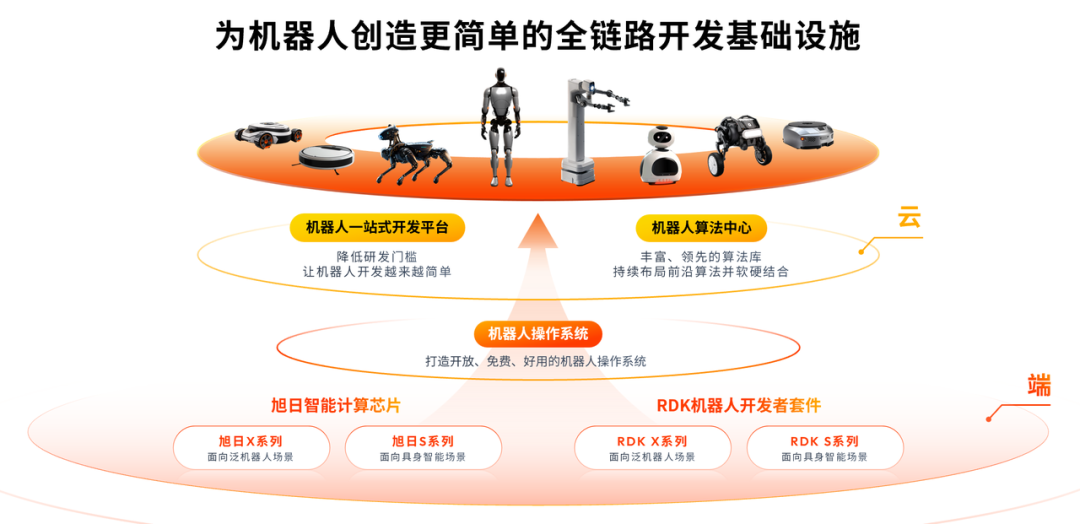
Diguah Robotics' hardware product lines are clearly defined, with chips and development kits divided into X and S series:
X Series: Targets low-computing-power applications, emphasizing low power consumption and high cost-effectiveness, covering general robotics fields such as robotic vacuums, lawn mowers, service robots, and consumer drones. Products include the X3 (3 TOPS computing power) and X5 (10 TOPS computing power).
S Series: Targets high-computing-power applications, primarily for embodied AI and humanoid robots, providing high computing power to meet complex decision-making and motion control needs. Products include the S100 (128 TOPS computing power) and S600 (560 TOPS*(INT8) computing power). 
Thus, Diguah Robotics' chip and development kit products can generally meet the computing power needs of various robot products on the market. Among them, the latest S600 high-computing-power development platform for embodied AI robots is optimized for such robots, supporting efficient edge deployment of various embodied large model algorithms, including VLA, VLM, LLM, and Locomotion. When adapted to Pi0, its performance can exceed mainstream embodied brain platforms by 2.3 times, meeting complex decision-making needs. 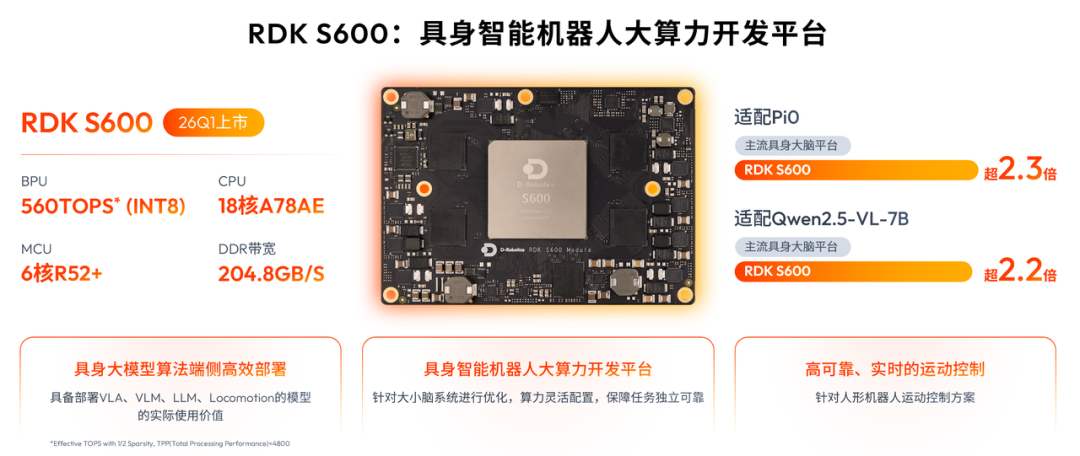
Manufacturers such as Fourier Intelligence, Accelerated Evolution, Autovariable Robotics, Star Motion Era, Beijing Humanoid Robot Innovation Center, Humanoid Robot (Shanghai) Co., Ltd., Zhuriji Dynamics, and GAC Group have become the first strategic customers for the S600.
In terms of software ecosystems, Diguah Robotics also provides systematic support, with its one-stop development platform being the core:
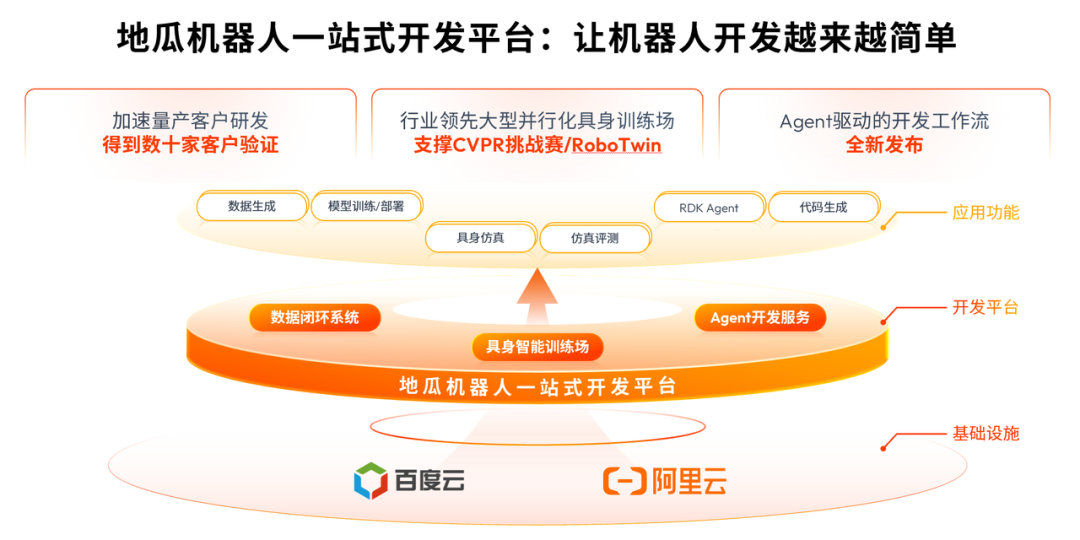
The Diguah Robotics one-stop development platform offers three main services: data closed-loop systems, embodied AI training grounds, and Agent development services, addressing data, training deployment, and application development expansion issues in robot development.
Data Closed-Loop System: Automatically generates and annotates data, completing the full-link data closed loop from 'data collection/generation → data annotation → model training → cloud quantization → edge deployment.'
Embodied AI Training Ground: Supports training for different robot forms and various embodied AI algorithms, providing full-link capabilities from data generation, hybrid training, simulation verification, to real-machine migration.
Agent Development Service: Acts as an intelligent programming assistant team for developers, supporting the creation of various Agents to assist in robot development. Developers can describe needs in natural language, and the system automatically generates code, debugs, and deploys it, enabling robot application creation with a single sentence. Users can also fine-tune exclusive Agents (exclusive Agents) with their own data.
Currently, Diguah Robotics' ecosystem development has begun to take shape, serving over 100,000 robot developers across more than 20 countries globally. They have launched the 'Diguah Gravity Plan,' providing technical empowerment and resource matching support to startups, benefiting over 500 small and medium-sized innovation teams. In the past year, Diguah Robotics' hardware product shipments have increased by 180% year-on-year, with customer numbers growing by 200% year-on-year.
Internet giants and top research institutes like Tencent, Huawei Cloud, JD, and the Zhiyuan Research Institute focus more on software platform construction.
These companies have natural advantages in cloud computing, big data, large models, and AI algorithms, choosing to build public software foundations through open-source models, algorithms, standard toolchains, data platforms, and unified interfaces.
Tencent (Embodied AI Open Platform Tairos 'Titan Screw'): Provides large models and cloud services in a modular way, covering model algorithms such as multimodal perception models and planning large models, as well as cloud services like simulation platforms, data platforms, and development tools.
Huawei Cloud (CloudRobo Embodied AI Platform): Integrates end-to-end capabilities such as data synthesis, data annotation, model development, simulation verification, and cloud-edge collaborative deployment, promoting technological incubation in various vertical scenarios.
JD (JoyInside Platform): Focuses on endowing robots with high emotional intelligence dialogue capabilities to enhance human-machine interaction experiences, primarily operating at the application layer.
Zhiyuan Research Institute: Has open-sourced multiple embodied large models (RoboBrain series, EMU series), the world's largest and most finely annotated dual-arm robot real-machine dataset RoboCoin, and the embodied one-stop platform RoboXStudio, covering an extremely comprehensive development link.
Whether through Diguah Robotics' hardware empowerment or the software empowerment by internet giants, their methods differ but share the same goal: significantly lowering development barriers and improving research efficiency across the industry by building industry-wide foundational unification.
As robot manufacturers enter large-scale mass production, any non-standardized foundational technology will translate into high marginal costs. Unified hardware and software foundations can reduce procurement and training costs for chips and software through economies of scale while substantially shortening robot integration cycles. In China's fiercely competitive market, this is essential for maintaining price advantages and delivery speeds.

Robot Body Manufacturers: From Selling Products to Competing for Technological Platforms
In China, robot body manufacturers are also vying to build ecosystems.
Companies such as Unitree Robotics, Acceleration Evolution, Galaxbot, Fourier Intelligence, Roboascent, LimX Dynamics, and Enabot are establishing their own ecosystems to varying degrees.
The core approach to their ecosystem construction is to open up robot body hardware interfaces and software development resources to buyers, providing development toolchains that allow developers to conduct secondary development on the robot bodies.
Secondly, they also open-source algorithms, models, action libraries, datasets, etc., enabling developers to stand on the shoulders of giants, accelerate model iteration, reduce application costs, and rapidly accumulate data and application scenarios.
The active construction of ecosystems by robot body manufacturers is driven by deeper strategic considerations.
On one hand, widespread sales of robot body hardware represent companies' efforts to become technological platforms by promoting their hardware architectures as industry standards.
On the other hand, continuous open-sourcing serves as a means for companies to build technological influence and foster external innovation among developers.
In the era of embodied intelligence, the speed of technological capability expansion depends on the pace at which developers can conduct iterative experiments using robot bodies. The more open-sourced resources are available, the greater the technological influence of robot body manufacturers, and the easier it is for external innovation to occur.
The paths taken by Chinese humanoid robot manufacturers to build ecosystems can be divided into two categories:
The first is hardware-driven ecosystems, which open up ecosystems through low-cost, high-performance products. Representative companies include Unitree Robotics, Acceleration Evolution, Fourier Intelligence, and Roboascent, whose core competitiveness lies in their technological capabilities in 'robot body + cerebellum.'
The high-performance, cost-effective hardware of these companies has greatly attracted developers. For example, Unitree's newly launched R1 robot and Acceleration Evolution's new humanoid robot Booster K1 are both priced as low as 29,900 yuan.
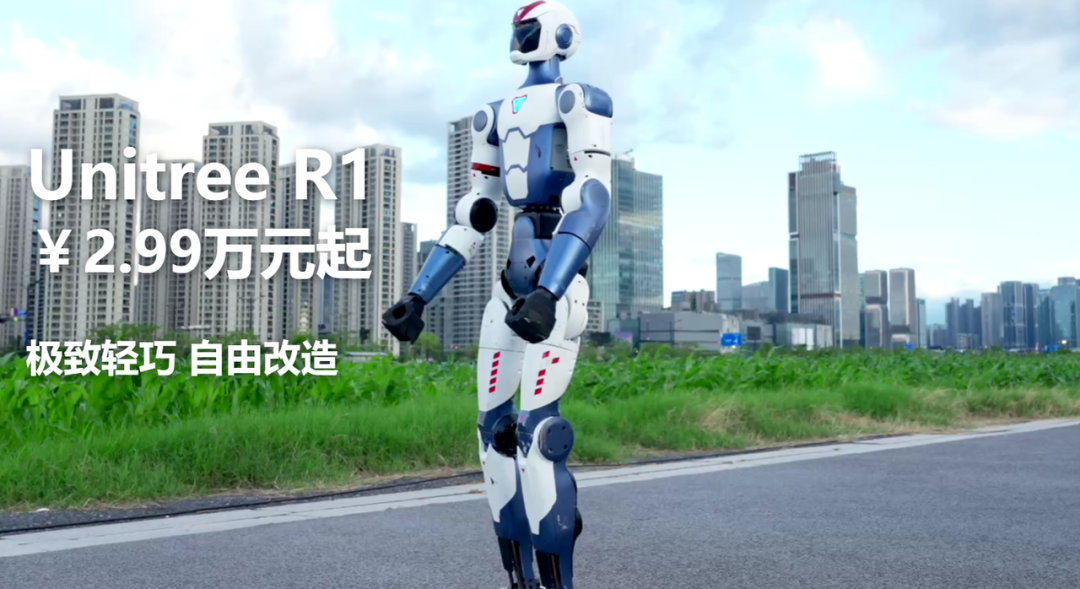
The extreme cost compression is achieved through their deep in-house research and development of robot components, highly mature supply chains, and software strategies that are lighter and focused on general-purpose development platforms rather than full-stack systems. Additionally, most of these companies can reuse software and hardware technologies from their previous quadruped robot dog products.
The lower the price of the robot body, the more conducive it is for developers to conduct experiments and innovations. This represents an ecosystem style very characteristic of China's industrial chain.
In the scientific research community, there is even a prevailing sentiment that Unitree's G1 has become the default experimental platform, and not using it often makes it difficult to align experimental standards and Not conducive to determining the value of the paper (which makes it unfavorable for assessing the value of research papers).
The second is full-stack-driven ecosystems, which emphasize the construction of full-stack capabilities in 'brain + cerebellum + robot body,' such as Galaxbot, LimX Dynamics, and Enabot. The main difference from hardware-driven companies is their greater emphasis on and investment in the 'robot brain.'
These companies position themselves at a higher level, viewing embodied intelligence as a full-stack systems engineering endeavor capable of providing more systematic technological and resource support.
Such companies are generally developing their own embodied large models and choosing to open-source them. For example, Galaxbot open-sourced the G0 model, Enabot open-sourced the GO-1 embodied foundation large model, and LimX Dynamics open-sourced the embodied manipulation algorithm LimX VGM.
They also generally prioritize one of the biggest challenges of the 'robot brain': data.
Enabot open-sourced the AgiBot World dataset, which is the world's first full-function, full-scenario, high-quality million-scale real-machine dataset for humanoid robots.
Galaxbot open-sourced the Galaxea Open-World Dataset, which received over 400,000 downloads in just two months, indicating that its technological influence has reached the core research community in the field of embodied intelligence.
Galaxbot also launched the Embodied Intelligence Platform (EDP), which integrates functions such as data collection management, storage, processing, and quality inspection. Combined with real-machine datasets, it greatly simplifies data management, enabling developers to more easily complete development and iteration. Sources indicate that Galaxbot's annual revenue is expected to reach 70 million yuan, with its main revenue coming from the EDP platform.
These companies target higher-complexity task systems, so their robot body prices are relatively higher. By open-sourcing core models and data, they attract developers to use their full-stack solutions, aiming to establish a monopoly advantage at the 'embodied brain' level.
With the rapid growth of China's humanoid robot population, the technological foundation of the entire industry is being reshaped.
If each manufacturer insists on in-house development of full-link technologies, the high R&D costs will quickly escalate, and the pace of mass production will be slowed down. Under this market pressure, the industry will naturally move toward a more standardized and reusable unified foundation, allowing robot body manufacturers to share infrastructure and concentrate resources on differentiated capabilities.
More importantly, China's supply chain collaboration density is extremely high, with the 'software-hardware-complete machine-application' industrial chain often in a state of close linkage.
This means that China is more likely to form a multi-entity ecosystem involving robot body manufacturers, foundation manufacturers, algorithm companies, and industry partners, rather than a situation like in the United States where a single company dominates the full stack and operates independently.
In this collaborative atmosphere, a more open and flexible 'Chinese-style ecosystem' has a natural foundation and is more likely to produce a globally competitive technological system.
In the future, China's robot ecosystem is likely to develop along three lines:
The first is the standardization of computing foundations, where underlying technologies become standardized;
The second is the mainstream adoption of edge-cloud integration, enabling robots to possess continuous evolutionary capabilities;
The third is the rise of platform-type manufacturers, with the developer ecosystem becoming a core competitive advantage.
Ultimately, China has the opportunity to create a truly globally competitive 'Android-level robot ecosystem,' thereby regaining crucial technological definition rights for Chinese technology in the era of embodied intelligence.
-
![]()
Alibaba's AI Offensive: Over Half of Investment Allocated, Time to Reap Returns
-
![]()
Alibaba’s AI Push: Over Half of Investments Made, Time to Harvest Returns
-
![]()
Chinese Enterprises Going Global 3.0: From World Factory to AI Infrastructure Builder
-
![]()
Honor RobotPhone Review: Half Movie Camera, Half Robot
-
![]()
AI-Driven Cheating Surges in Universities! Online Exams Reduced to Mere Formalities, Degree Credibility on the Line
-
Insta360’s Decade in Panoramic Imaging: Making Cameras ‘Invisible’ and Returning Creation to the Masses
-
![]()
Foreign Media Claims Apple is Concentrating Resources on AI Development: Vision Pro and Siri Teams Lay Off 200 People
-
Big News! Huaneng and Huawei Hold Talks in Shenzhen with Ren Zhengfei in Attendance; Huawei Emerging as the 'Second Brain' of China's Energy System