In-Depth Analysis: Doubao AI Enters the Mobile Realm, Propelling ByteDance into the Strategic AI Arena
 12/10 2025
 747
747
Preface:
The Doubao Mobile Assistant transcends the status of a mere upgraded AI plugin; it symbolizes ByteDance's profound transformation of the mobile internet ecosystem. With system-level access, it dismantles the barriers between apps, marking the transition of AI-powered phones from conceptual to real-world applications and revealing ByteDance's grand AI strategy centered on alliances and collaborations.
AI Takes Command of Phones for the First Time
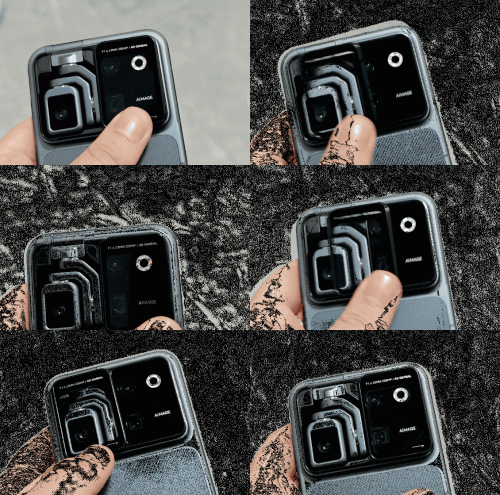
Recently, ByteDance's Doubao team unveiled the Doubao Mobile Assistant Technical Preview, with the ZTE Nubia M153 engineering prototype, now available for purchase, showcasing this functionality. Priced at 3,499 yuan, the initial batch of 30,000 units sold out swiftly, with resale prices soaring up to 6,500 yuan. ZTE's A-shares soared to their daily limit, while its Hong Kong-listed shares jumped 13.94%, pushing its market capitalization past 210 billion yuan.
In the mobile internet era, users are accustomed to navigating between apps like WeChat, Taobao, and Meituan, often requiring numerous clicks to complete a task. The Doubao Mobile Assistant fundamentally alters this interaction paradigm.
Unlike most AI assistants that merely offer voice-based Q&A, the Doubao Mobile Assistant boasts Android system-level INJECT_EVENTS permissions, earning it the moniker "God's Hand" in the industry.
It can mimic human actions such as clicks, swipes, and inputs, seamlessly navigating across multiple apps to complete tasks, truly enabling phones to operate autonomously based on user needs.
In official demonstrations, users simply press the side AI button and say, "Compare prices for this coffee bean," and the phone automatically opens e-commerce platforms like Taobao, JD.com, and Meituan, searches for the product, compares prices and coupons, and compiles a list for user confirmation and purchase.
For travel planning, a command like "Check tomorrow's bullet trains to Shanghai, calculate departure time, and set an alarm" prompts Doubao to automatically query 12306 for schedules, use maps to calculate commute times, and even inquire about preferred travel modes to optimize plans.
This cross-app scheduling capability breaks through the mobile internet's long-standing "sandbox isolation" mechanism.
Previously, AI assistants were confined to providing services within a single app, but Doubao transforms the phone into a "smart scheduling hub," unifying services scattered across various apps and achieving a shift from "people seeking services" to "services finding people."
The Doubao Mobile Assistant's innovation extends beyond cross-app operations. It deeply integrates Doubao's large multimodal model into the system's core, enabling more natural human-machine interaction: In the gallery, saying "remove bystanders" while pointing at a photo prompts the AI to perform retouching directly.
When browsing social media and encountering an image of a scenic spot, asking "Where is this?" yields an immediate answer; double-tapping the AI button initiates a voice call, allowing Doubao to read picture books bilingually or translate conversations in real-time.
More groundbreaking is its long-term memory capability. After enabling the memory function, Doubao can proactively provide services based on past conversations and schedules.
For instance, if a meeting is mentioned in the morning, it automatically organizes relevant documents and sends reminders as the time approaches; for users who jog at night, future versions may adjust lights and air conditioning before their return.
This agent-like trait evolves AI from a "single-instruction executor" to a "long-term life assistant."
A Mutually Beneficial "Two-Way Journey"
As market enthusiasm for AI phones surges, ByteDance's chosen partner is not Huawei, Xiaomi, or other leading manufacturers but ZTE, often seen as a "semi-transparent" player in the smartphone circle.
For mainstream brands like Huawei, Xiaomi, OPPO, and Vivo, AI assistants represent core ecological entry points, akin to a phone's "soul."
These manufacturers are heavily investing in self-developed large models, aiming to build vertical closed loops of "self-developed OS + self-developed large model," and are naturally reluctant to cede system-level permissions to ByteDance, reducing themselves to mere hardware OEMs.
The caution of leading manufacturers created an opportunity for ZTE's collaboration with ByteDance.
Once a giant during the "ZTE, Huawei, Coolpad, Lenovo" era, ZTE ranked fourth globally in smartphone shipments in 2012 but gradually marginalized due to international environmental impacts.
ZTE's "weakness" became its collaborative advantage, as it lacked the burden of self-developed large models and was willing to open system-level permissions for deep synergy with ByteDance.
Through this partnership, ByteDance achieved technical validation of AI phones at minimal cost, avoiding the high investment and ecological conflicts of self-developing smartphones.
Both sides understand that current AI cross-app operation technologies are still immature. The Nubia M153's product page explicitly states: "For industry professionals only; no guarantee of mature product functionality. Consumers should proceed with caution."
This positioning lowers market expectations while reserving space for technological iteration.
The "Permission War" Between Super Apps and AI Assistants
The most significant controversy surrounding the Doubao Mobile Assistant is not its technical imperfections but its challenge to the core interests of the mobile internet ecosystem: traffic distribution rights and data control.
This conflict erupted during the WeChat login anomaly incident, reflecting a life-and-death struggle between super apps and AI newcomers.
On December 2, multiple users reported being unable to log in to WeChat via the Nubia M153, with accounts automatically logging out even after switching. Tencent responded that this was due to "existing security risk control measures."
To enable cross-app operations, Doubao must use GUI Agent to scan screens and simulate clicks, but WeChat's risk control system cannot distinguish between "user-authorized AI operations" and "illegal intrusions," forcing it to safeguard security through forced logouts.
A deeper reason lies in the battle for traffic entry points. WeChat has long been a super entry point for the mobile internet; if Doubao becomes users' "unified scheduling hub," enabling message replies and social interactions without opening WeChat, its traffic foundation would be shaken.
For Tencent, future AI agents must remain under its control. Tencent President Martin Lau has explicitly stated that WeChat will eventually launch its self-developed AI agent to complete tasks within its ecosystem.
The collective vigilance of these super apps fundamentally defends their traffic distribution rights.
In the mobile internet ecosystem, super apps rely on traffic monetization and data accumulation for their business models.
User consumption preferences, social relationships, and transaction records represent their core assets, but Doubao's cross-app operations effectively "intercept" user intent and traffic, reducing super apps to mere "service providers" and stripping them of direct user reach.
While Doubao's ambition to penetrate hardware manufacturers and leading platforms is commercially logical, it is a deadlock in game theory—no platform will willingly surrender its traffic source.
ByteDance's Grand AI Strategy Through Alliances and Collaborations
ByteDance has repeatedly emphasized "no plans for self-developed smartphones," but the launch of the Doubao Mobile Assistant reveals a grander ambition: to build a cross-brand, cross-device "AIOS" layer centered on AI assistants, becoming an "intelligent assistant operator" in the AI era.
ByteDance's ambition extends beyond a single mobile assistant. Through a trinity of "large model + super app + hardware terminal," it is constructing an AI ecosystem spanning B2C and B2B markets and connecting software with hardware.
Just as Zhang Yiming redefined information distribution a decade ago, ByteDance now seeks to redefine service distribution through AI.
This model avoids the high costs and ecological conflicts of self-developing smartphones while rapidly expanding AI technology coverage.
For second-tier smartphone manufacturers and niche brands, integrating Doubao's AI capabilities can quickly enhance product competitiveness and create differentiated advantages, while ByteDance gradually gains control over user entry points in the AI era through such collaborations.
The confidence behind the Doubao Mobile Assistant stems from ByteDance's full-stack AI layout.
Its Doubao large model has upgraded to version 1.6, supporting 256K context windows and achieving global leadership in multimodal understanding and video generation.
Volcano Engine provides cloud-native infrastructure, processing 30 trillion tokens daily and ranking first in domestic market share.
ByteDance also integrates self-developed models with third-party open-source models via Model Router technology, enabling optimal solution matching on demand.
Beyond technology, ByteDance's traffic advantage is undeniable. With over 1 billion monthly active users on Douyin, it drives massive traffic to the Doubao App.
As of October 2025, Doubao boasts 159 million monthly active users, firmly ranking as China's top AI-native application.
This vast user base not only validates its technical roadmap but also provides rich data for model iteration.
ByteDance's AI strategy is essentially an extension of its core logic. Over a decade ago, Zhang Yiming transformed "people seeking information" into "information finding people" using algorithms, giving rise to Today's Headline and Douyin.
Now, ByteDance aims to transform "people seeking services" into "services finding people" through AI, redefining mobile internet interaction rules.
In ByteDance's vision, future phones will no longer be collections of apps but AI assistant-centric smart terminals.
Once this model takes shape, it will overturn the existing app ecosystem, elevating ByteDance from a "content platform" to a "smart service scheduling hub."
Collaborating with upstream and downstream industrial chain partners, it outputs AI solutions via Volcano Engine, with companies like Thundersoft providing end-side adaptation support, forming a "model + technology + hardware" collaboration chain.
Integrating its hardware (Ola Friend earbuds, AI toys) and applications (Douyin, Feishu), it creates a "phone-centric, multi-device collaboration" scenario ecosystem, such as using earbuds to activate Doubao for cross-device operations.
With phones and computers as core entry points, it extends into smart homes and vehicles, building a unified AI interaction hub.
Balancing B2C user experience and B2B industry empowerment, it monetizes through "licensing fees + shipment-based revenue sharing," reinvesting profits into model iteration.
In essence, ByteDance's move is not about competing in the smartphone hardware market but about deploying its powerful AI capabilities across the largest user base through technological licensing and collaborative ecosystems, securing a favorable ecological niche in future AI competition.
The Competition for AI Phones Will Reshape Ecosystem Models
As large model technologies mature, AI phones have transitioned from feature stacking to ecosystem restructuring, with the core of industry competition undergoing a fundamental shift.
Over the past decade, smartphone competition focused on hardware parameters like chips, screens, and cameras.
In the AI era, competition will center on "whether AI can truly solve user pain points," including cross-app task completion, understanding deep user needs, and ensuring security and privacy.
The iPhone moment for AI phones lies not in specifications but in freeing users from tedious operations to achieve "what you say is what you get."
The development of AI phones will accelerate industry differentiation. The first tier includes leading manufacturers like Huawei, Apple, and Xiaomi, which will adhere to vertical closed loops of "self-developed OS + self-developed large model" to control ecological cores.
The second tier comprises second-tier brands like ZTE and Meizu, which will rapidly enhance AI capabilities through partnerships with large model firms like ByteDance and Alibaba, seeking opportunities in the existing market.
This differentiation will trigger new ecological struggles, with large model firms attempting to control intelligent entry points through technological output, smartphone manufacturers defending hardware territories, and super apps striving to maintain existing traffic patterns.
App forms may disappear, replaced by AI-callable service modules; traffic distribution will shift from app-driven to AI-driven; business models will evolve from advertising to service commissions.
Conclusion
Regardless of whether self-developed AI assistants from smartphone manufacturers or third-party agent platforms like Doubao prevail, one fact is certain: the interaction logic of the mobile internet has reached the eve of transformation.
Doubao's "trial" has mapped out the "road conditions" for the entire industry. In this war shaping the next decade's ecological landscape, no party can remain aloof.
Sources: Lianxian Insight: "ZTE Hitches a Ride on Doubao's Gravy Train," Huang Qingchun Channel: "ByteDance Explodes," All-Weather Technology: "Doubao Mobile Phone Sparks Tidal Waves," Yifan YIFAN: "Doubao Mobile Assistant Bursts Onto Scene; ByteDance and Giants Engage in Mutual Strangulation," Geek Park: "First Batch of 30,000 Doubao AI Phones Sold Out; Who Are the Buyers?" Digital Frontline: "Fierce Doubao: In-Depth Analysis of ByteDance's AI Strategy," Kung Fu Finance: "Why I Favor ByteDance Over Alibaba in This AI War"
-
![]()
Alibaba's AI Offensive: Over Half of Investment Allocated, Time to Reap Returns
-
![]()
Alibaba’s AI Push: Over Half of Investments Made, Time to Harvest Returns
-
![]()
Chinese Enterprises Going Global 3.0: From World Factory to AI Infrastructure Builder
-
![]()
Honor RobotPhone Review: Half Movie Camera, Half Robot
-
![]()
AI-Driven Cheating Surges in Universities! Online Exams Reduced to Mere Formalities, Degree Credibility on the Line
-
Insta360’s Decade in Panoramic Imaging: Making Cameras ‘Invisible’ and Returning Creation to the Masses
-
![]()
Foreign Media Claims Apple is Concentrating Resources on AI Development: Vision Pro and Siri Teams Lay Off 200 People
-
Big News! Huaneng and Huawei Hold Talks in Shenzhen with Ren Zhengfei in Attendance; Huawei Emerging as the 'Second Brain' of China's Energy System