Qianwen Reaches 30 Million MAU in 23 Days: Is the AI Landscape Less Congested Than It Seems?
 12/11 2025
 541
541
Today, I stumbled upon the news that Alibaba's Qianwen has amassed over 30 million monthly active users, achieving this remarkable feat just 23 days after its launch. This milestone sets a new global benchmark for the growth of AI applications.
To be honest, I was somewhat taken aback. After all, it's evident to everyone just how fiercely competitive this AI sector has become.
Qianwen's forerunner, the Tongyi App, adhered to a purely organic growth strategy and started with virtually no significant user base.
Hence, this achievement can be solely attributed to Qianwen's own endeavors in establishing its unique position in the market.
Having grown accustomed to witnessing major players boasting hundreds of millions of MAU, people might not fully appreciate the significance of Qianwen's figures.
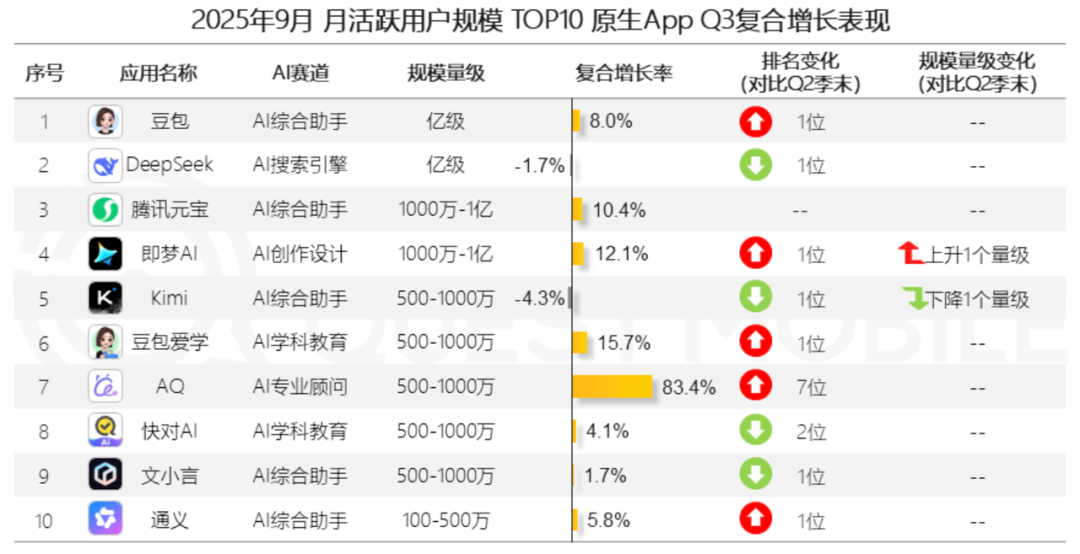
Some time ago, QM released a Q3 report on the AI application industry, which included a set of data: among the leading AI-native apps, Tencent Yuanbao, Jimeng AI, and Kimi had monthly active user bases of 32.86 million, 10.12 million, and 9.67 million, respectively.
Some friends might recall that when Qianwen was first introduced, 'Xiangxianzhi' conducted an analysis of Alibaba's AI strategy.
At that time, we mentioned that Alibaba was pursuing a vertically integrated AI strategy, with a comprehensive layout that spans from foundational infrastructure at the base, through model development and services in the middle, to AI applications at the top.
However, in the ChatBot arena, Alibaba had previously taken a hands-off approach.
So, when Bloomberg reported on the Qianwen project, Alibaba's stock price immediately soared, indicating that the market already had high expectations for Alibaba in this regard.
Nevertheless, we must admit that, more than twenty days ago, despite believing in Alibaba's leading technological prowess, we weren't overly optimistic about Qianwen's prospects.
Over the past twenty-plus days, Qianwen has been rapidly evolving, moving swiftly yet adeptly. It has demonstrated that once a top-tier large model is in place, consumer-end products can quickly mature and become more user-friendly.
These product updates, user experiences, and data have given us an initial insight into Alibaba's strategy for Qianwen and provided a basis for a phased review and adjustment of our original assessments.
Qianwen's success proves that, although the industry may seem highly crowded, there is still a substantial amount of unmet user demand.
In economics, there's a concept known as 'ineffective supply.' This refers to situations where companies provide products or services that the market cannot effectively absorb, thus failing to generate genuine demand.
The proliferation of highly similar AI assistants from various companies, both large and small, serves as a classic MBA case study of ineffective supply.
Users don't truly need an abundance of Q&A applications. What they really require are AI assistants capable of solving practical problems in their daily lives and work—products that represent effective supply.
Qianwen's positioning as an 'AI assistant that gets things done' is the core reason behind its breakthrough.
Once you create effective supply, the rest is left to the French economist Jean-Baptiste Say's famous dictum: supply creates its own demand.
Before the GPT-5 update in August, Sam Altman posted an image of the Death Star.
The Death Star was the Galactic Empire's ultimate weapon of fear. By posting this image without any accompanying text, Altman's message was crystal clear: GPT-5 is incredibly powerful, capable of world-altering feats—come and witness its might.
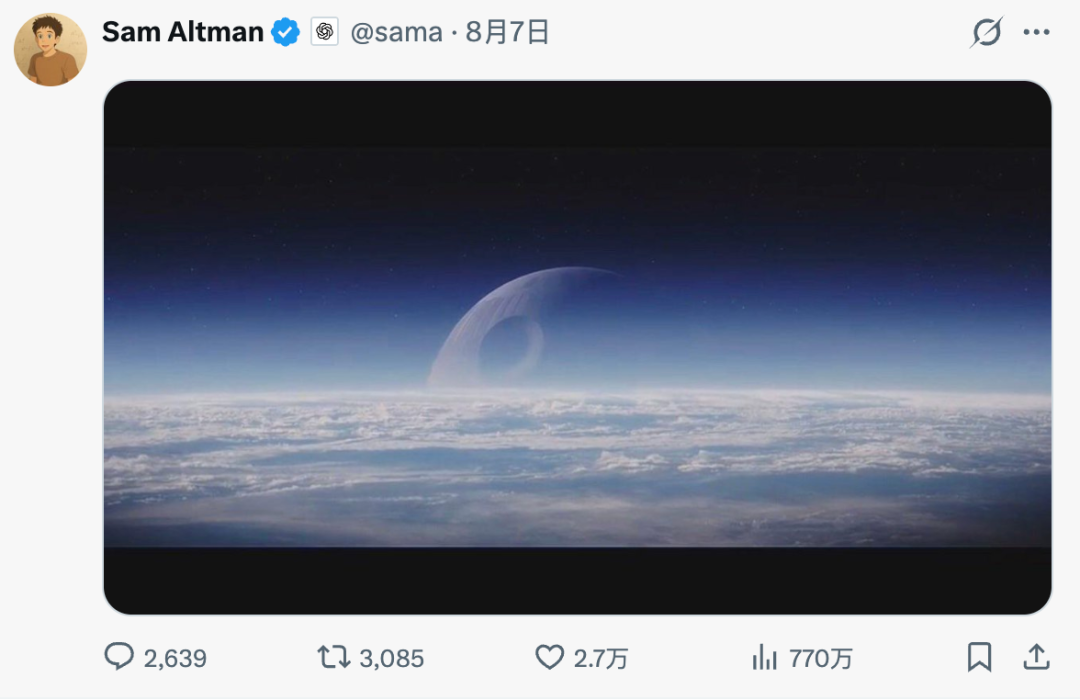
Of course, after GPT-5's actual release, the global audience was largely underwhelmed, as the gap between humanity and Artificial General Intelligence (AGI) remained as vast as ever.
Since then, a segment of the venture capital community has come to believe that while AGI will eventually arrive, it is unlikely to do so as rapidly as OpenAI or Anthropic had once claimed.
In other words, people had overestimated the current upper limits of model capabilities.
Debates on this issue have long existed within the industry, but recently, more individuals have begun to acknowledge this point. Not long ago, Ilya even stated directly on a podcast that 'the era of Scaling has ended.'
Corresponding to the overestimation of model upper limits is a widespread tendency to underestimate the current lower limits of model capabilities. The former is frequently discussed, while the latter is rarely mentioned. This misalignment between overestimation and underestimation influences approaches to developing AI products.
In reality, the existing transformer architecture may not immediately lead us to AGI or Artificial Super Intelligence (ASI). However, the capabilities of models built on this architecture are already sufficient to address a wide range of high-frequency learning, living, and working scenarios.
This may not sound as grand, ambitious, or thrilling, but it represents the practical path through which AI creates value and delivers impact. While we must certainly pursue the lofty goals of the stars, humanity has never reached its destinations in a single leap.
To reshape reality with AI, one must first immerse oneself in reality.
Let us examine the four initial features Qianwen has rolled out to all users and how they enable 'getting things done':
• AI PPT supports 39 input formats and offers 100,000 free templates. A single sentence can generate a polished slide deck, with conversational modifications to content and style.
• AI Writing covers various copywriting and formatting needs, with built-in templates for university papers, official documents, contracts, and more.
• AI Document Library enables one-sentence searches across hundreds of millions of documents, delivering results directly in PDF or Word format.
• Problem Explanation simulates a teacher's thought process, clearly outlining reasoning step by step.

From these features, three clear directions emerge.
Firstly, Qianwen addresses highly frequent needs.
While some vertical products already cater to these high-frequency demands, their solutions are clearly inadequate. For example, creating PPTs is a task nearly every worker faces, yet existing vertical products often require expensive subscriptions, feature crude page designs, or lack content understanding, resulting in empty forms and chaotic presentations.
Qianwen's AI PPT specifically targets these pain points. On one hand, it gathers a vast collection of polished templates as high-quality data. On the other, it leverages strong foundational model capabilities to understand content, ensuring both form and substance are well-balanced to better meet user needs. Finally, by providing these capabilities free of charge to all users, Qianwen has naturally received widespread acclaim.
Secondly, it minimizes user barriers and significantly enhances product usability.
For instance, supporting multiple input formats eliminates the format barriers between users and content. In the past, creating PPTs often required users to first organize their materials into documents, followed by manual copying, decomposition, and adjustment. Even in the AI era, many products only offer outlines or copywriting references without direct PPT generation—or if they do, the generated PPTs are simplistic and non-editable, rendering them highly impractical.
Qianwen, however, allows users to directly input an image, an audio clip, or even a scanned document, with the model automatically handling content extraction, structuring, and visualization. Conversational PPT editing further transforms 'editing' from traditional mouse-based selection and dragging into efficient natural language instructions. With a single sentence, Qianwen can automatically adjust visual styles, page layouts, and even support free editing of text, formatting, and styles on each slide, making AI PPT genuinely practical and user-friendly.
Thirdly, it demonstrates profound and differentiated scene understanding.
Take document downloads as an example. Today, the internet hosts numerous resource websites, but the core issue is that most materials are locked behind membership tiers, forcing users to either subscribe or settle for low-quality, unofficial databases. Qianwen aggregates these documents and provides them directly—something competitors like ChatGPT have not achieved.
Another feature I particularly appreciate is Qianwen's built-in library of 1,000 university thesis templates. To this day, I still recall the pain of writing my thesis in LaTeX during graduation: tedious formatting, strict guidelines, and dozens of pages of layout details. Arguably, 95% of my effort was wasted on operations unrelated to content—meaningless and only painful.
Qianwen eliminates this pain, and its greatness speaks for itself.
Thus, Qianwen's breakthrough is traceable. It has genuinely transformed AI from a mere Q&A bot into a learning and productivity tool capable of solving real-world problems: high-frequency needs are recognized, complex processes are simplified, and real-world contexts are understood.
Ultimately, the ability to get things done—and to do them well—is now the greatest expectation users have for AI assistants.
-
![]()
Alibaba's AI Offensive: Over Half of Investment Allocated, Time to Reap Returns
-
![]()
Alibaba’s AI Push: Over Half of Investments Made, Time to Harvest Returns
-
![]()
Chinese Enterprises Going Global 3.0: From World Factory to AI Infrastructure Builder
-
![]()
Honor RobotPhone Review: Half Movie Camera, Half Robot
-
![]()
AI-Driven Cheating Surges in Universities! Online Exams Reduced to Mere Formalities, Degree Credibility on the Line
-
Insta360’s Decade in Panoramic Imaging: Making Cameras ‘Invisible’ and Returning Creation to the Masses
-
![]()
Foreign Media Claims Apple is Concentrating Resources on AI Development: Vision Pro and Siri Teams Lay Off 200 People
-
Big News! Huaneng and Huawei Hold Talks in Shenzhen with Ren Zhengfei in Attendance; Huawei Emerging as the 'Second Brain' of China's Energy System