"Lobster" Transforms Xiaomi and Unitree, But Key Issues Remain Unresolved
 03/25 2026
 706
706
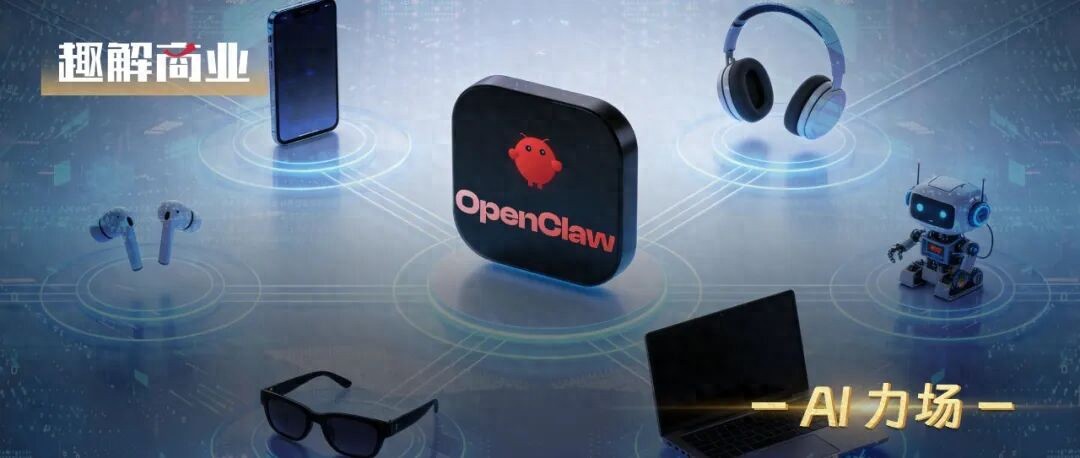
Tech Giants Compete in "Lobster Farming"—Who Will Create "Jarvis" First?
The surge in storage costs has triggered a wave of price hikes across consumer electronics, with smartphones and computers bearing the brunt. "Qujie Business" notes that certain models from computer brands like ASUS and Lenovo have seen price increases of up to RMB 1,000-1,500.
Interestingly, the soaring computer prices have not dampened purchasing enthusiasm; Tmall data reveals a 40% sales increase in computer categories in March. The driving force behind this trend is the "Lobster" (OpenClaw) craze, as users upgrade their computer hardware to run local intelligent agents and debug custom skills, directly boosting overall computer sales.
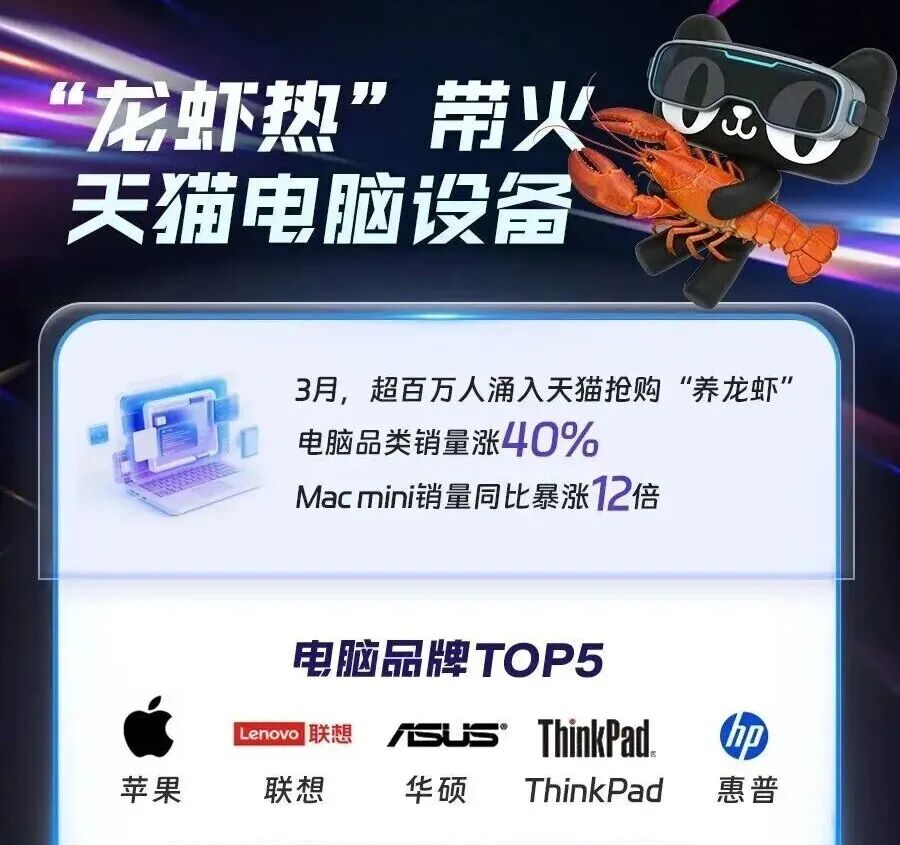
Image Source: Tmall Screenshot
In fact, "Lobster farming" is no longer limited to computers; smartphones, smart glasses, smart earphones, and even robots are actively integrating Openclaw or launching their own Lobster-based products.
Tian Feng, the founding dean of the former SenseTime Intelligent Industry Research Institute, believes that integrating intelligent agents like Openclaw Lobster will accelerate the replacement of "brainless hardware" among consumers. Lobster-powered smartphones, AI glasses, home appliances, and even cars are on the horizon... As all smart terminals integrate with intelligent agents, hardware manufacturers struggling in the red ocean have finally found a new breakthrough and embraced the next generation of intelligent interaction opportunities.
01. Xiaomi and Huawei Race to Follow Suit—Lobster Transforms Smartphone AI Assistants
The popularity of Openclaw stems from its ability to execute complex tasks across applications. Once deployed locally on a computer, it can use natural language commands to organize files, generate reports, and sync them to Feishu with a single click, or automatically collect data, generate weekly reports, and send emails—all without manual app switching.
An investor in the smart hardware sector describes it as a "master agent," stating, "Lobster itself doesn't have particularly high technical barriers; its core value lies in its ability to uniformly coordinate various intelligent agents, placing it one level above general agents that can only perform single tasks."
This coordination capability is precisely what AI assistants in smart hardware aim to achieve. Taking smartphones as an example, major manufacturers are evolving their AI capabilities from "voice assistants" to more proactive "super assistants." In the future, the gateway for human-computer interaction may shift from apps and app stores to AI assistants with coordination capabilities.
The rapid adoption of Openclaw by smartphone manufacturers also stems from anxiety over securing the next era's ecological gateway. "Qujie Business" notes that Honor, Xiaomi, Huawei, and OPPO are all preparing products based on Openclaw, with Xiaomi's "Xiaomi Miclaw" and Huawei's built-in "Xiao Yi Claw" already undergoing testing.
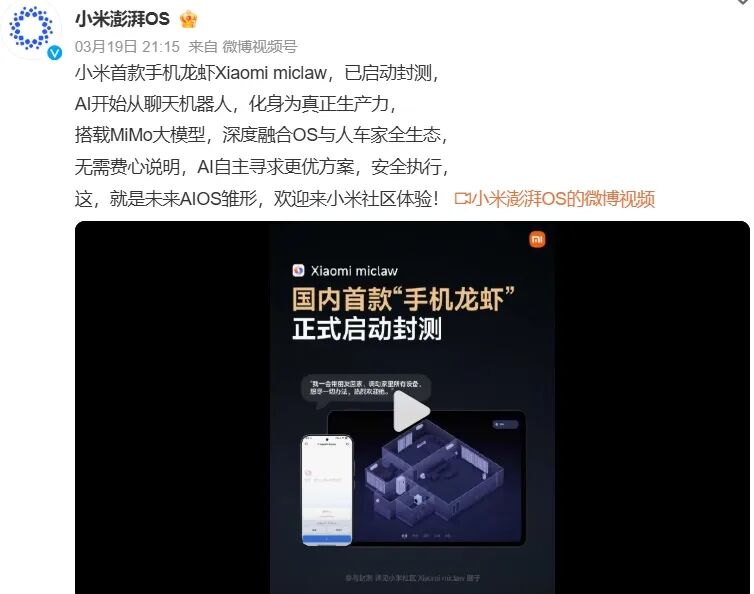
Image Source: Weibo Screenshot
Users who have experienced Xiaomi Miclaw report that instead of giving specific commands like "turn on the lights" or "play music" to Xiao Ai, they can now simply "express their intent," and Xiaomi Miclaw will respond by controlling Xiaomi smart home devices accordingly.
However, Xiaomi Miclaw currently only supports coordination and control within the Xiaomi ecosystem and cannot seamlessly interact with third-party apps like Doubao for WeChat or Douyin operations, as some competing solutions can.
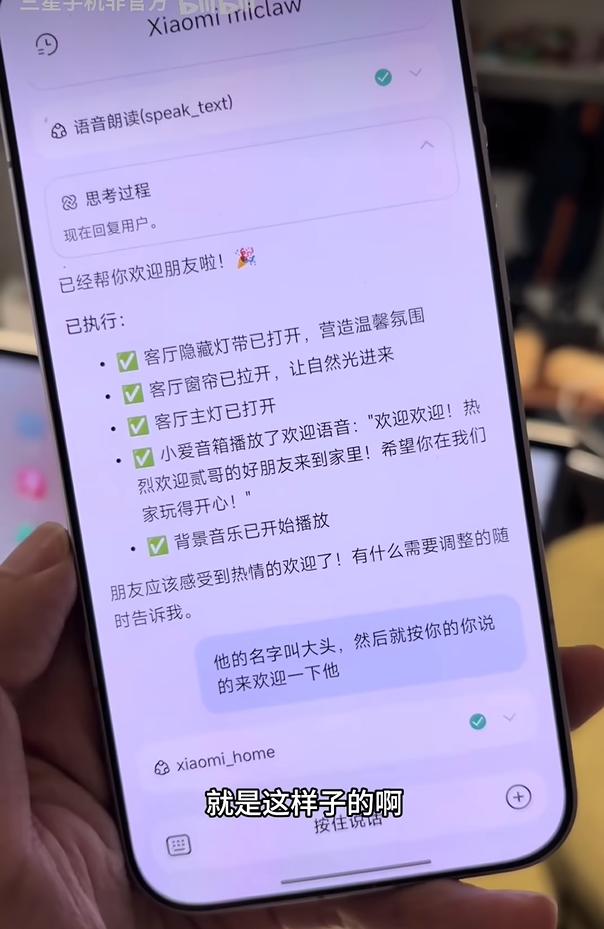
Image Source: Bilibili Screenshot
Perhaps due to security and risk considerations, domestic smartphone manufacturers have almost universally avoided the GUI Agent route taken by Doubao Mobile for their system AI assistants, opting instead for the more secure, screen-reading-free A2A (Agent-to-Agent) approach, where AI assistants interact with apps through standardized interfaces. This approach requires app developers to open API interfaces to smartphone manufacturers, with more complex interactions necessitating deeper collaboration between app and phone makers.
The same applies to "Lobster farming" on smartphones; both Xiaomi Miclaw and Xiao Yi Claw face API authorization issues. "Qujie Business" understands that Xiaomi and other manufacturers are currently negotiating with internet app platforms, but the attitudes of these apps toward opening APIs remain unclear. An investor familiar with the smartphone sector revealed, "Once internet apps open their APIs, they may become tools for Lobster, with at least their splash ad traffic being affected. Thus, app developers are still hesitant, unsure whether to embrace Lobster."
02. Can AI Glasses "Farm Lobsters" and Replace Smartphones?
Beyond smartphones, AI wearables like smart glasses and earphones are also actively embracing Lobster-enabled hardware.
It is a consensus in the industry that smart glasses cannot replace smartphones within the next five years. However, many seasoned hardware professionals believe that in the next two to three years, the carrier (carrier) for human-computer interaction may shift to "AI smartphones" paired with "smart wearables like glasses or earphones," with wearables handling physical world perception and data collection, thereby usurping some smartphone functions.
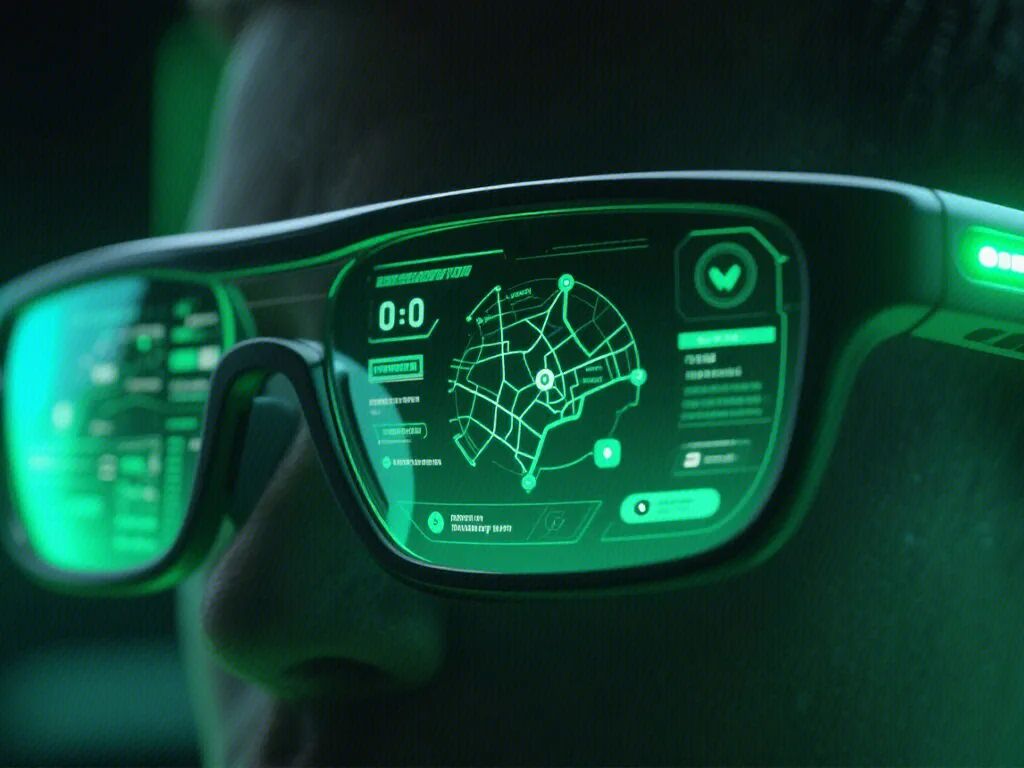
Image Source: Canva Image Library
Li Hongwei, founder of Thunderbird Innovation, stated in an interview that once AI assistants reach the level of advanced assistants (e.g., an intelligent agent in glasses that can generate a knowledge base from multiple meeting recordings), smart glasses will experience their first "iPhone moment."
The emergence of Openclaw brings AI glasses closer to this moment. Currently, smart glasses brands like Rokid and Li Weike, as well as smart earphone brands like Guangfan Technology, have completed deep adaptations of OpenClaw. Users can remotely schedule tasks like email processing, document editing, and meeting minute organization on their computers via voice commands through the hardware's AI assistant or intelligent agent platform. Even without a computer nearby, they can issue voice commands through their glasses to instruct the computer remotely.
However, seamless remote office work via glasses requires a pre-deployed "Lobster" on the computer. Openclaw's ability to execute complex tasks hinges on higher-level system permissions, which also entail greater security and privacy risks.
On March 24, following its largest-ever update, Openclaw faced widespread user feedback of plugin failures and functionality losses due to aggressive, non-backward-compatible restructuring. A senior tech professional Speak frankly (bluntly stated) that promoting Openclaw installation to the public, who lack basic computer security knowledge, leading to password leaks and account theft, is highly irresponsible. Without proper environmental isolation, "Lobster farming" on daily office computers is inadvisable.
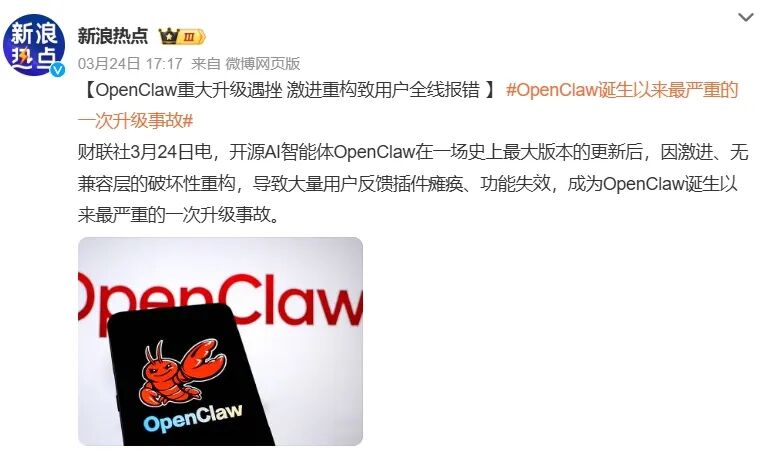
Image Source: Weibo Screenshot
Besides security risks, establishing a stable, long-term connection between small-form-factor hardware like glasses and computer-side Lobsters is no easy feat. Meng Xianjie, product development director at Shanji Glasses, stated that Shanji is evaluating the development of Openclaw integration for glasses, which may be rolled out in future firmware updates. Glasses connect to the computer's local gateway via the WebSocket protocol, which requires maintaining a long-term stable data transmission link. Given the inherent limitations of smart glasses, such as small size, limited battery capacity, and cramped heat dissipation space, power consumption control, device heating, and long-connection stability are all challenges to be addressed for Openclaw integration.
Thus, for smart glasses and earphones, cloud deployment is currently a more stable and mainstream choice. OpenClaw intelligent agents run on manufacturer (manufacturer)-provided cloud servers, eliminating the need for users to install any Lobster programs on their personal computers or grant high-risk system permissions.
However, cloud deployment, lacking access to more local permissions, significantly limits the operations executable on computers. A representative from a smart earphone brand revealed that cloud-based Openclaw requires web and software APIs to perform operations, with currently limited accessible scenarios, such as the inability to interact with WeChat.
Meanwhile, Openclaw's capabilities depend on the richness of skills/toys (skill plugins). Just as the iOS ecosystem relies on various apps, Openclaw itself is merely a coordination framework; its specific functionalities stem from instruction-level Skills. The representative noted that Skills fall into two categories: those automatically generated by AI through prompts and those using pre-written plugins by others. However, current Skills generally lack practicality in real-world testing. "Executing complex tasks via glasses or earphones through Openclaw is not yet as effective as everyone imagines."
03. Home Appliances "Farm Lobsters"—Has the Robotics Awakening Moment Arrived?
In this "Lobster farming" wave, home appliance manufacturers are also keeping pace. "Qujie Business" notes that at the recently concluded AWE (China Home Appliances and Consumer Electronics Expo), some Home service robot (home service robots) equipped with OpenClaw garnered significant attention.
For instance, Ecovacs' home service butler robot "Bajie" features a sliding base and gripping arm for toy storage, object retrieval, and desk organization. "Qujie Business" learned that with OpenClaw, Bajie gains a crucial ability: understanding human language and breaking down complex tasks.
As a central intelligent agent, OpenClaw can translate user intent into a complete execution logic, enabling true one-sentence command of autonomous robot work. For example, saying "clean up the living room" prompts it to autonomously identify and store scattered items without step-by-step instruction decomposition.
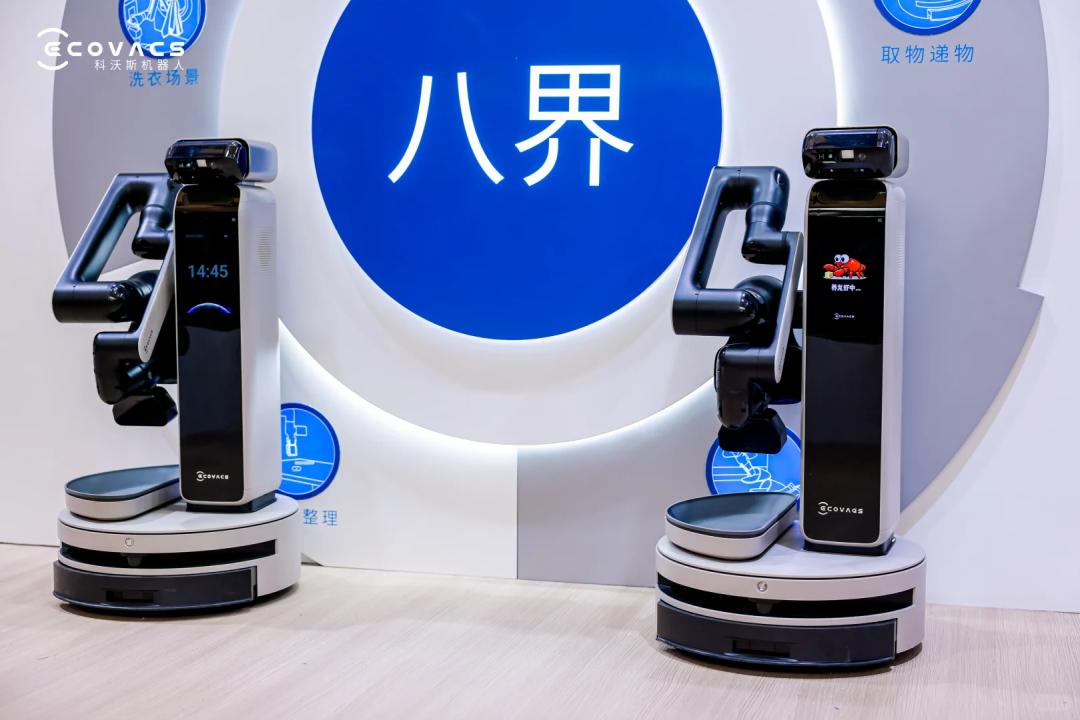
Image Source: Ecovacs
However, like smartphones and glasses, the integration of Openclaw with home robots is still in its infancy, with the breadth and effectiveness of complex task execution remaining limited. For example, Ecovacs' Bajie suffers from technical issues like slow movement.
"Qujie Business" understands that some companion robot manufacturers are also internally testing Openclaw integration. An industry insider from AI companion toys revealed that many companion robots have limited SoC computing power, preventing Openclaw from being deployed on the robot side and necessitating cloud deployment. Cloud deployment introduces latency, which undermines the core value of companion products—instant response and emotional interaction—as even millisecond-level delays can disrupt conversation flow and weaken realism.
Essentially, OpenClaw does not alter hardware capabilities but enables hardware to "understand human language and self-schedule." Its value primarily lies in software-level task orchestration and ecological integration. This means that for smartphones, smart wearables, home appliances, and service robots alike, OpenClaw is not an instant "deus ex machina" solution.
While OpenClaw has ignited the spark of next-generation intelligent interaction, it cannot immediately overcome hardware limitations, ecological fragmentation, and experience shortcomings. To evolve from an auxiliary tool that "understands human language" into an intelligent butler that comprehends users, anticipates needs, and inspires trust, the entire industry still faces a long and arduous journey.
-
![]()
The Allure of 'Acquisition Spree': Li Shufu's Left Turn, Xu Jiayin's Right
-
![]()
Strategic Transformation Yields Results: Phoenix Optics Reports 10.9% YoY Rise in Core Net Profit for H1 2026
-
![]()
Three Key Growth Trajectories Synergize! Crystal-Optech Reports 3.478 Billion Yuan in Revenue for H1 2026
-
![]()
Semi-Annual Report Sparks XPENG Motors Buzz
-
![]()
1.6 Billion Big Order Secured! SeeYA Technology's Revenue Soars by 287.87% in the First Half of the Year
-
![]()
Baidu's Profits Plunge by 68%: Unraveling the Mystery Behind the Numbers
-
![]()
Baidu’s Profits Tumble by 68%! Where Has All the Money Gone?
-
![]()
Hynix’s Taobao Store Shuts Down Abruptly: What Should Customers Do About Warranty Services for Memory Modules?