Producing 5,000 Units En Masse Isn't the Ultimate Goal; Zhiyuan's New Beginning Will Shape Its Fortune in the Next Phase
 12/12 2025
 595
595
Over the past two years, the humanoid robot sector has been fueled by enthusiasm and imagination. Videos showcasing robots 'dancing, pouring water, and shaking hands' have inundated screens, propelling the entire industry forward amid a wave of conceptual hype. However, as investment capital gradually regains its composure, a more pressing question emerges: Can robots truly transition from the realm of concepts to real-world applications?
At this crucial juncture, Zhiyuan Robotics (hereinafter referred to as 'Zhiyuan') has announced the official mass production and launch of its 5,000th humanoid robot, alongside the simultaneous opening of three production facilities and the establishment of a comprehensive manufacturing capability. Zhiyuan has emerged as one of the first companies in the industry to surpass the 'engineering replication' milestone.
Yet, mass production is merely a stepping stone. As Zhiyuan stands on the brink of large-scale manufacturing, it must not only overcome technical hurdles but also navigate the rapidly evolving commercial landscape of the entire industry.
5,000 Units Unveiled: Zhiyuan Paves the Way for Mass Manufacturing
Zhiyuan has officially launched its 5,000th general-purpose humanoid robot, 'Lingxi X2,' marking the moment when Chinese embodied AI companies have finally transformed 'mass production' from a concept on slides to a tangible reality.
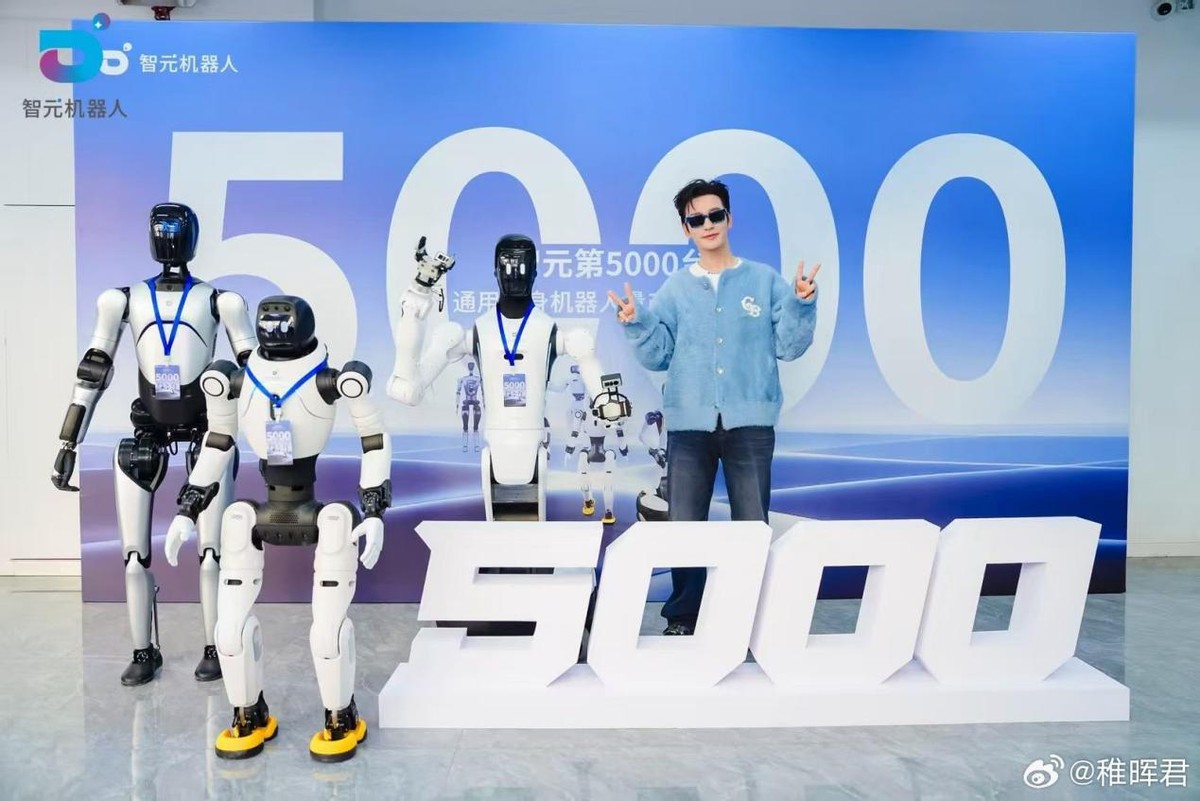
Image source: Weibo @Zhihui Jun
Viewed over a longer timeline, this event serves as a starting signal for China's humanoid robot industry to truly dive into the deep end, shifting the industry's focus from 'prototype competition' to 'scale warfare.'
For the past decade, competition in the humanoid robot sector has remained mired at the prototype stage. Whether it was the withdrawal of U.S. investment following Google's sale of Boston Dynamics in 2015 or Tesla's high-profile unveiling of the Optimus prototype in 2022, market attention has often centered on fleeting technological demonstrations rather than systematic manufacturing capabilities.
However, the true challenge for humanoid robots has never been about the number of joints or cables but about whether technology can be seamlessly integrated into assembly lines, enabling precise replication of robots on an industrial scale.
Zhiyuan's achievement of mass-producing and launching 5,000 units signifies that it has crossed a critical threshold in the humanoid robot industry's mass production journey, forming a reusable industrial closed loop (closed loop) encompassing the supply chain, manufacturing systems, algorithm stacks, whole-machine calibration (whole-machine tuning), and cost modeling. This marks a pivotal watershed for humanoid robots transitioning from technical prototypes to scalable manufacturing.
This is particularly significant given that domestic companies have long lacked a complete manufacturing foundation in the humanoid robot sector, with critical sensors, actuators, and joint modules heavily reliant on imports or fragmented supply chains.
Zhiyuan's demonstrated mass production capability provides the industry chain with predictable and stable demand, thereby fostering collaboration among local supply chains and achieving economies of scale. This is a prerequisite for all latecomers to reduce costs and shorten iteration cycles.
However, whether achieving the mass production goal of 5,000 units can propel Zhiyuan into a self-accelerating 'singularity' zone remains to be seen. After all, unlike the photovoltaic and lithium battery industries, where once mass production scales beyond a certain threshold, costs rapidly decline, and application scenarios naturally expand, the application barriers for humanoid robots are far higher than those for consumer electronics, and scenario deployment is more intricate.
Now, with 5,000 units, Zhiyuan stands at the forefront of the industry but also confronts a harsher reality: While production capacity is a core challenge, application capability is even more critical. If mass production outpaces application capability, manufacturing will not become an advantage but instead a counterproductive force that consumes resources and accelerates cash flow depletion.
This is the true significance behind the 5,000th unit—it compels Zhiyuan to venture into uncharted territory, pushing it to find a solution within the triangular relationship of mass production capability, cost structure, and scenario application.
Mass Production Leadership ≠ Application Leadership: The Crux Lies in Real-World Scenarios
Just as another transformation is underway in the humanoid robot industry's watershed moment: deployment scenarios are shifting from 'showcasing' to 'practical use.'
This year, starting with the viral success of Unitree's robots on the Spring Festival Gala, demand for commercial performances, corporate annual events, and wedding ceremonies surged, quickly plunging the robot rental market into a state of 'machines in high demand.'
However, by year-end, the market had clearly reversed course. The dividends (dividends) of showcasing rapidly faded, with rental prices plummeting. Some manufacturers even resorted to leasing back robots at near-cost prices. This signifies the abrupt end of the stage era.
Under such industry conditions, the launch of the 5,000th unit is both a milestone and a 'countdown' to finding results faster. If humanoid robots cannot enter genuinely high-demand scenarios, mass production will only lead to inventory buildup, cash flow pressure, and supply chain burdens without generating a positive commercial cycle.
Examining Zhiyuan's existing products, the issues become clearer. Take Lingxi X2, for example: it boasts millisecond-level interactive response and the ability to understand and perceive the world through vision, offering significant advantages in tasks like precise grasping and command response (command response).

Image source: Weibo @Zhihui Jun
However, competition in the robot industry is shifting to a deeper level—not just about 'whether it can move' but about the strength of generalization capabilities. Currently, Zhiyuan's robots still focus on basic tasks in terms of generalization: routine action sequences like inspection, material handling, simple assembly, and scenario inquiry.
The pain point lies in the fact that once action complexity increases, robots tend to exhibit unstable strategies, ineffective path planning, and unsteady operations. This poses a challenge not only for Zhiyuan but also for all humanoid robot companies.
Moreover, the 'breadth' of Zhiyuan's current commercialization landscape cannot compensate for its 'lack of depth.' Although Zhiyuan has covered eight major scenarios—explanation and reception, cultural and entertainment performances, industrial smart manufacturing (intelligent manufacturing), logistics sorting, security inspection, data collection training, scientific research, and education—the robots' performance in new scenarios or tasks remains limited due to weak generalization capabilities.
The biggest risk behind this is that if scenario adaptation lacks depth, customer willingness to pay is weak, and ROI remains unimpressive, then scaling up will only lead to faster losses.
This is why the industry generally believes that the current competition is no longer about 'who releases a robot first' but about 'who can truly integrate robots into high-demand scenarios.' The depth of scenario adaptation determines the strength of willingness to pay, which directly impacts the speed of scale expansion. In turn, scale expansion determines whether cost-reduction pathways can be successfully implemented.
Therefore, at this juncture, while Zhiyuan advances mass production, it must also shift from 'being visually appealing' to 'being practically useful,' from 'demonstrating value' to 'generating value.' This is not a multiple-choice question but a survival imperative.
Large Models as the Biggest Variable: Can Zhiyuan Leap the Gap with AI?
As mass production speeds take center stage, the core issue exposed by humanoid robots has shifted from 'what they can do' to 'how they can learn.'
When traditional strategies frequently fail in complex scenarios and manual rules struggle to support scalable replication, the industry increasingly recognizes that hardware is no longer the bottleneck; instead, defining robots through software and large model capabilities has become the key.
In the past, robot intelligence relied on real-world data collection, custom strategy programming, and manual annotation. However, such 'weak generalization' technological systems inherently lack scalability potential. They require extensive repetitive training and scenario adaptation, leading to high costs and low efficiency.
At this juncture, the emergence of general-purpose robot large models has transformed this path. For instance, capabilities like synthetic data generation, strategy transfer, and environmental simulation brought by general-purpose models like GPT enable robots to potentially learn complex actions in virtual scenarios before transferring them to the real world.
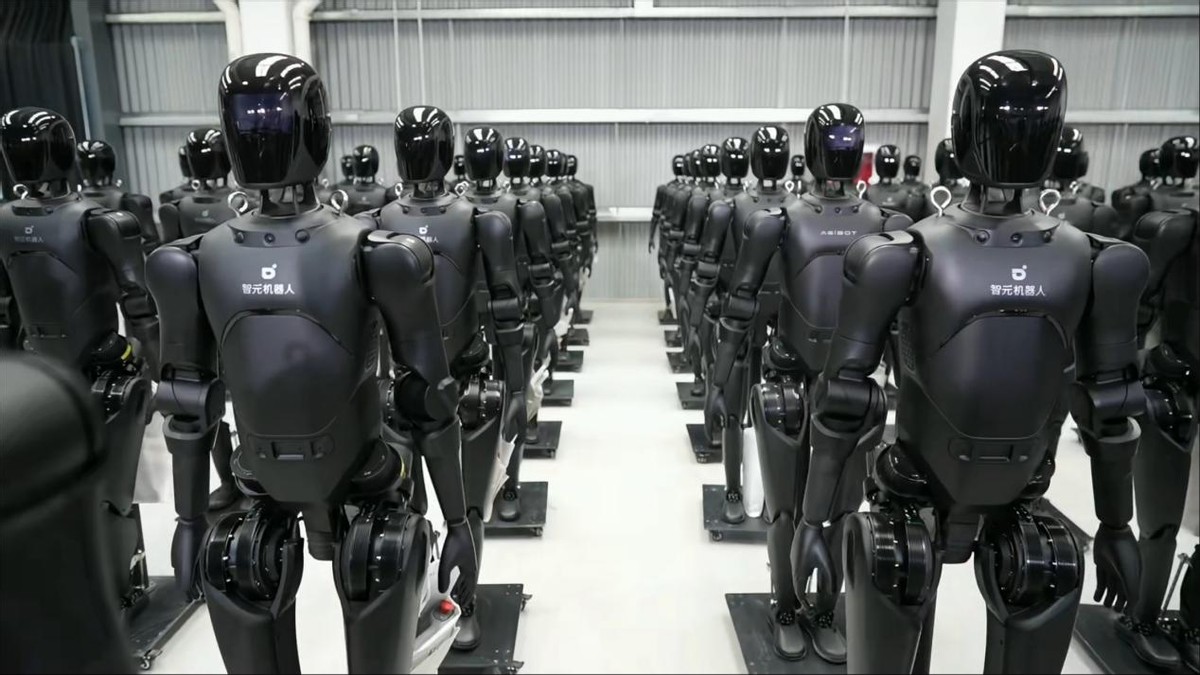
Image source: Weibo
Moreover, large models can automatically generate interactive strategies, perception pathways, and planning schemes, breaking through the bottleneck of traditional robots' reliance on manually designed rules.
Furthermore, humanoid robots are inherently a fusion of hardware and software. Without foundational models or the support of large models like VLA, achieving full commercialization through supply chain and hardware advancements alone is impossible.
For Zhiyuan, this means the ceiling for robot generalization capabilities has finally been raised.
If engineering-driven mass production determines whether Zhiyuan can 'be manufactured,' large models determine whether it can 'be utilized.' The former represents industrial capability, establishing scale advantages; the latter represents intelligent capability, deciding long-term competitive moats.
Precisely because of this, large models are becoming the biggest variable determining the next round of success or failure. They will decide whether Zhiyuan can translate the scale advantage of its 5,000th unit into the ability to cross the generalization gap.
However, the issue lies in the fact that the path of large models cannot progress linearly. During the initial construction phase, large models require structured data, scenario feedback, and continuous optimization—all of which depend on large-scale deployment.
For Zhiyuan, the faster it achieves mass production, the more it needs model capabilities, cost structures, and real-world scenarios to keep pace. If these three elements are not synchronized, scale will become a burden, trapping Zhiyuan in a reverse cycle where 'capabilities lag behind production capacity.'
Now, the true question Zhiyuan must answer is whether it can accelerate the improvement of generalization capabilities to match the expansion pace of production volume. Can it create a positive amplification loop among algorithms, scenarios, and scale? The answers to these questions will determine whether Zhiyuan fades away quickly or emerges as an industry leader.
Epilogue
Up to the 5,000th unit, Zhiyuan indeed holds the lead. However, from the 5,000th unit onward, it will confront all the unresolved challenges in the industry—shifting from technological showcasing to practical production deployment, from showcasing traffic to genuine high-demand scenarios, and from engineering-driven leadership to a final showdown in generalization capabilities.
The 5,000th unit is not the endpoint of glory but a ruthless new starting point.
Source: Hong Kong Stocks Research Society
-
![]()
Alibaba's AI Offensive: Over Half of Investment Allocated, Time to Reap Returns
-
![]()
Alibaba’s AI Push: Over Half of Investments Made, Time to Harvest Returns
-
![]()
Chinese Enterprises Going Global 3.0: From World Factory to AI Infrastructure Builder
-
![]()
Honor RobotPhone Review: Half Movie Camera, Half Robot
-
![]()
AI-Driven Cheating Surges in Universities! Online Exams Reduced to Mere Formalities, Degree Credibility on the Line
-
Insta360’s Decade in Panoramic Imaging: Making Cameras ‘Invisible’ and Returning Creation to the Masses
-
![]()
Foreign Media Claims Apple is Concentrating Resources on AI Development: Vision Pro and Siri Teams Lay Off 200 People
-
Big News! Huaneng and Huawei Hold Talks in Shenzhen with Ren Zhengfei in Attendance; Huawei Emerging as the 'Second Brain' of China's Energy System