Praise Be to Alibaba! Meta's 'Avocado' Project Abandons Llama, and QianWen Emerges as the New Cornerstone of Global AI!
 12/12 2025
 744
744
A December 10 news report from Bloomberg delivered a sharp wake-up call, revealing to the world that the landscape of AI open-source has quietly undergone a transformation—Meta is now training its new model, 'Avocado,' using Alibaba's QianWen (Qwen).
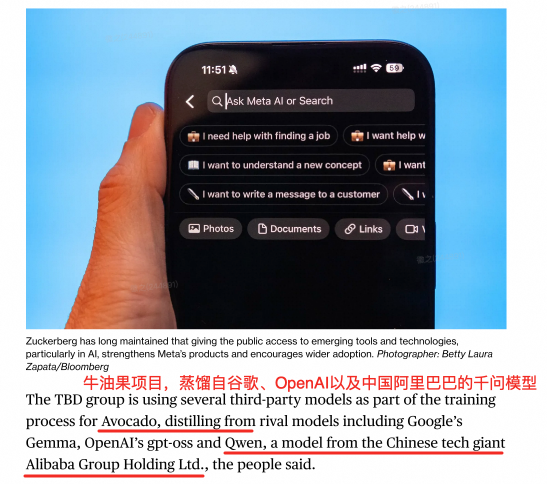
This move is not a sign of weakness but a strategic choice by a powerhouse. Even Meta, a trailblazer in the open-source arena, has opted to build upon the foundation laid by Alibaba, demonstrating that Chinese AI is not merely a participant but a rule-setter in the global game.
This subtle yet profound shift in power is already evident in the code of developers worldwide, in NVIDIA CEO Jensen Huang's presentation slides, and in the technological choices of every Silicon Valley startup. Today, when discussing global AI infrastructure, an undeniable truth emerges: China's QianWen (Qwen) has become the new epicenter of AI innovation.
01 Meta's Open-Source Dominance Faces Its 'Dunkirk Moment'
Previously, as a towering figure in the global tech landscape, Meta's leader, Mark Zuckerberg, had repeatedly and publicly championed U.S. models, even calling for 'America to triumph in the AI open-source war.'
However, Bloomberg's December 10 report disclosed that Meta's new model project, 'Avocado,' has chosen to refine the open-source model from China's Alibaba QianWen (Qwen). This revelation, akin to a depth charge, exposed the long-held secret among Silicon Valley elites—the retreat of Meta's Llama is now inevitable, and Chinese open-source models are poised to dominate global AI infrastructure with unstoppable momentum.
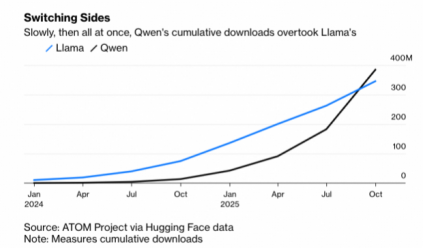
On the day the news broke, Alibaba's pre-market stock price surged over 4%, while Meta's stock faced its thirteenth ratings downgrade since 'Llama's setback.'
Zuckerberg's abrupt 'shift' is closely linked to Llama 4's dismal performance. This once highly anticipated model fell short of Qwen2.5 in multiple benchmark tests, with a developer community attrition rate as high as 37%. More critically, while Meta was still entangled in the commercial restrictions of open-source agreements, Alibaba had already embraced a 'full-size, full-modality' open strategy, attracting developers from over 200 countries globally.
Today, Alibaba's Qwen outperforms Meta's Llama in every metric. In August 2024, the number of derivative models based on Alibaba's QianWen exceeded 100,000, surpassing Llama for the first time. By October 2025, global downloads surpassed 700 million, leaving Llama in the dust. When Qwen3-Max, as an open-source model, ranked among the top three globally in performance, alongside GPT-5 and Gemini 3 Pro, it became clear to all: the throne of open-source AI has changed hands.
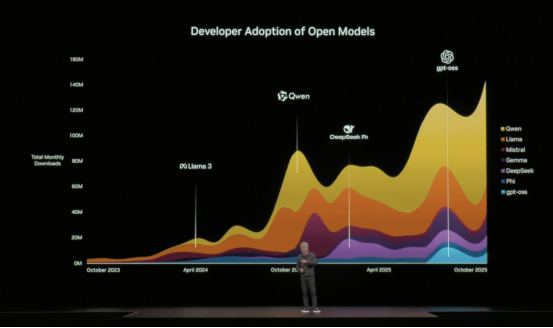
At NVIDIA's GTC Conference in October, Jensen Huang's presentation slides laid bare the reality: among open-source model downloads in 2025, Alibaba's QianWen reigned supreme, with its lead expanding at a rate of 12% per month.
02 The Secret Behind China's Open-Source 'Dimensional Leap'
Alibaba's QianWen's triumph is no fluke; it stems from a 'dimensional leap' in 'full-stack capabilities' over 'single-point breakthroughs.'
While other vendors were still debating the merits of open-source, Alibaba Cloud had already constructed a comprehensive ecosystem, spanning from underlying chips and cloud infrastructure to model services.
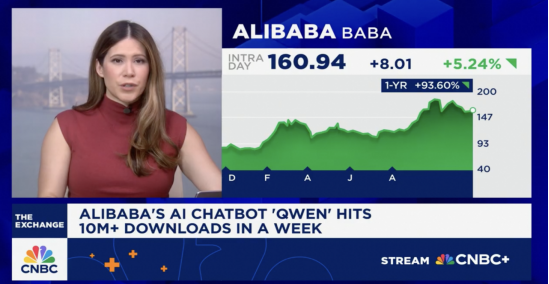
Foreign media outlet CNBC contends that truly groundbreaking products often emerge from companies with a complete ecosystem, and China's Alibaba exemplifies this point. CNBC notes that Alibaba boasts an end-to-end full-stack AI system, enabling continuous iteration of its large models through its ecosystem, from underlying chips to cloud infrastructure. The QianWen APP has achieved remarkable breakthroughs.
This unique end-to-end capability allows Qwen to iterate at an astonishing rate of 1.8 versions per month, three times that of Llama. Financial reports provide compelling evidence: Alibaba Cloud's quarterly revenue grew 34% year-over-year to 39.824 billion yuan, with AI-related product revenue achieving triple-digit year-over-year growth for nine consecutive quarters. Alibaba Cloud continues to solidify its lead as the top player in the AI cloud market, with a share exceeding the combined total of the second to fourth-ranked competitors. This is akin to using commercial success to fuel the open-source ecosystem, creating a snowball effect.
Additionally, Alibaba's 'full-size, full-modality' approach is not mere rhetoric but a formidable engineering feat. From 0.5B edge models to 480B behemoths, covering text, vision, voice, and code, Alibaba has open-sourced over 300 models in two years, supporting 119 languages and dialects. This 'no-dead-zone'布局 (layout) leaves Silicon Valley developers with no choice but to engage—startups leverage Qwen-7B to balance cost and performance, research institutions explore multimodal frontiers with Qwen-VL, and even Singapore's National AI Plan has abandoned Meta for Qwen's architecture. More critically, Alibaba pioneered a new paradigm of 'Model as a Service': enterprises not only download models but also deploy them with a single click through Alibaba Cloud, accelerating technology diffusion tenfold.
Performance data reveals that Qwen3-Coder has surpassed GPT-4.1 in programming benchmarks like HumanEval, while its agent capability evaluation outperforms Claude-4. When HuggingFace's CEO tweeted 12 times in praise, Perplexity's CEO exclaimed 'Open-source wins big!', and Airbnb's CEO declared it 'better and cheaper than OpenAI,' China's open-source models completed a qualitative shift from 'usable' to 'preferred.' Amazon's Lab126 team even used Qwen to control humanoid robots, enabling mechanical arms to understand natural language and plan actions—this is no longer simple model invocation but a deep reconstruction embedding AI capabilities into the physical world.
03 Alibaba's Global Sweep: 'West Valley, East Alibaba' Defines the New Global AI Order
During NVIDIA's Q2 earnings call in May this year, Jensen Huang stated that China's Qwen (Alibaba Tongyi QianWen) and DeepSeek are the best among open-source AI models. Additionally, at NVIDIA's GTC Conference in October, Huang's presentation slides revealed that NVIDIA and Alibaba Tongyi QianWen were far ahead in the number of global open-source models.
Countries worldwide are leveraging Qwen to build localized AI capabilities, with Alibaba's open-source ecosystem weaving an invisible global technology network that bypasses U.S. controls. This explains why Wall Street now ranks Alibaba alongside Google—both companies possess the uncopyable moat of 'full-stack AI,' with their stock prices surging over 93% year-to-date.
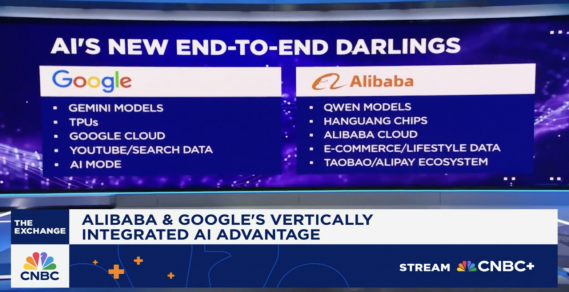
Today, the consensus of 'West Valley, East Alibaba' is increasingly taking root, marking a new era in AI competition. Google and Alibaba demonstrate that only by mastering the entire chain from chips to applications can one sustain leadership in the long race of large models. Behind this consensus lies a microcosm of China's tech giants' collective transformation: while Silicon Valley still debates whether open-source harms short-term interests, Alibaba has proven with over 300 models, 180,000 derivative ecosystems, and 700 million downloads that openness is the best moat.
Government projects in Singapore, South Korea, the UAE, and other countries have adopted Qwen en masse, essentially building technological sovereignty outside the U.S. dollar system. Alibaba's open-source models have become the 'digital infrastructure' for this decentralization movement.
The deeper revolution lies in standard-setting power. The shift from Llama to Qwen signifies that the global AI development paradigm is 'East-izing.' When Stanford's Li Fei-Fei team uses Qwen for cutting-edge research and Silicon Valley unicorn Thinking Machines Lab builds its next-gen AI system on Qwen, China is no longer just a technology user but a technology exporter. The significance of Qwen3-Max ranking among the top three lies not only in its performance metrics but also in its declaration to the world: the ceiling for open-source models is no longer set by Silicon Valley, and Chinese engineers now stand at the forefront of global AI innovation.
This is not the endpoint. On December 10, the QianWen APP surpassed 30 million monthly active users, topping the global growth chart just 23 days into its public beta. Its evolution from 'chat-capable' to 'task-capable' is clearly visible.
04 Conclusion
From 'Made in China' to 'Created in China' and now to 'Open-Sourced by China,' this is not merely a victory of technical routes but also a triumph of civilizational logic—true strength lies not in building walls for others to admire but in humbly opening up so that the entire world can grow on your shoulders. The milestone of Qwen replacing Llama marks China's AI beginning its glorious transformation from 'chaser' to 'definer.' In the next decade, the map of AI technology will bear Alibaba's indelible imprint.
-
![]()
Alibaba's AI Offensive: Over Half of Investment Allocated, Time to Reap Returns
-
![]()
Alibaba’s AI Push: Over Half of Investments Made, Time to Harvest Returns
-
![]()
Chinese Enterprises Going Global 3.0: From World Factory to AI Infrastructure Builder
-
![]()
Honor RobotPhone Review: Half Movie Camera, Half Robot
-
![]()
AI-Driven Cheating Surges in Universities! Online Exams Reduced to Mere Formalities, Degree Credibility on the Line
-
Insta360’s Decade in Panoramic Imaging: Making Cameras ‘Invisible’ and Returning Creation to the Masses
-
![]()
Foreign Media Claims Apple is Concentrating Resources on AI Development: Vision Pro and Siri Teams Lay Off 200 People
-
Big News! Huaneng and Huawei Hold Talks in Shenzhen with Ren Zhengfei in Attendance; Huawei Emerging as the 'Second Brain' of China's Energy System