Ultraman Clings Tenaciously to Disney's Leg: Can OpenAI Avoid Being Shoved Off the Table?
 12/12 2025
 700
700
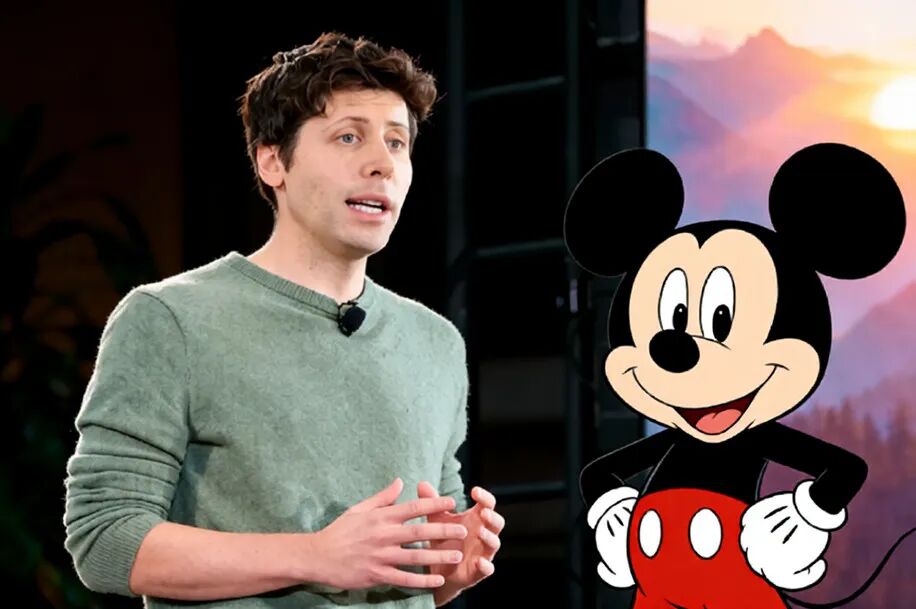
Mickey Mouse Set to Make an Appearance on Sora 2
A Real-Life Encounter Between Mickey Mouse and Ultraman Looms
According to The Information, on December 11, Disney unveiled a staggering $1 billion equity investment in OpenAI and inked a three-year strategic licensing partnership with the company.
The agreement also encompasses provisions for OpenAI's AI video generation platform, Sora, to receive authorization for creating short videos centered around Disney's intellectual property (IP) based on user-input prompts. Disney can harness OpenAI's API to develop innovative products, tools, and immersive experiences, as well as deploy ChatGPT for employees to boost work efficiency.
Overall, this collaboration transcends a mere financial investment; it represents a strategic maneuver by Disney to deeply integrate OpenAI's generative AI capabilities.
Under the terms of the agreement, starting from early 2026, OpenAI's Sora, ChatGPT Images, and other image and video generation products will officially support a plethora of classic Disney IP characters. Users will then have the ability to incorporate characters from works like Mickey Mouse, The Lion King, Cinderella, Toy Story, and Zootopia into their creative endeavors.
On the same day, Disney also issued a cease-and-desist notice to Google, accusing the tech behemoth of engaging in large-scale unauthorized "replication" of Disney's copyrighted works to train generative AI models and potentially distributing "generated IP content" to consumers.
Google neither confirmed nor denied Disney's allegations, merely stating that it would engage in discussions with Disney and emphasizing that the company constructs its AI using public data from the open web and implements copyright controls (such as YouTube's Content ID).
So, why is Disney investing a hefty $1 billion in OpenAI? And what competitive landscape does OpenAI face?
01
Disney and Ultraman: A Meeting of Mutual Needs
For Disney, this $1 billion investment resembles a "protective shield" investment.
This investment not only grants Disney a minority stake and potential equity subscription rights in OpenAI but, more significantly, secures three pivotal assets: technology, distribution channels, and rule-setting authority.
In terms of technological empowerment, Sora 2 has the potential to become Disney's "magic factory" for reshaping content production.
Disney's core competitiveness lies in its vast IP portfolio. From Snow White to Frozen, Disney has consistently expanded the boundaries of animated filmmaking through generations of technological innovation. Now, with the advent of Sora, Disney envisions a new frontier for content production.
As a text-to-video generative model launched by OpenAI, Sora 2 has made significant strides compared to its predecessor. It can currently comprehend complex natural language instructions and generate high-quality, physically plausible videos.
This implies that future Disney animators could, by instructing Sora 2 to "have Mickey Mouse pilot a Star Wars X-wing fighter above Shanghai Disneyland Castle amidst a backdrop of dazzling fireworks," generate a high-quality preview video within minutes. This will effectively reduce the costs and time associated with preliminary creative exploration and production, enabling creators to focus more on core storytelling and detailed refinement.
The most crucial and symbolic aspect of this deal is the permission granted to ordinary users to create with Disney's IP on Sora. This channel innovation marks Disney's transition from a closed IP owner to an open IP platform enabler.
In the past, fan-made secondary creations of Disney IP existed in a legal gray area. Now, Disney is proactively opening Pandora's box. Users can have Iron Man engage in a conversation with Princess Elsa or have Buzz Lightyear pilot the Millennium Falcon in Sora 2. This "official meme-making" approach will unleash the immense potential of UGC (user-generated content).
Additionally, Sora 2 plans to introduce a feature called "Cameo," enabling users to insert their own likenesses into AI-generated videos and interact with beloved characters.
These user-created, highly personalized short videos will spread virally through social networks, becoming the most vivid and widespread advertisements for Disney's IP.
Through this approach, Disney's IP will no longer be static assets confined to movies and theme parks but will achieve "cyber immortality" in the AI world, constantly being reinterpreted, disseminated, and cherished. This not only reinforces the vitality of existing IP but also provides a new pathway for incubating and promoting future IP.
Most crucially, Disney is beginning to participate in AI rule-setting from a copyright vantage point.
Disney's partnership agreement with OpenAI explicitly stipulates that the licensing does not include any actor likenesses or voice roles appearing in animated or illustrated forms. This safeguards creator rights while cautiously exploring AI ethics and legal boundaries.
By becoming Sora's first major content licensing partner, Disney effectively gains a first-mover advantage in defining copyright usage rules for the AI era. OpenAI also plans to introduce refined copyright control options and revenue-sharing models, allowing copyright holders to autonomously decide how their IP is used within Sora.
By "opting in" and engaging in deep collaboration, rather than simply "opting out" or remaining on the sidelines like other Hollywood studios, Disney has successfully transformed itself from a potential "victim" to a "rule-maker." It also provides the industry with a case study: copyright issues in AI-generated content are not insurmountable but can be regulated through commercial cooperation and technical means.
Once this model proves successful, Disney will pioneer a new business model: IP licensing will no longer be confined to traditional merchandise and film adaptations but will extend into AI-generated services. In the future, any AI company seeking to legally use Disney's IP will have to adhere to the "Sora paradigm" jointly established by Disney and OpenAI and pay corresponding licensing fees.
While forging a deep partnership with OpenAI, Disney has also dealt a significant blow to Google, Ultraman's biggest competitor.
Disney's lawsuit against Google squeezes its copyright gray space, objectively achieving a "surround the Wei to rescue the Zhao" effect (a Chinese strategic term meaning to attack an enemy's weak points to relieve pressure on a stronger ally).
Against a backdrop of converging general-purpose large model technologies, high-quality, exclusive training data is becoming the core competitiveness of AI companies.
Through its exclusive partnership with Disney, OpenAI's Sora can position itself as a legitimate AI video platform capable of large-scale generating top-tier IP content. When users want to create a short video of "Iron Man vs. Thanos," Sora will be their go-to choice.
Leveraging Sora's strong traffic appeal, more users will flock to the platform due to Disney's IP, and their UGC creations will generate additional clicks, providing OpenAI with user data and model iteration fuel.
In contrast, Google's AI, while technically equally powerful, will lag behind Sora in terms of content ecosystem richness and appeal, potentially slowing Google's progress in the generative AI field and buying OpenAI precious development time.
Ultraman has ingeniously transformed a copyright issue that could have strangled its throat into a sword to pin down its opponent. This "using the enemy's strength against them" tactic is truly brilliant.
02
After Being Knocked Off Its Technological Pedestal, OpenAI Must Engage in "Trench Warfare"
However, while OpenAI has secured Disney's investment and licensing, adding significant weight to its content generation and entertainment sector strategy, its recent days have been far from smooth.
Everything traces back to Google's latest model, Gemini-3.
As Google's newest foundational model, Gemini 3 has comprehensively outperformed GPT-5.1, demonstrating staggering "generational-level" superiority in multimodal understanding and complex task processing.
If past AI models merely "recognized images and text," Gemini 3 possesses true "eagle eyes."
Gemini 3 not only identifies what is depicted in an image but fully comprehends the complex relationships between images, videos, and sounds. In video understanding tests, Gemini 3 scored far ahead, achieving a leap from "comprehension" to "understanding relationships," undoubtedly revolutionizing content generation and professional analysis.
Even more formidable is its versatility in handling complex tasks. Gemini 3 boasts exceptionally long contextual memory, capable of "digesting" information equivalent to an entire academic monograph in one go while maintaining astonishing information retention rates. This enables it to exhibit far superior capabilities in real-world tasks compared to similar models.
This all-encompassing and highly pronounced technological lead has caught OpenAI off guard.
Brian Colello, a senior equity strategist at Morningstar, stated, "People increasingly believe Alphabet (Google's parent company) has all the ingredients to become the dominant player in artificial intelligence model construction. Just a few months ago, investors would have awarded that title to OpenAI. But now, the situation is murkier, competition fiercer, and the risk that OpenAI ultimately loses out is greater."
In response to Google's onslaught, CEO Ultraman declared a "Code Red" state, focusing all efforts on enhancing ChatGPT's quality and delaying the development of other products.
The most apparent sacrifice has been the temporary halt to the key advertising monetization business.
According to OpenAI's latest strategic plan (SP), advertising-related revenue is projected to reach $45 billion by 2030, accounting for over 20% of that year's revenue. This was set to be one of OpenAI's most crucial future "cash cows." However, under the intense pressure from Gemini 3, its plan to test shopping ads based on the search behaviors of ChatGPT's millions of users was abruptly suspended, highlighting the immense pressure.
In the capital markets, companies that have aligned with OpenAI have also faced a vote of no confidence from investors.
As a strategic partner for OpenAI's cloud computing infrastructure and core services, Oracle's stock performance has resembled a rollercoaster in recent months.
During the third quarter of this year, Oracle signed a massive five-year, $300 billion cloud computing services deal with OpenAI. This enormous partnership briefly caused Oracle's stock to surge nearly 40% overnight, with the market hailing it as the "shovel seller" of the AI era.
However, as OpenAI's technological "lag" becomes increasingly apparent, market concerns about the partnership's future have grown, viewing the huge order's outcome as uncertain. Consequently, Oracle's stock price nearly halved in just three months, fully reflecting capital's lack of confidence in OpenAI.
Yet, this is merely the "appetizer" of challenges facing OpenAI. Currently, OpenAI is burdened with a series of staggering computational power procurement or leasing orders, involving enormous sums and scales: hundreds of billions of dollars in orders with upstream hardware giants like NVIDIA, AMD, and Broadcom, as well as multi-trillion-dollar collaborations with cloud service providers like Microsoft and AWS.
Such massive computational investments are commercially logical only under the assumptions of sustained model leadership, smooth business implementation, and viable commercialization pathways.
However, with its core model capabilities now publicly questioned, OpenAI's very foundation has been shaken. Once its technological edge is lost, a crisis of confidence in its business model will follow.
Against the backdrop of model lag, the probability of OpenAI's commercial "positive cycle"—which should attract users and revenue through leading models and then use that revenue to purchase computational power for further model research—successfully materializing is exceedingly low.
Nevertheless, the current competitive landscape among leading models is a relentless game of catch-up, with dynamics shifting rapidly. What latest model OpenAI will unveil after sounding the red alert remains unknown.
What is certain is that the OpenAI of late 2025 bears little resemblance to the one that electrified the globe three years ago. Today, it is undoubtedly more mature and expansive but also faces far crueler and intense competition.
- THE END -
-
![]()
Alibaba's AI Offensive: Over Half of Investment Allocated, Time to Reap Returns
-
![]()
Alibaba’s AI Push: Over Half of Investments Made, Time to Harvest Returns
-
![]()
Chinese Enterprises Going Global 3.0: From World Factory to AI Infrastructure Builder
-
![]()
Honor RobotPhone Review: Half Movie Camera, Half Robot
-
![]()
AI-Driven Cheating Surges in Universities! Online Exams Reduced to Mere Formalities, Degree Credibility on the Line
-
Insta360’s Decade in Panoramic Imaging: Making Cameras ‘Invisible’ and Returning Creation to the Masses
-
![]()
Foreign Media Claims Apple is Concentrating Resources on AI Development: Vision Pro and Siri Teams Lay Off 200 People
-
Big News! Huaneng and Huawei Hold Talks in Shenzhen with Ren Zhengfei in Attendance; Huawei Emerging as the 'Second Brain' of China's Energy System