The Race for the First Listing of Large Models: MiniMax, Zhipu AI, and Yuezhi'an Compete for Hong Kong IPOs
 12/12 2025
 629
629


As leading companies vie for listings on the Hong Kong Stock Exchange, the industry's competitive focus has quietly shifted. The allure of technological innovation is diminishing, and the ability to generate real, measurable value has emerged as the new standard for success.
Content/Huanlao
Editor/Yonge
Proofreading/Mangfu
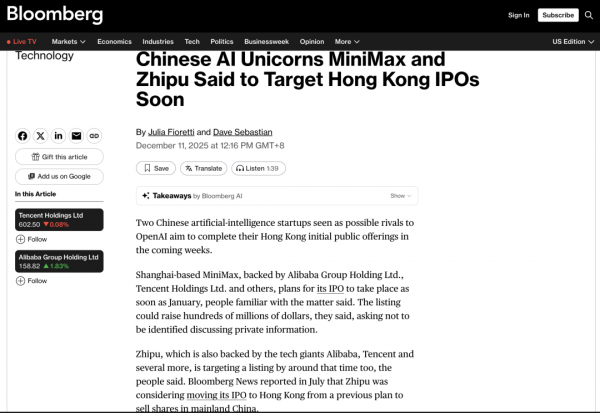
On December 11, market sources disclosed that two domestic AI unicorns, MiniMax and Zhipu AI, are planning to proceed with Hong Kong IPOs soon. Meanwhile, Yuezhi'an is exploring a backdoor listing in Hong Kong, aiming to secure the title of the first domestically listed large model company.
Bloomberg provided further details, reporting that MiniMax could go public as early as January next year, aiming to raise hundreds of millions of dollars. Zhipu AI is also targeting a similar timeframe. Previously, Zhipu AI had considered a mainland listing but has now shifted its focus to Hong Kong.
Although none of the companies involved have commented on the IPO rumors, a market consensus has formed. This race for the first listing of large models is not merely about securing a stock ticker; it represents a pivotal moment as the industry transitions from technological hype to tangible value creation.
The first company to cross the finish line will set new valuation benchmarks and competitive standards for the entire sector.
Part.1
Evolution of Capital Logic
From Financial Investment to a Multidimensional Ecosystem Game
The essence of the race for the first listing is to compete for scarce capital market attention and pricing power during a critical window. For AI companies still in the heavy investment phase, raising funds through public offerings is not just a necessity to stay competitive in the technological race but also a strategic reserve for the next stage of scaled expansion.
However, while the Hong Kong Stock Exchange provides a listing pathway for unprofitable tech companies, the poor performance of several mainland tech stocks last year has made investors increasingly wary of high-valuation, high-loss business models. The first company to successfully list will set a benchmark valuation for the industry, directly influencing subsequent players' financing expectations and bargaining power.
What deserves deeper analysis is that behind MiniMax and Zhipu AI stand strategic investors Alibaba and Tencent—both giants with powerful proprietary models (Tongyi Qianwen and Hunyuan, respectively). Their substantial investments are far from mere financial support; they represent a sophisticated blend of ecosystem competition and strategic hedging.
Large model technology is still in its early explosive growth phase, with future mainstream technical routes—such as architecture, training methods, and multimodal fusion—yet to be determined.
Proprietary models are the cornerstone and foundation for these giants, prioritizing stability, controllability, and strong alignment with their own businesses. However, their development processes may lean more toward industrialization, with high innovation trial-and-error costs and long development cycles. Investing in external star teams is akin to betting on different, potentially more aggressive "technical blind boxes" outside the mainstream track.
Startups in the large model sector are often led by top scientists, unconstrained by existing businesses, and may achieve breakthroughs at specific technical points. Through investment, giants acquire options on potentially disruptive future technologies, ensuring they remain competitive regardless of which technical route succeeds.
Moreover, a healthy ecosystem cannot rely solely on "domesticated" species; it needs competitive and diverse wild forces. Introducing high-quality third-party models like Zhipu GLM and MiniMax significantly enriches Alibaba Cloud and Tencent Cloud's AI market offerings, enhancing their appeal to developers. This essentially builds an AI-era app store, leveraging ecosystem prosperity to counter single-product competition.
Investing in leading startups is also a key defensive move to prevent them from falling into rival camps. Furthermore, AI is a capital-intensive industry, where early investments can yield substantial financial returns. More importantly, as the industry enters a consolidation phase, these giants, as major shareholders, will occupy highly advantageous positions in potential business collaborations, data sharing, and even mergers and acquisitions.
Thus, giant-driven capital propels invested companies to act as both pathfinders and collaborative forces within their designated ecological channels, strengthening the overall strategic position. Even if proprietary development and external investments compete potentially, the synergistic gains in securing ecological dominance far outweigh internal friction.
Part.2
Tightening IPO Window
How Will the Industry Landscape Differentiate Post-IPO?
Frost & Sullivan's report provides critical context for this IPO wave. In the first half of 2025, the daily invocation volume of enterprise-grade large models in Chinese companies reached 10.1865 trillion tokens, surging approximately 363% from the second half of 2024. This data not only confirms explosive market demand but also marks a fundamental shift: large models are moving from technological validation to scaled deployment.
Industrial competition logic is being reshaped. Businesses are shifting their focus from "ultimate performance contests" to "balancing scenario fit and commercial value." Decision-making has evolved from "pursuing the single strongest model" to "seeking optimal solutions for specific business scenarios."
This transformation is particularly evident in changes to core business pain points. The once-dominant challenge of "high training and inference costs" has been supplanted by more fundamental issues: "unclear application scenarios that generate actual value" and "difficulty integrating with existing business systems."
This clearly indicates that the industry has moved beyond technological novelty and entered the deep waters of commercialization. Success in addressing these profound challenges will directly determine the outcome of IPO narratives.
If successfully listed, AI unicorns will enter a radically different arena, where transparent financial disclosures, regular performance reviews, and global investor scrutiny will force them to shift from telling technological stories to proving commercial capabilities.
Listing itself will act as an accelerator for industry differentiation. Companies that secure sufficient resources can further expand technological advantages, pursue strategic acquisitions, and refine industrial layouts. Those that fail to list or underperform post-listing risk falling into a vicious cycle of "financing difficulties - talent loss - technological stagnation."
Frost & Sullivan's data reveals a harsh reality of concentration. In model invocation volume, Alibaba Tongyi (17.7%), ByteDance Doubao (14.1%), and DeepSeek (10.3%) collectively account for over 40%, with industry concentration accelerating.
This "Matthew effect" manifests simultaneously across capital, talent, data, and computing power. Giants' ecosystem investment strategies further consolidate this top-heavy structure, incorporating the most promising external innovations into their growth trajectories through capital ties.
For numerous small and medium-sized AI companies, survival space is rapidly shrinking. Focusing on vertical sectors like healthcare, law, and finance to build deep industry knowledge barriers has become a pragmatic—though limited—survival path.
Part.3
Commercialization Capabilities
The Ultimate Watershed Determining the Future
Successful listing merely grants entry to the next competition stage. The true test lies in converting financing and valuation advantages into sustainable, scaled commercial superiority.
Future winners will need to simultaneously possess multiple capabilities: profound and sustained technological innovation, clear and replicable commercialization paths, strong ecosystem integration abilities, and deep understanding of specific industry processes.
Currently, IPO contenders are showcasing differentiated explorations. Zhipu AI employs an open-source strategy combined with significant price reductions, demonstrating cost control and technological confidence while advancing AI toward genuine productivity tools capable of operating smartphones.
MiniMax is diving deep into film and television content creation, attempting to build a commercial closed loop from foundational technology to content output, though it faces dual challenges of return cycles and content risks.
Yuezhi'an continuously optimizes product experiences, focusing on efficiency gains in office and learning scenarios. However, its market share indicates that the path from excellent product to broad commercial success still requires breakthroughs.
As AI deployment reaches a critical inflection point, 2026 is highly likely to become the industry's true watershed. The technological halo is fading rapidly, and the ability to create tangible value will emerge as the ultimate yardstick for enterprises.
For IPO-bound unicorns, the test is twofold: short-term, they must prove commercialization potential and valuation rationality to capital markets; long-term, they must carve out indispensable, irreplaceable strategic ecological niches within ecosystems dominated by giants—whether as absolute experts in specific verticals or key components of universal platforms.
For China's large model industry, the bell ringing at the Hong Kong Stock Exchange will mark a highly symbolic moment. It signals the end of the era of maverick pioneers and the beginning of a market-driven, capitalized coming-of-age ceremony.
This IPO race is not just about securing a time window but also about defining qualifications for the next industry phase.
-
![]()
Alibaba's AI Offensive: Over Half of Investment Allocated, Time to Reap Returns
-
![]()
Alibaba’s AI Push: Over Half of Investments Made, Time to Harvest Returns
-
![]()
Chinese Enterprises Going Global 3.0: From World Factory to AI Infrastructure Builder
-
![]()
Honor RobotPhone Review: Half Movie Camera, Half Robot
-
![]()
AI-Driven Cheating Surges in Universities! Online Exams Reduced to Mere Formalities, Degree Credibility on the Line
-
Insta360’s Decade in Panoramic Imaging: Making Cameras ‘Invisible’ and Returning Creation to the Masses
-
![]()
Foreign Media Claims Apple is Concentrating Resources on AI Development: Vision Pro and Siri Teams Lay Off 200 People
-
Big News! Huaneng and Huawei Hold Talks in Shenzhen with Ren Zhengfei in Attendance; Huawei Emerging as the 'Second Brain' of China's Energy System