The Giant Makes a Comeback! Google's New AI Browser Disco Is Here—Is the PC Version a Game-Changer?
 12/15 2025
 706
706
Chrome users are left puzzled.
As the world's leading browser, Chrome's strengths and shortcomings are well-known. Over the past three years, amidst the surge of AI technology, Chrome's sluggish progress in integrating AI has been undeniable, with significant advancements only emerging in September of this year.
Nonetheless, Chrome remains, at best, a “tweaked” version. Google's latest AI browser, Disco, truly earns the title of a “native AI browser.”
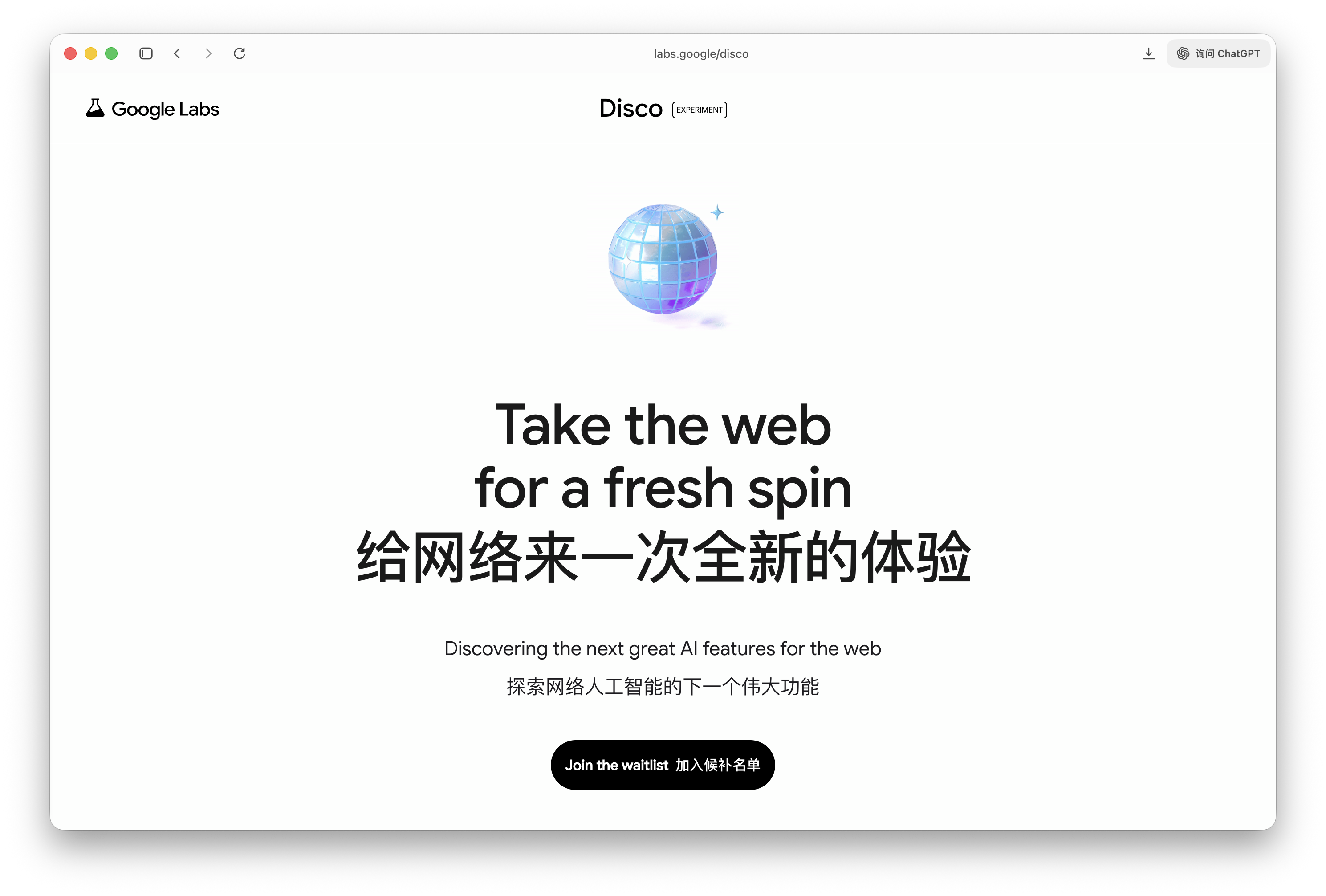
Image Source: Google
Disco is an experimental AI browser recently launched by Google through Labs. It's not a major update to Chrome, nor a simple feature extension; it's an independent browser project. With Disco, Google has set aside its fixation on stability and scale to explore a more radical browser concept.
Beyond its conversational design, akin to other AI browsers, Disco's most striking feature is a new mechanism called GenTabs. Google describes it as “Disco's first web discovery feature,” hinting at more functional enhancements in the future.
In simple terms, Disco transcends merely summarizing web pages and answering queries. It aims to directly generate an interactive web application tailored to your needs from a set of tabs you're browsing—be it an itinerary planner, comparison chart, checklist, or conceptual model, all seamlessly emerging during the browsing process.
AI dialogue and web browsing are no longer just about acquiring information but also about creating a web application within the “context.”

Image Source: Google
While AI browsers are racing towards “smarter chat assistants,” Disco offers a different perspective: perhaps the real transformation lies not in how human-like the responses are, but in whether AI capabilities can be converted into immediately usable tools.
Speaking of which, many may recall Ant Group's Ingenious Flash Apps from a while back. Indeed, there are parallels.
Learning from Ingenious, Google Brings “Flash Apps” to the Web World
Viewing Disco as just another AI browser would underestimate its true purpose. In today's product landscape, Disco is more about answering a fundamental question:
When AI can instantly generate interfaces and logic, is there still a need for “fixed-form applications” in browsers?
This is where Disco sets itself apart from most AI browsers on the market. From Dia to Comet, and then to OpenAI's Atlas, the mainstream direction of this wave of AI browsers has been to embed AI dialogue into browsers, transforming them into personal information assistants, or even allowing AI to perform operations on behalf of users.
Their commonality lies in AI's primary forms being “conversation” or “agency”—either answering you or clicking for you. Google doesn't dismiss these capabilities; Disco also offers conversational interaction, but its true focus lies in a more radical approach:
Based on browsing and dialogue, (using Gemini 3) directly generate a usable web application.
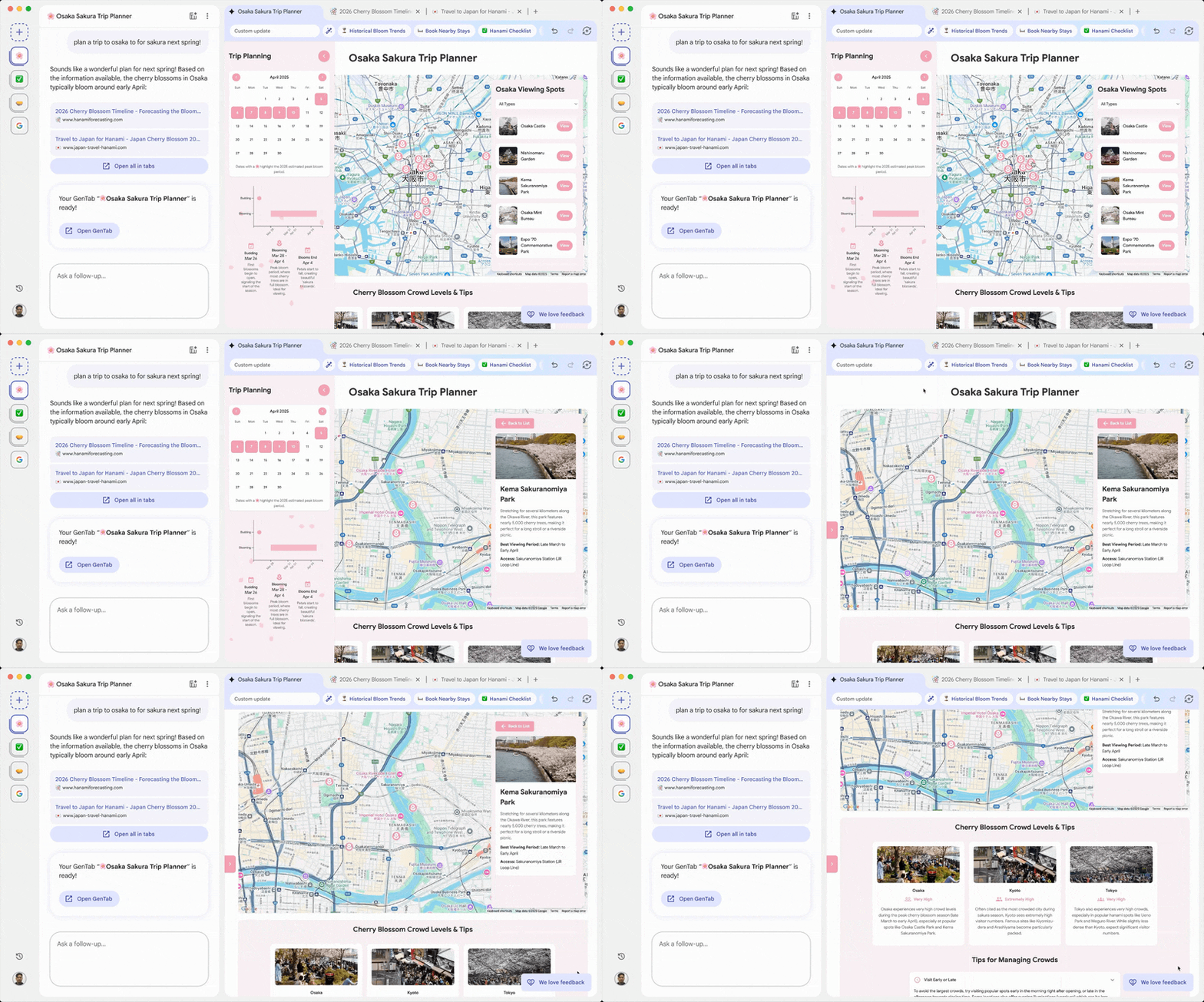
Image Source: Google
This is precisely GenTabs' unique product-level feature.
In Disco, tabs are no longer just passive information carriers but the “raw materials” for generating applications. When you present a specific need, Disco will guide you to open relevant web pages around this goal and, based on that, automatically reorganize this scattered information into an interactive, customized interface.
It could be a travel planning app or an application for understanding the solar system's structural model. The key is that the generated result is no longer just an “answer” but an application entirely tailored to meet personalized needs, even iteratively refined through simple language. And Gemini 3's capability in generating web applications is evident to all.
This inevitably draws comparisons to the recently launched and rapidly popularized Ingenious APP and its “Ingenious Flash Apps” feature.
The core logic of Ingenious Flash Apps is to enable ordinary users to generate a flash app that fits their current needs with just one sentence. It could be an exclusive flower-growing assistant app or a children's English phonics app. The emphasis is on “immediate usability” and “high personalization” rather than “complete functionality.”

Image Source: Xiaohongshu
GenTabs shares a highly similar philosophy. The difference is that Ingenious Flash Apps are designed for mobile devices, catering more to personal life and high-frequency scenarios. In contrast, GenTabs is rooted in the web world, drawing from web pages with higher information density, often addressing complex tasks like planning, research, and comparison. However, their starting points are almost identical.
From this perspective, Disco can be seen as Google's “Flash Apps” experiment for the web world.
Unlike other AI browsers emphasizing “Chat with your tabs,” GenTabs does not merely satisfy answering questions around tabs or focusing on agency execution. Instead, it further “compiles” these tabs into a new interactive web application.
This choice may bring about a subtle yet significant experience shift. Unlike the past, where we had to sift through vast amounts of information to build a simulation of a concept or could only organize a pile of static information, Disco, with the help of AI, can generate exclusive web applications, better meeting our needs through more intuitive and flexible interactive GUI interfaces.
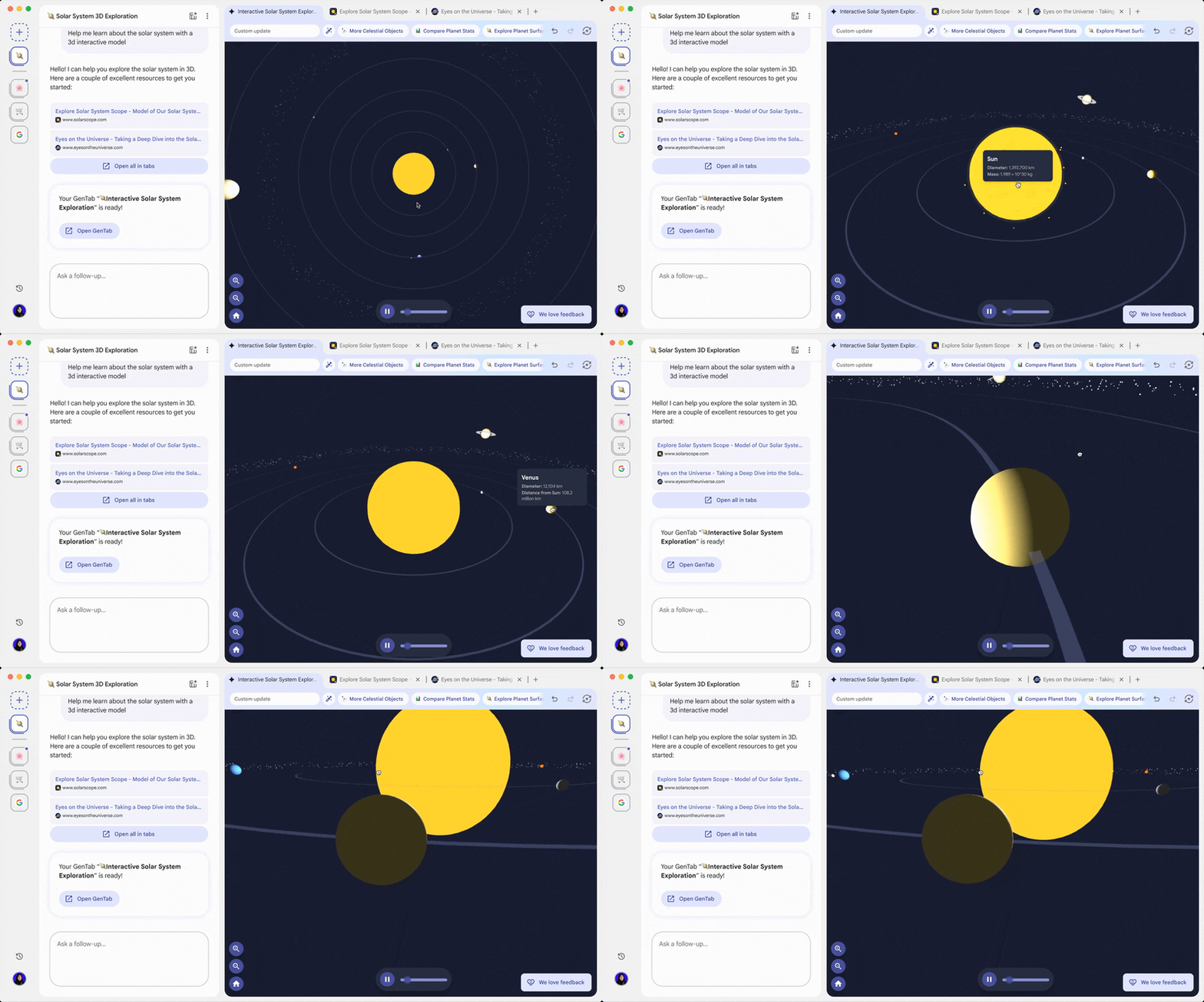
Image Source: Google
No longer switching back and forth in “tab hell,” but watching a tool gradually take shape during the browsing process. Web pages are no longer just consumed information but become the context for building tools.
This is GenTabs' most ambitious aspect and where it most closely aligns with the spirit of “Flash Apps.” Whether this form can truly take hold and be sustainable remains to be seen over a longer period.
But at least in terms of direction, Google has provided a sufficiently different and worthy answer.
The AI Browser War: Google's Conservatism and Radicalism
Over the past year, AI browsers on the PC side have become a “battleground.” Abroad, there are Dia, Comet, and Atlas; domestically, there are new versions of Kuake and Doubao PC, among others. More and more products are attempting to prove that browsers should not just be shells for web pages but intelligent hubs capable of understanding, organizing, and even acting on behalf of users.
In contrast, Chrome's AI integration progress appears “restrained,” even “conservative.” It wasn't until the recent major update that Gemini was introduced into the sidebar, enabling AI tab management, AI Mode, and other features.
The issue may not lie in Google's inability but rather its reluctance to take risks on Chrome. StatCounter data shows that Chrome's global browser market share has reached a record high of over 70% this year. Unlike startups that can quickly iterate through “continuous innovation,” Chrome, as a “global-scale” product, is unlikely to be “radical” from either a public opinion or business perspective.
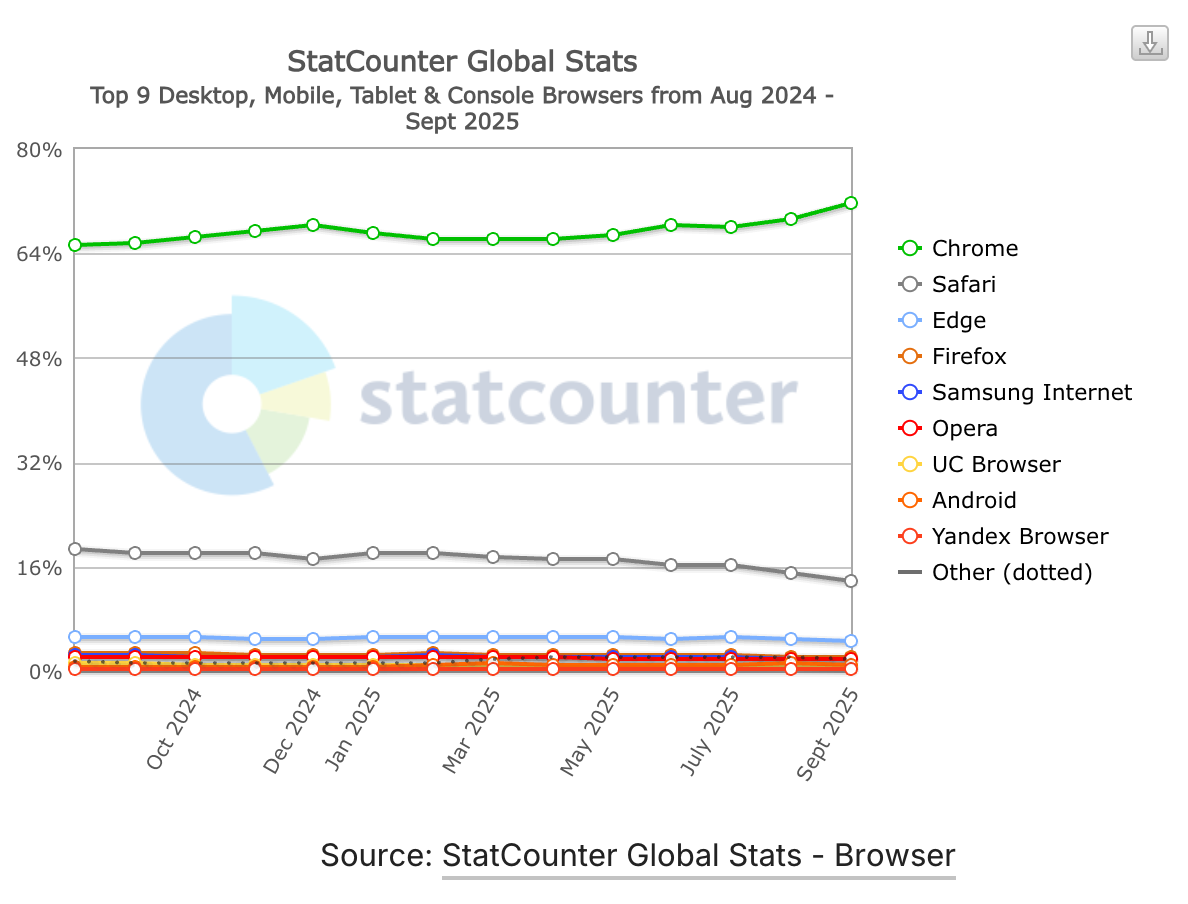
Image Source: StatCounter
However, this does not mean Google lacks ambition in the AI browser direction.
Disco's emergence also reveals Google's more authentic strategy: maintaining conservatism on the mainline product Chrome while releasing radicalism in experimental products. As an independent project placed in Google Labs and deliberately isolated from the Chrome ecosystem, Disco does not need to immediately serve a vast user base or promise stability and compatibility. It is more like a “testbed” specifically designed to validate future directions.
And the direction Disco validates is quite Google-esque. Instead of letting AI directly perform operations on behalf of users, Disco places its radicalism in a more fundamental and controllable area—interface generation and task structuring. GenTabs does not attempt to “make decisions for you” but quickly compiles scattered information across web pages into a tool that humans can understand and operate.
To some extent, this implicitly reflects Google's judgment on the future of browsers and even AI applications: in the AI era, true breakthroughs may not come from assistants that are more human-like but from instantly transforming complex information into structures and interfaces. This judgment is also evident in the Ingenious APP.
In Conclusion
From Ant Group's Ingenious to Google's Disco, the core does not lie in how intelligent the conversation is but in whether scattered information and vague needs can be quickly organized into an immediately usable form.
Behind this lies a questioning of traditional software logic. In the past, applications were always pre-designed, long-term installed, and repeatedly used. The path shown by Ingenious and Disco, however, is another, lighter, and more immediate paradigm: no preset product form, no emphasis on lifecycle, just generating an “application” that is just good enough for the current task.
Tools are no longer preparations before entry but natural results of the browsing, dialogue, and thinking process.
Therefore, the value of Disco does not depend on whether it will feed back into or even merge with Chrome, or whether GenTabs can evolve into a new platform capability. More importantly, it allows people to see a new relationship and interactive experience between AI-driven browsers and users.
As for where this path will ultimately lead, a clear answer is not yet visible. But what is certain is that as AI begins to participate in interface and structure generation, the boundaries between browsers, applications, and even systems are being redefined.
Google, Ant Group, Ingenious, Gemini, Disco
Source: Leitech
Image Credits: 123RF Licensed Image Library
-
![]()
Alibaba's AI Offensive: Over Half of Investment Allocated, Time to Reap Returns
-
![]()
Alibaba’s AI Push: Over Half of Investments Made, Time to Harvest Returns
-
![]()
Chinese Enterprises Going Global 3.0: From World Factory to AI Infrastructure Builder
-
![]()
Honor RobotPhone Review: Half Movie Camera, Half Robot
-
![]()
AI-Driven Cheating Surges in Universities! Online Exams Reduced to Mere Formalities, Degree Credibility on the Line
-
Insta360’s Decade in Panoramic Imaging: Making Cameras ‘Invisible’ and Returning Creation to the Masses
-
![]()
Foreign Media Claims Apple is Concentrating Resources on AI Development: Vision Pro and Siri Teams Lay Off 200 People
-
Big News! Huaneng and Huawei Hold Talks in Shenzhen with Ren Zhengfei in Attendance; Huawei Emerging as the 'Second Brain' of China's Energy System