Moore Threads Secures 7.5 Billion Yuan via Listing for Wealth Management—A Scenario That Seems Almost Unbelievable
 12/15 2025
 580
580
Produced by / Wangjie
Written by / Wang Miao
At first glance, the announcement from Moore Threads is bound to catch anyone off guard.
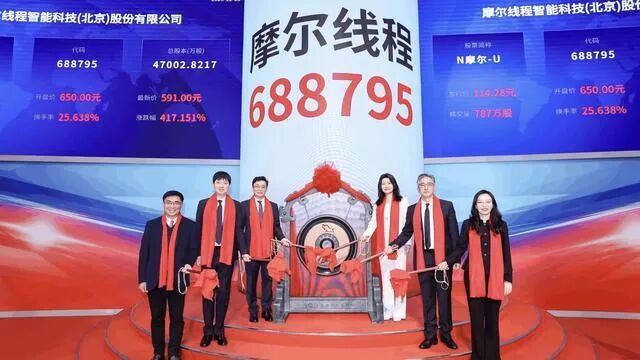
As the inaugural domestic GPU company to go public, immediately after ringing the bell at the stock exchange, it announces plans to invest up to 7.5 billion yuan of the raised funds in wealth management products. Not for mergers and acquisitions, not for production expansion, nor for accelerating tape-out processes, but for negotiated deposits, call deposits, and structured deposits.
Many investors' immediate reaction is blunt: I'm entrusting you with my money to take on Nvidia, not to become a major client of a bank.
What's even more striking is the proportion involved. After deducting issuance expenses, Moore Threads' actual raised funds from the IPO amount to approximately 7.576 billion yuan. The announced upper limit for wealth management investment is 7.5 billion yuan. In essence, nearly 99% of the money is temporarily being allowed to 'remain unutilized'.
This is not a typical case of capital turnover or small-scale financial management. It's an extremely extreme and direct signal being sent: At this juncture, Moore Threads believes that depositing the money in the bank is a safer option than spending it immediately.
The unreal aspect of this situation doesn't stem from 'buying wealth management products' itself, but rather from the fact that it's occurring in an industry that, theoretically, should be burning through money the most.
01.
It's not that the money doesn't want to be spent; it's that it genuinely can't be spent.
If one only considers the announcement, it's easy to criticize the CFO and label it as 'relaxed management.' However, anyone with knowledge of the chip industry would understand that things aren't that straightforward.
Moore Threads clearly outlines the intended use of the funds in its prospectus. The majority is earmarked for three areas: next-generation AI training and inference integrated chips, next-generation graphics chips, and next-generation AI SoCs. The directions are well-defined and seem quite 'solid'.
The issue arises from the fact that chip R&D doesn't operate like the internet industry.
In the internet sector, if you raise 7.5 billion yuan, the quickest way to spend it is on market expansion, traffic acquisition, and server investments. The speed at which the money arrives and the speed at which it's spent can be nearly simultaneous.
But that's not how chip development works.
Chip development consumes money gradually, constrained by physical laws. Architecture design takes time, verification takes time, physical design takes time, and tape-outs take even more time. Even if you have 10 billion yuan in your account, you can't spend it all within a single quarter.
Many people assume that chip manufacturing is a 'bottomless pit,' but in reality, it's the opposite. During a single stage, the rate of money consumption is fixed. You can't skip processes, nor can you spend next year's budget this year.
Therefore, having money sit in the account initially isn't unusual.
What's truly unusual is the high proportion of idle funds and the extended duration of inactivity.
This indicates a reality: Under the current technological pace and supply chain conditions, Moore Threads doesn't have a short-term, definitive window to rapidly consume funds.
02.
The slowest part isn't the chips; it's the ecosystem.
If hardware R&D is already slow, what truly slows down the pace is software.
Nvidia's most difficult-to-replicate asset has never been a specific generation of GPUs but CUDA. That's the result of over a decade of coding, line by line.
Moore Threads has chosen to build its own MUSA ecosystem. There's no right or wrong in this path, but the cost is extremely high, and the pace is extremely slow.
You can purchase EDA tools, hire engineers, and pay tape-out fees upfront. But you can't directly buy developers' migration costs with money.
Software adaptation requires negotiating with each vendor individually. Toolchain refinement requires multiple rounds of version iterations. Establishing developer habits takes years.
These investments may not stand out on the balance sheet, but they are extremely demanding on management patience in practice.
A more practical issue is that such investments rarely result in 'surge spending.' They are more like continuous drip irrigation than a one-time watering.
Therefore, even with 7.5 billion yuan in the account, it doesn't mean you can immediately convert it into R&D acceleration.
This is why, despite having substantial funds, the project pace remains slow.
03.
Capital moves at lightning speed; production capacity crawls.
Another less discussed but equally critical factor is production capacity.
In the high-end GPU sector, the true bottleneck isn't just the manufacturing process but advanced packaging. Whether it's CoWoS or other routes, global production capacity is extremely tight.
Money can't directly buy production capacity.
Even if you stand at the foundry's door with a check, you may not succeed in cutting in line. Scheduling is calculated by quarters or even half-years.
This creates an extremely asymmetric reality: The capital market completes pricing and financing in an instant, but the manufacturing system remains stuck in a lengthy physical cycle.
The result is that money arrives first, while production capacity is scheduled later. The money can only sit idle, waiting for a window of opportunity.
From this perspective, Moore Threads' 'wealth management announcement' seems more like a passive response than an active choice.
It exposes not the company's lack of ambition but the ceiling of resource conversion efficiency in the entire domestic high-end chip ecosystem.
04.
Outside, dreams are being made; inside, survival is the priority.
Shifting the perspective from within the company to the capital market, the contrast becomes even more pronounced.
After listing, Moore Threads' stock performance has been extreme. Its market capitalization has rapidly expanded, with its valuation system completely detached from current performance and instead betting on a distant future.
This pricing method is essentially a vote of confidence.
However, the issue lies in the fact that confidence and cash flow operate on two separate systems.
The capital market may be willing to pay for the 'domestic GPU' narrative for a decade, but the company itself must first survive the next three years.
From its financial reports, Moore Threads is still in a continuous loss-making phase and has explicitly stated that it won't prioritize profitability in the short term. This means that the 7.5 billion yuan in the account isn't expansion capital but survival capital.
Under these circumstances, keeping the money in low-risk, redeemable wealth management products is essentially a defensive strategy.
It may not look appealing or exciting, but it's realistic enough.
Summary
The unreal aspect isn't wealth management but our expectations for hard tech.
The reason Moore Threads' move to 'invest raised funds in wealth management' has sparked such controversy isn't that it violates financial common sense but that it punctures a collective illusion.
Many assume that with money in place, domestic GPUs can immediately accelerate. But the reality is that hard tech development never follows the rhythm of capital.
Money can arrive in a day, but ecosystems take years to cultivate. Orders can explode overnight, but production capacity requires slow queuing.
In this process, having money in the account that can't be spent immediately isn't uncommon.
What truly warrants caution is when the capital market has already priced in a decade of success, while the real world is still stuck at the starting point of infrastructure and ecosystem development.
Therefore, these 7.5 billion yuan are less about being 'idle' and more about serving as a buffer.
They give the company time to wait for production capacity, refine the ecosystem, and endure the cycle.
As for short-term stock price movements, that's the market's concern. But for hard tech, the true turning point never comes from a wealth management announcement but from the day when these funds are massively redeemed and converted into tape-out orders, engineer salaries, and prototypes in the lab.
That's when the story truly begins.
-
![]()
Kuaishou's 'Fundification' Strategy: Going All-in on Kling AI
-
![]()
"Tech Ferrari" Xiangjie RX: Yu Chengdong’s Glowing Review Sparks Wild Netizen Speculation: Is It the YU7?
-
![]()
Chery's 'Audi Suit Gangster' Makes Waves with Unbeatable Pricing. Netizens React: 'Is This the Aorui A6L?'
-
![]()
AITO Takes a Bold Leap, Forms Joint Venture with BMW and Mercedes-Benz
-
![]()
How Does the Cloud Data Engine Transform Physical Labor into Technical Work for Autonomous Driving Annotators?
-
![]()
Historic Strongest Mercedes-Benz GLE L Faces Intense Competition from Domestic 9 Series
-
![]()
Jeff Dean's First Entrepreneurial Venture After Leaving Google: Why Launch an AI Company 'Not Aiming to Make Money' at This Juncture?
-
![]()
Caught in the Traffic 'Web'