Unitree Unveils the World's Pioneering Robot App Store: Striving to Forge an Apple-Inspired User Ecosystem
 12/15 2025
 756
756
On December 13th, Beijing time, Unitree Technology rolled out the world's inaugural robot app store, drawing inspiration from Apple's iconic 'APP Store'. This digital marketplace empowers Unitree Technology's existing customers to download motion algorithm model software, either officially launched or shared by fellow users, as well as to effortlessly upload and distribute their self-developed and trained motion algorithm models with a single click. 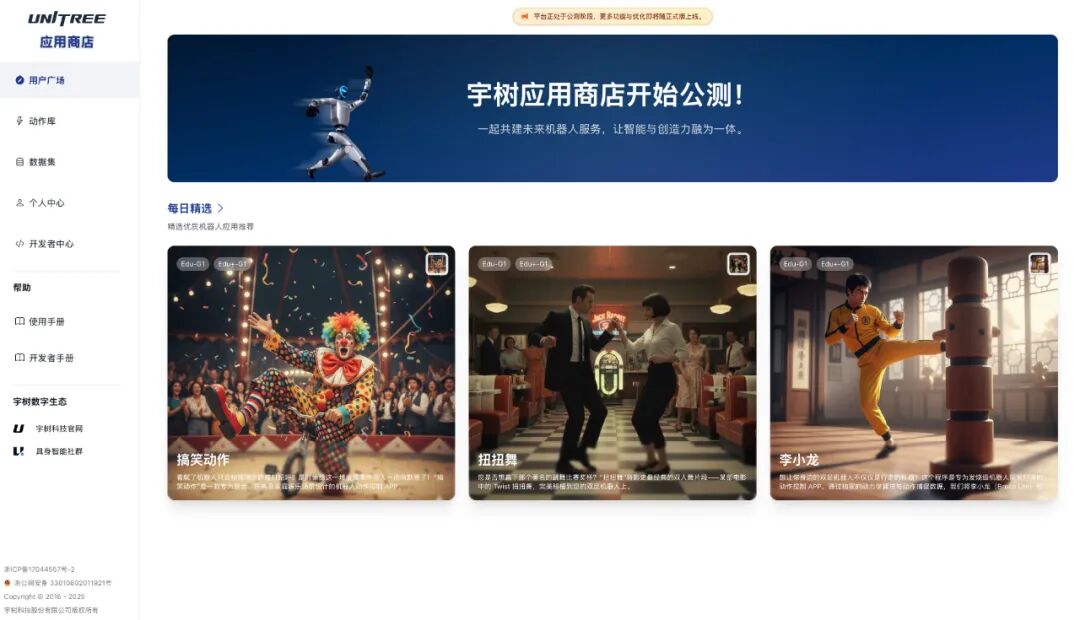
This groundbreaking move in the robotics realm is unprecedented in the industry. Unitree Technology is on a mission to cultivate an Apple-esque user ecosystem.
Moreover, this endeavor represents Unitree Technology's bid to ignite a fresh impetus for user expansion. Presently, Unitree Technology's user base predominantly comprises research institutions and B-end clientele, with a relatively small contingent of C-end enthusiasts.
Through the app store, the sharing of motion model software enables developers to generate supplementary income to offset their development expenditures, while also allowing newcomers to economize on development time and costs.
Simultaneously, it aims to foster entertaining products to unlock new avenues for user growth.
The deployment of entertainment or service robots has the potential to expand the user base.
The three major offerings introduced during the public beta phase—comical maneuvers, twist dance routines, and Bruce Lee-inspired moves—are applications imbued with entertainment value.
According to the official introduction, the 'Bruce Lee' program is a motion control APP tailored for robot aficionados at the enthusiast level. Leveraging proprietary kinematic algorithms and motion capture data, it seamlessly integrates Bruce Lee's iconic Jeet Kune Do techniques into your robot hardware.
This application leverages Unitree G1's formidable motion control capabilities to accurately replicate Bruce Lee's classic martial arts maneuvers. Users can effortlessly toggle between Unitree's walking and running modes and martial arts states, initiating or halting martial arts sequences with a single tap.
The overarching goal is to render motion software installation on applicable platforms as straightforward as mobile phone software installation, yet with a more enriched user experience. 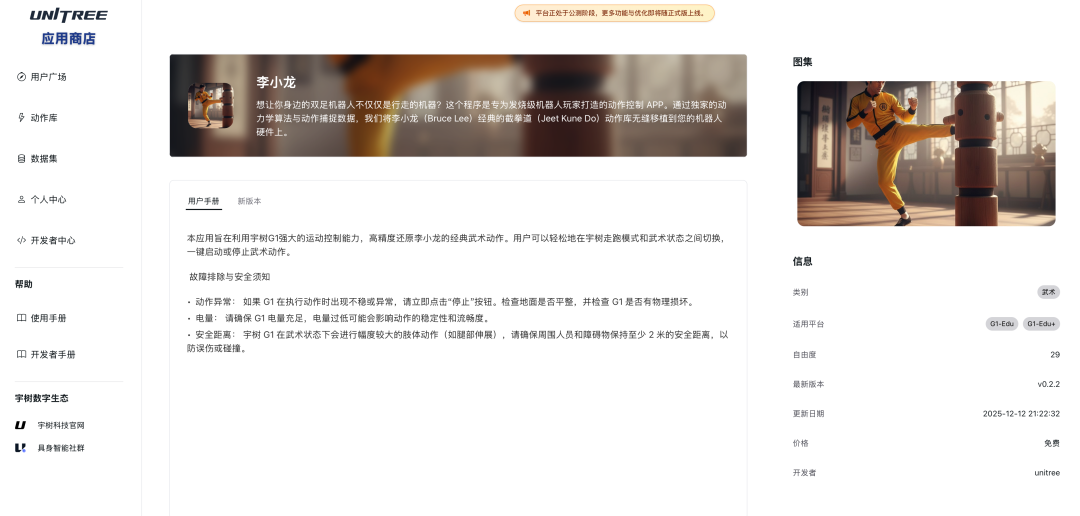
Once this motion library becomes abundant, with more developers inclined to upload their developed and tested motions to the app store for sharing, it could potentially galvanize the C-end user market.
Particularly in the service robot sector, where each niche scenario and even every motion of service robots necessitates extensive development, testing, and iteration to cater to user demands.
Unitree's app store initiative is a collaborative endeavor.
However, the challenges are formidable. Even in the realm of pure software and large models, OpenAI's attempt to launch a similar app store has thus far yielded lukewarm results.
In the hardware domain, currently recognized as the physical AI landscape, can this fusion of entertainment, playability, and practicality, bolstered by Unitree Technology's commitment to investing in operations, gradually materialize?
Technically, Unitree's app store adopts a distributed microservices architecture, encompassing four core modules: User Plaza, Motion Library, Dataset, and Developer Center. Users can seamlessly connect to robots via a mobile phone APP and deploy intricate control algorithms from the cloud to the robot terminal with a single click, akin to installing mobile phone software.
Meanwhile, the platform also aggregates datasets sourced from real robots, enabling users to upload their data or download datasets shared by others for algorithm training and optimization. Unitree has outlined three objectives to achieve within the next three years:
1. Link up with 100,000 robot devices;
2. Foster 100 developer enterprises with annual revenues surpassing 10 million;
3. Cultivate application scenarios worth billions.
IDC forecasts that by 2027, the robot app store market will reach a staggering $18.7 billion, with Unitree Technology poised to capture over 15% of the market share, thanks to its first-mover advantage.
So, what is the current landscape? What hurdles will it encounter?
Over 1,200 Developers, 237 Apps Listed
According to reports, the platform currently boasts 237 listed apps, spanning logistics and warehousing (accounting for the highest proportion at 38%), industrial manufacturing (29%), and service robots (17%).
In terms of developers, over 1,200 have already joined the platform.
By industry, the aforementioned three major sectors—logistics and warehousing, industrial manufacturing, and service robots—constitute 84% of the developer base.
Geographically, developers exhibit a regional clustering effect: 42% hail from the Yangtze River Delta, 27% from the Pearl River Delta, and 19% from the Beijing-Tianjin-Hebei region. These three regions collectively account for 88% of developers.
To a certain extent, the regional clustering effect surpasses the industry clustering effect.
From an industry concentration perspective, it is evident that the three major sectors in the robotics field anticipated to lead in commercialization are logistics and warehousing, industrial manufacturing, and service robots.
In reality, each industry represents a vast market, with numerous niche fields within. These niche fields precisely necessitate each application developer to first devise a suitable motion model.
At this juncture, the significance of Unitree Technology's app store becomes apparent. As previously mentioned, newcomers can acquire the corresponding software capabilities post-hardware purchase, while early adopters who have trained motions can recoup their development costs.
More crucially, it can mitigate the societal cost of redundant development.
Public data cites cases such as JD Logistics deploying an intelligent scheduling application, which boosted robot cluster operation efficiency by 230% and slashed order processing time from 4.2 hours to 1.3 hours; BYD's Xi'an factory implemented a welding quality inspection application, reducing the welding defect rate from 0.8% to 0.2%, saving 1.26 million yuan in costs annually.
However, the question remains whether industrial or sectoral applications, which prioritize cost reduction and product competitiveness as core demands for industrial users, are willing to share their hard-earned training results with competitors. This remains an open question.
Compared to applications that enhance production efficiency, entertaining applications may better ignite user enthusiasm.
Perhaps Unitree has also recognized this, as the homepage showcases three highly entertaining applications for public beta testing. Now, large models are vying for supremacy in applications, and so are robots.
-
![]()
Kuaishou's 'Fundification' Strategy: Going All-in on Kling AI
-
![]()
"Tech Ferrari" Xiangjie RX: Yu Chengdong’s Glowing Review Sparks Wild Netizen Speculation: Is It the YU7?
-
![]()
Chery's 'Audi Suit Gangster' Makes Waves with Unbeatable Pricing. Netizens React: 'Is This the Aorui A6L?'
-
![]()
AITO Takes a Bold Leap, Forms Joint Venture with BMW and Mercedes-Benz
-
![]()
How Does the Cloud Data Engine Transform Physical Labor into Technical Work for Autonomous Driving Annotators?
-
![]()
Historic Strongest Mercedes-Benz GLE L Faces Intense Competition from Domestic 9 Series
-
![]()
Jeff Dean's First Entrepreneurial Venture After Leaving Google: Why Launch an AI Company 'Not Aiming to Make Money' at This Juncture?
-
![]()
Caught in the Traffic 'Web'