Luo Fuli Makes Her Debut: Lei Jun's New AI Endeavor
 12/18 2025
 546
546
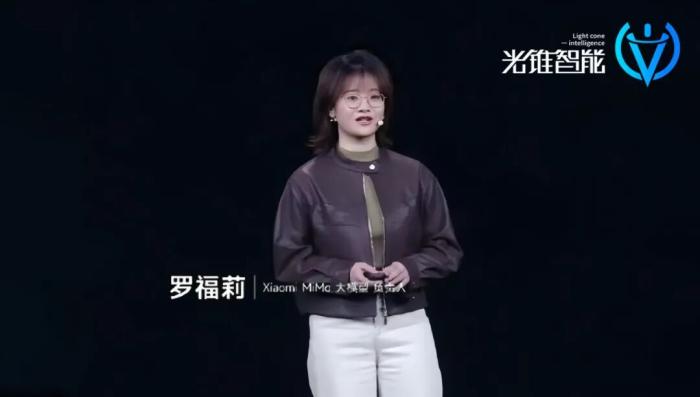
From the swirling rumors of her being in contact with Lei Jun and her early - year resignation, to her official announcement of joining Xiaomi last month, and then her attendance at Xiaomi's 'Human - Car - Home Full Ecosystem Conference' this month, Luo Fuli, the so - called 'genius girl', took center stage to unveil the new model, MiMo - V2 - Flash.
Xiaomi, a newcomer in this field, has put up what seems to be an impressive performance.
As a 'large' model with 309 billion parameters and 15 billion active parameters (Luo herself mentioned that this model is too small to truly be called a large model), in Xiaomi's vision, it is designed to serve as a foundation for training agents.
To achieve this, the model's optimization is more focused on specific directions, with cost - effectiveness and speed at the core:
For instance, it can achieve a generation speed of 150 tokens per second at an extremely low cost. While maintaining high cost - effectiveness, it also ensures the model's performance.
'Its code capabilities and agent capabilities have ranked among the top 1 - 2 global open - source models on world - class, publicly fair evaluation benchmarks,' Luo said. 'Most evaluation benchmarks show that it has surpassed or is comparable to models like DeepSeek - V3, Kimi K2 - Thinking, and Qwen, but its parameters are only one - half to one - third of theirs.'
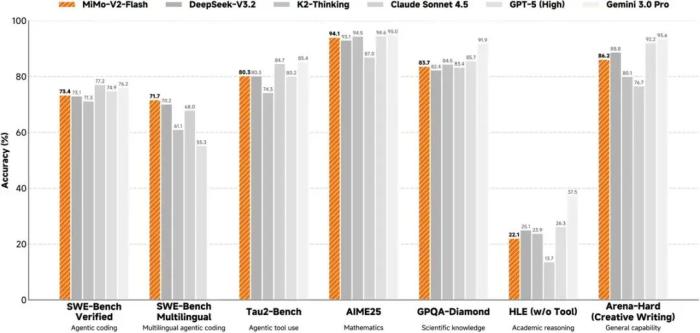
The released Xiaomi model has also received polarized reviews. Some praise its leading code capabilities, while others dismiss it as just an attempt to chase high scores.
Regardless, Xiaomi needs AI.
The choice to hold the Human - Car - Home Full Ecosystem Conference on December 18th underscores the importance of AI to Xiaomi.
In terms of smart terminals, Xiaomi has two tasks: First, develop lightweight models for edge deployment to upgrade 'Super Xiaomi AI' and Pengpai OS, integrating AI into smart terminals; Second, in intelligent driving, Xiaomi requires large models as a foundation to enhance intelligent driving capabilities.
Xiaomi is demonstrating through its actions that it is serious about AI.
01 Cost Reduction, Speed Boost: Xiaomi Bets on Agents
From the very beginning, Xiaomi's AI goals, which might have been mentioned as early as Lei Jun's 2023 annual speech, have been 'lightweight + edge deployment'.
Luo Fuli stated directly in her speech that the current direction of model learning diverges from the evolutionary path of biological intelligence, and that mere 'brute force' is no longer sufficient to give rise to higher - order intelligence.
As the improvements brought by the Scaling Law diminish, Xiaomi has chosen a path more suitable for itself: developing a model with small parameters, good performance, and low cost.
'The Scaling paradigm has gradually shifted from pre - training to post - training,' Luo explained. 'How do we unleash the potential of post - training? This requires a stable paradigm to invest more computational power in reinforcement learning (RL).'
To this end, as a foundational model for agents, the optimization logic of MiMo - V2 - Flash points to three key issues:
Efficient Communication: Strengthen code capabilities and tool invocation, which are the foundations of agent interaction.
Accelerated Bandwidth: Solve information transfer bottlenecks between agents through extremely high inference efficiency.
Focus on Post - Training: Unleash the potential of reinforcement learning through stable paradigms.
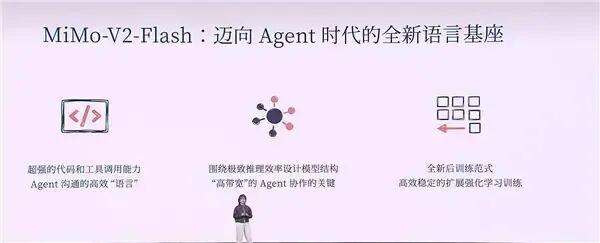
Thus, Xiaomi has developed the 309 - billion - parameter MiMo - V2 - Flash model, which stands out most prominently in terms of code capabilities.
According to official data, the model even surpasses a series of closed - source large models, including GPT - 5, in the SWE - Bench Multilingual (the multilingual version of the software engineering benchmark test).
Although there is still some gap between this model and open - source models like DeepSeek V3.2 and Kimi K2 - Thinking in other metrics, its performance is already remarkable for a relatively small model.
The core, however, lies in the model's optimization in terms of inference speed and cost:
Using Claude Sonnet 4.5 as a comparison metric, Xiaomi's new model costs only 2.5% of Claude's inference price while achieving twice the generation speed.
The API pricing for MiMo - V2 - Flash is set at 0.7 yuan per million tokens for input and 2.1 yuan per million tokens for output. This is also a highly competitive price compared to domestic models.
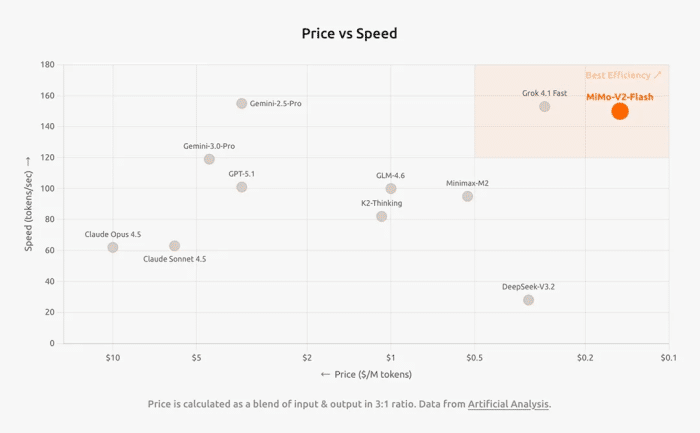
To optimize costs and boost inference speed, Xiaomi has revealed its choice of technical architecture - hybrid attention mechanisms.
Exploring similar directions, unicorns like Yuezhi'anmian and MiniMax have also ventured into hybrid attention mechanisms.
Xiaomi has opted for a hybrid structure combining a 5:1 ratio of Sliding Window Attention (SWA) and Global Attention (GA).
Official experiments show that SWA outperforms mainstream linear attention mechanisms in long - text and reasoning capabilities, and its fixed - size KV Cache makes it highly compatible with existing infrastructure (Infra).
However, for Xiaomi, achieving the effects showcased at the conference and integrating the model into devices like cars and smartphones still requires a model size of 300 billion parameters, which is not small and is still far from edge deployment.
The most intriguing part, perhaps, is Luo Fuli's concluding remark in her speech:
'The next starting point for AI evolution must be a physical model capable of interacting with the real environment,' Luo said. 'What we aim to create is not essentially a program but a virtual universe with physical consistency and temporal - spatial coherence.'
From Xiaomi's model release dynamics this year, we speculate that Xiaomi's future optimization will be divided into two lines: First, relentlessly pursuing edge deployment to empower smart terminals; Second, conquering physical models to enhance model capabilities in intelligent driving.
02 Edge Deployment and Intelligent Driving AI: The Foundation for Xiaomi's Ecosystem
Regardless of the heated discussions on parameters and architectures externally, for Xiaomi, the value of AI must ultimately return to its business.
The choice to release the model at the Human - Car - Home Full Ecosystem Conference on December 18th itself illustrates the strategic significance of AI to Xiaomi:
On the smart terminal side, by upgrading 'Super Xiaomi AI' and Pengpai OS, they transform from mere instruction executors into true assistants; On the intelligent driving side, large models are urgently needed as a foundation to expand the limits of intelligent driving.
Looking back at 2025, Xiaomi's efforts in the MiMo series have shown a sense of urgency, unlike the quiet aftermath of model releases two years ago. This year, Xiaomi has become more vocal.
April: Open - sourced the MiMo - 7B series, covering basic, instruction fine - tuned, and reinforcement learning versions.
May: Released MiMo - VL - 7B, making a breakthrough in multimodal visual understanding.
November: Introduced the MiMo - Embodied embodied intelligence large model, integrating autonomous driving and robotics technologies.
December: MiMo - V2 - Flash made its debut, focusing on ultimate efficiency and agent capabilities.
Behind this series of moves lies substantial financial investment. Lu Weibing, President of Xiaomi Group, clearly stated on the earnings call that AI is a core R&D direction. In 2025, Xiaomi's R&D investment is expected to exceed 30 billion yuan, with about a quarter (around 7.5 billion yuan) directly allocated to AI, and plans to invest over 200 billion yuan in the next five years.
'On the edge side, we must pursue lightweight computational power, low power consumption, and lifecycle costs to popularize edge AI,' Lu said. 'This is definitely Xiaomi's future direction and where our strengths lie.'
Organizational actions also reflect Xiaomi's determination: Since 2024, Xiaomi has built its own AI Infra platform. Last year, Jiemian News reported that Xiaomi was working on establishing its own GPU 10,000 - card cluster, making a significant investment in AI large models. It is reported that the team had 6,500 GPU resources upon its inception.
To support this strategy, Xiaomi's talent pool has also gradually become complete in 2025.
Besides Luo Fuli, who is responsible for the foundational large model, Xiaomi has also recruited Chen Long to serve the intelligent driving team. This 'dual - core' configuration has already shown initial success in technical routes - Chen Long's team proposed and open - sourced the world's first cross - embodied (X - Embodied) foundational model, MiMo - Embodied, which bridges autonomous driving and embodied operations.
This model attempts to solve the knowledge transfer challenges between autonomous driving and robotics, indicating that Xiaomi is trying to drive its vast hardware ecosystem - from smartphones in hand to smart homes and intelligent driving - with a unified AI logic.
Lei Jun once mentioned that Xiaomi's AI strategy is 'lightweight + local deployment'. It is evident that Xiaomi will leverage its massive installed base of over 1 billion devices globally to drive its business with AI.
For Xiaomi, the release of MiMo - V2 - Flash is not just about securing a spot on the leaderboard. It is a new story that Xiaomi is trying to tell the capital markets and users:
A hardware company is attempting a complete evolution in the intelligent era by mastering the most efficient 'brain' (AI models) and the most extensive 'body' (human - car - home ecosystem).
Whether this story can be told successfully depends not only on how well the models are developed but also on whether these technologies can truly run through every Xiaomi device, translating into tangible user experiences.
-
![]()
Can Domestic Autos Still Hold Their Own Against Joint Venture Brands?
-
![]()
Domestic Cars Priced Above 300,000 Yuan Are Gaining Ground in Chengdu
-
![]()
BBA Takes a Leap of Faith: No Sales, No Tomorrow
-
![]()
Chengdu Unfaded: BYD and Geely Vie for Championship While the Weak Exit
-
![]()
3X Salary Poaching, 40 Executives Depart: Autonomous Driving Talent is Batch-Producing Embodied AI Leaders
-
![]()
Apple’s Foldable iPhone and Huawei’s Straightened Pura X: Two Paths, One Vision
-
![]()
Dong Yuhui Departs with Traffic, Yet East Buy Crafts a Profit-Generating Engine
-
![]()
Did Alibaba Say AI Investments Would Pay Off in Three Years, Then Turn Around and Ask Shareholders for HK$80 Billion to 'Tide Over'?