OpenAI's 'Equity-for-Copyright' Approach: A Potential Lifesaver for IPO-Bound MiniMax
 12/19 2025
 601
601
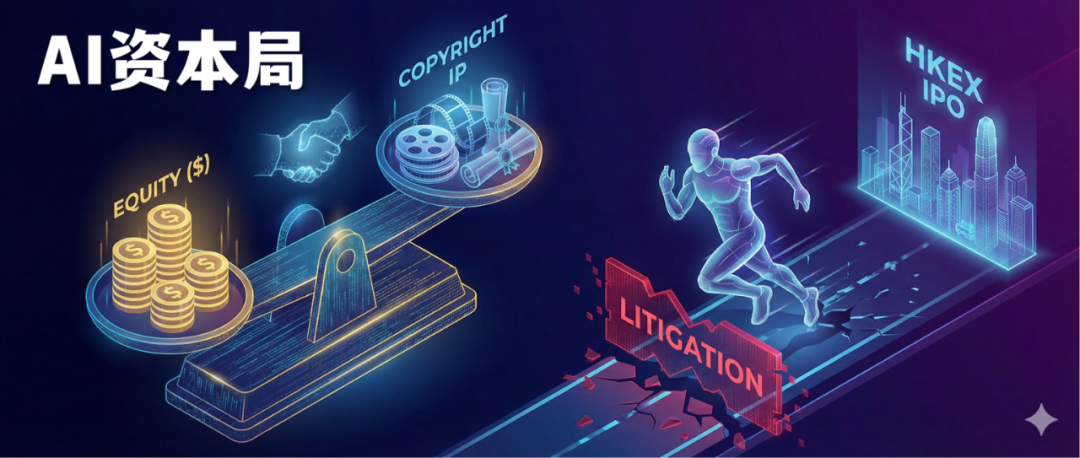
Yesterday, two significant developments in the global AI landscape brought the core issues of 'copyright compliance' and 'capitalization process' into sharp focus.
On one front, OpenAI announced a hefty $1 billion investment from Disney, marking the beginning of a deep strategic partnership. The market interpreted this move as OpenAI successfully exchanging equity for the legal usage rights of high-value intellectual property (IP), thereby clearing the most substantial compliance obstacle for the commercialization of video models like Sora.
On the other hand, according to Bloomberg sources familiar with the matter, Chinese AI unicorn MiniMax (Xiyu Technology) is planning to launch its initial public offering (IPO) in Hong Kong as early as January next year.
Against the backdrop of Hollywood giants filing infringement lawsuits against MiniMax, OpenAI's recently proven 'equity-for-copyright' model could offer a valuable blueprint for MiniMax, which is now on the verge of its IPO quiet period.
Timeline Deduction: MiniMax May Have Already 'Confidentially Submitted'
If Bloomberg's reported timeline of an 'IPO as early as January next year' is accurate, working backward from the Hong Kong Stock Exchange's (HKEX) listing process, MiniMax's progress may be far more advanced than the market currently perceives.
It is reported that since May 6, 2025, the HKEX has implemented new regulations, officially allowing applicants under Chapter 18C (specialized technology) and Chapter 18A (biotechnology) to confidentially submit listing applications.
Typically, a Hong Kong IPO takes several months from submitting the A-1 prospectus to passing the hearing, even under ideal conditions. Given that MiniMax has not yet disclosed its prospectus, to meet the January issuance window, it is highly probable that MiniMax has already confidentially submitted its listing application to the HKEX in the past one to two months, or possibly even earlier.
This also indicates that MiniMax is currently in a critical phase where regulatory authorities are conducting a substantive review of its business compliance.
Copyright Litigation: A Critical Issue on the IPO Path
Previously, Disney, along with Universal Pictures and Warner Bros., filed a lawsuit against MiniMax, alleging that its video generation tools involve intellectual property infringement. For a company planning to go public, unresolved major intellectual property litigation related to its core business often becomes a focal point of regulatory inquiries. 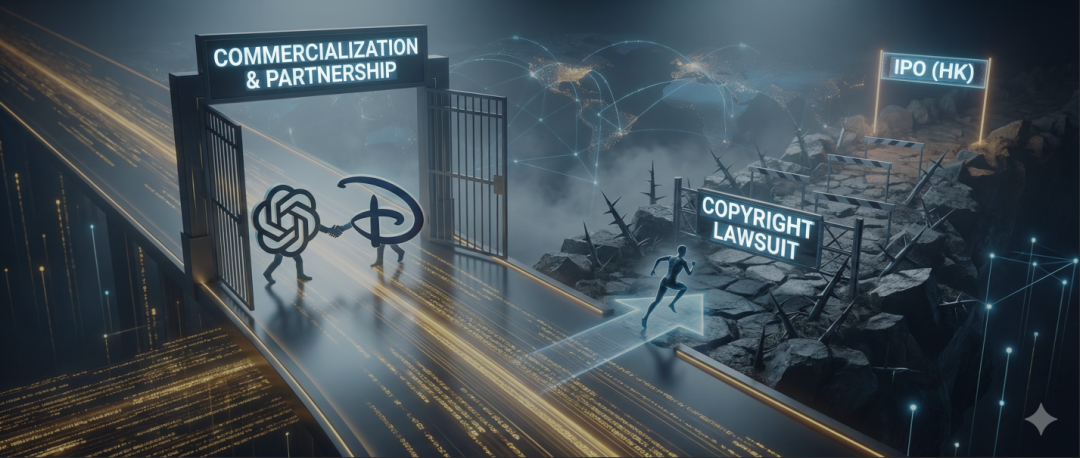
This not only raises concerns about potential compensation amounts but also about the stability and sustainability of the company's business model. Investors need assurance that the company's technological foundation is built on compliant data and that there is no risk of decreased competitiveness due to future compliance rectifications.
Exploring the Feasibility of the 'OpenAI Model'
Against this backdrop, the partnership between OpenAI and Disney provides the industry with a commercial approach to 'turn swords into ploughshares': by bringing copyright holders on board as strategic shareholders, transforming adversarial legal battles into shared interests.
For MiniMax, this path is not only worth considering but also presents objective challenges:
Path Advantages: If MiniMax can emulate OpenAI by ceding partial equity or reaching long-term profit-sharing agreements with copyright holders to achieve an out-of-court settlement, it would significantly reduce uncertainties during the IPO period and signal to the secondary market that 'the worst is over.'
Practical Challenges: The threshold for this model lies in negotiation leverage and geopolitical considerations. OpenAI's valuation in the hundreds of billions of dollars and Sora's technological dominance give it significant bargaining power. As a growing unicorn, MiniMax may need to carefully consider the proportion of equity dilution and whether copyright holders recognize its long-term strategic value if it chooses to follow this path.
It remains unclear whether MiniMax is currently seeking contact or settlement with Hollywood studios.
Whether this lawsuit will become a 'stumbling block' hindering its IPO process or, as in OpenAI's case, lead to a 'grand reconciliation' at the capital level remains to be seen. However, one thing is certain: before the rumored bell-ringing moment in January next year, how to properly manage relations with copyright giants will be a critical question that MiniMax's management must address.
-
![]()
Which Brands Will Be the First to Skip the Next Chengdu Motor Show?
-
![]()
Walmart: Steady Performance Marred by Overvaluation Concerns
-
![]()
Can Domestic Autos Still Hold Their Own Against Joint Venture Brands?
-
![]()
Domestic Cars Priced Above 300,000 Yuan Are Gaining Ground in Chengdu
-
![]()
Sedans Face an Uphill Battle in Sales
-
![]()
BBA Takes a Leap of Faith: No Sales, No Tomorrow
-
![]()
Chengdu Unfaded: BYD and Geely Vie for Championship While the Weak Exit
-
![]()
3X Salary Poaching, 40 Executives Depart: Autonomous Driving Talent is Batch-Producing Embodied AI Leaders