Analysis丨SpaceX + Space Data Center: Is Musk Set to Rewrite the Rules of Computing Power?
 12/21 2025
 660
660
Preface:
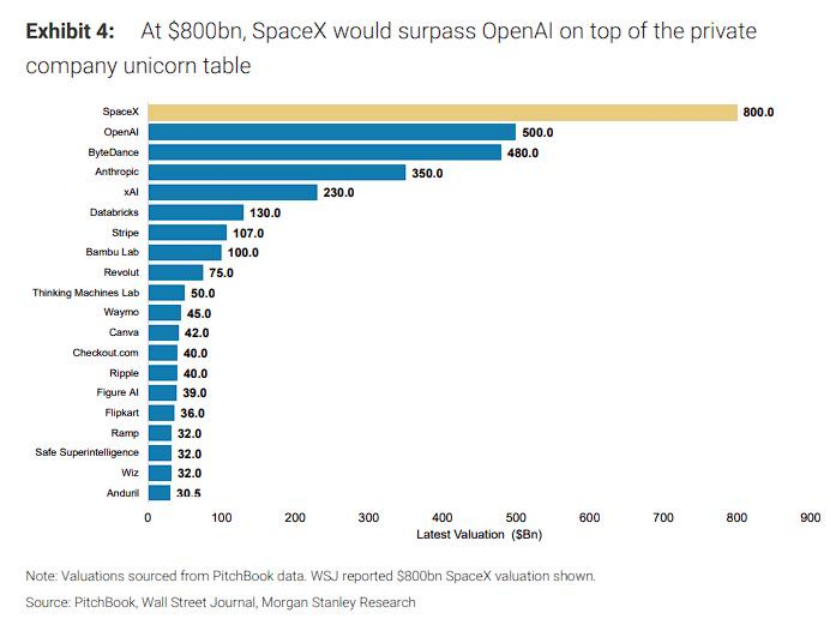
In 2026, SpaceX is poised to launch what could be the largest Initial Public Offering (IPO) in history, boasting a staggering $1.5 trillion valuation and aiming to raise over $30 billion. At the heart of this ambitious vision lies the space data center, a concept hailed by the tech community as the [next frontier in computing].
This revolution is fueled by a stark contrast: the explosive growth in AI computing demand clashes with Earth's resource limitations, while tech giants engage in a fierce battle for dominance in future computing.
Image Source | Network
Earth's Computing Conundrum: Resource Strains in the AI Age
The International Energy Agency forecasts that by 2030, global data center electricity consumption will more than double, equivalent to the power demands of several medium-sized nations combined.
As AI model parameters soar into the trillions and applications like autonomous driving and intelligent robots demand exponential computing growth, Earth's power resources, land availability, and cooling capacities are struggling to keep pace with this technological leap.
Critically, easily accessible Earth-based power sources are dwindling. Traditional fossil fuels face environmental pressures, while renewable energy supplies are constrained by geographical and climatic factors.
Data centers, as major energy consumers, not only strain power grids but also emerge as the primary bottleneck restricting sustainable AI industry development.
The tech world increasingly acknowledges that achieving AI's ultimate evolution necessitates transcending Earth's physical constraints to discover new computing habitats.
From a fundamental perspective, space data centers outperform their Earth-bound counterparts in every aspect and could represent the most significant technological breakthrough in the next three to four years.
Space Computing: Core Advantages Reshaping the Computing Landscape
Space's ideal location for next-generation computing centers stems from its unique natural conditions and technical feasibility, with core advantages disrupting traditional computing economics.
① Ultimate Solar Utilization: Space enjoys nearly constant solar radiation, 30% stronger than Earth's best lighting conditions, unaffected by atmospheric attenuation, weather fluctuations, or day-night cycles.
In low-Earth orbit, solar panel energy generation per unit area is five times that on Earth. A 1m² gallium arsenide cell can produce 300W in space compared to a maximum of 60W on Earth.
Through sun-synchronous orbit designs or mega-solar arrays, space data centers achieve 24/7 uninterrupted power without the need for expensive energy storage batteries.
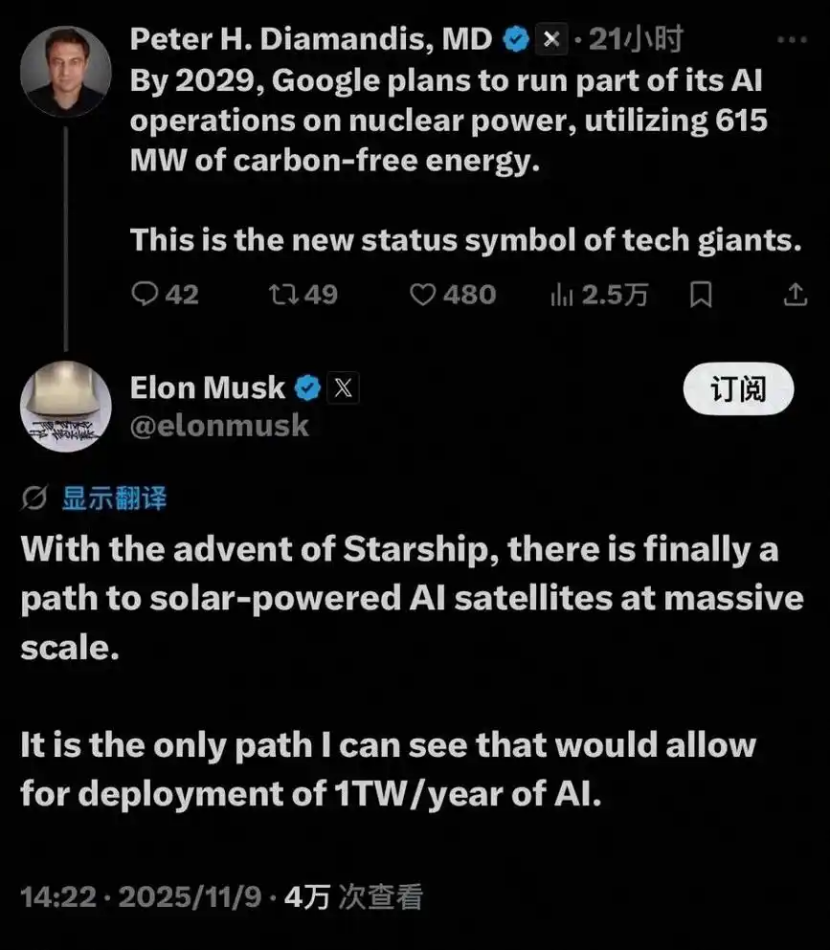
Musk calculates that Earth receives only 1/2 billionth of the sun's total energy output. Meeting AI's exponential energy demands necessitates space expansion.
② Cosmic Vacuum's Natural Edge: One of the most complex and costly systems for ground data centers is cooling, whereas space's near-absolute zero vacuum provides a natural [ultimate radiator].
Simply installing radiators on satellite shaded sides enables efficient heat dissipation via radiation, eliminating the need for ground data centers' HVAC systems, cooling distribution units, and liquid cooling technologies.
Starcloud CEO Philip Johnston estimates that cooling cost savings alone could reduce space data center operational costs to one-tenth of ground facilities.
③ Millisecond Coverage Capability: Space data centers deployed in low-Earth orbit (LEO) significantly reduce latency for globally distributed users.
Space computing power can directly connect users via inter-satellite laser links, delivering computing resources to most population centers within milliseconds.
Starlink satellites have already demonstrated direct cellular network connectivity. Future satellite-to-phone technology maturation will simplify data transmission paths, offering lower-latency, lower-cost user experiences.
This global seamless computing coverage holds revolutionary significance for latency-sensitive applications like autonomous driving, telemedicine, and real-time navigation.
④ In-Orbit Facility Uniqueness: Once deployed, space data centers incur virtually no traditional operational or maintenance costs.
Connected to the Starlink constellation via high-bandwidth laser links, these facilities operate autonomously without ground data centers' expenses like site leasing, security, and human maintenance.
Satellite design lifespans of about five years perfectly align with chip manufacturers' product update cycles (e.g., NVIDIA), achieving ideal hardware iteration synchronization.
Tech Titans Clash: Global Race for Space Computing Dominance
As the frontrunner, SpaceX's plan leverages its existing Starlink satellite network, upgrading to Starlink V3 satellites carrying AI computing payloads.
The new Starlink V3 satellites weigh approximately 1.5 tons with 1 Tbps communication capacity, nearly 70 times that of early satellites, featuring high-speed laser links designed for gigabit internet speeds.
Musk's vision is to construct a distributed orbital computing architecture where tens of thousands of satellites collaborate like a beehive, enabling edge computing, AI inference, and content distribution in LEO.
This decentralized design allows for [graceful degradation], where partial satellite failures do not disrupt overall network operations, offering far higher reliability than monolithic structures.
To support this plan, SpaceX is advancing a $1.5 trillion valuation IPO, with partial proceeds earmarked for space data center development and chip procurement.
Musk also revealed that Tesla, SpaceX, and xAI are accelerating integration, forming a closed-loop ecosystem where Tesla produces chips and data centers, SpaceX handles launch deployment, and xAI provides algorithmic support, creating unique competitive advantages.
Amazon founder Bezos' Blue Origin is SpaceX's primary competitor in this arena.
Blue Origin has assembled a team conducting over a year of R&D on technologies required for orbital AI data centers.
Its [New Glenn] heavy-lift rocket achieved successful first-stage recovery in December 2025, marking key progress in reusable rocket technology.
With a massive payload fairing designed for single-launch deployment of numerous satellites, Bezos predicts that orbital data center costs will undercut ground facilities within 10-20 years, viewing it as a natural extension of the satellite revolution from meteorology and communications to computing and manufacturing.
Leveraging AWS' over 30% global cloud computing market share, Blue Origin aims to deeply integrate space data centers with AI cloud services, building an orbital version of AWS.
Google unveiled its [Moonshot] Project Suncatcher in early November 2025, planning to collaborate with satellite company Planet Labs to build an 81-satellite AI computing cluster in 650km LEO.
These satellites will carry Google's self-developed TPU chips, connected via high-throughput free-space optical communication. The first two test satellites are scheduled for an early 2027 launch.
Google engineers have begun bombarding Trillium-generation TPU chips with 67MeV proton beams to simulate space radiation environments, achieving 1.6Tbps bidirectional transmission rates in labs.
NVIDIA participates deeply through technological empowerment, with its H100 GPU successfully deployed on the Starcloud-1 satellite, validating the feasibility of operating ground-level AI data center hardware in space.
As Starcloud's investor and technical partner, NVIDIA is integrating its advanced chip technologies with space scenarios to drive space AI computing implementation.
Founded in 2024, startup Starcloud emerged as a dark horse in the space data center field.
The company has raised over $20 million in seed funding from Y Combinator, Sequoia Capital, and other renowned funds, successfully launching the Starcloud-1 satellite in November 2025.
This satellite, carrying NVIDIA's H100 GPU, delivers 100 times more computing power than any previous GPU sent to space, achieving historic breakthroughs within just one month.
It successfully invoked Google's Gemma model to send [Hello, Earthlings] greetings from space.
Based on Karpathy's nanoGPT open-source project, it trained models using Shakespeare's complete works and completed inferences, marking humanity's first large language model training in space.
Starcloud's ambitions extend further, planning to carry multiple H100s in its next October 2026 launch, integrating Blackwell platforms and Crusoe's cloud infrastructure modules.
The ultimate goal is to build a 5GW orbital data center equipped with ~4km-wide solar panels and cooling arrays.
Facing global competition in space computing power, China is accelerating its deployment.
In November 2025, Beijing hosted the [Space Data Center Construction Work Promotion Meeting], releasing a clear construction plan proposing to build and operate a centralized large-scale data center system with over gigawatt (GW) power on 700-800km dawn-dusk orbits.
Currently, Beijing has formed the [Space Data Center Innovation Consortium], breaking through a series of key core technologies and completing development of the first-generation test satellite [Chenguang-1], scheduled for launch in late 2025 or early 2026.
Future Vision: The Starry Ocean of Computing Revolution
Despite formidable challenges, the development trend of space data centers is irreversible.
BIS Research data shows that by 2035, the in-orbit data center market will reach $39 billion with a 67.4% compound annual growth rate.
① Space data centers will initially serve specific niche scenarios, with clearer application prospects for inference tasks, while training tasks (due to their massive scale) may take longer to migrate to space.
Starcloud plans to pioneer satellite image-based inference for applications like maritime search and rescue and forest fire localization.
② As technologies mature and costs decline, space data centers will enable ground data relay to space for computing and results transmission back to Earth.
At this stage, space computing power will become an important supplement to ground computing, alleviating energy and cooling pressures on ground data centers.
③ With large-scale satellite production and networked launches, ultra-large-scale space data centers will be constructed through in-orbit docking.
Future core computing power will be provided by space. Musk even envisions grander blueprints: building satellite factories on the Moon, using electromagnetic railguns to accelerate AI satellites to lunar escape velocity for orbital deployment, enabling AI computing power production exceeding 100TW annually, and propelling human civilization toward a [Kardashev Type II Civilization].
Conclusion:
The impact of this computing revolution will far exceed technology itself. It will not only break through AI development's resource bottlenecks but also reshape the global tech competition landscape.
Countries and enterprises with space computing power advantages will dominate future AI industry competition.
Meanwhile, space data center development will drive progress in reusable rockets, satellite manufacturing, space materials, radiation protection, and other related industries, forming new industrial clusters.
References: Hard AI: [SpaceX + Aerial Data Center: Musk's Next Grand Narrative for AI?], NeurIPS: [World's First Space AI Born: H100 Trained in Orbit Praised by Musk], IoT Intelligence: [$1.5 Trillion Valuation! Musk's New Story: Building Space Data Centers with Starlink], Tencent Tech: [World's Richest Man Aims for Space Again: Dream Valued at $10.6 Trillion], Starlink Star: [Feasibility Discussion on Musk's Starlink Space Data Center], NetEase Tech: [Musk Elaborates on Space AI: Lunar Factories, Electromagnetic Railguns, Perpetual Computing Power]
-
![]()
The Allure of 'Acquisition Spree': Li Shufu's Left Turn, Xu Jiayin's Right
-
![]()
Strategic Transformation Yields Results: Phoenix Optics Reports 10.9% YoY Rise in Core Net Profit for H1 2026
-
![]()
Three Key Growth Trajectories Synergize! Crystal-Optech Reports 3.478 Billion Yuan in Revenue for H1 2026
-
![]()
Semi-Annual Report Sparks XPENG Motors Buzz
-
![]()
1.6 Billion Big Order Secured! SeeYA Technology's Revenue Soars by 287.87% in the First Half of the Year
-
![]()
Baidu's Profits Plunge by 68%: Unraveling the Mystery Behind the Numbers
-
![]()
Baidu’s Profits Tumble by 68%! Where Has All the Money Gone?
-
![]()
Hynix’s Taobao Store Shuts Down Abruptly: What Should Customers Do About Warranty Services for Memory Modules?