Alibaba's Monumental C-End Transformation: Wu Jia Steps Up, Qianwen Strikes Out on Its Own, and AI Takes Center Stage
 12/24 2025
 585
585

By Daoge
Source / Node AI View
On December 18, the Qianwen APP made headlines by officially announcing its integration with Gaode Maps. This marked the first instance of deep interoperability between this AI assistant and a major physical super APP.
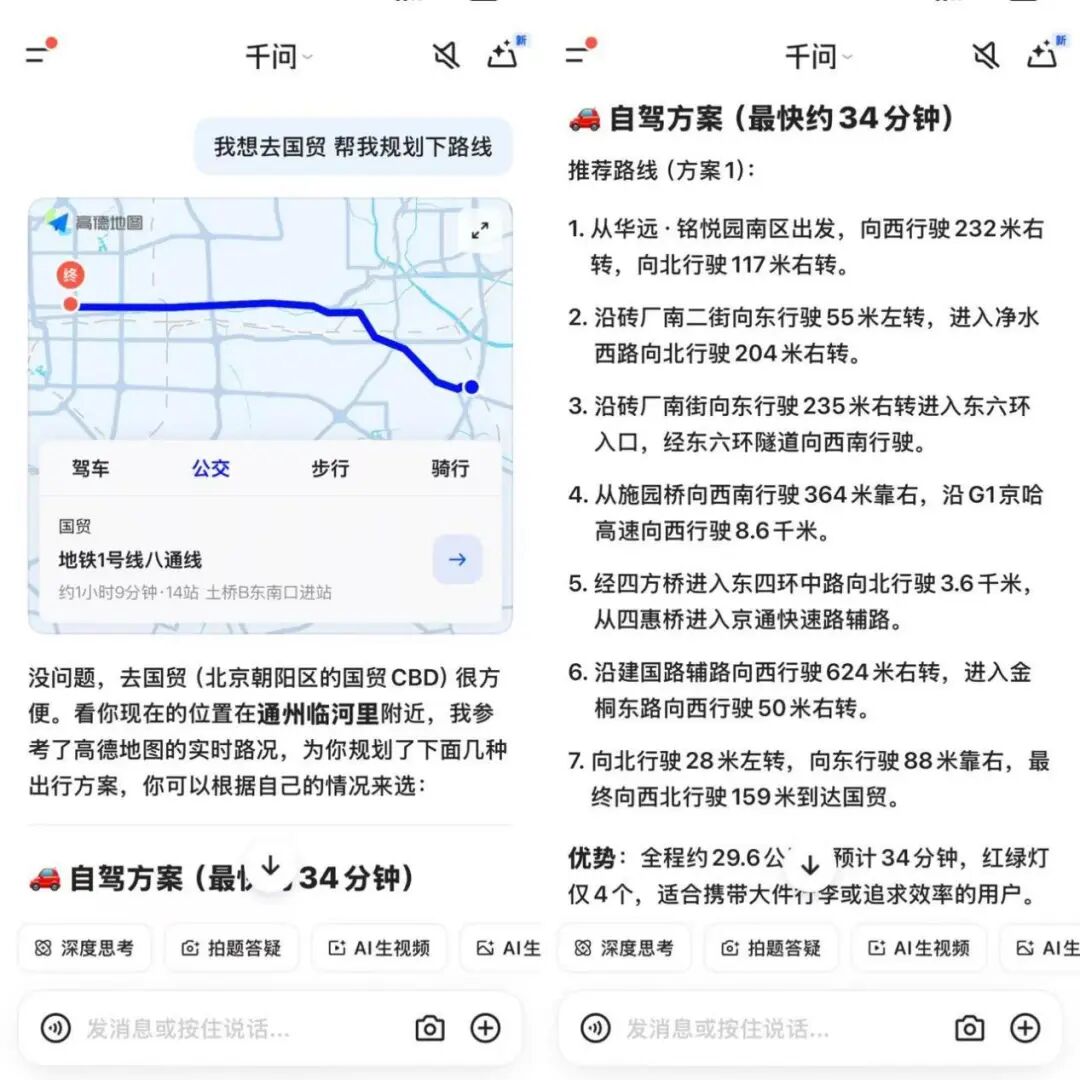
To put it to the test, I asked Qianwen to help plan a route to Beijing Guomao. Almost instantly, a map card popped up in the chatbox. It not only allowed for easy navigation to Gaode but also provided detailed transportation plans, covering subway, taxi/self-driving, and biking options. This innovative feature was rolled out just a month after the Qianwen APP's official launch on November 13.
In that short span of time, Alibaba has shown remarkable agility. On December 9, it announced the formation of the Qianwen Business Group. Its mission? To coordinate various businesses, including the Qianwen APP, Kuake, AI hardware, UC, Shuqi, and more. On the product front, there's been a flurry of activity, with AI PPT, AI writing, AI problem-solving, and the video generation model Wanxiang 2.6 being seamlessly integrated.
Recent reports indicate that Qianwen's monthly active users have soared past the 30 million mark. Unlike the under-the-radar approach during the Kuake era, Alibaba is clearly gearing up to go head-to-head with ByteDance, Tencent, and other tech giants in the race for the AI era's super entrance.
According to DataEye, a third-party agency, among the top native AI apps in the mainland market in November, Tencent Yuanbao led the pack in terms of advertising materials. However, Qianwen demonstrated more significant growth, even overtaking Tencent Yuanbao in daily advertising materials by the end of the month.
When you factor in moves like integrating Taobao Flash Sales and other instant retail businesses, 2025 stands out as a year of major C-end adjustments and the clearest strategy from Alibaba in recent memory.
01 Organizational Overhaul: Wu Jia Takes the Helm, Ending 'Internal Rivalry'

This marks the most sweeping restructuring of Alibaba's C-end AI products in terms of organizational structure in recent times.
The current business blueprint of the Qianwen Business Group can be traced back to 2021. That April, Alibaba established the Intelligent Information Business Group, building on the foundation of the Innovation Business Group. Led by Zhu Shunyan, it focused on intelligent information services. Initially, its core businesses included UC Browser, Kuake, Shuqi Novels, and other products.
In 2022, Alibaba took another bold step by setting up the Intelligent Internet of Things Business Group as a first-tier business department. With Tmall Genie as its flagship brand, it became one of the few core business segments within the group dedicated to C-end hardware.
Then came the global phenomenon of ChatGPT. ByteDance launched Doubao, Baidu introduced Wenxiaoyan, and Tencent unveiled Yuanbao. However, Alibaba's response was somewhat sluggish at this juncture.
This delay stemmed from Alibaba's indecisiveness regarding its C-end AI strategy. It wasn't until the end of 2024 that Alibaba transferred the Tongyi App team, responsible for AI applications, from Alibaba Cloud to the Intelligent Information Business Group. Prior to this move, there was a sense of internal rivalry. Just this March, Kuake was heavily promoted as an All-in-One AI super frame, with Wu Jia still holding the title of Kuake CEO at the time.
The root cause lies in Alibaba's background in cloud and large model technologies. Within the group, the priority for B-end has long outweighed that for C-end. This technology-centric DNA led to perceived strategic confusion externally, even leaving many users puzzled about the differences between Tongyi and Tongyi Qianwen for an extended period.
The establishment of the separate Qianwen C-end Business Group marks a clear turning point. Alibaba has finally decided to let Qianwen take the reins as the vanguard of its AI to C efforts, replacing Kuake.
So, who is Wu Jia, the driving force behind this organizational shift?
As a representative of Alibaba's young management, Wu Jia embodies the 'young and dynamic' spirit. After graduating with a master's degree in Information and Electronic Engineering from Zhejiang University in 2010, he joined Alibaba through campus recruitment as a technical expert at Alibaba Cloud. After nearly seven years of honing his technical skills, he became the general manager of Alibaba's UC Business Unit in 2017, leading the development of the Kuake browser. In the fiercely competitive search market, Kuake quickly carved out a niche with its minimalist, fast, and clean product style. In April 2021, Wu Jia was appointed President of Alibaba's Intelligent Information Business Group.
At the end of 2023, following Alibaba Chairman and CEO Wu Yongming's succession of Dai Shan as CEO of Taobao and Tmall Group, he appointed six young managers born in the 1980s, with Wu Jia being one of them. As Kuake emerged as the pioneer in Alibaba's quest for a future super entrance, this operator, who possesses a deep understanding of both technology and products, officially took up the banner of Alibaba's AI to C efforts.
02 Weaving the Agent Ecosystem Together with Qianwen as the Linchpin
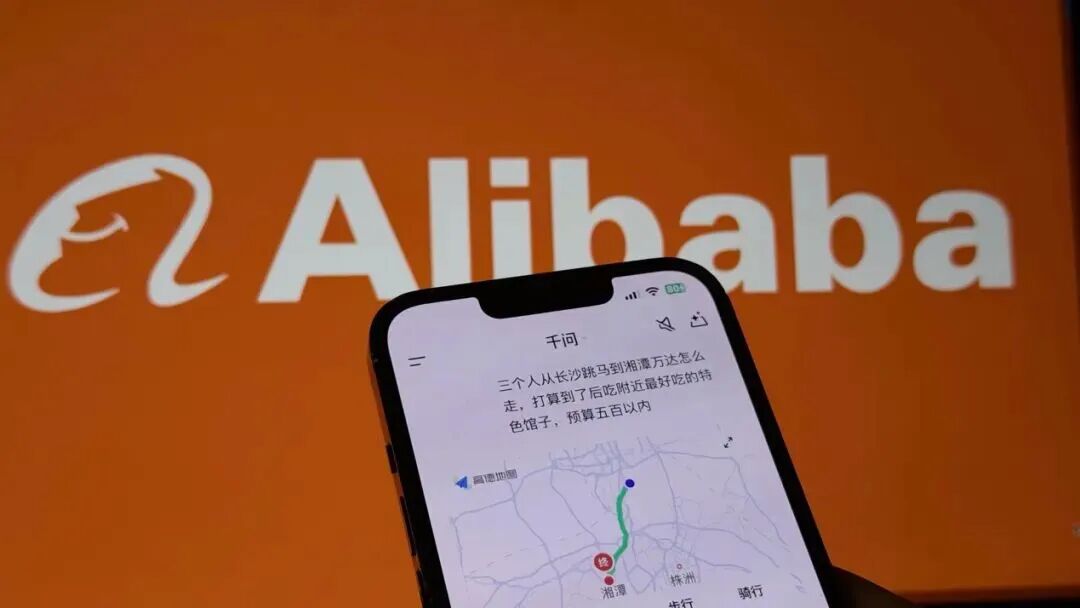
The independence of the Qianwen Business Group isn't just an isolated tactical move; it's a pivotal piece in Alibaba's overall C-end strategy.
Looking back at 2025, the overall integration logic of Alibaba's C-end business this year has become crystal clear, with two main threads: consumption and AI.
One thread involves the evolution from Taobao e-commerce to a broader consumption platform this year.
In May, 'Taobao Flash Sales' officially secured a first-tier entrance on the Taobao App homepage. After some adjustments, it integrated the advantageous resources and capabilities of Taobao and Ele.me. In June, Ele.me and Fliggy were merged into Alibaba's China E-commerce Business Group to solidify its consumption moat.
The other thread revolves around the major reconstruction of AI to C, with Qianwen serving as the linchpin to connect businesses like Kuake, DingTalk, and smart glasses.
In the future, Qianwen won't just be a Q&A tool; it's destined to become a super Agent. Alibaba envisions Qianwen as the precise connector of the scattered businesses within its ecosystem. With Alibaba Cloud providing the technical foundation and the Qwen large model offering technical support, Qianwen, as a super APP, will seamlessly link the sub-businesses of Alibaba's consumption ecosystem.
The integration of Qianwen with Gaode Maps is a tangible demonstration of Alibaba's strategy in action.
Previously, Alibaba mentioned in internal communications that the primary goal of the Qianwen C-end Business Group is to make Qianwen the 'first entrance for users in the AI era.' Looking ahead, Qianwen is set to evolve into an ubiquitous AI assistant, covering scenarios like glasses, PCs, and automobiles. This will enable every ordinary person to harness the power of AI anytime, anywhere, and continuously reap its benefits.
Picture this scenario: In the morning, you ask Qianwen to read you the latest news or directly hand over a document to Qianwen to create a mind map. When you're eager to attend a concert by a certain singer, you can ask Qianwen to help you secure tickets on Damai. For the concert route, you can use Gaode to book a taxi, reserve a hotel room through Fliggy, and even conveniently order your usual latte on Taobao Flash Sales.
Each era of the internet has been characterized by the evolution of super entrances. The internet era had the Baidu search engine, while the mobile internet era boasted super apps like WeChat and Douyin. As the AI industry steps into the Agent era and large models evolve to 'assist human decision-making,' we need a native AI application to step up as a super entrance. Its role isn't merely to 'answer questions' but to integrate a wealth of content and scenarios into a single gateway.
This is also the direction that many tech companies are striving towards.
After announcing its third-quarter financial results this year, Tencent unveiled its strategic blueprint for AI-izing WeChat, stating that 'WeChat will eventually launch an AI agent.' According to Tencent's official announcement, Yao Shunyu, a former researcher at OpenAI, has joined Tencent as Chief Scientist. As per The Information, Tencent is aggressively recruiting AI teams, making unprecedented efforts to increase its voice in the AI main arena.
Doubao, under the ByteDance umbrella, has integrated e-commerce information from Douyin Mall into search results. It has even launched the Doubao phone, enabling consumers to compare prices across multiple e-commerce platforms with just their voice through a system-level agent.
As 2026 draws to a close, the competition for the entrance to the AI era has entered a new phase. The momentum of startups has been eclipsed by the major players. Having recognized the immense potential of C-end chatbots, these tech giants are launching determined assaults on their goals. In the past, Alibaba lacked a super traffic entrance on par with Baidu Search, Douyin, or WeChat. Now, it's hoping to fill this crucial piece of the traffic puzzle.
*The featured image is generated by AI.
-
![]()
CHN Energy Teams Up with Chery, Further Strengthening Green Power Alliance Between Power Generation and Auto Companies
-
![]()
Insights from the Chengdu Motor Show: Overseas Brands Step Up Their Game
-
![]()
Chengdu Auto Show: Some Brands Opt Out, While Others Go All-In with 'Pavilion Dominance'
-
![]()
8.2 Billion Yuan Invested to Launch a New Entity: Dongfeng Peugeot Citroen Automobile Reboots After Years of Inactivity
-
![]()
Why Are Once-Prominent 'Honored Guests' Now Mostly Missing from the Chengdu Motor Show?
-
Kuaigo’s ‘Inverted’ Valuation vs. Kling: Who Has Misjudged the Pricing?
-
![]()
Harbor Weekly Review | Dreame's 200,000-Yuan Smartphone: A Symbolic Gesture with Limited Impact
-
![]()
Harbor Weekly Review | Dreame’s 200,000-Yuan Smartphone: A Symbolic Gesture Lacking Substance