Post-92 Generation from Peking University, Raises 2.1 Billion in Funding
 12/24 2025
 664
664
While Unitree Technology and Zhi Yuan Robotics were vying for a spot on the Spring Festival Gala, someone quietly set a new industry funding record.
GalaxyBot announced the completion of a Series C funding round exceeding $300 million (approximately RMB 2.1 billion).
This $300 million funding round sets a new record for single-round financing in the general-purpose intelligent robotics sector. To date, GalaxyBot's cumulative funding has approached $800 million, with its latest valuation rising to $3 billion, making it the highest-valued general-purpose intelligent robotics startup in China.
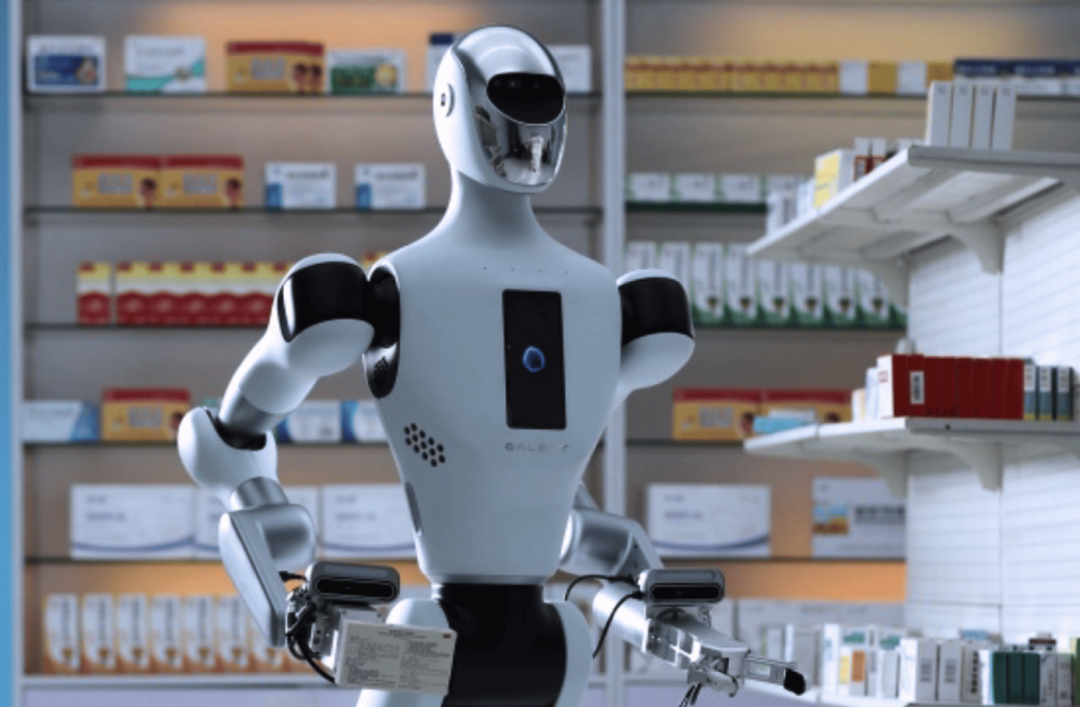
Founded just over two years ago, GalaxyBot has so far released only one product—the wheeled dual-arm robot Galbot G1. Galbot G1 lacks bipedal locomotion, does not pursue full-scenario coverage, and does not emphasize 'human-like intelligence.' Instead, it performs specific tasks: picking medications in smart pharmacies and repeatedly transporting materials in factories operated by CATL and Toyota.
GalaxyBot has chosen a less glamorous but immediately revenue-generating path—using robots to replace repetitive labor in B-end scenarios.
- 01 -
GalaxyBot was co-founded by Wang He, an assistant professor and doctoral supervisor at Peking University's Center for Frontier Computing Research, along with another co-founder, Yao Tengzhou.
Born in 1992, Wang He spent six years at Beijing National Day School for his middle and high school education. He was admitted to Tsinghua University through a physics competition, where he 'primarily researched semiconductor physics devices' and earned a Bachelor of Engineering degree from the Department of Microelectronics and Nanoelectronics in 2014.
After graduating from Tsinghua, Wang He pursued further studies at Stanford University in the United States. He was mentored by Professor Leonidas J. Guibas, a renowned algorithm expert and director of the Computer Science Department's Geometric Computing Group. Professor Guibas has made significant contributions in computational geometry, geometric modeling, computer graphics, computer vision, sensor networks, robotics, and discrete algorithms.
During his doctoral studies, Wang He focused on 'physical interaction' as his research direction, studying object perception for physical interactions. 'He dedicated more time and effort to 3D vision research, aiming to equip robots with generalized object perception capabilities, enabling them to accurately recognize and manipulate unfamiliar (unlabeled) objects.' The intelligence of physical interaction is today's hot topic of embodied AI.
In 2021, Wang He earned his Ph.D. from Stanford University's Department of Electrical Engineering and returned to Peking University as an assistant professor and doctoral supervisor at the Center for Frontier Computing Research. He also serves as the director of the Embodied AI Research Center at the Beijing Academy of Artificial Intelligence (BAAI).
Yao Tengzhou graduated from Beihang University, where he was mentored by Professor Wang Tianmiao, a renowned robotics expert. Before co-founding the company with Wang He, Yao Tengzhou held key positions at ABB Group's Shanghai Robot R&D Center and ROOBO's Robot R&D Department, where he was responsible for developing multiple series of robot products, including Pudding and Jelly.
In 2023, Google released the PaLM-E model, which integrated language, vision, and robotic manipulation into a single model framework, enabling robots to understand their environment and decide how to act rather than merely being programmed to perform actions. This marked the true entry of large models into the robotics field.
Wang He noticed this shift. Previously, the boundaries of the robotics industry were clear: industrial robotic arms handled fixed processes, while service robots performed a limited number of preset functions. However, in real-world scenarios, such clear divisions did not exist. Warehouses, stores, and factories required robots capable of following instructions, perceiving their environment, and completing tasks, rather than devices limited to a single function.
In Wang He's view, once large models compensated for understanding capabilities, the feasibility of general-purpose robots ceased to be merely a technical discussion and became a matter of time. In 2023, Wang He and Yao Tengzhou founded GalaxyBot.
In June 2024, GalaxyBot completed a $100 million angel round funding, setting a record for the largest angel round in the sector that year, and officially unveiled its product, the wheeled dual-arm robot Galbot G1. Collaborating with Meituan, Galbot G1 was trialed in Meituan's 24-hour smart pharmacies, where it performed tasks such as restocking and retrieving medications.
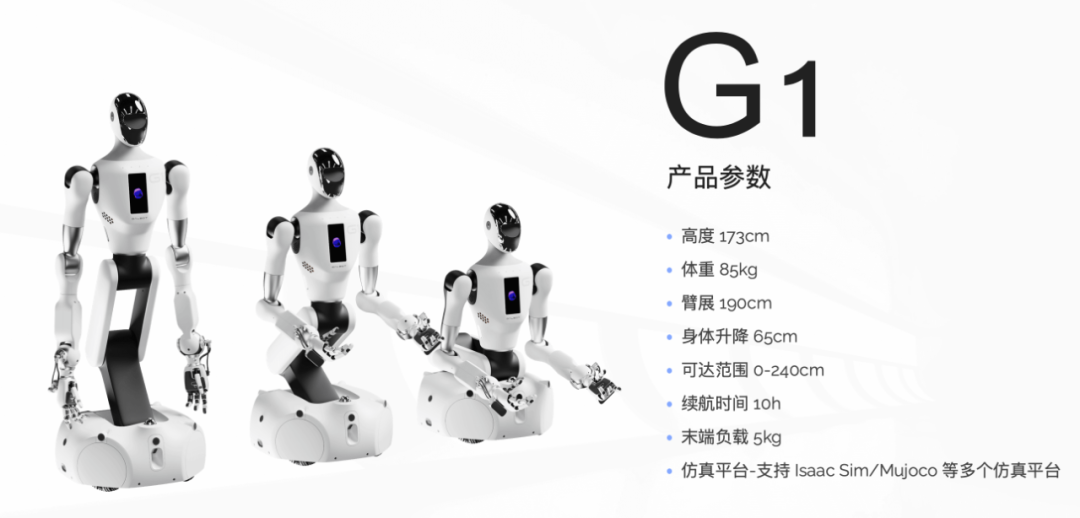
Wheeled Dual-Arm Robot Galbot G1
Today, GalaxyBot has established R&D centers in Beijing, Shenzhen, Suzhou, and Hong Kong, and has formed joint laboratories with institutions such as Peking University.
- 02 -
The robotics market is already substantial.
It is projected that by 2025, China's general-purpose intelligent robotics market will reach $32 billion. Domestic brands collectively hold approximately 30% of the market share, with leading positions primarily occupied by companies such as Estun and SIASUN. Meanwhile, the international 'Big Four' robotics companies still hold over half of the market.
Globally, the potential is even greater. McKinsey's 'Global Robotics Industry Outlook 2050' predicts that by 2050, the global general-purpose intelligent robotics market could exceed $1 trillion, roughly one-third of the current global automotive market size.
However, significant obstacles remain between current reality and these projections. On one hand, the integration of general artificial intelligence with mechanical structures is still inadequate, limiting robots' operational precision in complex environments. On the other hand, reliance on imported core components keeps costs high. Additionally, varying demands across industries and scenarios increase the difficulty of developing a 'one-size-fits-all' solution.
Against this backdrop, differentiation among leading companies has begun to emerge. Within China's first tier of embodied AI companies, GalaxyBot, Unitree Technology, and Zhi Yuan Robotics are all leading contenders. However, they differ in their understanding of the 'core capabilities of general-purpose robots' and have pursued distinct technological paths.
GalaxyBot has chosen to be driven by embodied large models, with its product form being the wheeled dual-arm robot. It focuses on B-end scenarios such as smart pharmacies and industrial manufacturing, emphasizing replicable and scalable industry solutions.
Unitree Technology excels in hardware self-research and motion control, specializing in bipedal humanoid robots and robotic dogs. It expands its market through cost-effectiveness and mass production capabilities, with primary customers in universities, research institutions, and industrial inspection scenarios.
Zhi Yuan Robotics takes a different approach: full-stack self-research and full-scenario coverage. Its products span industrial, commercial service, and consumer markets, developing hardware while building an ecosystem, aiming to create synergies through multi-scenario adaptation.
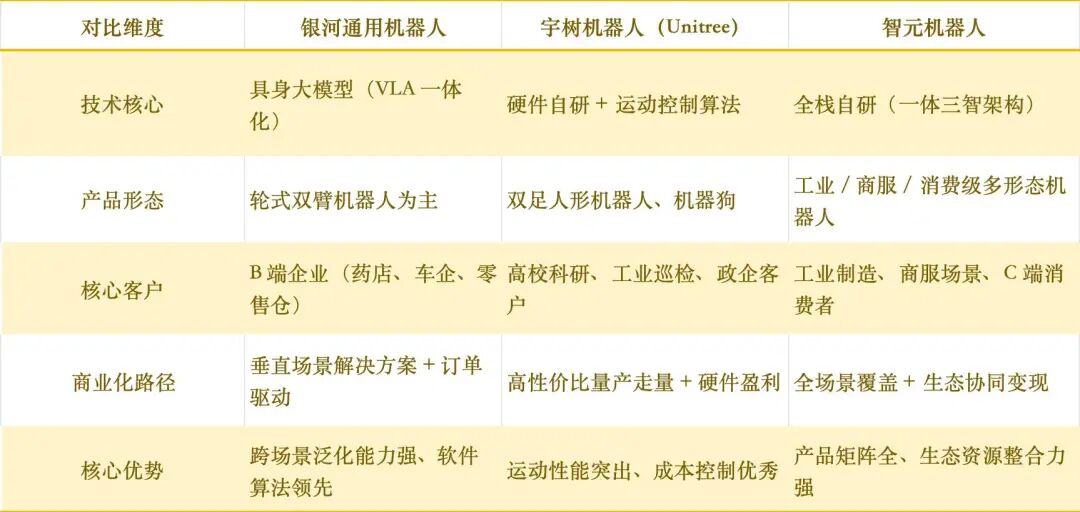
A Comparative Overview of Core Differences Among GalaxyBot, Unitree Robotics, and Zhi Yuan Robotics
One often overlooked detail is that despite Unitree and Zhi Yuan Robotics having higher public recognition, GalaxyBot has advanced more rapidly in terms of capital progress.
Within just a year and a half of its founding, GalaxyBot has raised over RMB 4 billion in funding, with its latest valuation reaching $3 billion. This surpasses Unitree's valuation of approximately RMB 12 billion and Zhi Yuan's valuation of approximately RMB 15 billion, making GalaxyBot the highest-valued embodied AI company in China. During this period, GalaxyBot has released only one robotic product—Galbot.
The tasks performed by this robot are also highly specialized: either picking medications in unmanned pharmacies or performing material handling operations in factories operated by CATL and Toyota. It has not expanded into multiple forms or simultaneously covered multiple scenarios.
This comparison raises a discussable question: In the early stages of general-purpose intelligent robotics, is focusing on a few vertically integrable scenarios more likely to succeed in commercialization?
- 03 -
GalaxyBot has not ventured into household or consumer scenarios. Instead, it has concentrated all its efforts on pharmacies, warehouses, and factories. Additionally, the company has so far developed only one robotic product, with several considerations in mind.
The household scenario is too challenging for current-stage robots.
Every household is unique, with different layouts, furniture sizes, and arrangements. Human behavior is random, and instructions are non-standard. More importantly, ordinary users have almost zero tolerance for failure. A single lag or misjudgment could render the robot 'unusable.' This means that the household scenario demands higher levels of general capability from robots than industrial environments.
In contrast, pharmacies, warehouses, and factories operate by 'clear rules.'
These settings involve numerous actions and complex processes. However, the spatial structure is stable, the rules are clear, and the objectives are well-defined. For robots, this provides a more forgiving starting point. GalaxyBot can continuously obtain real, reusable data in these scenarios and establish unified task standards. The more robots are deployed, the faster the models can be refined; the more clients there are, the more stable the system's performance becomes in similar environments. This positive feedback loop is difficult to achieve in household scenarios.
Commercial logic also drives the company toward similar choices.
Enterprise clients are not concerned with whether a robot 'resembles a human' but rather whether it can perform tasks and reduce costs. In factories or warehouses, robots can be seamlessly integrated into workflows. Even if issues arise, human intervention is possible. This gives GalaxyBot room to compensate for model limitations through engineering and system design, rather than relying solely on algorithmic performance.
Focusing on a single product also reduces cost pressures. In the early stages of embodied AI, developing multiple products often leads to greater complications. Different hardware structures and control logics result in entirely different data distributions, which are challenging for general models to digest.
GalaxyBot has chosen to use the same 'body' to repeatedly perform similar tasks, with a single goal: to keep the data cleaner and enable the model to learn faster. For instance, in CATL's factories, the robot performs the same skylight transportation task daily. Every action generates training data. Within three months, the task's success rate improved from 85% to 98%.
Only when the system operates smoothly in the real world can general capabilities be extended to more complex scenarios.
This article does not constitute any investment advice.
-
![]()
CHN Energy Teams Up with Chery, Further Strengthening Green Power Alliance Between Power Generation and Auto Companies
-
![]()
Insights from the Chengdu Motor Show: Overseas Brands Step Up Their Game
-
![]()
Chengdu Auto Show: Some Brands Opt Out, While Others Go All-In with 'Pavilion Dominance'
-
![]()
8.2 Billion Yuan Invested to Launch a New Entity: Dongfeng Peugeot Citroen Automobile Reboots After Years of Inactivity
-
![]()
Why Are Once-Prominent 'Honored Guests' Now Mostly Missing from the Chengdu Motor Show?
-
Kuaigo’s ‘Inverted’ Valuation vs. Kling: Who Has Misjudged the Pricing?
-
![]()
Harbor Weekly Review | Dreame's 200,000-Yuan Smartphone: A Symbolic Gesture with Limited Impact
-
![]()
Harbor Weekly Review | Dreame’s 200,000-Yuan Smartphone: A Symbolic Gesture Lacking Substance