AI's Crossroads: Hype to the Left, Substance to the Right
 12/24 2025
 605
605
Recently, there's been a recurring narrative: while Kimi boasts formidable technical prowess, its APP monthly active users (MAUs) pale in comparison to those of tech giants with built-in distribution channels and deep financial reserves.
However, the reality is that Kimi isn't fixated on competing in the APP traffic arms race.
Traffic Isn't the Be-All and End-All
Obsessing over APP MAUs reflects a mindset trapped in the internet era, where traditional metrics like daily active users (DAUs) and download counts reigned supreme. In the AI age, the benchmark has shifted from "user breadth" to "value depth."
According to QuantumBit Think Tank data, Kimi led the industry with an average session duration of approximately 8.5 minutes in November. Its web version also witnessed a 48.6% month-on-month increase in traffic.
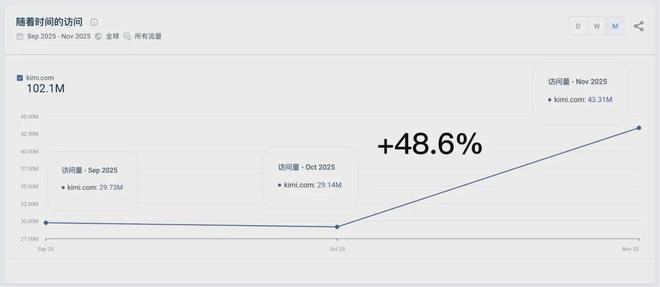
This indicates that Kimi users are genuinely engaging with the platform. Rather than merely posing a question and exiting the app, they spend nearly ten minutes completing specific tasks.
On Zhihu, educational researchers have attested to Kimi's efficacy, whether guiding students in creative endeavors or conducting their own research and lesson planning.
"We had students utilize Kimi in tandem with Cherry Studio for creative projects. Within weeks, they secured contracts with platforms. Given a setting document spanning tens of thousands of words, Kimi could seamlessly continue the narrative while preserving consistent character traits. Now, these students can churn out tens of thousands of words daily with Kimi's aid, staying focused during class instead of fiddling with their phones, and consistently earning Perfect Attendance Awards (full attendance bonuses) for extra income."
This educational researcher also highlighted that by leveraging Kimi's robust understanding and execution of complex prompts, teachers in their research group could swiftly create customized teaching assistance agents by merely providing prompt rules and examples, thereby boosting research efficiency.
Other professionals have shared their experiences using Kimi to dissect financial reports of listed companies. It can rapidly distill a company's core operational conditions and financial data. When encountering reports in English or traditional Chinese, it can simultaneously furnish simplified Chinese translations. For industry-specific jargon, there's no need to toggle between platforms for searches—Kimi can provide direct answers.
In truth, Kimi isn't incapable of driving traffic; it has consciously opted out of the APP traffic frenzy.
Behind this decision lies a choice between two fundamentally divergent development paths:
One path is entertainment-centric, attracting a broad user base for casual banter and joke-sharing. While it swiftly garners new users, the lack of profound utility often results in low user retention.
The other path zeroes in on professional scenarios, delving deeply into high-value tasks such as in-depth research, data analysis, and long-form content processing. Its core users encompass students, researchers, content creators, and professionals seeking productivity enhancements. These users return repeatedly because their objective is to accomplish tangible work.
This "productivity moat" is something that mere traffic numbers cannot purchase—it must be constructed brick by brick through technological innovation.
Silicon Valley Titans Vouch for It
The bedrock of Kimi's approach lies in its hardcore innovation at the model level.
Kimi President Zhang Yutong recently remarked in a speech at Tsinghua University that when Kimi embarked on its journey, the industry was rife with skepticism: "How can you compete with tech giants without a million GPUs?" The prevailing belief was that stronger models necessitated exorbitant spending on computing power.
However, Kimi didn't tread this path. When training their trillion-parameter K2 model, they employed the Muon second-order optimizer—a tool previously deemed too risky for models of this magnitude—achieving at least a twofold increase in token efficiency.
In layman's terms, the same amount of training data yields greater intelligence.
Zhang Yutong stated, "We're not claiming to have the world's best model yet, but that's our next pivotal strategic goal. What we've already accomplished is delivering the highest intelligence value per unit of computing power."
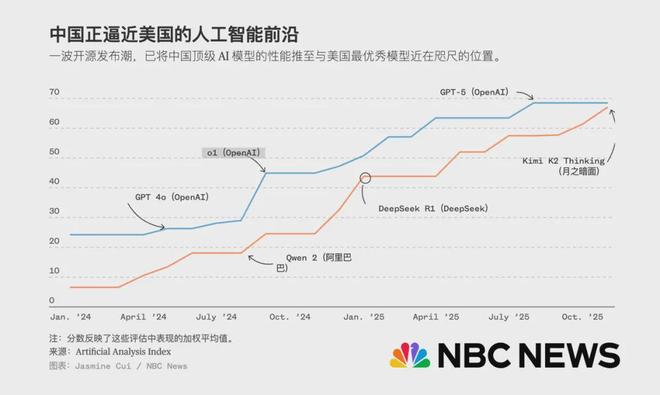
Market recognition serves as the ultimate litmus test for technology. The K2 reasoning model, launched in November this year, performed on par with the world's top models in multiple benchmark tests, including "Humanity's Final Exam." In Stanford University's HELM comprehensive evaluation, the K2 model achieved the highest score among non-reasoning models.
Currently, the K2 reasoning model ranks first among open-source models globally in assessments by third-party blind-testing platform LMArena and AI analysis firm Artificial Analysis.
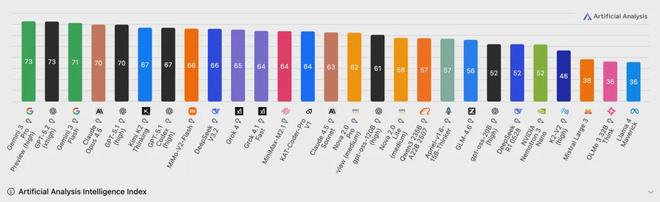
This solid technological track record has also garnered strong support from top global users.
The founder of OpenRouter, the world's largest AI model platform, relies on it as his go-to model;
Marc Andreessen, founder of a16z and dubbed the "Godfather of Silicon Valley Venture Capital," publicly stated that China boasts many outstanding AI models, particularly DeepSeek, Qwen, and Kimi.

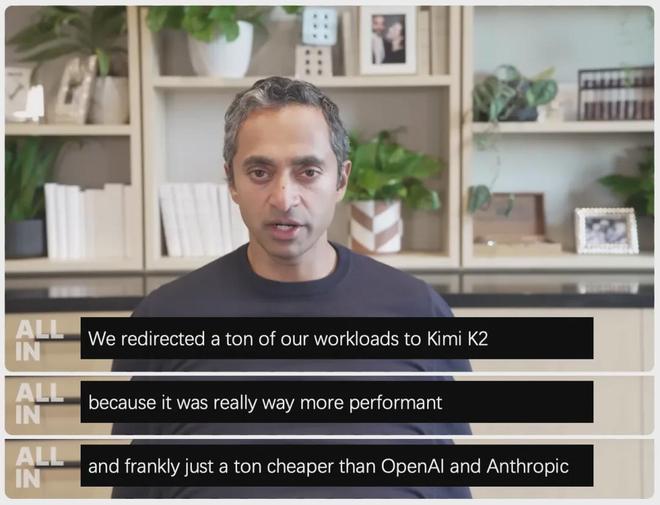
Nobel laureate in Chemistry Michael Levitt "uses Kimi daily for research," while renowned Silicon Valley investor Chamath has shifted a significant portion of his workload to Kimi K2 due to its superior performance and lower costs.
Additionally, Microsoft, Google, and Amazon's cloud platforms have all integrated Kimi. Perplexity, the world's largest AI search application valued at over $100 billion, has also chosen Kimi as its sole Chinese model integration.
These industry leaders don't fret over metrics like DAUs or MAUs; they solely care whether a model can solve problems and reduce costs. Kimi has clearly passed their rigorous commercial tests.
AI's True Value Lies in Productivity
In the AI industry, identifying the right value proposition enables companies to thrive without chasing traffic. Instead, we should envision what a healthy AI ecosystem entails:
It requires both popular products like Doubao and Yuanbao that cater to a broad audience and deep products like Kimi that focus on professional tasks. Together, they propel industry progress.
We must also acknowledge the scarcity and strategic significance of the path represented by Kimi.
For nations, having companies that can compete with global tech giants in foundational AI technologies and earn international acclaim is crucial for reducing technological dependencies and securing industrial influence.
For the industry, companies like Deepseek and Kimi demonstrate that through relentless innovation in engineering and algorithms, they can carve out a niche amidst competition from tech behemoths. This provides a viable path for entrepreneurs focused on hardcore technology.
For users, it ensures the availability of reliable tools capable of solving complex problems, preventing the entire industry from descending into low-level entertainment and homogenization.
Therefore, we must truly adopt evaluation criteria suited for the AI era instead of clinging to outdated traffic-based metrics. Beyond traffic numbers, we should assess whether a company possesses genuine capabilities, what core problems it can solve, and how far it can go in contributing to the industry's long-term development.
AI isn't a tool for inflating traffic numbers but an amplifier of human capabilities and a key to exploring intelligent possibilities. Pushing the boundaries of intelligence matters far more than obsessing over traffic.
•END•
-
![]()
CHN Energy Teams Up with Chery, Further Strengthening Green Power Alliance Between Power Generation and Auto Companies
-
![]()
Insights from the Chengdu Motor Show: Overseas Brands Step Up Their Game
-
![]()
Chengdu Auto Show: Some Brands Opt Out, While Others Go All-In with 'Pavilion Dominance'
-
![]()
8.2 Billion Yuan Invested to Launch a New Entity: Dongfeng Peugeot Citroen Automobile Reboots After Years of Inactivity
-
![]()
Why Are Once-Prominent 'Honored Guests' Now Mostly Missing from the Chengdu Motor Show?
-
Kuaigo’s ‘Inverted’ Valuation vs. Kling: Who Has Misjudged the Pricing?
-
![]()
Harbor Weekly Review | Dreame's 200,000-Yuan Smartphone: A Symbolic Gesture with Limited Impact
-
![]()
Harbor Weekly Review | Dreame’s 200,000-Yuan Smartphone: A Symbolic Gesture Lacking Substance