The World's First Remote-Free Robotic Dog Goes Viral Upon Launch: Is the Era of Consumer-Grade Embodied AI Here?
 12/29 2025
 576
576
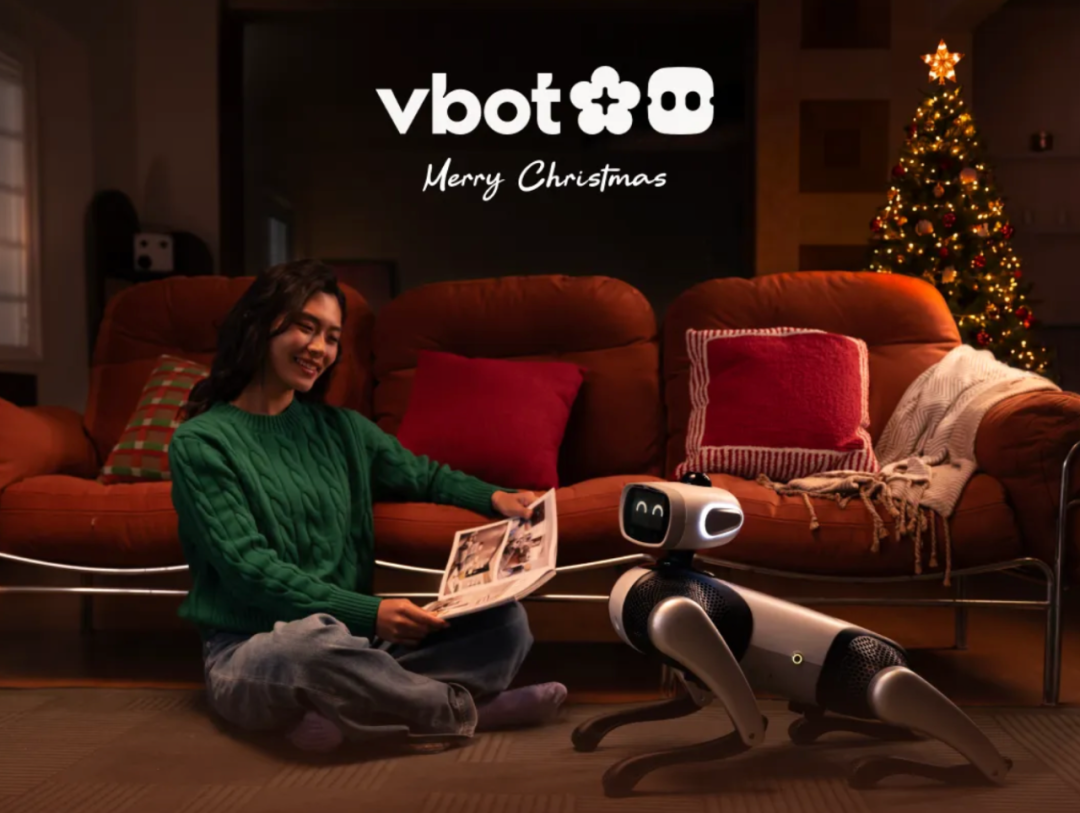
The era of consumer-grade embodied AI has been unlocked.
December 25, 2025, marks not only Christmas but also the first anniversary of Vbot Power (hereinafter referred to as 'Vbot'). In Zhao Zhelun's 'A Letter to Vbot's Founding Users' released on that day, the co-founder and product president of Vbot mentioned that exactly one year ago today, they set a modest goal: to create a robot for users' living spaces within a year.
His confidence stems from the official launch of the Vbot super-powered robotic dog on December 23. They have successfully marketed a Vbot robotic dog capable of autonomous navigation, understanding human commands, and operating without a remote control, all priced under RMB 10,000, with a founding member price of RMB 9,988.
A Game-Changer in the Consumer-Grade Embodied AI Market
This is a game-changer in the consumer-grade market: within just 5 hours of launch, it soared to the Top 7 on Weibo's trending list. Within 52 minutes of going live, orders surpassed 1,000 units, with first-day sales exceeding RMB 10 million, setting a new record for order value in the robotics industry. It also stands as a rare case where a new brand's inaugural product achieved large-scale sales.
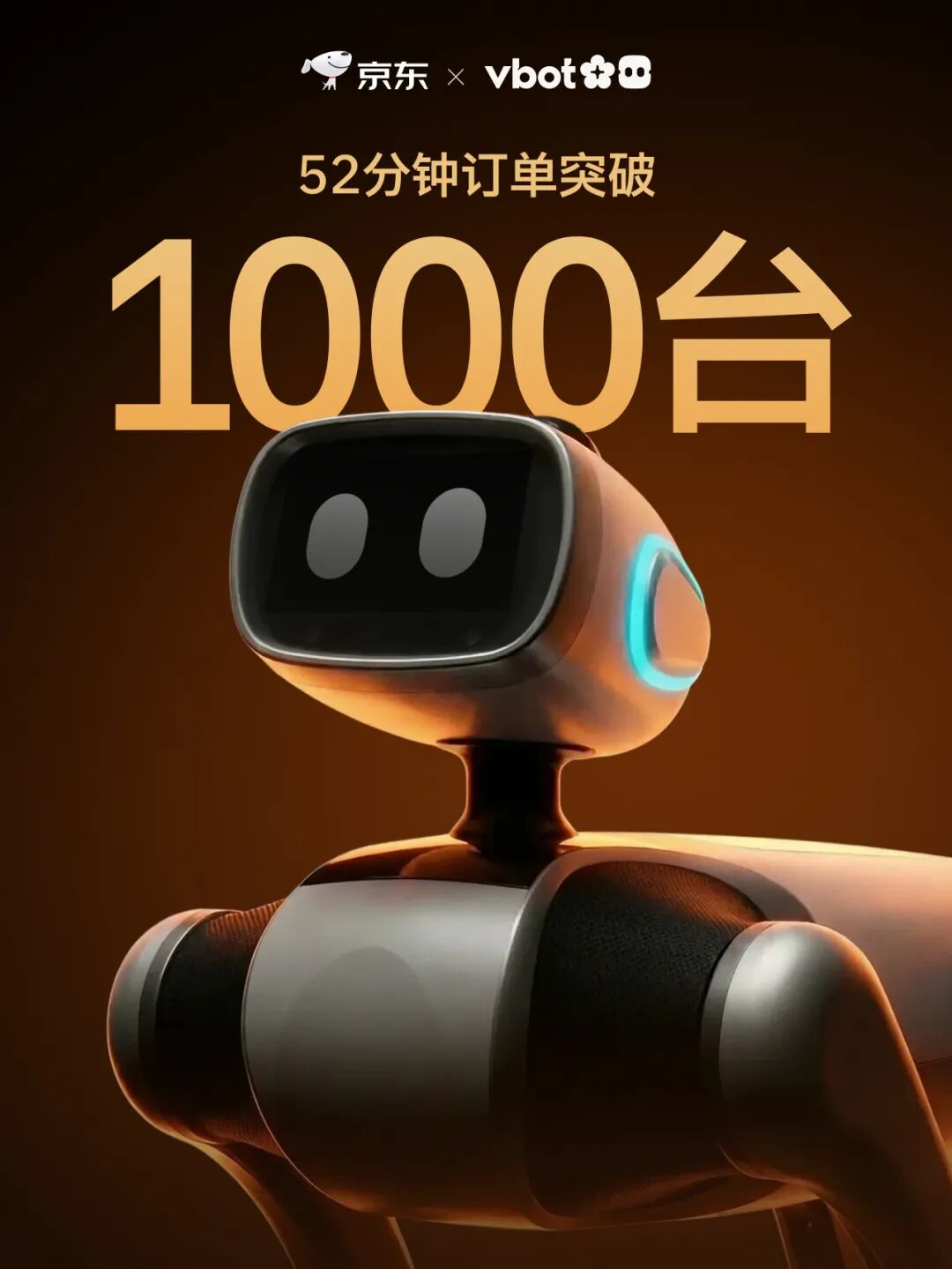 Orders surpassed 1,000 units in 52 minutes | Image source: Vbot Power
Yu Kai, founder and CEO of Horizon Robotics, secured the 001 order immediately upon the pre-sale launch. Wang Cong, CEO of Digua Robotics, also shared his order, confirming that Vbot is equipped with their self-developed S100P chip.
 User 001 of Vbot's super-powered robotic dog: Yu Kai, founder and CEO of Horizon Robotics | Image source: Vbot Power
As the world's first remote-free intelligent robotic dog, it can autonomously perform various tasks such as full-scene escorting, carrying objects, and follow-shooting. The overwhelming response to its debut exceeded the Vbot team's expectations. Zhao Zhelun said this has brought immense confidence and motivation to the team.
In my view, this is motivation, but also pressure. Vbot needs to respond swiftly to capitalize on this wave of popularity and translate it into long-term growth.
Zhao Zhelun and his team recognize this. In his letter, he pledged to actively upgrade the user service team, ensuring contact with every pre-order user within a week to establish one-on-one service channels. Additionally, from January to March, 500 Vbot super-powered robotic dogs will be provided for public testing free of charge.
How Vbot Brings Remote-Free Robotic Dogs into Daily Life
For a long time, the consumer robotics industry has been stagnant. Many products are confined to research labs, performance stages, and industrial settings, let alone mass production for consumer use. Only a handful of tech enthusiasts and early adopters have brought them into their homes and daily lives.
Yet, they all end up with the same fate: after a couple of days, the novelty wears off, and they become oversized remote-controlled toys or simply gather dust. Essentially, they remain 'advanced remote-controlled vehicles' rather than true life companions.
As Dr. Yu Yinan, founder and CEO of Vbot Power, puts it, 'Robots can improve life, but first, they must enter our lives, allowing people to naturally coexist with them in living spaces.' The issues are clear: insufficient intelligence, high costs, poor interaction experiences, and neglect of user pain points. These problems are fatal in the consumer market, preventing robotic dogs from entering households like robotic vacuum cleaners.
 Vbot's debut live stream popularity | Image source: Vbot Power
Geek Park commented that the core issue might lie in the misalignment of 'intelligence.' The industry has long been preoccupied with enhancing motion capabilities while overlooking users' true needs: they want a partner that understands commands and makes autonomous decisions, not a tool requiring a controller. As long as a remote is needed, it can never truly be 'embodied AI.'
Zhao Zhelun stated that intelligent robots truly entering living spaces must simultaneously possess stable and reliable physical capabilities, spatial understanding of real environments, and agent capabilities driven by user needs.
In other words, achieving a breakthrough in 'consumer-grade embodied AI' is impossible with traditional robotic paradigms.
To address this, Vbot has systematically reconstructed robotic intelligent architecture by integrating three core levels: 'physical intelligence,' 'spatial intelligence,' and 'agent intelligence,' filling the gaps of 'spatial cognition' and 'professional skills' found in most robots on the market, making it possible for robots to enter daily life.
Physical intelligence acts as the robotic dog's 'cerebellum.' Focusing on the core scenario of 'home use,' Vbot has enhanced its all-terrain mobility, battery life, and structural safety, enabling it to go anywhere humans can without range anxiety.
Spatial intelligence serves as the robotic dog's 'brain.' Vbot has invested heavily in sensor hardware, computing power, and reasoning capabilities, allowing it to perceive and understand its environment and make intelligent decisions such as path selection, target recognition, obstacle avoidance, and interaction. This is the fundamental difference from traditional remote-controlled robotic dogs, truly 'discarding' the remote and evolving into an embodied AI product in the home.
Agent intelligence forms the top layer of the three-tier architecture and is key to Vbot becoming a 'consumer-grade embodied AI' product. It enables the robotic dog to understand tasks and execute complex instructions. By integrating environmental judgment with semantic understanding, it responds autonomously while moving, transforming the robotic dog into an 'intelligent life companion.'
 Reached No. 7 on Weibo's tech trending list within 5 hours of launch | Image source: Vbot Power
In reality, these three capabilities have been pursued by enterprises and research institutions before, but often in isolation.
The founding team of Vbot, hailing from Horizon Robotics and Li Auto, has led the mass production of L4 autonomous driving technology and products over the past decade. They have transplanted the complete L4 autonomous driving chain—perception, decision-making, and control—onto quadruped robots, addressing the traditional robotic shortcoming (Chinese term meaning 'weakness') of 'strong body, weak mind.'
Vbot Ushers in the Era of Consumer-Grade Embodied AI
In terms of pricing, Vbot has, for the first time, brought the price of consumer-grade embodied AI robots below RMB 10,000. Prior to Vbot, owning a robotic dog with powerful computing capabilities, advanced LiDAR, deep vision, long battery life, and strong performance could cost tens of thousands of yuan.
More imaginatively, Vbot has opened up the ecosystem for consumer-grade embodied AI. At the agent intelligence level, Vbot has equipped its super-powered robotic dog with a versatile expansion backplate featuring multiple interfaces, including direct connections to Type-C, CAN communication, Ethernet, and 24V DC power supply. It can also be paired with robotic arms, cargo baskets, camera selfie sticks, and trailing carts.
In other words, the Vbot super-powered robotic dog is also an embodied AI platform that can become smarter through OTA large models, function as a mobile photography platform when connected to DJI products, or meet home or outdoor camping needs with external robotic arms. This not only extends functional boundaries but also continuously improves the embodied AI ecosystem, enabling multi-scenario companionship.
During this period, Vbot has successfully completed the full loop from product definition (remote-free), pricing strategy (RMB 10,000 range), to real-world household scenario delivery (pre-sale equals mass production). It has thus become an officially defined intelligent robot capable of truly entering living spaces, serving as your outdoor companion, full-time butler, security guard, and child-minding partner.
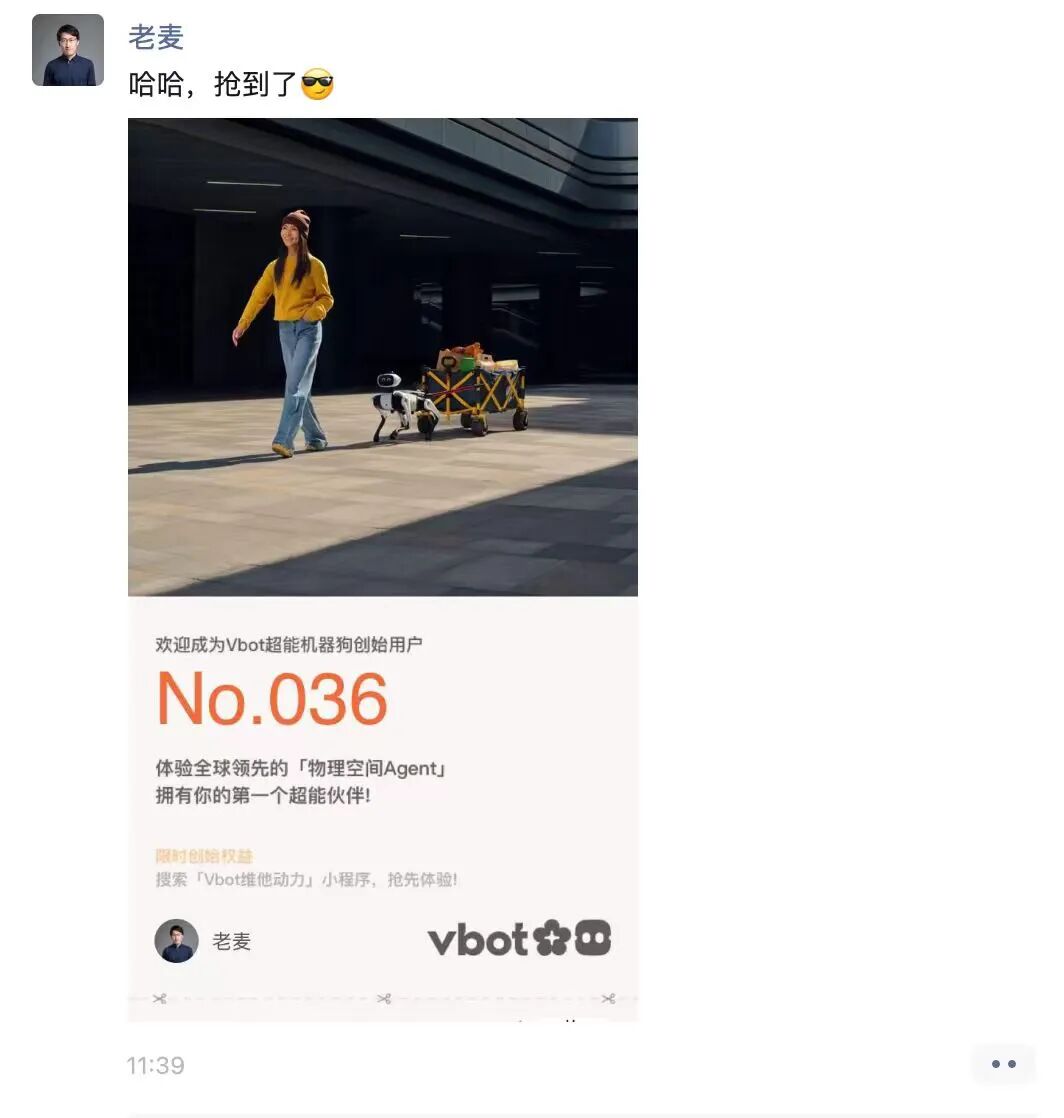 Vbot founding user's order | Image source: Vbot Power
Steve Jobs once said during the launch of the original iPhone that every so often, a revolutionary product emerges.
Vbot now stands at such a pivotal moment: it is not about creating 'another embodied robot' but about opening a new frontier in the path of consumer-grade embodied AI robots. As autonomous, follow-me intelligent robotic dogs from sci-fi movies become reality, it signifies that embodied AI is about to enter the consumer-grade era for households and individuals.
Of course, as Zhao Zhelun previously mentioned in an interview with Sohu Technology, the consumer robotics industry is still in its infancy, and China's robotics supply chain remains immature. Robot manufacturing is far from reaching a 'Ford moment,' let alone a 'Tesla moment.'
Vbot and other players in the field are in a race. However, one thing is certain: 'consumer-grade embodied AI' is not just a concept in a PowerPoint presentation but a real market with immense demand.
Vbot must truly create a partner that integrates into daily life and solves specific problems to solidify its position as the 'first brand in consumer embodied AI.' As some have commented, if Vbot can overcome this threshold, it has the potential to become the first embodied AI enterprise to enter the trillion-yuan consumer market.
Before that, Vbot still faces many challenges.
References: Geek Park, 'Vbot Unleashes Embodied AI Era with a Robotic Dog'
Jimu News, 'Vbot Power Launches Remote-Free Robotic Dog, Unlocking New Scenarios for Consumer-Grade Embodied AI'
-
![]()
Autohome Faces a Shrinking Window of Opportunity
-
![]()
Even a Titan Like Musk Has Faced Setbacks in Fulfilling Promises
-
![]()
AI Office: The End of the Racing Era, Context Becomes the Key to Success
-
![]()
Domestic Vehicle Chassis Revolution ②: The Steering Wheel Remains, But Mechanical Connections in the Steering System Are Decreasing
-
![]()
Exploring MiniMax Design: Can Video Editing Be as Simple as Speaking?
-
![]()
Why Can SenseTime Achieve Profitability While CloudWalk Still Faces Challenges, Despite Both Adopting Large Models?
-
![]()
Domestic Car Chassis Revolution Part 3: Suspension Systems Transform Vehicle Posture, from Vibration Absorption to Active Force
-
![]()
Hainan is Going on a Crazy Satellite-Building Spree