Behind the Failure to Reach the 1 Billion User Goal: How OpenAI's Organizational and Product Issues Harm ChatGPT? | T Insights
 12/29 2025
 587
587

ChatGPT Hits the Wall: 'Technological Progress ≠ User Experience'.
Over the past year, some OpenAI employees have noticed a concerning trend in user reactions to ChatGPT improvements.
In previous years, whenever significant upgrades were made to the AI driving ChatGPT, user numbers surged—because the experience improved.
However, this year, despite attracting more users, enhancements to the underlying AI model’s intelligence and capabilities seem to have had little impact on most users.
This trend has left employees puzzled.
The company’s research team spent months developing new reasoning models that take far longer than ChatGPT’s previous versions to solve complex problems in mathematics, science, and other fields.
OpenAI once claimed its AI demonstrated gold medal-level performance at the 2025 International Mathematical Olympiad last summer and won first place at the 2025 International Collegiate Programming Contest in autumn.
Yet, when users engage with ChatGPT, most fail to see the value of these technological advancements.
Peter Gustafsson, Head of AI Capabilities at AI evaluation startup LMArena, noted that OpenAI’s focus on science, mathematics, programming, and other areas 'seems misaligned with the needs of ChatGPT’s target users.'
In most cases, ChatGPT users 'might just ask simple questions like movie ratings—problems that don’t require the model to spend half an hour thinking.'
Query data for ChatGPT released by OpenAI in September appears to validate Gustafsson’s viewpoint.
This issue, along with other disconnections between OpenAI’s underlying technology and its products, has created opportunities for competitors like Google to surpass ChatGPT.
As a result, OpenAI CEO Sam Altman issued a 'red alert' earlier this month, demanding the company refocus on improving ChatGPT to attract more users.
Hidden Risks Amid Prosperity
The changing user response to ChatGPT updates suggests that the goals of OpenAI’s core AI technology development division—which contributes the majority of the company’s revenue—may not align with ChatGPT’s needs.
It also indicates that as competitors like Google enrich their AI products’ features, OpenAI’s reliance on ChatGPT revenue could become a vulnerability.
Currently, opinions on whether ChatGPT will overtake Google Search have shifted compared to a year or two ago:
Back then, executives at both OpenAI and Google believed ChatGPT might replace mainstream search engines. (An OpenAI spokesperson claimed ChatGPT’s global assistant usage reached around 70%, topped Apple’s annual free download charts, and captured 10% of the search market share in less than three years.)
Since then, Google has added AI-powered answers at the top of search results and claimed this is 'significantly' driving search query growth and revenue as users 'come to realize Google can answer more questions.'
While OpenAI has relaunched ChatGPT promotion, its ambitious user growth targets face risks of falling short:
Earlier this year, when ChatGPT reached 350 million weekly active users, OpenAI aimed to surpass 1 billion by year’s end. However, as of early this month, weekly active users were below 900 million, making the goal unlikely.
Nevertheless, OpenAI has excelled in persuading more individual workers and businesses to subscribe to ChatGPT for additional features and unlimited usage.
The company’s annualized revenue has now surpassed $19 billion (primarily from such subscriptions), up sharply from $6 billion in January this year.
This suggests it is on track to meet the $20 billion annualized revenue target set in August this year by year’s end.
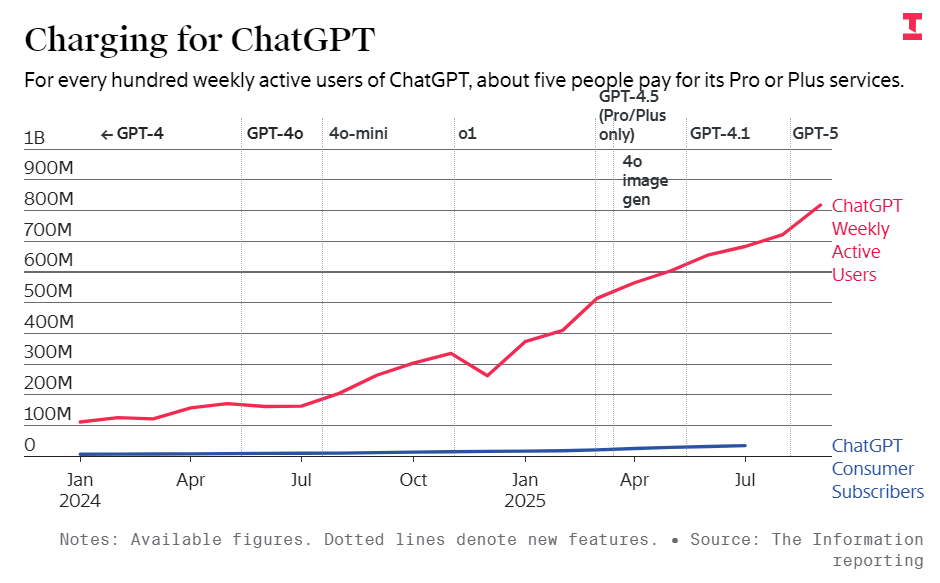
ChatGPT’s payment model: About 5 out of every 100 weekly active users pay for Pro or Plus services. (Note: Existing data. Dashed lines indicate new features. Data source: The Information)
OpenAI is also on pace to exceed its 2025 revenue target of $13 billion (up from around $4 billion last year) and plans to raise funds at a $750 billion valuation (50% higher than its equity financing valuation two months ago).
By most standards, these figures are staggering and enviable.
However, to achieve its projected $200 billion revenue target by 2030, OpenAI may need to find ways to convert weekly active users into daily active users.
This would increase opportunities for advertising or taking a cut from product sales facilitated by ChatGPT.
Limitations of the Text Interface
To reach its goals, OpenAI needs to address organizational and product-level challenges.
It is reported that OpenAI’s research division (with over a thousand members, largely isolated from the rest of the company) focused primarily on developing reasoning models this year rather than specifically improving ChatGPT.
However, insiders revealed that reasoning models have limited impact on ChatGPT because users generally seek quick answers.
Reasoning models often take seconds to minutes to respond—an eternity for users accustomed to Google’s instant search results.
OpenAI stated that reasoning models are better suited for complex multi-step tasks, reviewing vast amounts of code, or retrieving specific information from corporate document libraries.
ChatGPT’s dilemma extends beyond reasoning models: Users seem unable to fully grasp its knowledge boundaries—limiting their engagement duration.
In particular, ChatGPT’s text-based design makes it difficult for users to discover its non-text capabilities, such as analyzing images of mechanical or computer errors and providing repair suggestions.
Nick Try, ChatGPT’s product lead, noted that the current interface resembles Microsoft’s text-only MS-DOS PC operating system from the 1980s. (The PC revolution truly took off only after Microsoft introduced the more visually appealing and intuitive Windows OS.)
Other OpenAI executives echoed this sentiment, arguing that ChatGPT must redesign its interface to gain wider adoption.
Fiji Simo, head of applications at OpenAI, revealed that ChatGPT is 'evolving from primarily text-based conversations to a full generative interface with dynamically generated components based on user operational needs.'
Last week, OpenAI launched a new image generation model for ChatGPT users and announced enhancements to visual elements in text replies.
The Product Is Not the Ultimate Goal
However, Simo (who joined OpenAI from Instacart months ago), responsible for applications like ChatGPT, seems acutely aware of the company’s internal limitations. She recently wrote in a blog post that OpenAI remains fundamentally a research-focused company, and 'the product itself is not the goal.'
Unlike OpenAI (whose core products target consumers), some competitors have not experienced a disconnect between research and product.
For example, Anthropic primarily invests research resources into application programming interfaces (APIs) for enterprises. Currently, the smarter its models become (especially in generating computer code), the higher its API sales to other businesses and app developers.
At OpenAI, model improvements also drive API sales, but they account for only a tiny fraction of current and projected total revenue.
It is reported that for much of this year, Altman appeared to run the company as if OpenAI had already conquered the chatbot market: He launched numerous other product projects, including the Sora video app, music-generating AI, a web browser, dedicated AI agents, consumer hardware devices, robots, and more.
Multiple OpenAI researchers pointed out that these projects diverted resources from enhancing ChatGPT’s mass appeal.
Recently, OpenAI’s management has increasingly recognized the potential risks facing ChatGPT, leaving many uneasy. Altman stated during the 'red alert' that he plans to redirect some employees back to ChatGPT development.
An OpenAI spokesperson said, 'Product and research are deeply interconnected, not opposed. Research breakthroughs shape products, and product feedback informs research. This is a unified strategy for building and safely deploying increasingly powerful models, not a split between opposing camps.'
Limitations of Reasoning Models
Over the past year, divisions between OpenAI’s research team and ChatGPT’s product team have become apparent.
The company shifted its focus to reasoning models after traditional training methods proved ineffective at improving large language models, hoping to eventually achieve artificial general intelligence (AGI) with or beyond human capabilities.
Initially, researchers believed reasoning models would also enhance ChatGPT’s performance. However, early this year, when OpenAI converted its most advanced reasoning model into a ChatGPT-compatible version, the model’s performance declined.
It turned out that adapting the model for chat unexpectedly weakened its intelligence.
Ultimately, OpenAI managed to introduce reasoning models into ChatGPT. These models now power ChatGPT’s 'Think Mode' and 'Deep Research' agent (launched in February this year, capable of generating reports), as well as OpenAI’s programming assistant app, Codex.
However, in reality, only a tiny fraction of ChatGPT’s nearly 900 million weekly active users regularly use these features.
Internal OpenAI researchers noted significant uncertainty remains about whether reasoning models can drive AGI development.
Recent adjustments to ChatGPT by OpenAI suggest that reasoning models are becoming a burden. (Earlier this month, OpenAI quietly removed the automatic routing of user questions to reasoning models in free and lowest-tier ChatGPT subscriptions.)
OpenAI also faces other obstacles when introducing improved models into ChatGPT: Even non-reasoning AI models may conflict with ChatGPT’s functionality.
It is reported that in the weeks leading up to the release of its flagship large language model, GPT-5 (which powers OpenAI’s products), researchers found that its performance on specific tasks like programming declined after integration into the chatbot.
This happened because when users send queries to ChatGPT, it personalizes responses using its knowledge of the user (e.g., occupation). However, this personal information sometimes interferes with the model’s understanding of the question, leading to incorrect answers.
While the company fixed this issue before releasing GPT-5, some employees believe interference between new models and ChatGPT’s functionality will persist.
Google’s Counterattack
Other signs of a rift between OpenAI’s internal research and product divisions have emerged.
It is reported that this year, OpenAI deprioritized developing image generation models (which briefly boosted ChatGPT’s usage and user numbers in March).
While the decision’s rationale is unclear, after Google launched its critically acclaimed image-generating AI, 'Nano Banana,' in August, OpenAI executives urgently decided to elevate image technology.
This sparked a disagreement between Altman and Research Lead Mark Chen: The former argued image generation capabilities were vital for ChatGPT’s growth, while the latter advocated prioritizing other projects.

Image generated by Google’s Nano Banana
Earlier this month, Altman emphasized in the 'red alert' that image generation would be a core focus for optimizing ChatGPT. Last week, OpenAI released a new image generation model for ChatGPT.
As a competitor, Google holds an advantage in AI adoption by reaching users through its search engine, Chrome browser, and office applications like Gmail.
Recently, Google’s AI models have improved significantly, matching ChatGPT’s capabilities in image generation and computer code writing, making its Gemini and other AI products more appealing.
This has raised concerns among OpenAI’s leadership that average users may struggle to distinguish ChatGPT from Google’s Gemini: Unlike social apps like Facebook and Instagram, chatbots typically lack network effects.
OpenAI also faces another disadvantage: its financial position.
To train and run its AI, including ChatGPT, OpenAI is burning cash at a rate of billions of dollars annually, continuously leasing more servers.
While OpenAI is developing its own data centers and server chips to reduce long-term costs, Google’s decade-old AI-specific server R&D program now enables more efficient operations.
Editor: Bian Huiting
Source: The Information
END
-
![]()
Autohome Faces a Shrinking Window of Opportunity
-
![]()
Even a Titan Like Musk Has Faced Setbacks in Fulfilling Promises
-
![]()
AI Office: The End of the Racing Era, Context Becomes the Key to Success
-
![]()
Domestic Vehicle Chassis Revolution ②: The Steering Wheel Remains, But Mechanical Connections in the Steering System Are Decreasing
-
![]()
Exploring MiniMax Design: Can Video Editing Be as Simple as Speaking?
-
![]()
Why Can SenseTime Achieve Profitability While CloudWalk Still Faces Challenges, Despite Both Adopting Large Models?
-
![]()
Domestic Car Chassis Revolution Part 3: Suspension Systems Transform Vehicle Posture, from Vibration Absorption to Active Force
-
![]()
Hainan is Going on a Crazy Satellite-Building Spree