Strive for Excellence in All Endeavors: ByteDance Produces Numerous Outstanding College Graduates This Year
 12/29 2025
 503
503
Source: YuanSight
ByteDance has once again boosted employee salaries.
In early 2024 and November 2024, ByteDance revised its year-end incentive schemes, increasing the maximum number of months for year-end bonuses. In December 2025, ByteDance issued a company-wide memo announcing a continued hike in talent investment, encompassing bonuses and salary adjustments, and raising the minimum and maximum salary packages for all job levels.
Offering globally competitive salaries, 'leading at the pinnacle' in every market, will underpin ByteDance's ambitious expansion strategy in the future.
From a business standpoint, ByteDance has witnessed substantial growth in its AI, entertainment, e-commerce, and local services sectors this year. Applications such as Doubao, Hongguo Short Drama, Qishui Music, Douyin E-commerce, and local services are expanding their user bases.
From a broader ecosystem perspective, Douyin, as a nationally recognized application, is reshaping ByteDance's ecosystem in diverse ways, continuously exerting pressure on Tencent and Alibaba.
01
Doubao Temporarily Takes the Lead
ByteDance boasts five of the top ten free applications in Apple's China region, with Doubao currently ranking first.
Recently, multiple media outlets reported that Doubao's daily active users have exceeded 100 million, making it the ByteDance product with the lowest promotional expenditure to reach this milestone. According to Questmobile data from August and September, Doubao has firmly secured the top position among AI comprehensive assistant products in terms of monthly active users.
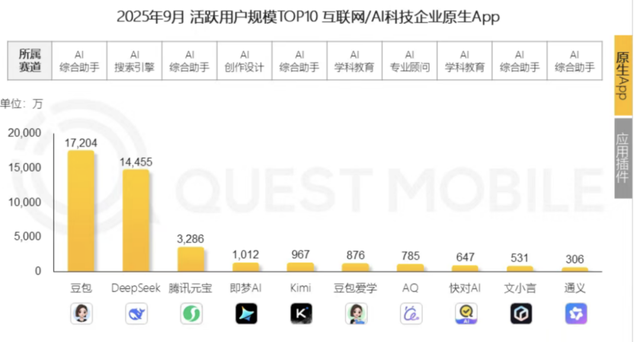
Image Source: Questmobile
Evidently, Doubao has emerged as a leader among the first wave of national-level AI applications, breaking through a significant user scale bottleneck on the consumer side compared to its competitors.
Moreover, according to the latest news, ByteDance's brand Volcano Engine has become the exclusive AI cloud partner for the 2026 Spring Festival Gala. Doubao will also be deeply involved, planning to introduce innovative features such as 'AI deskmate watching the Spring Festival Gala.'
Through this massive traffic gateway, Doubao's influence among the general public will be further amplified.
As an internet giant with a long-standing focus on content but seeking expansion in multiple areas, ByteDance has indeed demonstrated keen sensitivity in the AI field. Comparing product launch times, Doubao's beta version was released in June 2023, while Deepseek's foundational large model launched in November 2023, Kimi in October, and Tencent Yuanbao not until May 2024. The only product that launched earlier than Doubao was Alibaba's Tongyi Qianwen, which began beta testing in April 2023.
Doubao's early growth followed ByteDance's tradition of 'achieving miracles through force,' relying on the traffic support of the Giant Engine and continuously iterating its large model. This approach allowed Doubao, perhaps not the most intelligent, to strike a balance in terms of ease of use, effectiveness, and user reach efficiency.
Reviewing the star products in China's AI market, both DeepSeek and Kimi from the 'Six Little Dragons' have briefly topped the charts. However, after internet giants like ByteDance, Tencent, and Alibaba entered the general AI application arena, these AI unicorns, despite their strength, still struggle to compete with the giants—who not only possess ample resources but also rich ecosystems and diverse scenarios for deep AI integration.
ByteDance's ecosystem sets the upper limit for Doubao.
Although ByteDance is known as an 'app factory,' most of its apps revolve around content ecosystems, such as Douyin, Hongguo, and CapCut. The data from these products is highly beneficial for training Doubao's text, image, video, and voice interactions. On the other hand, Doubao also needs integration into lifestyle scenario apps.
To overcome ecosystem barriers, Doubao Phone represents an ambitious attempt to break app barriers, integrate apps, and achieve true cross-platform one-click operations. Naturally, other giants reacted swiftly: WeChat was the first to block Doubao Phone, followed by Taobao and Dianping.
In terms of consumer-side influence, Doubao may temporarily lead the pack, but as long as Alibaba and Tencent maintain their respective ecological strongholds, they can still look forward to a promising future.
02
Complementary Business Ventures
Beyond AI, ByteDance has continued to excel in other areas this year.
According to QuestMobile data, Hongguo Short Drama's monthly active users reached 236 million in September, nearing Tencent Video's 350 million. Hongguo achieved this milestone in just two years.
From initially relying on Douyin's support to absorb traffic to now becoming self-sufficient and establishing itself as an industry platform to redefine benefit distribution rules, Hongguo has built a small empire in the short drama industry.
Recently, 'Home Inside and Out 2' on Hongguo Short Drama surpassed 2 billion views, marking a successful end to the short drama craze of late 2025. This marks the second collaboration between renowned industry label 'Tinghua Island' and Hongguo. Such partnerships with successful teams and IP continuation strategies help Hongguo continuously attract industry talent.
Another rising star this year, 'Qishui Music,' seen as a future contender against QQ Music and NetEase Cloud Music, is another testament to ByteDance's ability to create hits.
Qishui Music's monthly active users have now surpassed 100 million, just a step away from NetEase Cloud Music. Its biggest constraint currently is copyright, but it seems to intend to bypass this with AI-generated music.
It should be noted that Hongguo Short Drama and Qishui Music still have limited monetization capabilities. Although some media reported that Hongguo Short Drama's revenue exceeded 15 billion this year, ByteDance has denied this, and it is still in the investment phase for Hongguo's business.

Image Source: Apple App Store
In the entertainment content sector, Hongguo's success has made up for ByteDance's absence in the previous round of long-form video competition—its close cooperation with production and Tomato's IP supply seems capable of replicating a successful case like Tencent Video + China Literature. Qishui Music's rapid growth also puts some pressure on QQ Music.
In the retail sector, while Alibaba, JD.com, and Meituan have been clashing in the instant retail arena, ByteDance seems uninterested in this fray, focusing instead on perfecting Douyin Mall's internal ecosystem.
After two years of building up through live-stream content e-commerce, Douyin has achieved notable success in shelf e-commerce this year. Currently, shelf e-commerce accounts for over 40% of GMV, and Douyin E-commerce's overall GMV is expected to surpass 4 trillion in 2025. It can indeed compete with Taobao, Tmall, JD.com, and Pinduoduo in the future.
Offline, Douyin Pay has quietly expanded its reach, taking root in multiple apps and launching features like Douyin Checkout and 'Tap to Pay.' After scanning a Douyin code, users can make payments, entering another ecosystem dominated by Alipay and WeChat Pay.
In local services, Douyin is also 'sneaking in.' According to third-party estimates, Douyin Local Services' GTV is expected to exceed 800 billion this year, further closing in on Meituan's GTV scale. Besides catering and travel, Douyin's current group-buying categories also include bathing, billiards, home renovation, and other broad industries. Moreover, the group-buying entrance is conveniently located between Douyin's 'Follow' and 'Live' sections, providing significant traffic support.
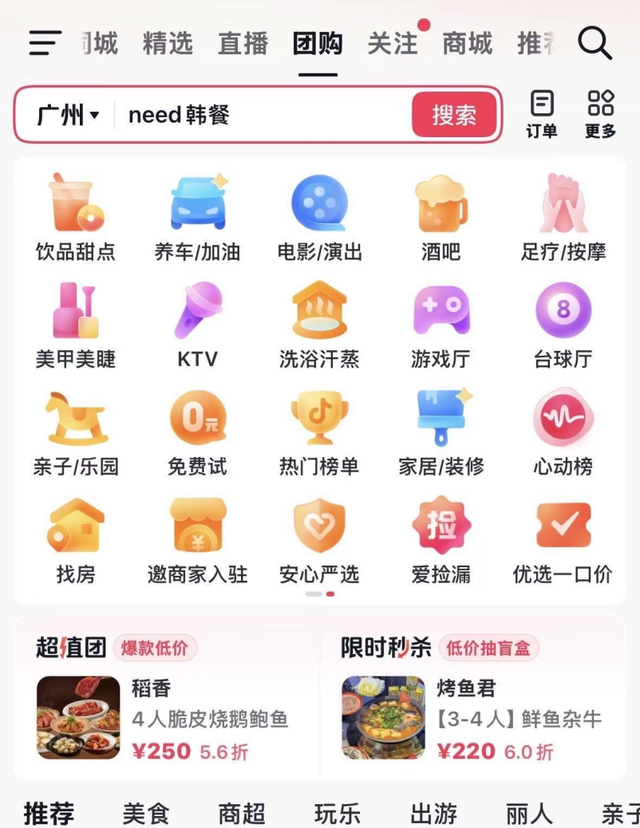
Image Source: Douyin
Overall, entertainment content continues to provide ByteDance with some complementary talking points, while the retail sector, with Douyin as its fulcrum, has become a key piece in ByteDance's ecological strategy.
02
Tencent and Alibaba's Strategic Moves
With ByteDance advancing aggressively, other giants have their own strategies.
Tencent's Yuanbao quickly counterattacked after integrating Deepseek earlier this year and now consistently ranks among the top three in AI application rankings. Yuanbao integrates seamlessly with WeChat, offering rich interactive content in the video feed and official account comment sections.
Following the appointment of 27-year-old Yao Shunyu as Tencent's CEO/President Office Chief AI Scientist and the establishment of the AI Infrastructure and Large Language Model Department, the strengthening of the underlying research team has raised market expectations for breakthroughs in the Hunyuan large model.
After Yao Shunyu's appointment, the three giants now seem evenly matched in terms of AI scientist caliber: ByteDance's large model is led by Wu Yonghui, who oversaw Seed and came from Gemini; Tencent now has Yao Shunyu, who honed his skills at OpenAI; and Alibaba relies on Zhou Jingren, the 'technical helmsman' integrating AI and cloud computing.
After improving infrastructure, Tencent's next AI focus is likely to extend to WeChat.
During Tencent's Q3 earnings call this year, management responded to analysts' questions about developing WeChat's AI capabilities by stating that, ideally, WeChat could eventually develop an AI assistant to help users complete most tasks across communication, social, payment, and Mini Program ecosystems. However, progress is still in the very early stages of enhanced search.
Given WeChat's AI business layout, Doubao Phone's anticipated market breakthrough to dismantle ecological silos will face greater difficulties. Since WeChat remains Tencent's core ecological entry point, Tencent will never entrust this part of AI functionality to others.
Turning to Alibaba, its current AI strategy involves pursuing both general and vertical markets simultaneously. Qianwen and Lingguang target the general market, while Ant's Afu focuses on the specialized medical sector. Leveraging Ant's years of accumulation, Afu's moat in professional sectors like finance and healthcare is difficult for other vendors to replicate.
Additionally, Qianwen has integrated with Gaode Maps. If successful, this could pave the way for integrating applications like Alipay, Taobao, Dianping, and Fliggy into local services.
Overall, Tencent and Alibaba's ecosystems have deeply penetrated the daily lives of ordinary people. Although ByteDance has achieved widespread growth and 'taken a seat at the table' this year, it still faces significant challenges in winning against its rivals at the new table.
Some images are sourced from the internet. Please notify us for removal if there is any infringement.
-
![]()
Autohome Faces a Shrinking Window of Opportunity
-
![]()
Even a Titan Like Musk Has Faced Setbacks in Fulfilling Promises
-
![]()
AI Office: The End of the Racing Era, Context Becomes the Key to Success
-
![]()
Domestic Vehicle Chassis Revolution ②: The Steering Wheel Remains, But Mechanical Connections in the Steering System Are Decreasing
-
![]()
Exploring MiniMax Design: Can Video Editing Be as Simple as Speaking?
-
![]()
Why Can SenseTime Achieve Profitability While CloudWalk Still Faces Challenges, Despite Both Adopting Large Models?
-
![]()
Domestic Car Chassis Revolution Part 3: Suspension Systems Transform Vehicle Posture, from Vibration Absorption to Active Force
-
![]()
Hainan is Going on a Crazy Satellite-Building Spree