Zhipu/MiniMax IPO Insights: The Next Hardware Battleground Is in GEO (Discovery and Trust via AIoT Agents)
 01/16 2026
 693
693
In early 2026, Chinese large-scale AI model firms Zhipu AI and MiniMax made their debuts on the Hong Kong Stock Exchange. This milestone marks not just a capital influx but also an industry inflection point: large models are evolving from conceptual narratives to tangible infrastructure.
As models become as ubiquitous as electricity and the internet, the next competitive frontier will shift from marginal intelligence gains to the ability to swiftly, reliably, and stably translate agent intentions into real-world actions.
This challenge directly poses a new growth imperative for IoT companies:
When agents need to solve problems, where will they locate tools? How can your devices and systems become their first choice—discoverable, callable, and trustworthy?
Search Paradigm Shift: From Human Information Retrieval to Agent Capability Discovery
For two decades, internet traffic has been governed by SEO (Search Engine Optimization). We optimize keywords and backlinks to ensure content discoverability and click-through rates.
However, with the rise of generative AI, GEO (Generative Engine Optimization) is emerging as the new standard. Researchers from Princeton and elsewhere have demonstrated that optimized content can boost visibility in AI-generated responses by 40%.
Yet, for the physical world, GEO must transcend content-level optimization. When agents gain tool-using capabilities, their search targets undergo a fundamental transformation:
Past (Human-Centric): Search for pages, data, and answers.
Present (Agent-Centric): Search for capabilities, interfaces, and executable tools.
This necessitates a paradigm shift: while SEO helps search engines find digital content, "Device SEO" must enable agents to perceive, understand, and safely control physical devices.
Under this new framework, next-gen smart terminals and IoT devices will naturally become the primary battleground for GEO.
Intelligent Connectivity of All Things: The Gateway Shifts from Apps to "Agent Tool Selectors"
In a world of intelligent connectivity, the primary actors are no longer just humans but also robots and agents forming a social network. They collaborate, delegate tasks, and forward missions, functioning as a new traffic distribution system.
This shift redefines user engagement:
Past: Users discover you → understand you → purchase you → learn to use you.
Future: Agents discover you → call upon you → verify results → form preferences and reuse.
In essence, the future gateway may no longer be an app homepage but an "agent tool selector."
A consumer-side example already in motion illustrates this transition: the Qianwen App, following a recent upgrade, now directly invokes services within the Alibaba ecosystem to complete tasks like food ordering, hotel booking, and flight reservations through a "conversation + task" approach.
For instance, when a user says, "Help me book a highly rated Sichuan restaurant nearby for 7 PM tonight," Qianwen doesn't just return a link. It orchestrates Gaode Maps for location, Ele.me/Koubei's restaurant database, and online booking interfaces to fulfill the intention-to-action loop. Users no longer need to switch apps; they entrust their goals to the agent, which handles tool selection, invocation, and result organization in the background.
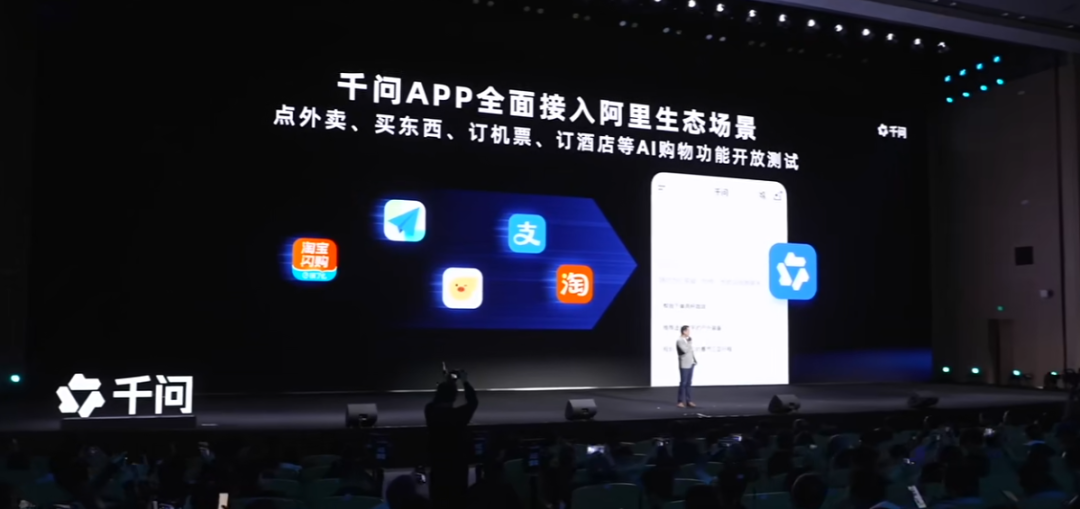
Critically, this reveals a profound insight for hardware GEO: agents don't "browse functions" but "invoke capabilities." When Qianwen integrates capabilities from Taobao/Flash Sale, Alipay, Fliggy, Gaode, etc., into a unified conversational interface, tools are orchestrated seamlessly, and transactions are embedded in the task flow. This is the embryonic form of "call growth": ease of integration, invocation, and closed-loop completion determines default selection.
Of course, such capabilities currently thrive more within closed ecosystems, highlighting a trend: while closed systems offer smoother end-to-end experiences, any device/system that cannot be understood across agents and invoked across ecosystems will gradually fade from the tool selector.
This underscores a harsh reality: in this new world, closure equals invisibility; openness is vitality.
Three Pillars of Hardware GEO
To stand out in the agent-centric world, companies must build a hardware GEO system anchored in three core pillars: discoverability, callability, and trustworthiness.
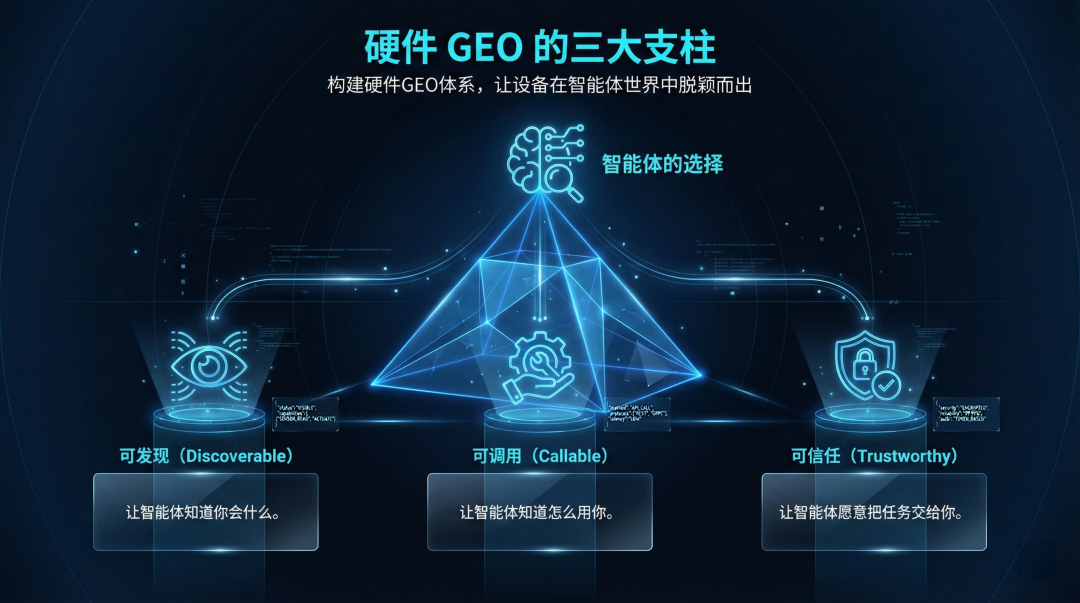
1. Discoverable: Let Agents Know Your Capabilities
When agents select tools, the first step is retrieval and matching. They rely not on marketing rhetoric but machine-readable capability descriptions: What interactions can you provide? What are the inputs/outputs? What are the constraints? Applicable scenarios? A device reduced to a model code string becomes a "semantic black hole" for large models.
Key Action: Translate instruction manuals into machine-readable language.
Thus, don't just broadcast your ID; broadcast your capabilities. Example: "I am a living room smart bulb supporting color and brightness adjustment."
For industrial scenarios, discoverability demands indexable capability resumes:
Self-Introduction (Capability-Based): Don't just report your MAC address. Clearly state: What can I measure (vibration/temperature/pressure)? What can I do (frequency modulation/start-stop/threshold switching)? What are my boundaries (max speed/interlock conditions)?
Semantic Clarity (Standardized): Specify inlet vs. outlet pressure, units (Pascal vs. bar). Unclear semantics deter agent invocation.
Active Registration (Indexable): Use protocols like Matter to register in a "device directory" or open ecosystem, enabling millisecond retrieval.
Discoverability means issuing "capability IDs" to devices and integrating them into agent retrieval systems.
2. Callable: Let Agents Know How to Use You
Discoverability is just the first step. Agents need tools that can be stably invoked, with verifiable parameters and orchestratable processes.
This is a psychological hurdle for traditional IoT vendors. Closed app ecosystems requiring downloads and registrations create "interaction friction." In the agent era, such barriers lead to bypassing in favor of standard-interface alternatives.
Hardware GEO demands "liquid" service capabilities:
Standardized Interfaces: Adopt standards like MCP (promoted by Anthropic) to encapsulate APIs as AI-universal resources. This transforms devices from islands to plug-and-play plugins in the large model context.
Atomic Capabilities: Decompose complex functions into independent, combinable actions. Example: A smart washing machine should expose water injection, rotation, and drainage as separate actions. When a user says, "Clothes aren't rinsed clean," the agent can invoke rinsing and dehydration without rewashing the entire load.
Function Call Friendliness: Align API naming, parameters, and return structures with large model logic.
In industrial settings, this means providing orchestratable atomic action libraries, enabling agents to combine processes like energy reduction, yield maintenance, and shutdown control.
Callable means upgrading devices from "human-button-pressed" to "agent-toolchain-integrated."
3. Trustworthy: Let Agents Entrust Tasks to You
In the physical world, AI calls carry risks. Large models may "hallucinate," but physical errors like incorrect heating (fires) or valve openings (leaks) are catastrophic.
Thus, "trustworthy" in hardware GEO requires machine-readable evidence systems:
Permission Minimization and Tiered Authorization: Define which actions allow automation and which require human review.
Auditable Logs: Track who invoked what, when, and with what parameters.
Reliability Metrics: Success rate, latency, availability, degradation, and fallback mechanisms.
Explainable Outputs: Justify adjustments, expected impacts, and verification paths.
Trust must be hardened at the hardware level:
Prove device integrity via trusted identities and tamper-proof mechanisms.
Utilize firmware-level guards to reject dangerous instructions.
Implement risk tiering for high-risk actions, mandating human review.
Trustworthy means agents verify completion, not just accept assertions.
Future Vision: A New Industrial Order
If the internet's gateway for two decades was the search box, the next decade's gateway will be the "agent tool selector."
Imagine a smart factory where the "production operations agent" wakes up each morning not to open MES or EAM dashboards but to select tools. Its tasks are business objectives: "Increase line OEE by 3% today," "Reduce energy peaks," "Stabilize yield rates," "Minimize shutdown risks."
It will:
Retrieve capabilities: Who measures vibration? Who adjusts frequency? Who checks raw materials?
Invoke actions: Call sensors for fault matching, PLCs for micro-adjustments, energy systems for peak shaving.
Verify results: Did quality improve? Did energy consumption decrease? Adjust strategies accordingly.
In this world, searching means finding capabilities, not information; ranking means calls, not clicks; branding means trust evidence, not mindshare.
Thus, IoT companies now compete on three harder questions:
Are you machine-understandable?
Are you machine-callable?
Are you machine-verifiable?
Epilogue
In this new world, closure is not a moat but a path to obscurity; openness is not a posture but a survival imperative.
Future growth belongs to companies that make their capabilities combinable, reusable, and verifiable in the agent network.
Hardware GEO is not optional but essential.
The answer lies in your device capabilities, interface design, and trust mechanisms.
-
![]()
Registered Capital Slashed to 372 Million Yuan! Yutong Optical Finalizes Industrial and Commercial Change Registration
-
![]()
Zhuque-3 Successfully Lands, and 'Time Traveler' Secures Another ¥100 Million in Funding: China's Commercial Space Industry Experiences a 'Dynamic August'
-
![]()
Autohome Faces a Shrinking Window of Opportunity
-
![]()
Even a Titan Like Musk Has Faced Setbacks in Fulfilling Promises
-
![]()
AI Office: The End of the Racing Era, Context Becomes the Key to Success
-
![]()
Domestic Vehicle Chassis Revolution ②: The Steering Wheel Remains, But Mechanical Connections in the Steering System Are Decreasing
-
![]()
Exploring MiniMax Design: Can Video Editing Be as Simple as Speaking?
-
![]()
Why Can SenseTime Achieve Profitability While CloudWalk Still Faces Challenges, Despite Both Adopting Large Models?