Qianwen vs. Doubao: The AI Agent Showdown Looms
 01/16 2026
 553
553
As 2026 dawns, the AI industry's gaze turns towards practical applications in the real world. Fundamentally, even the most intelligent large-scale models merely serve as vocal conduits. In contrast, users seeking to offload work truly require tools capable of accomplishing tasks. ByteDance and Alibaba have both made significant strides, nearly simultaneously. The recently upgraded Doubao infiltrates from the entry point, aiming to retain users within the chat interface by consolidating answers, music, e-commerce, and local services into a unified window. 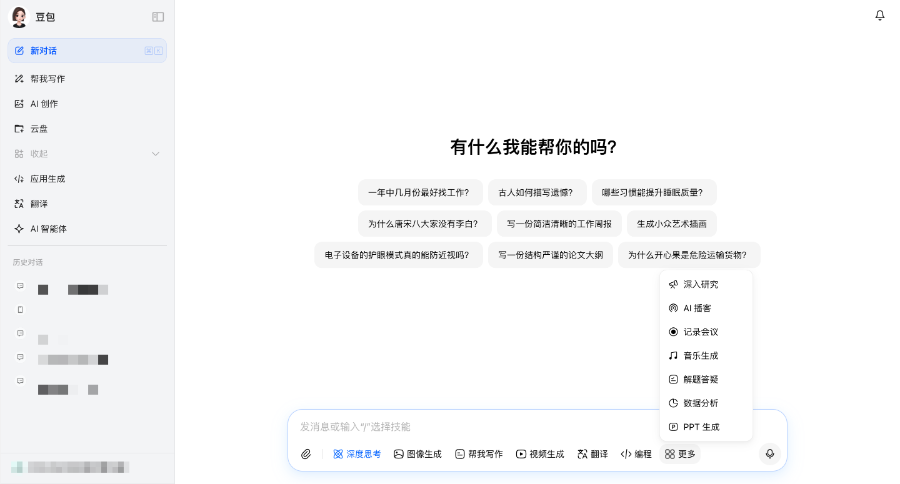
Image Source: Doubao Web Version
On January 15th, Alibaba capitalized on its group resources to unveil a major update to Qianwen, opting to enter from the execution end. It seamlessly integrates complex tasks such as ordering food, booking hotels, and purchasing air tickets into a single conversation, with AI managing the entire process. Both are addressing the same query: Can AI transition from a conversationalist to an executor? The distinction lies in Qianwen's direct dive into tasks, whereas Doubao first secures the intent entry point. This agent showdown has thus evolved into a race between two paths: one demonstrating 'I can get things done' through closure, and the other relying on habit formation, awaiting the gradual filling in of the ecosystem. 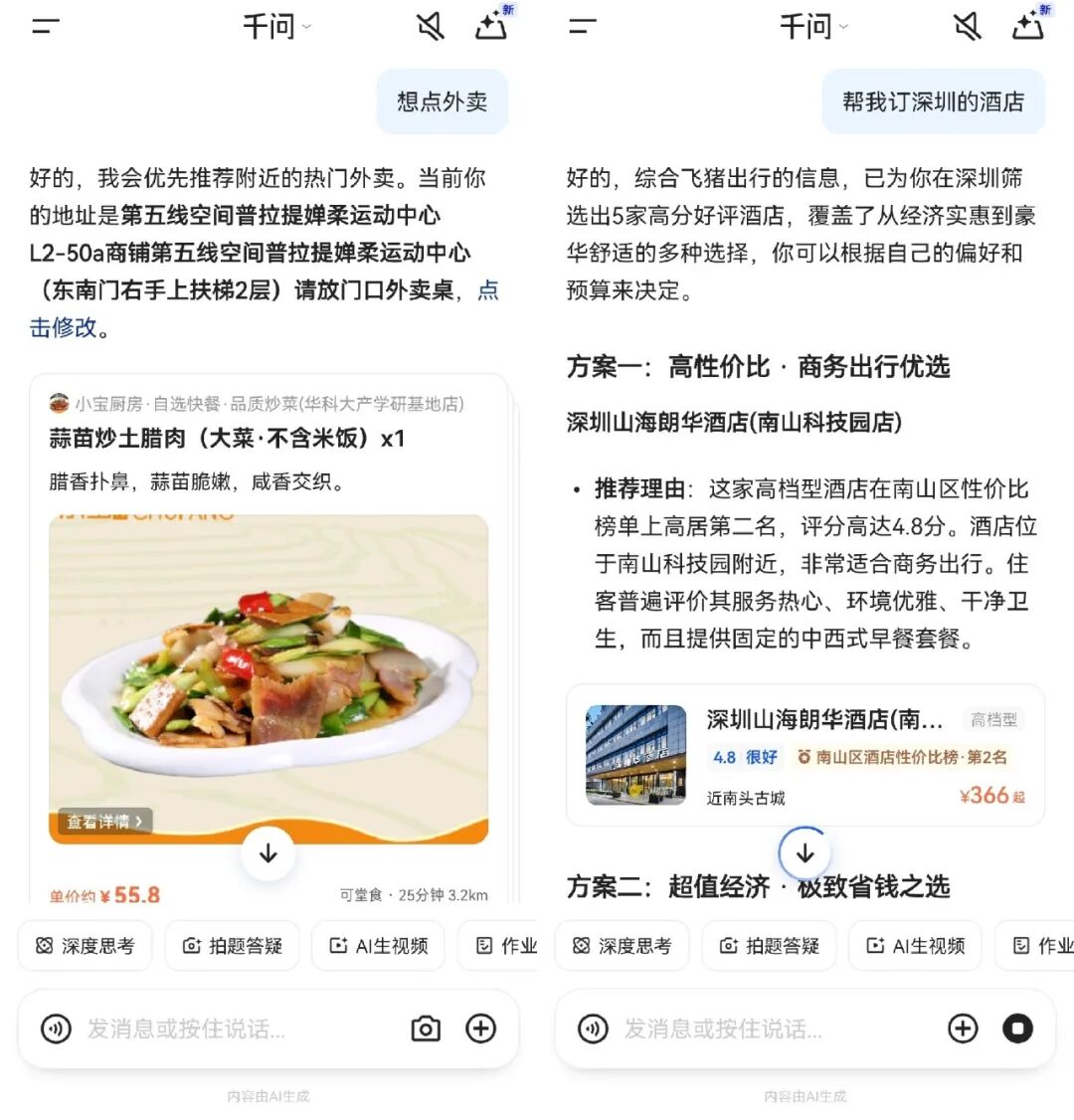
Image Source: Qianwen App
The essence of an AI agent lies in its demand for a highly developed product ecosystem. Computing power can be outsourced, and models can undergo iterations, but real-world systems such as payment, inventory, fulfillment, maps, travel, and offline services are challenging to redesign for AI in a short span. From this premise, Qianwen does appear to hold a distinct advantage, as it leverages the ecosystem built by Alibaba over the long term. However, the duration of this advantage is not merely a technical issue but a long-term ecological endeavor. 
The Ambitions and Capabilities of Qianwen and Doubao
By scrutinizing the recent maneuvers of both companies, we can discern their roughly similar directions yet distinctly different paths.
Qianwen's high-profile major update signifies that its Chatbot service aims to transcend merely providing 'answers' and instead directly undertakes 'task' execution.
The two fundamental scenarios are work and life. The former encompasses most daily tasks of office workers, such as 'organizing invoices,' 'creating financial reports,' and 'generating PPTs,' with over 100 sub-scenarios solvable directly through Qianwen. 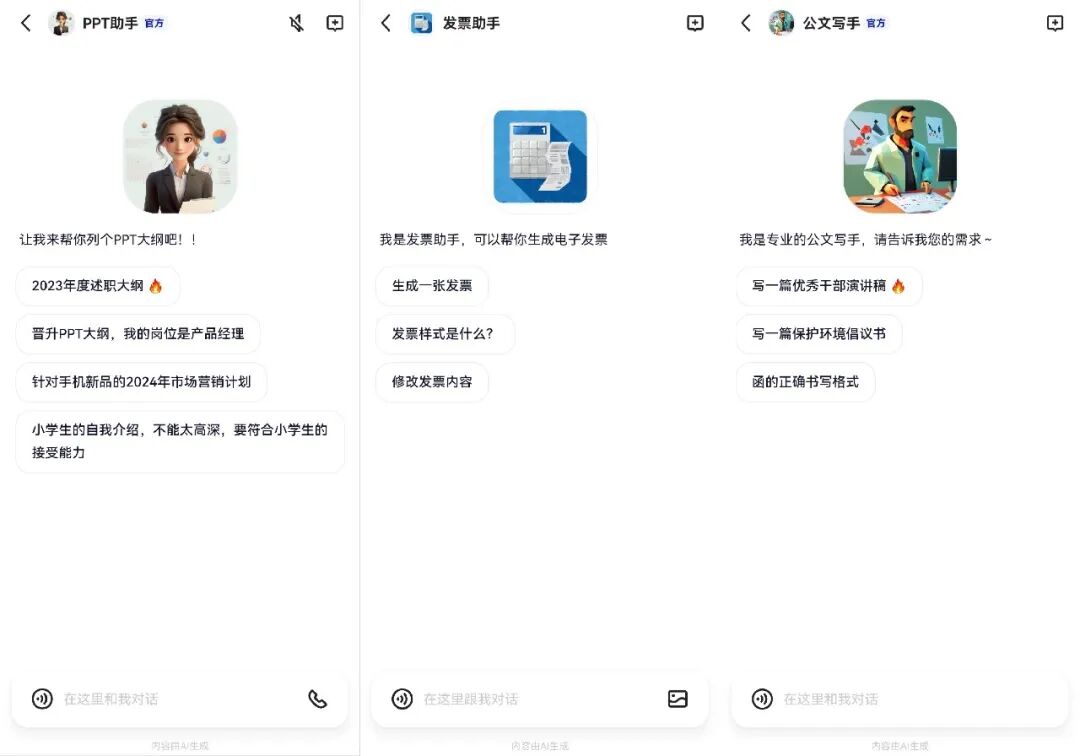
Image Source: Qianwen App
Of course, for the general populace, scenarios outside of work are where AI tools are currently more frequently utilized. This is also a fiercely contested arena among major companies and a scenario that underscores the differences in product ecosystems.
For instance, when a user desires to order from Luckin Coffee or Heytea, Qianwen can automatically place the order and complete the payment based on the user's habits retained in Alibaba's ecosystem services like Taobao Flash Purchase, ultimately delivering the coffee or milk tea to the user.
When a user mentions the need to travel to Shanghai early the next morning, Qianwen will filter flights, compare classes and prices from Fliggy, provide a candidate list, and then streamline the confirmation steps into a single conversation. 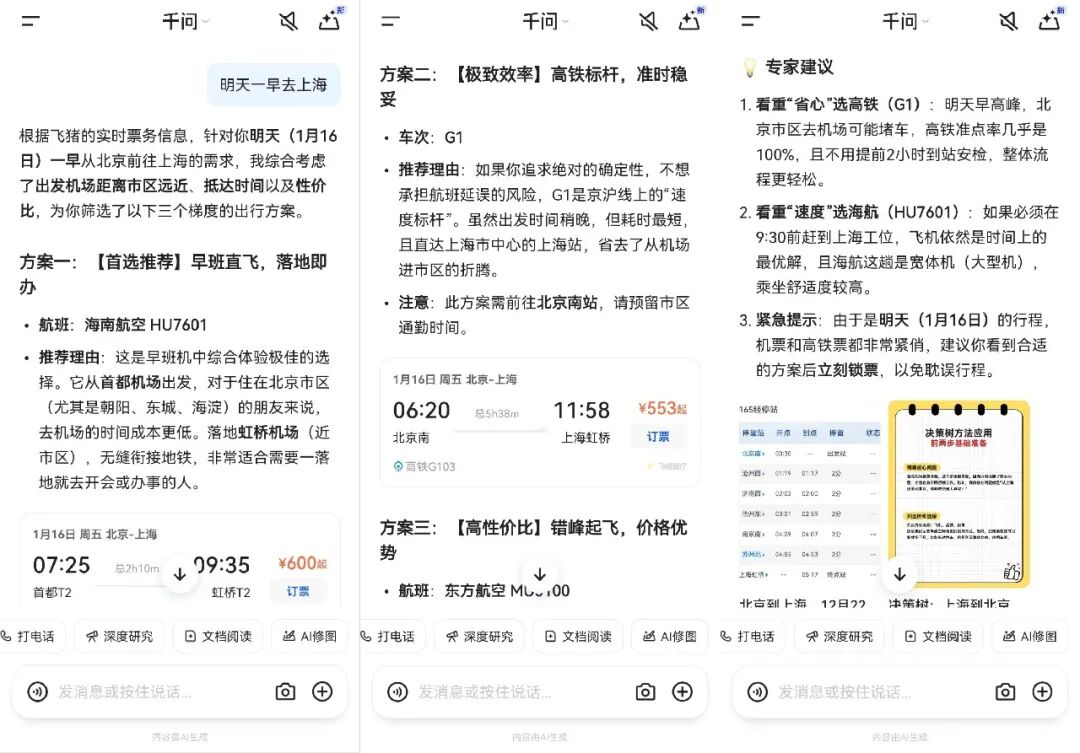
Image Source: Qianwen App
For the user, it merely involves a few extra words; for the system, it entails consolidating processes originally scattered across multiple apps into a single entry point.
In this process, Alibaba repackages its years of accumulated e-commerce, local life, and travel capabilities into Qianwen, aiming to make it the operational layer for users to manage life affairs rather than just a chat entry point. Qianwen's direction is straightforward: to demonstrate that AI can truly accomplish tasks.
Of course, considering ByteDance's previous vision for the Doubao AI mobile assistant, ByteDance has already attempted to achieve these feats through Doubao on mobile devices.
It even ventured to break out of the chatbox and directly implement all the aforementioned capabilities on mobile terminals. However, as we all know, the outcome was a blockade by major companies, leading to its demise. 
Doubao Mobile Assistant
However, this does not imply that Doubao has abandoned the agent route. Currently, it may lack the capability to pursue complete closure, so it can only patiently undertake lighter tasks.
For example, by integrating more existing ecosystem services, when a Doubao user requests, 'Play some music,' Doubao can directly play Qishui Music within the chat window; when a user inquires about remedies for dry lips, it first explains the reasons and then posts a lip balm card from Douyin Mall below the answer; when a user seeks weekend activity suggestions, it provides recommendations while conveniently displaying local group-buying links. 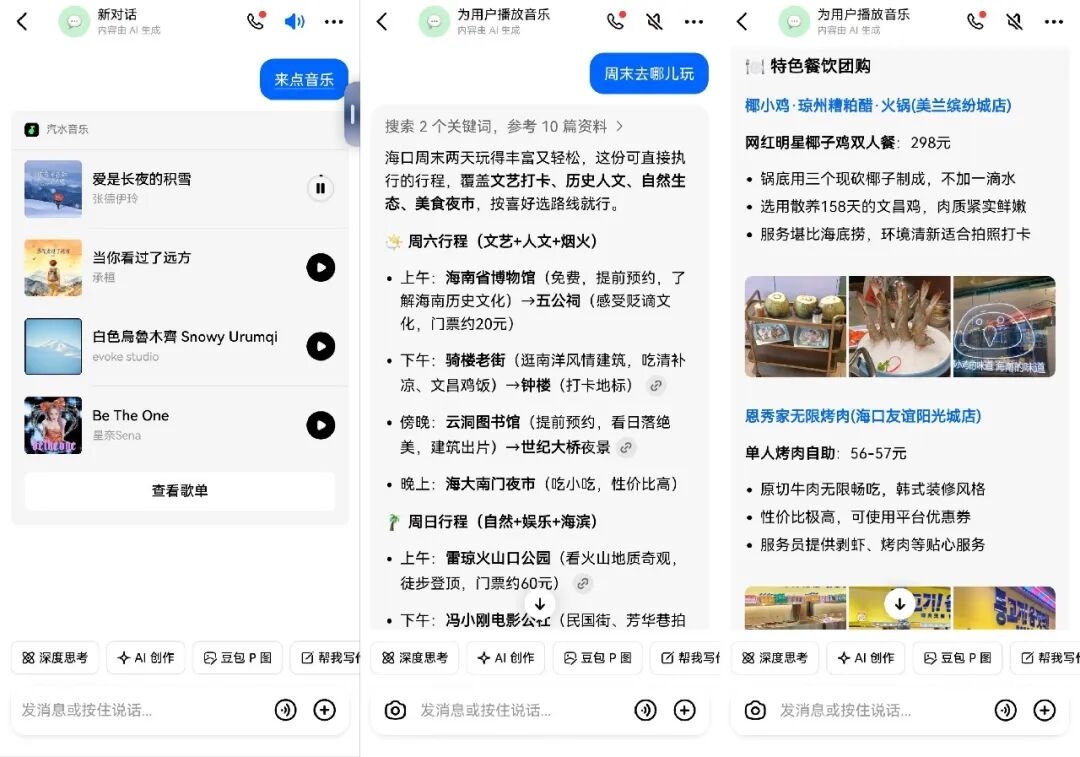
Image Source: Doubao App
Individually, these actions do not 'complete tasks,' but each step captures the user's attention, keeping the problem and subsequent behavior within its chatbox.
Compared to the aggressiveness of the Doubao mobile assistant, Doubao's current approach is essentially centered around itself, initially integrating ByteDance's internal capabilities into the AI agent's service process.
It indeed does not resemble a complete agent system but more like an automated capability testing the waters. For Doubao, with over 100 million daily active users, as long as the problem first lands in its hands, the subsequent execution can be refined over time.
One path flows from execution back to the entry point, while the other expands from the entry point to execution. Ultimately, it still hinges on the gap in product ecosystems outside of AI between the two companies, which is precisely the crux of the current AI agent showdown. 
The True Threshold of AI Agents: Ecosystem as the Foundation, But Not the Endpoint
What truly differentiates these two paths is not so much the basic model capability but rather the ecosystem capability.
Models do not automatically become errand runners; the ability to invoke payment, travel, maps, identity, and customer service systems does. The fact that Qianwen can order a cup of milk tea on January 15th (regardless of whether it's overpriced) is precisely because it stands on Alibaba's long-accumulated product ecosystem, with a complete product closure. As long as it connects to the entry point, it can continuously expand scenarios. 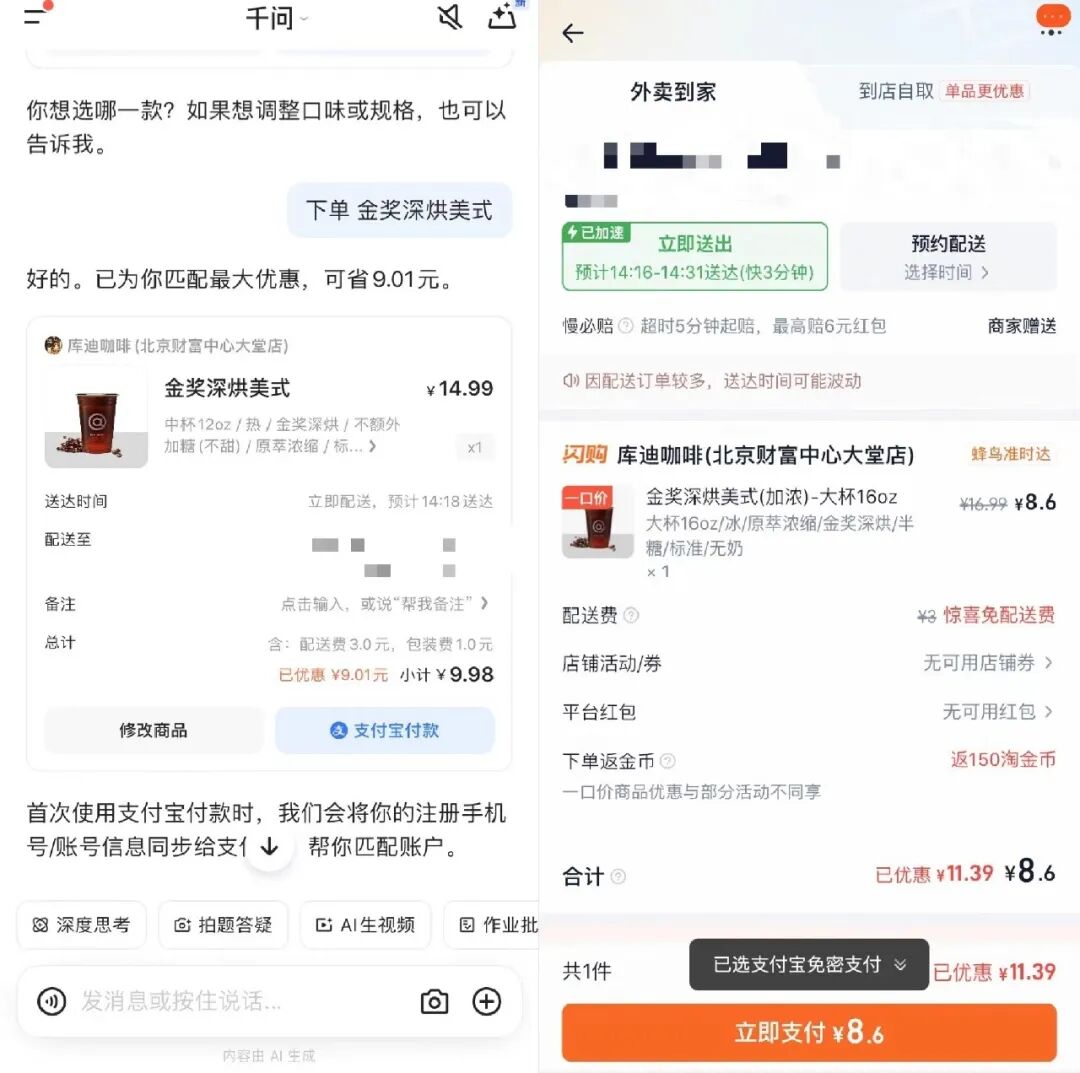
Image Source: Comparison between Qianwen and Taobao Flash Purchase
After all, neither Meituan nor Flash Purchase, nor Alipay or WeChat Pay, is likely to grant Doubao these permissions, especially when domestic life core scenarios are almost entirely centered around mobile devices.
Even if Doubao aspires to, it can only achieve capabilities similar to Manus on the desktop end. However, in the mobile-first domestic market, this level of agent capability is clearly inadequate.
Of course, possessing an ecosystem does not render AI agents invincible. The deeper one delves, the more substantial this advantage appears.
Behind each new scenario lies a system transformation. Interfaces need to be rewritten, risk control logic needs to be migrated, and business responsibilities need to be redefined. The issues exposed by Qianwen's agent at this moment are simply illustrated by some netizens posting that ordering food through it is more expensive than Flash Purchase, likely due to internal permission allocation issues. 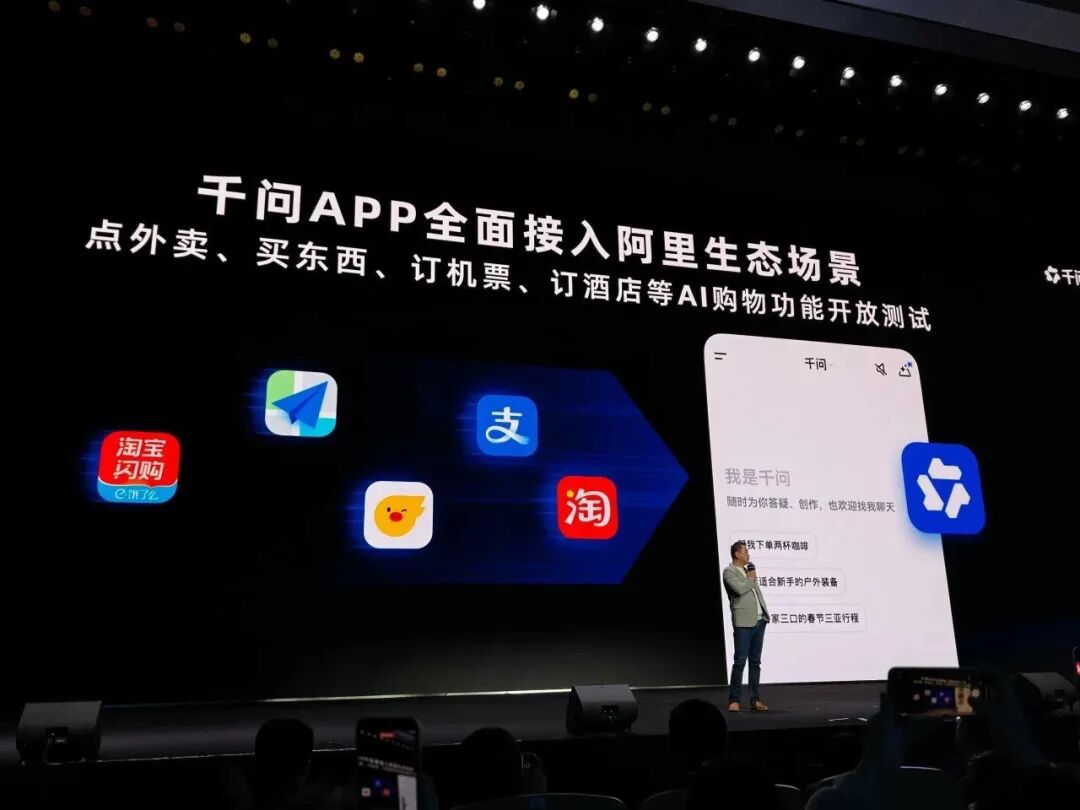
Image Source: Qianwen App Launch Event
If all Alibaba services are abstracted into capabilities that can be invoked by AI, essentially, other departments within Alibaba besides Qianwen must cede a portion of their core control rights, handing over behavioral data and execution rights to Qianwen.
AI, of course, does not discriminate, but where there are people, there are factions. The market share that Taobao Flash Purchase invested heavily to gain last year is now being utilized to promote Qianwen, a young upstart. No one would feel pleased about that.
More realistically, Alibaba's ecosystem does not encompass the entire internet.
No matter how robust Qianwen's agent capability is, for now, it can only cover the tracks it can control within the Alibaba ecosystem. However, in the real world, users' lives are not divided by ecosystems. Whether third parties are willing to open interfaces, whether platforms are willing to let AI operate on behalf of users, and how regulators draw the line are all variables that Qianwen cannot decide on its own.
Just like the heavily emphasized food ordering, without the ability to compare prices from other vendors, for ordinary users, is it more crucial to experience the so-called intelligence or to save money?
Especially since the domestic ecosystem is not confined to Alibaba. Even if Doubao and ByteDance still have obvious gaps in many aspects, Tencent's WeChat ecosystem, with its new AI leader, is certainly no weaker than Alibaba's. Alibaba's so-called ecosystem advantage is only relative.
From this perspective, no victory or defeat has been determined, especially when AI's own capabilities are still rapidly evolving.
Qianwen benefits from the ecosystem but is also constrained by it; Doubao lacks an ecosystem but holds the entry point. One side needs to solve how to mobilize the system in the long term and reduce transformation costs, allowing services within the system to better coexist under Qianwen; the other side needs to solve how to convert entry point advantages into sustainable execution capabilities and seek more allies outside the giant ecosystems.
The AI agent showdown will next enter a stalemate phase, where the competition will likely not be about who first creates a flashy feature list based on ecosystem capabilities but rather who breaks through ecosystem boundaries to truly provide users with the best experience through AI.
-
![]()
Registered Capital Slashed to 372 Million Yuan! Yutong Optical Finalizes Industrial and Commercial Change Registration
-
![]()
Zhuque-3 Successfully Lands, and 'Time Traveler' Secures Another ¥100 Million in Funding: China's Commercial Space Industry Experiences a 'Dynamic August'
-
![]()
Autohome Faces a Shrinking Window of Opportunity
-
![]()
Even a Titan Like Musk Has Faced Setbacks in Fulfilling Promises
-
![]()
AI Office: The End of the Racing Era, Context Becomes the Key to Success
-
![]()
Domestic Vehicle Chassis Revolution ②: The Steering Wheel Remains, But Mechanical Connections in the Steering System Are Decreasing
-
![]()
Exploring MiniMax Design: Can Video Editing Be as Simple as Speaking?
-
![]()
Why Can SenseTime Achieve Profitability While CloudWalk Still Faces Challenges, Despite Both Adopting Large Models?