Dual Platform Transformation Is Here: Unpacking Jensen Huang's CES 2026 Keynote and NVIDIA's Role in Revolutionizing AI and the Physical World
 01/16 2026
 708
708
Every 10 to 15 years, the computer industry experiences a "platform reset"—shifting from mainframes to PCs, and from the internet era to the mobile age. However, at CES 2026, Jensen Huang announced that we are on the brink of an unprecedented "dual platform transformation":
Transformation at the Application Layer: Software is evolving from pre-written logic to intelligent agents powered by AI.
Transformation at the Compute Layer: General-purpose computing (CPU-centric) is being replaced by accelerated computing (GPU-driven), leading to a complete overhaul of the computer manufacturing ecosystem.
This keynote not only unveiled NVIDIA's next-generation hardware marvel, the Vera Rubin platform, but also laid out a bold vision for AI's future: transitioning from "chatting" to "thinking" and ultimately integrating into the physical world (through robotics and autonomous driving). Below are the key highlights from the speech.
I. The Evolution of Intelligence: From Chatbots to Agents (Agentic AI)
While 2022 was dominated by ChatGPT, 2025 marks the rise of Agentic AI. Jensen Huang emphasized that AI has moved beyond pure language models and entered the era of reasoning. 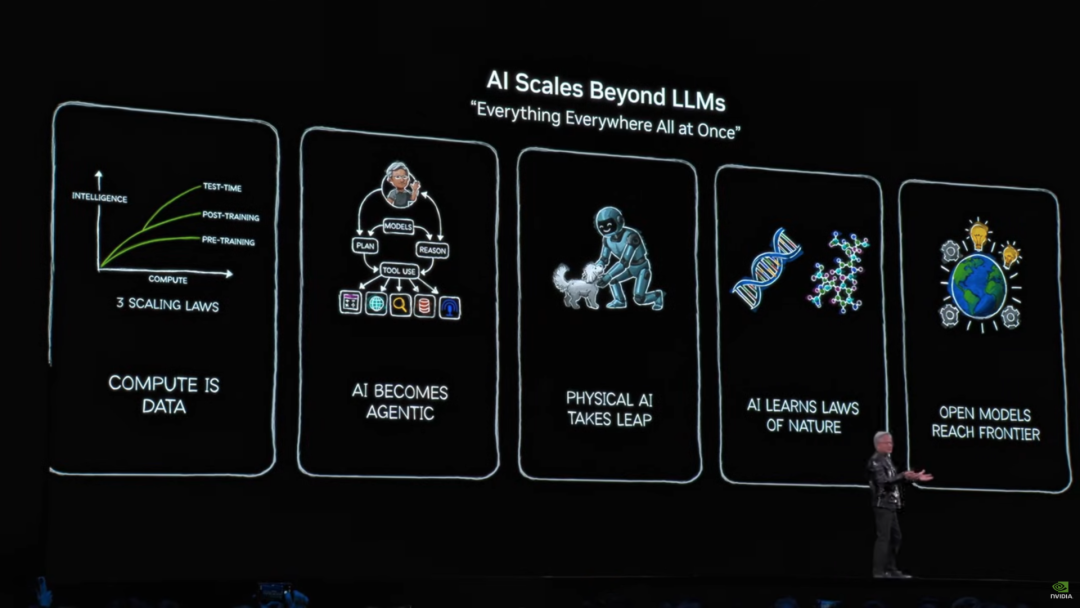
Test-Time Scaling: Modern AI "thinks" before responding. Instead of generating immediate answers, it employs reinforcement learning and Chain of Thought to reason logically, akin to human cognition, enabling it to tackle unfamiliar complex problems.
Blueprint for Agentic AI: Future application architectures will comprise three layers:
- Frontier Large Models: Equipped with world-class general knowledge.
- Domain Models: Highly customized, enterprise-specific expertise.
- Intelligent Router: A "brain" that interprets user intent and decides whether to delegate tasks to a cloud-based superbrain, a local private model, or external tools (e.g., email management, graphic design).

II. AI Enters the Physical World: Cosmos and the "Three Computers"
AI cannot remain confined to screens; it must grasp physical laws (gravity, friction, inertia) to operate robots and autonomous vehicles. NVIDIA introduced the concept of "Physical AI" and unveiled the World Foundation Model, Cosmos.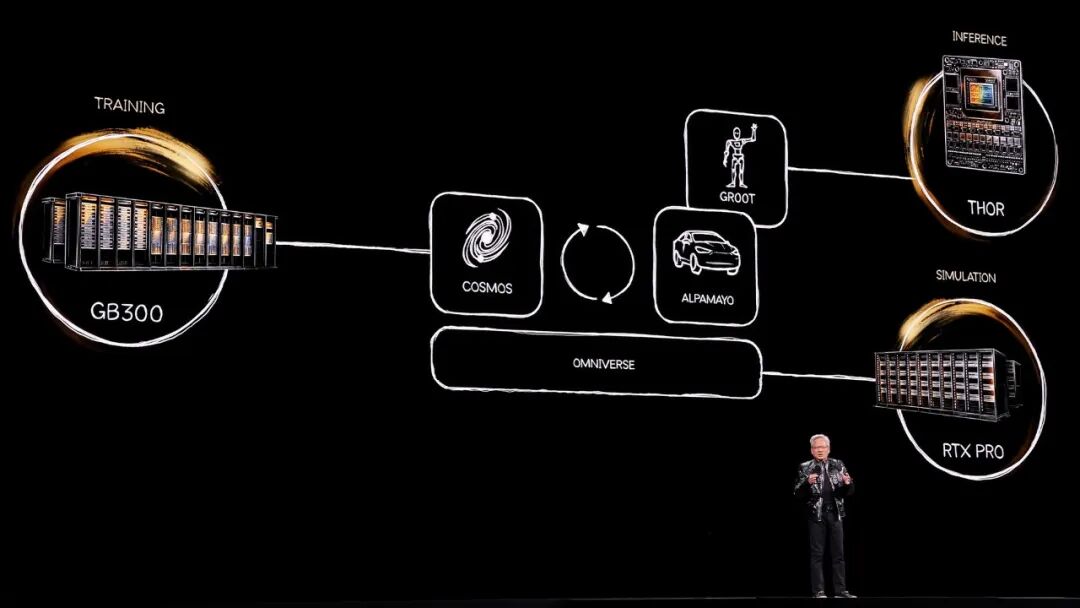
What Does Cosmos Do? It acts as a "simulator" for the physical world. By learning from internet-scale videos and physical data, it understands real-world dynamics. It can transform basic traffic simulation diagrams into realistic, physics-compliant videos.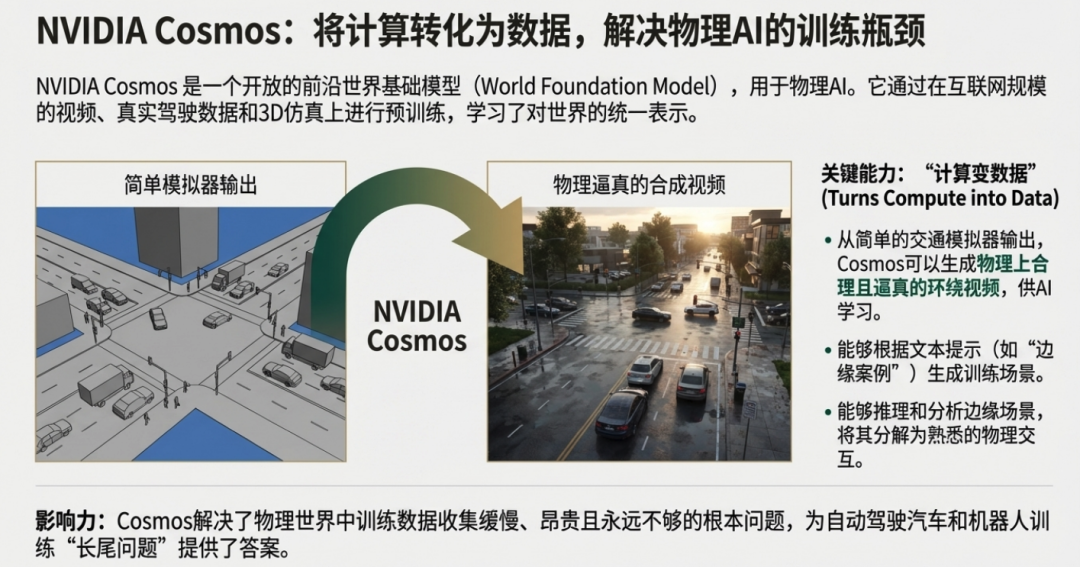
The "Three Computers" Theory for Robotics: Jensen Huang argued that deploying a robotic system requires three distinct computers:
- Training Computer: Creates the AI brain.
- Simulation Computer (Omniverse): Tests the AI in a digital twin environment, enabling virtual learning of locomotion and grasping.
- Inference Computer: The actual chip installed in robots or vehicles (e.g., Thor).
III. Redefining Autonomous Driving: The Thinking Alpamayo
NVIDIA announced the Alpamayo autonomous driving model, hailed as the "world's first thinking, reasoning autonomous driving AI." For details, refer to our previous article, "Wu Xinzhou Leads NVIDIA's Charge Toward L4 Autonomy with VLA Large Model Algorithms."
More Than Driving—It's Reasoning: Traditional autonomous driving follows a "see red light → stop" logic. Alpamayo is "end-to-end," not only outputting driving actions but also explaining its thought process—e.g., "I detect an obstacle ahead; due to inertia, I need to brake early, so my current trajectory is..."
Dual Safety Stack: For absolute safety, NVIDIA employs a "two-tiered" approach:
- Alpamayo Stack: Handles complex driving scenarios and reasoning.
- Classic Safety Stack (Guardrails): A traceable, traditional control system. If the AI exhibits uncertainty, the system instantly switches to this classic "guardrail" mode to ensure vehicle safety.
Deployment Timeline: The first model equipped with this technology (Mercedes-Benz CLA) will debut on U.S. roads in Q1 2026.
IV. Hardware Powerhouse: The Vera Rubin Platform
To support the 10x annual growth rate of AI models, NVIDIA must transcend Moore's Law limitations. Jensen Huang unveiled the Vera Rubin computing platform, named after the astronomer who discovered dark matter.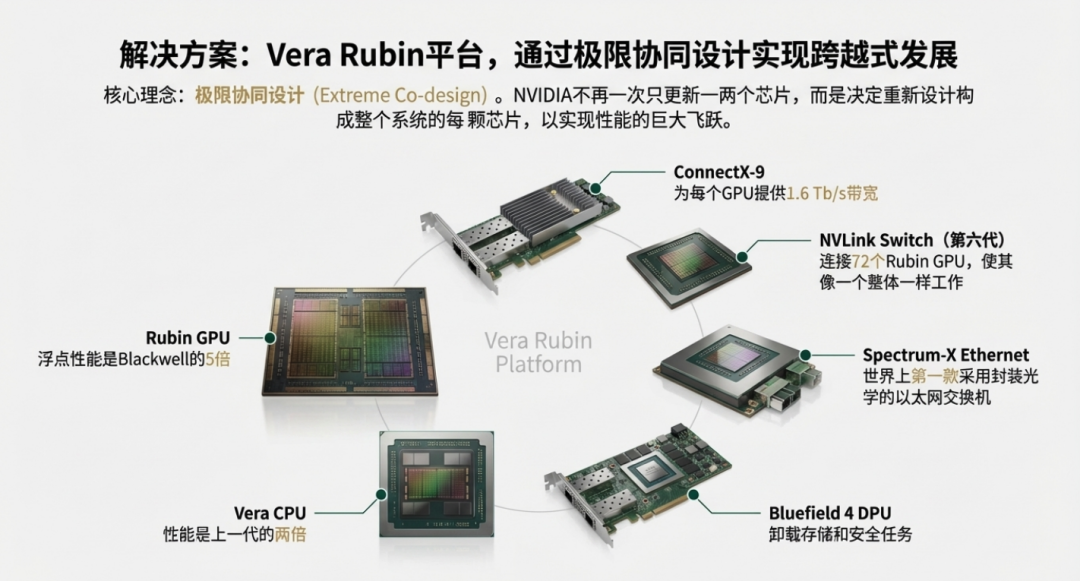
Core Highlights:
- Extreme Co-Design: NVIDIA redesigned all six chips in the system, including CPU, GPU, NICs, and switches.
- Rubin GPU: Delivers 5x the floating-point performance of the previous-gen Blackwell. It introduces NVFP4 precision, enabling adaptive computation precision adjustment for higher throughput with fewer transistors.
- 100% Liquid-Cooled Racks: The new NVL72 rack weighs 2.5 tons (including water) and uses 45°C warm water cooling, eliminating energy-intensive data center chillers and reducing energy consumption by 6%.
- Solving the "Infinite Memory" Problem: The longer AI chats, the worse its memory becomes due to limited VRAM. NVIDIA introduced a new memory architecture that uses BlueField-4 DPUs to offload AI's "short-term memory" (KV Cache) from GPU VRAM to a rack-level shared memory pool.
Results: Each GPU gains an additional 16 TB of ultra-fast contextual memory, enabling near-infinite conversation lengths for AI.
V. The Engine of Industrial Revolution
In closing, Jensen Huang emphasized that NVIDIA is no longer just a chip company but a full-stack computing powerhouse.
From chip design software (collaborating with Synopsys/Cadence) to chip manufacturing factories (collaborating with Siemens), NVIDIA is leveraging AI to reshape entire industries. Future factories will resemble massive robots, where products are designed, simulated, and tested countless times in computers (Omniverse) before physical production.
Summary
At CES 2026, Jensen Huang presented a clear vision: AI will not only achieve computational leaps through Vera Rubin and reasoning capabilities through Agentic architectures but will also step out of screens via Cosmos and Alpamo to truly understand and transform our physical world.
*Unauthorized reproduction or excerpting is strictly prohibited.
-
![]()
Registered Capital Slashed to 372 Million Yuan! Yutong Optical Finalizes Industrial and Commercial Change Registration
-
![]()
Zhuque-3 Successfully Lands, and 'Time Traveler' Secures Another ¥100 Million in Funding: China's Commercial Space Industry Experiences a 'Dynamic August'
-
![]()
Autohome Faces a Shrinking Window of Opportunity
-
![]()
Even a Titan Like Musk Has Faced Setbacks in Fulfilling Promises
-
![]()
AI Office: The End of the Racing Era, Context Becomes the Key to Success
-
![]()
Domestic Vehicle Chassis Revolution ②: The Steering Wheel Remains, But Mechanical Connections in the Steering System Are Decreasing
-
![]()
Exploring MiniMax Design: Can Video Editing Be as Simple as Speaking?
-
![]()
Why Can SenseTime Achieve Profitability While CloudWalk Still Faces Challenges, Despite Both Adopting Large Models?