Why the 'Vision-Centric Approach + Solid-State Radar' Combo is the Go-To for Autonomous Buses
 01/22 2026
 545
545
In the autonomous driving sector, debates over technology paths have been ongoing. Should we rely on laser radar? Is a pure vision system the way to go, or should we opt for a multi-sensor fusion approach? Will end-to-end systems eventually take over from rule-based ones?
These questions carried significant weight in the industry's infancy, when autonomous driving was largely confined to labs, test sites, and demonstration projects. Back then, the choice of technology path was a direct reflection of a company's capabilities.
However, as autonomous driving starts to make its way into public transportation systems, particularly buses, undergoing long-term, stable, and auditable public operations, these debates are undergoing a subtle yet significant transformation.
Technology paths are transitioning from 'subjective choices' to 'data-driven outcomes'.
01
Why do debates over 'technology paths' naturally lose relevance in public transportation scenarios?
During the demonstration phase of autonomous driving, technology paths were often used to 'prove technological advancement'. The more daring the path, the easier it was to showcase results in the short term; the more complex the system, the easier it was to appear 'all-capable' in demonstrations.
However, public transportation systems are not concerned with these aspects.
When a company truly starts operating autonomous buses, it faces a whole new set of questions:
Can this system operate continuously for three to five years?
Does it perform consistently in rainy conditions, at night, and during morning rush hours?
When anomalies occur, is the system explainable, manageable, and recoverable?
Under these constraints, the path is no longer about 'what you want to use', but rather:
What technology path can withstand long-term real-world operations?
Moreover, public transportation systems have a unique characteristic compared to other autonomous driving scenarios: they do not seek extreme capabilities but instead prioritize consistency. From a city's perspective, a single 'extremely intelligent but non-replicable' decision is far less valuable than a hundred 'stable, predictable, and reviewable' decisions.
This implies:
Technology paths must be stable.
Perception results must be controllable.
Decision-making behaviors must be explainable.
Any path overly reliant on 'extreme capabilities' will expose high maintenance costs and uncertainties during long-term operations.
02
The 'rationality' of a path is gradually revealed through real data.
As autonomous buses start operating day after day, technology paths enter a ruthless yet fair screening mechanism:
Paths capable of long-term stable operation are retained.
Paths that frequently trigger anomalies are gradually phased out.
Paths with uncontrollable costs are naturally eliminated.
This is not a one-time technical evaluation but rather a continuous feedback loop from long-term operational data. Path rationality no longer stems from engineers' beliefs but from real-world statistical results.
If we shift our perspective back to real-world public transportation operations, a repeatedly validated reality emerges:
Bus routes are highly repetitive.
Scenario changes are relatively predictable.
Numerous critical decisions occur at a visually interpretable level.
Under these conditions, vision systems offer several long-term advantages:
High information density, closely aligned with human traffic rules.
More intuitive representation of abnormal situations.
Highly isomorphic to human driving logic.
This does not mean that vision is 'more advanced', but rather that:
In highly repetitive and rule-bound scenarios like public transportation, vision systems more easily form stable and verifiable behavioral patterns.
So why is solid-state LiDAR still necessary? Focusing solely on vision could easily be misinterpreted as 'path fanaticism'. However, real-world operational data often reveals that a single sensor is insufficient to support system-level stability.
In scenarios such as nighttime driving, backlighting, rain, and fog, vision systems still exhibit uncertainty boundaries. Solid-state LiDAR, in these cases, provides:
Stable distance and structural information.
Compensation for visual blind spots.
Redundant validation of system behavior.
The key point is that solid-state radar's role here is not as the 'protagonist' but as a risk mitigator.
03
'Vision-Centric Approach + Solid-State Radar' represents a balance dictated by data.
From the combined feedback of long-term bus operational data and roadside data, a clear structure for technology paths has gradually emerged:
Vision systems handle primary perception and semantic understanding.
Solid-state LiDAR provides compensation for critical scenarios.
Roadside data offers system-level validation and coordination.
This is not the result of a single path review but rather the optimal balance 'forced' by successive rounds of data feedback in real-world public transportation scenarios.
It is neither the most daring nor the most conservative path but the one most conducive to long-term operation.
As autonomous driving begins serving public systems, an important transformation is underway:
The industry no longer rewards 'the most daring path'
but instead rewards 'the most survivable path'.
This marks technological maturity rather than regression.
Truly mature technologies never prove themselves by winning debates but by enduring in reality.
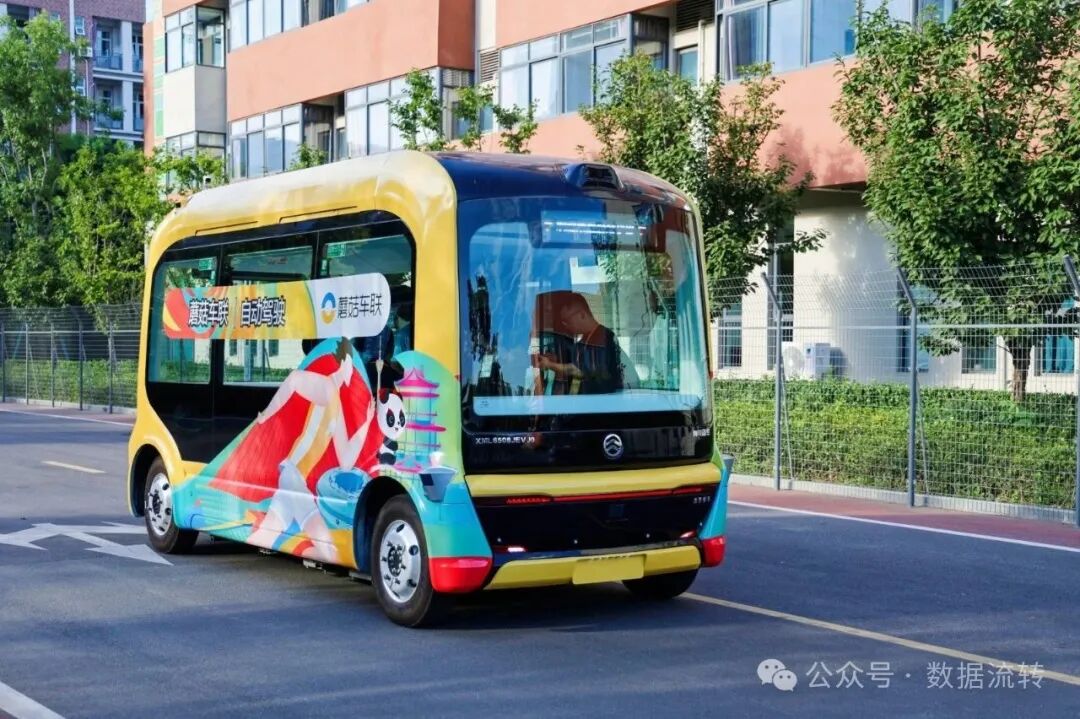
MooVita's autonomous buses employ a 'Vision-Centric Approach + Solid-State LiDAR' solution. Currently, they have deployed normalized Robobus operations in more than ten provinces across China, serving diverse scenarios such as scenic spot shuttles, large-scale event support, and urban commuting. They have cumulatively served over one million passengers.
When a company has been continuously operating in real-world public transportation systems for years, the path itself no longer requires 'proof'. It only needs to answer one question: Has this system been consistently operating in real cities?
'Vision-Centric Approach + Solid-State Radar' is not a declaration but a result.
-
![]()
Registered Capital Slashed to 372 Million Yuan! Yutong Optical Finalizes Industrial and Commercial Change Registration
-
![]()
Zhuque-3 Successfully Lands, and 'Time Traveler' Secures Another ¥100 Million in Funding: China's Commercial Space Industry Experiences a 'Dynamic August'
-
![]()
Autohome Faces a Shrinking Window of Opportunity
-
![]()
Even a Titan Like Musk Has Faced Setbacks in Fulfilling Promises
-
![]()
AI Office: The End of the Racing Era, Context Becomes the Key to Success
-
![]()
Domestic Vehicle Chassis Revolution ②: The Steering Wheel Remains, But Mechanical Connections in the Steering System Are Decreasing
-
![]()
Exploring MiniMax Design: Can Video Editing Be as Simple as Speaking?
-
![]()
Why Can SenseTime Achieve Profitability While CloudWalk Still Faces Challenges, Despite Both Adopting Large Models?