What Was the Global Sales Volume of Humanoid Robots in 2025?
 01/23 2026
 822
822
Produced by Zhineng Technology
In 2025, the global humanoid robot industry embarked on a journey towards mass production. According to the <2026 General-Purpose Embodied Intelligent Robot Report> issued by the market research firm Omdia, the total number of humanoid robots shipped worldwide in 2025 reached roughly 13,000 units.
Compared with the preceding phase, which centered on prototypes and small-scale pilot projects, this figure marks a substantial surge. The notable enhancement in technological maturity has empowered humanoid robots to attain sustainable delivery capabilities at the commercial level.
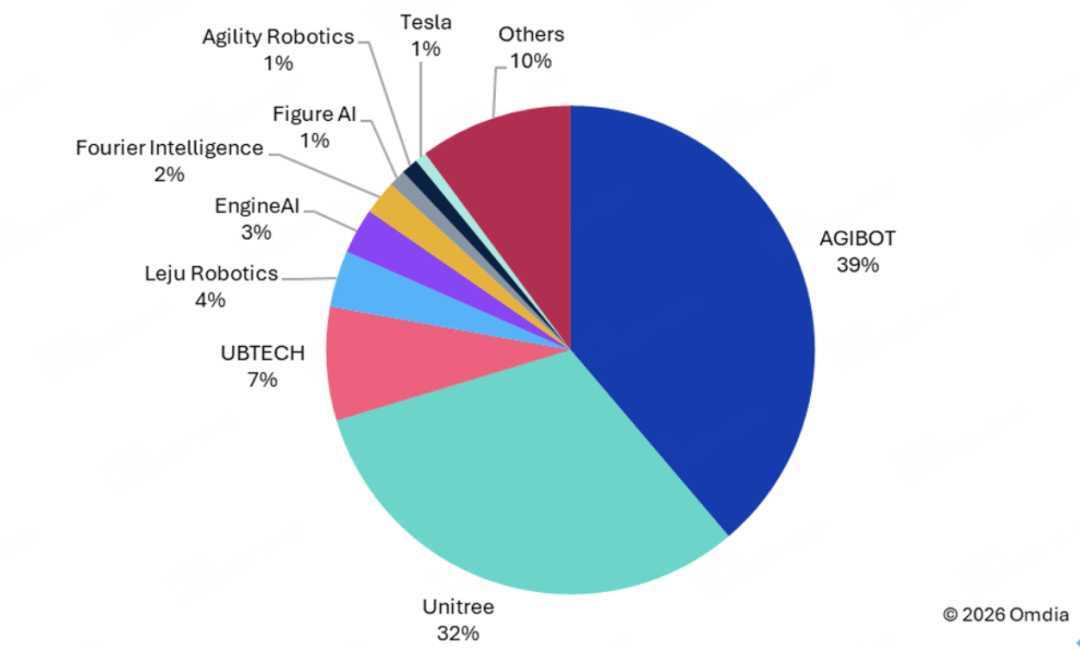
During this phase of rapid growth in the volume of humanoid robots, Chinese robotics firms have exhibited formidable industrial dominance, with the top six global humanoid robot shipment companies in 2025 all hailing from China.
Zhiyuan Robotics took the lead, with 5,168 annual shipments and a 39% share of the global market, ranking first in both shipment volume and market share. It emerged as the world's largest manufacturer of general-purpose embodied intelligent robots in 2025.
Unitree Technology followed closely, securing a 32% market share. UBTECH, Legu Robotics, EngineAI, and Fourier Intelligence were ranked subsequently.
In contrast, overseas manufacturers such as Figure AI, Agility Robotics, and Tesla still had single-digit market share levels in terms of shipment volume in 2025.
Note: Tesla's sales volume is still in the developmental stage and requires time to grow.
This pattern is far from coincidental. The core competition in the industry hinges on 'who can achieve stable mass production, genuine delivery, and continuous deployment'.
Unlike traditional industrial robots, humanoid robots are characterized by their intricate structures, highly integrated control systems, and extreme cost sensitivity, placing higher demands on supply chain integration capabilities, manufacturing process stability, and overall machine reliability.
Chinese manufacturers have capitalized on their comprehensive strengths in hardware manufacturing, system integration, supply chain collaboration, and cost control to make the leap from the laboratory to large-scale delivery earlier than their counterparts.
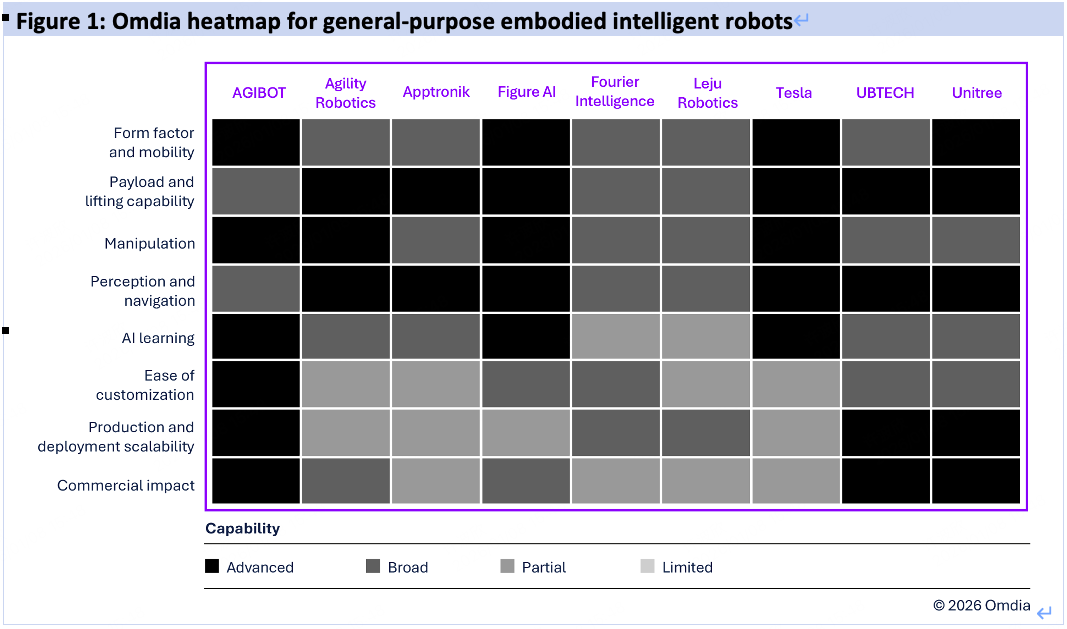
Zhiyuan Robotics' product lineup encompasses full-sized humanoid robots, semi-sized compact humanoid robots, and wheeled embodied robots. These have been deployed across a multitude of scenarios, including reception and greeting, commercial performances, industrial manufacturing, logistics sorting, security patrols, data collection and training, scientific research, and education. This multi-scenario, replicable application capability serves as the cornerstone of its leading shipment volume.
From a market structure perspective, humanoid robot shipments in 2025 were predominantly concentrated in research institutions, educational systems, corporate exhibitions, semi-closed commercial environments, and data collection and training scenarios. The proportion of robots entering complex public environments or household settings remained relatively low, indicating that the industry is still in its nascent commercialization phase.
Current products primarily function as 'embodied intelligent carriers' and 'data generation platforms', providing foundational support for subsequent algorithm training, environmental adaptability enhancement, and general intelligence evolution. The increase in shipment volume is essentially laying the groundwork for larger-scale intelligent evolution.
At the technological forefront, the deep integration of generative artificial intelligence with robot control systems has been a pivotal factor driving industry growth in 2025.
Compared to traditional rule-based robot control methods, the new generation of humanoid robots has begun to exhibit perception, understanding, multimodal interaction, and task planning capabilities based on large models, endowing them with stronger generalization abilities and self-learning potential in complex environments.
Currently, Zhiyuan, Unitree, and Tesla are recognized as global 'first-tier' developers. These companies are at the forefront of propelling the evolution of general-purpose embodied intelligence to new heights. From the perspective of actual shipment volume, Chinese manufacturers still hold sway at this stage.
From a long-term vantage point, Omdia predicts that the global humanoid robot market will witness exponential growth over the next decade, with annual shipments projected to reach 2.6 million units by 2035.
This forecast is predicated on multiple factors, including the continuous evolution of general embodied intelligence, declining costs of sensors and actuators, and enhancements in computing power and algorithm efficiency. If this trend persists, the 13,000 units shipped in 2025 may merely represent the starting point, rather than the pinnacle, of industrial growth.
Summary
The global humanoid robot market in 2025 exhibited three distinct characteristics: for the first time, shipment volume reached the 'ten-thousand-unit' threshold, signifying the industry's entry into the genuine delivery phase; Chinese manufacturers achieved absolute dominance in terms of shipment volume and market share; and the competitive focus shifted from technological demonstration to engineering capabilities and commercial implementation.
-
![]()
[Attendee Guide] The WAIE (10th) 2026 AI Industry Conference & AI Agent Industry Application Conference Kicks Off on October 23! (Including Conference Schedule + Transportation Guide)
-
![]()
Achieving 100% Year-on-Year Growth! Domestic Ultra-Precision Optical Equipment Emerges as a 'Dark Horse' with Thousand-Unit Shipments
-
Q3 Report | Inspur Information’s Net Profit Soars 176%, Fueled by Robust Server Demand
-
Chinese Automakers Shine Bright at the Paris Auto Show
-
![]()
Changan Technology Strikes Out on Its Own, Leaving Parent Company Behind
-
![]()
US/China: The All-Out War for AI Gateways
-
![]()
Leqi’s Second-Gen AI Glasses: The Path to Blending In—Four Optical Hurdles to Tackle!
-
![]()
GAC Toyota’s September Vehicle Registrations Reach 49,000 Units, with Camry Registering 6,898 Fewer Units Than Wholesale Volume